AI Interviews: The Good, The Bad, and The Illegal
In November 2024, UK employers received an average of 49 applications per vacancy. More people chasing fewer jobs. AI interviews are quietly becoming the new reality.
Here's a number that should make every hiring manager pause. In November 2024, UK employers received an average of 49 applications per vacancy — a 286% increase compared to the same month the year before (Tribepad, Dec 2024). At the same time, UK job vacancies dropped to 734,000 by the end of 2025 — down 8.6% year-on-year and below pre-pandemic levels (ONS, Jan 2026). More people chasing fewer jobs. And that's across the board — imagine what it looks like for entry-level roles in care, retail, or hospitality.
Now add this: 80% of CVs contain at least one discrepancy, up 10% from previous years (Risk Advisory Group). The CIPD estimates that recruitment fraud costs UK businesses £23.9 billion annually (The HR Director). The CVs landing in your inbox aren't just numerous — a significant chunk of them are "too good to be true."
So here's your reality: you're drowning in applications, many are misleading, and your team is spending weeks screening candidates who should never have made it past the first filter. Meanwhile, the great candidates? They've already accepted another offer.
Ironically, the same AI that made the problem worse — enabling mass applications and AI-polished CVs — is now solving it. In this post, we want to focus specifically on AI interviews and how they're quietly becoming the new reality for recruitment professionals.
Why AI Interviews Work
Consistency. Two human interviewers will evaluate the same candidate differently depending on their mood, energy level, or how the previous interview went. AI doesn't have bad Mondays. Every candidate gets the same structured experience, evaluated against the same criteria. This removes a huge layer of unconscious bias and gives you a genuinely level playing field.
Speed. Traditional pre-screening — reviewing CVs, scheduling calls, conducting 15-minute phone screens — takes weeks. An AI interviewer can conduct hundreds of structured interviews simultaneously, 24/7. Candidates complete their interview at a time that suits them, which dramatically improves participation rates.
Data. Every AI interview generates structured, comparable data points. Rather than relying on a recruiter's gut feeling after a phone call, you get scored assessments across multiple dimensions — technical skills, communication, problem-solving — all ranked and ready for decision-making.
Analysis tailored to your methodology. This is where it gets interesting. AI interviews aren't one-size-fits-all. You can configure them around your company's specific recruitment approach — competency-based frameworks, behavioural question scenarios, situational judgement, cultural fit indicators. The AI adapts to your methodology, not the other way around, ensuring every interview reflects how your organisation actually evaluates talent.
No more calendar clashes. Scheduling interviews shouldn't require a PhD in logistics. AI handles automatic scheduling, sends reminders, manages confirmations, and adapts to cancellations — all without a single email chain. 43% of candidates drop out of hiring processes due to long scheduling delays (Cronofy, 2024). Removing that friction keeps your pipeline moving and your candidates engaged.
Where AI Interviews Fall Short
AI interviews are powerful, but they're not magic — and pretending otherwise does everyone a disservice. No technology replaces human judgement entirely, and understanding where AI falls short is just as important as knowing where it excels. Here's where you'll still need your people to step in.
Cultural fit is hard to automate. AI can assess skills, knowledge, and communication style impressively well. But whether someone will truly thrive within your team — how they handle conflict, whether their energy matches your company's pace — that still needs a human in the room. AI interviews get the right candidates to the table faster. The final decision should always come from someone who understands the team and the culture that no algorithm can fully capture.
Leadership and senior roles need a different approach. When hiring a VP of Engineering or Head of Product, the qualities that matter most — strategic vision, executive presence, the ability to inspire — are near-impossible to evaluate through structured AI questioning. For these roles, use AI for initial qualification checks and competency questions, then bring in your leadership team for a live conversation where chemistry and strategic alignment can be properly assessed.
Candidate experience can suffer if done poorly. A robotic, impersonal AI interview will turn off top candidates. Voice quality, conversation flow, and question pacing matter enormously. A clunky experience doesn't just fail to assess the candidate — it damages your employer brand. The best candidates have options, and a poor AI interaction will push them towards your competitors. Investing in natural-sounding voice AI and thoughtful conversational design is non-negotiable.
The Legal Line: Diversity, Inclusion, and Compliance
Diversity and inclusion isn't guaranteed — and needs careful attention. AI interviews can inadvertently create invisible barriers for candidates who don't fit a "standard" profile. People with ADHD may take longer to formulate responses or speak in a less structured way — AI can interpret this as disengagement rather than a different cognitive style. Candidates with dyslexia may underperform in text-based assessments that penalise grammar or spelling. Those on the autism spectrum may score lower on eye contact or vocal tone metrics despite being perfectly competent for the role (Enna Global, 2025). The core issue is that AI learns from historical hiring data — and if those patterns favoured a particular profile, the system will keep replicating it.
How Softblues Builds AI Interviews That Actually Work
Every company interviews differently — and that's exactly the point. At Softblues, we don't sell a one-size-fits-all interview bot. We build custom AI interview platforms around your process, competency frameworks, culture and values, and evaluation methodology — whether that's structured behavioural interviews, competency-based assessments, situational judgement tests, or a hybrid approach unique to your organisation. We configure the AI to follow your logic: your questions, your scoring criteria, your definition of what "great" looks like. The result is an AI interviewer that sounds and thinks like your best hiring manager, not a generic chatbot reading from a script.
We know what a natural interview sounds like because we've conducted thousands of them ourselves. Over the past decade, Softblues has hired 900+ professionals across engineering, data science, and product roles — and we've learned exactly where conversations need to flex: the follow-up question when an answer feels rehearsed, the pause that lets a nervous candidate gather their thoughts, the redirect when someone goes off track. That experience is baked into every system we build, including how we handle edge cases — career changers, self-taught specialists, candidates with non-linear paths — where rigid AI would filter out exactly the people you want to meet.
Your candidate data deserves the same protection as your customer data. As a Google Cloud Partner, every Softblues deployment runs on Google Cloud infrastructure with enterprise-grade security, encryption, and compliance built in from day one — GDPR, SOC 2, data residency controls, and full audit trails, not bolted on as an afterthought.
But a great AI interview is just the starting point. We build custom integrations that eliminate the friction around it: automated scheduling that removes calendar ping-pong, pre-screening conversations that qualify candidates before they ever reach your team, and deep analytics dashboards that don't just score — they predict hiring success, flag retention risks, and surface patterns your recruiters would never spot manually.
How far you take it depends on your ambitions — and we're happy to explore that with you. We work hand-in-hand with your HR team to map what's possible, prioritise what delivers the biggest impact first, and build from there. You can see how we approach AI for HR and recruiting on our dedicated hub. If you're curious whether AI interviews could work for your process, book a discovery call with us. No commitment, just an honest conversation about where it makes sense.
Work out your numbers
One key process
Process automation ROI calculator
Five questions about one process. See the hours an AI agent frees up, what they are worth and how much becomes profit.
Work out your numbersYour whole firm
AI ROI calculator
Five questions about your firm. See the time AI frees up, what it is worth and when it pays for itself.
Work out your numbers
Free. No sign-up. Your answers stay in your browser.
See it in production
Systems we have built and run for clients, with the numbers that came out of them.
Related Articles
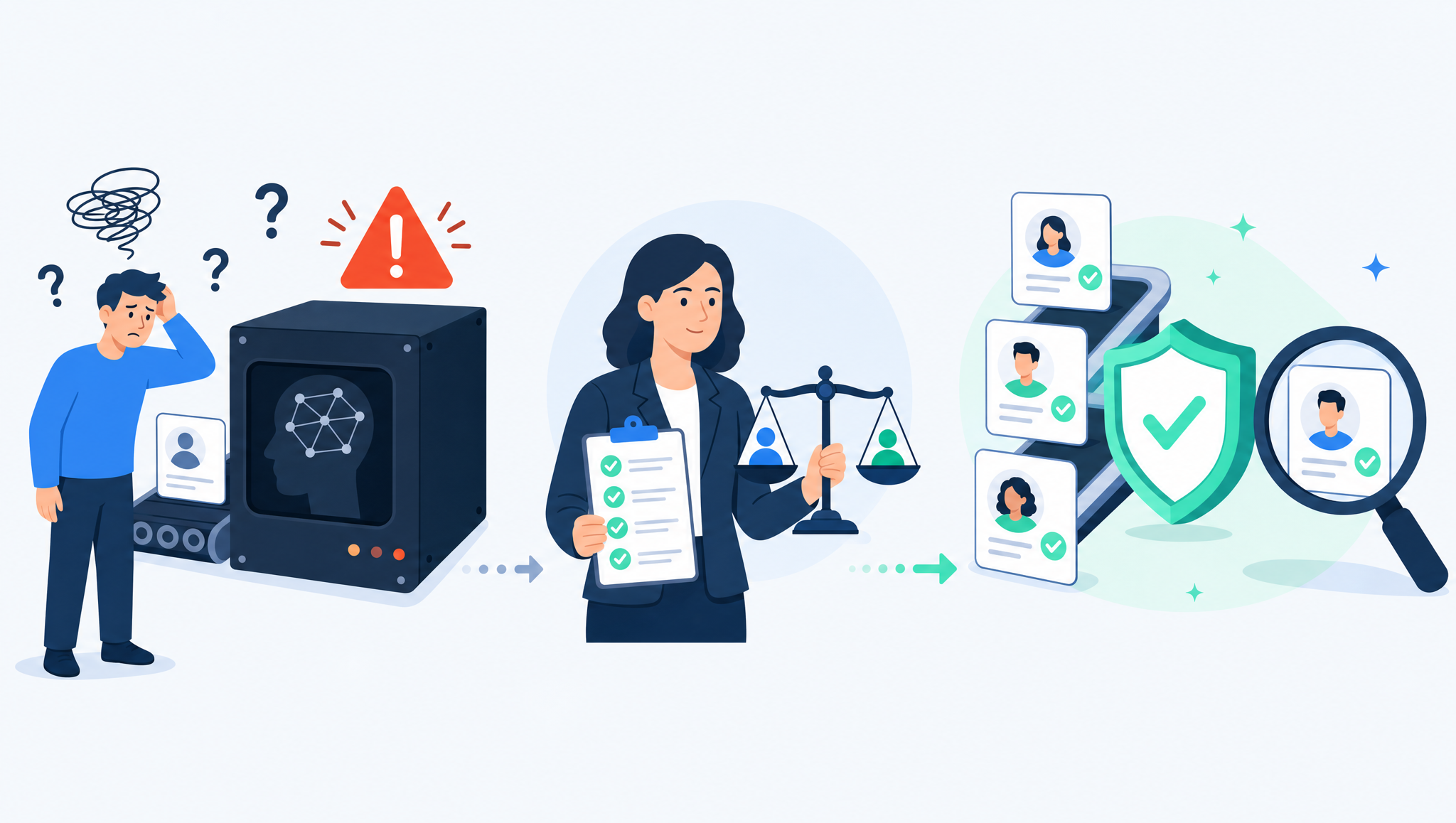
AI Recruitment Assessment Compliance Checklist: Bias, Explainability, Consent, Human Review
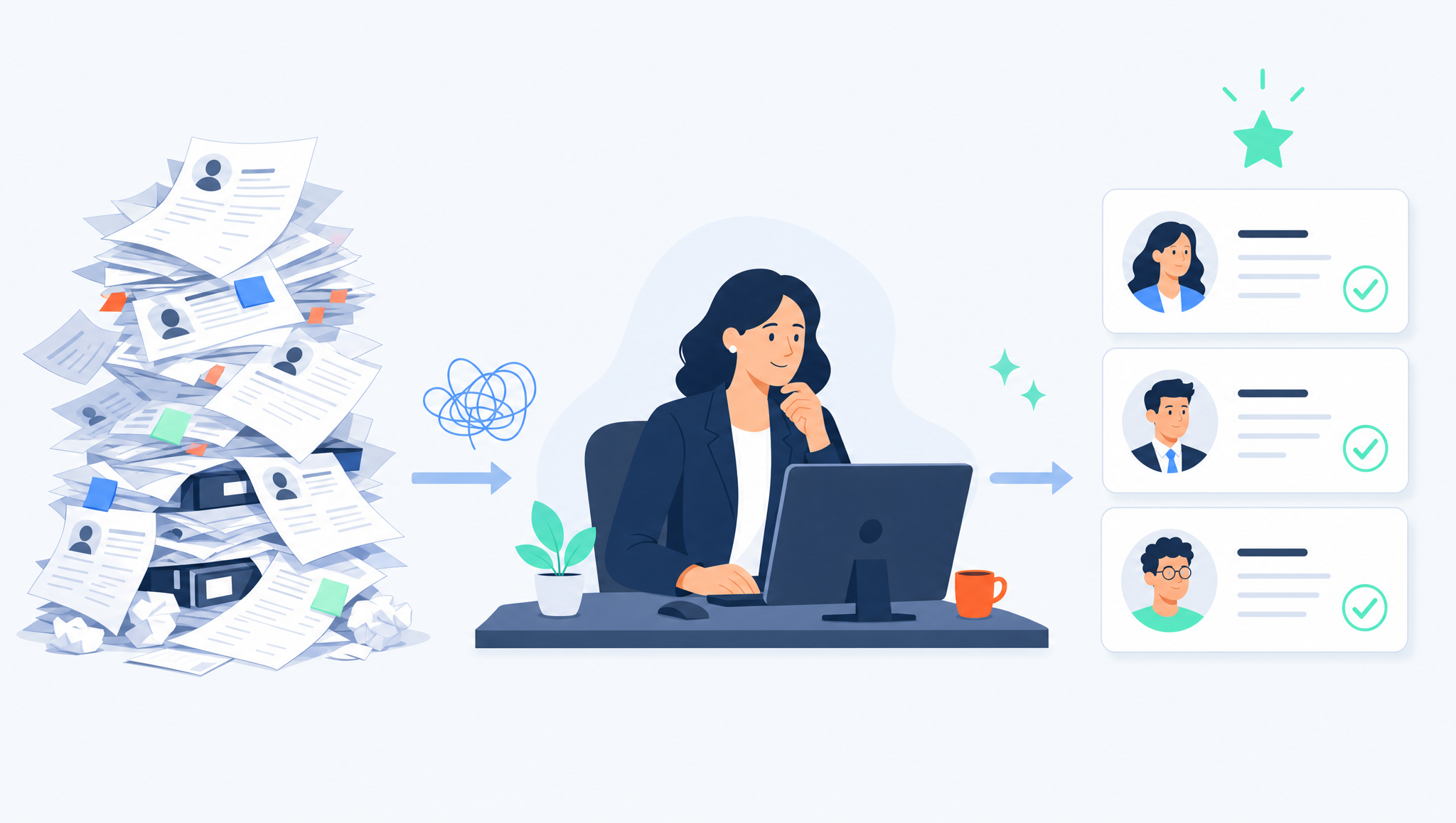
AI for Recruitment Assessment: Off-the-Shelf Tools vs Custom Hiring Workflows