
Generative AI consulting
Generative AI consulting that ends in a decision, not a deck
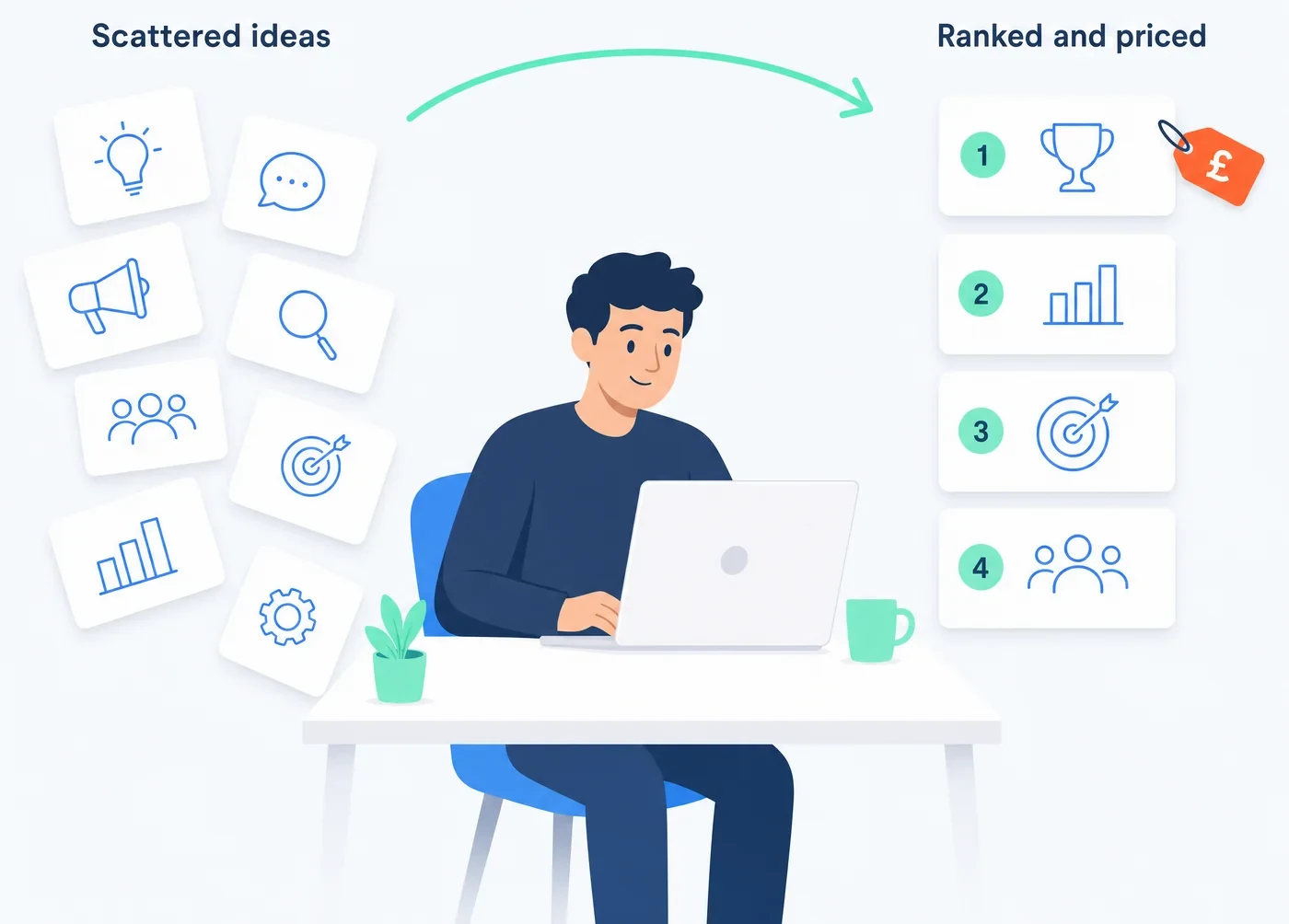
Softblues (softblues.io) is a London-based AI consultancy, Certified in the Claude Partner Network and a Google Cloud partner at Services Select tier. Our generative AI consulting is a short, paid engagement that ends with three things you keep: a ranked list of use cases, an honest feasibility and data readiness verdict on each, and a costed plan with a payback line for the one worth building first. It runs in two to three weeks and points to one of two routes, depending on what we find: a governed Claude deployment across your company, or a single expensive process automated end to end. If generative AI is the wrong tool for the job you have in mind, we write that down instead.
Key facts
Generative AI consulting at a glance
What it is
A short, paid assessment that ranks your generative AI use cases and prices the first build against your real numbers.
How long
Two to three weeks from kick-off to the plan on your desk.
What you keep
A ranked use-case list, a data readiness verdict, a target architecture, and a costed plan with a payback line. Yours whether or not you build.
What it costs
Discovery is priced up front: Mapping and Strategy £2,000 to £5,000, Full Discovery with strategy and business case £7,000 to £12,000. The build is priced in the proposal that follows, in GBP.
Where it leads
A governed Claude deployment, or one expensive process automated end to end. Or neither, if the numbers do not work.
Proof
We run six of our own departments on Claude. 50+ AI builds inside 200+ technology projects and 15+ years of delivery experience.
What is generative AI consulting, and what do you actually get?
Generative AI consulting is paid work that answers three questions before you spend money on a build: which use cases are worth doing, whether your data can actually support them, and what the first one costs against what it saves. Everything else is packaging.
Most generative AI consulting stops at the recommendation. Ours stops at a price. We spend the first week mapping where your people spend hours on work a model could do, and what that time costs you today. In the second week we test the top candidates against your real data rather than a demo set, because that is where most use cases quietly fail. In the third week we hand over the plan and the number.
You get four documents and they are yours to keep, whether you build with us, build with someone else, or decide not to build at all.
- The ranked use-case list
- Every candidate we found, scored on value, feasibility and how ready your data is. The ones we rejected are on the list too, with the reason.
- The data readiness verdict
- Where your data sits, what state it is in, what has to be fixed before a model can use it, and what that fix involves.
- The target architecture
- How the system would be built: models, integrations into the tools you already run, where the data lives, and who signs off on what the model produces.
- The costed plan
- Phased, with a price for the build and a payback line, so you know the cost and the month it returns before you commit.
Why do most generative AI projects stall before production?
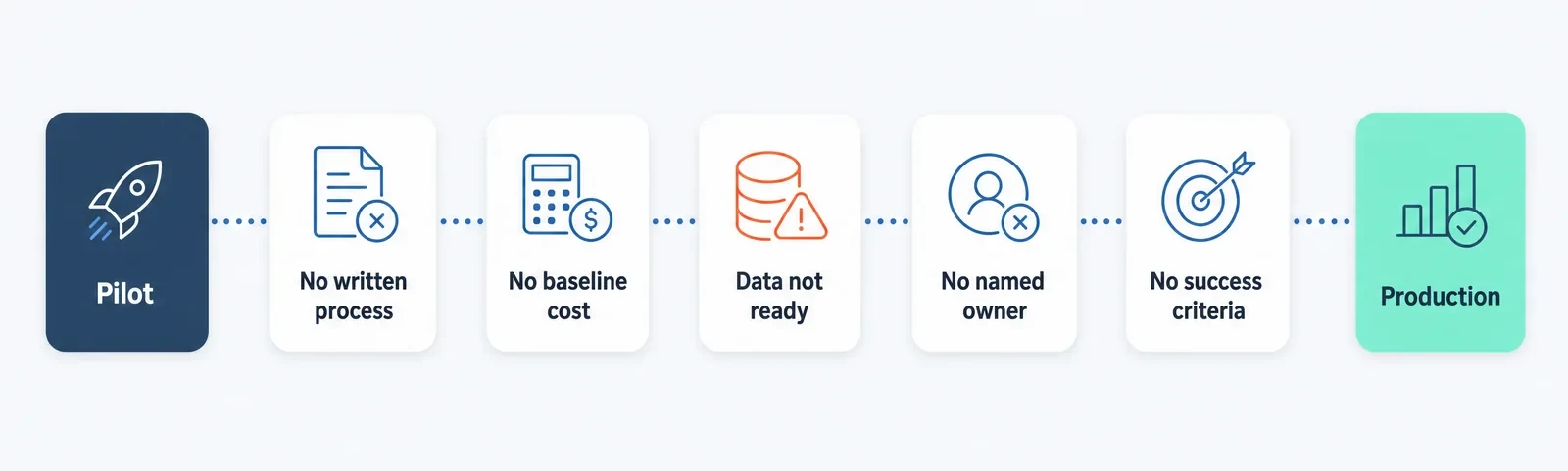
Because the pilot was never attached to a process with a cost. A demo that impresses the board is not the same as a system that survives contact with a Tuesday afternoon, and the gap between the two is almost always data, ownership and a missing baseline number.
We see the same five stalls, in roughly this order.
- 1
The process was never written down, so there is nothing to automate. The team knows how the work gets done, but the knowledge lives in three people's heads and two spreadsheets.
- 2
There is no baseline cost. Without knowing what the manual version costs per month, there is no way to price the build or to tell whether it worked.
- 3
The data is not ready. It is spread across systems, or it is in scanned PDFs, or the fields that matter were never filled in consistently. This is the most common single reason a promising use case gets dropped.
- 4
Nobody owns the output. When a model produces something that goes to a client or a regulator, someone has to sign it off. If that person has not been named, the system does not go live.
- 5
The pilot had no success criteria, so it cannot be declared finished. It runs, people say it is interesting, and it stays a pilot.
How does the assessment work, week by week?
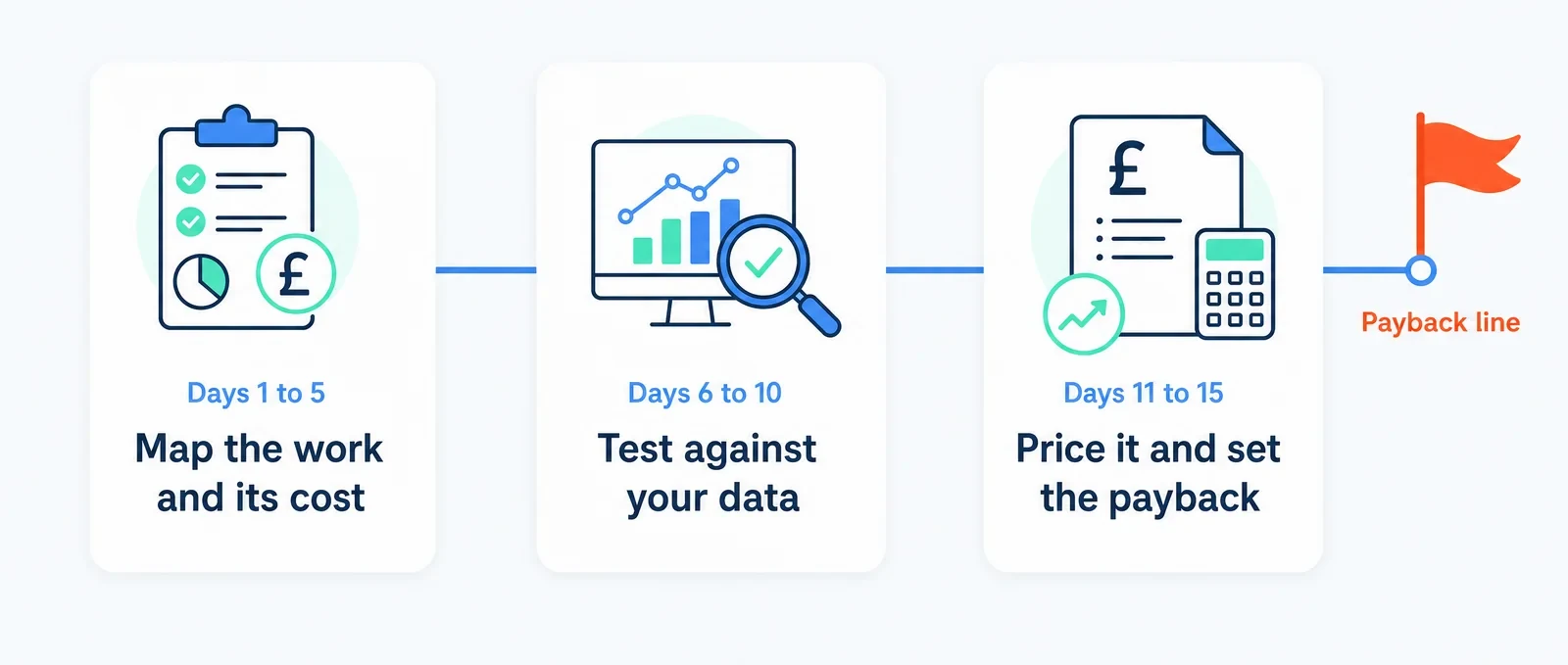
Three stages across two to three weeks: we map the work and its cost, we test the best candidates against your data, then we price the first build and put a payback line on it.
Days 1 to 5
Stage 1. Map the work and what it costs
Interviews with the people who do the work and the people who pay for it. We come out with a list of candidate use cases and, for each one, the volume, the handling time and the monthly cost of doing it by hand. That last number is what everything else is measured against.
Days 6 to 10
Stage 2. Test the shortlist against your data
We take the top candidates and run them against your real data, not a demo set. This is where a use case either survives or gets struck off, and it is the part most consulting engagements skip. You also get an honest read on what has to be fixed in the data before anything can ship.
Days 11 to 15
Stage 3. Price it and set the payback line
A target architecture, a phased plan, a price for the build, and the month the investment returns. If the payback does not work, we say so at this point and you have spent an assessment fee rather than a build budget.
If one use case needs proving rather than discussing, we can build a narrow proof of concept inside the engagement. Its acceptance criteria, delivery milestones and any refund terms are agreed in the contract.
Which route does the assessment point to?
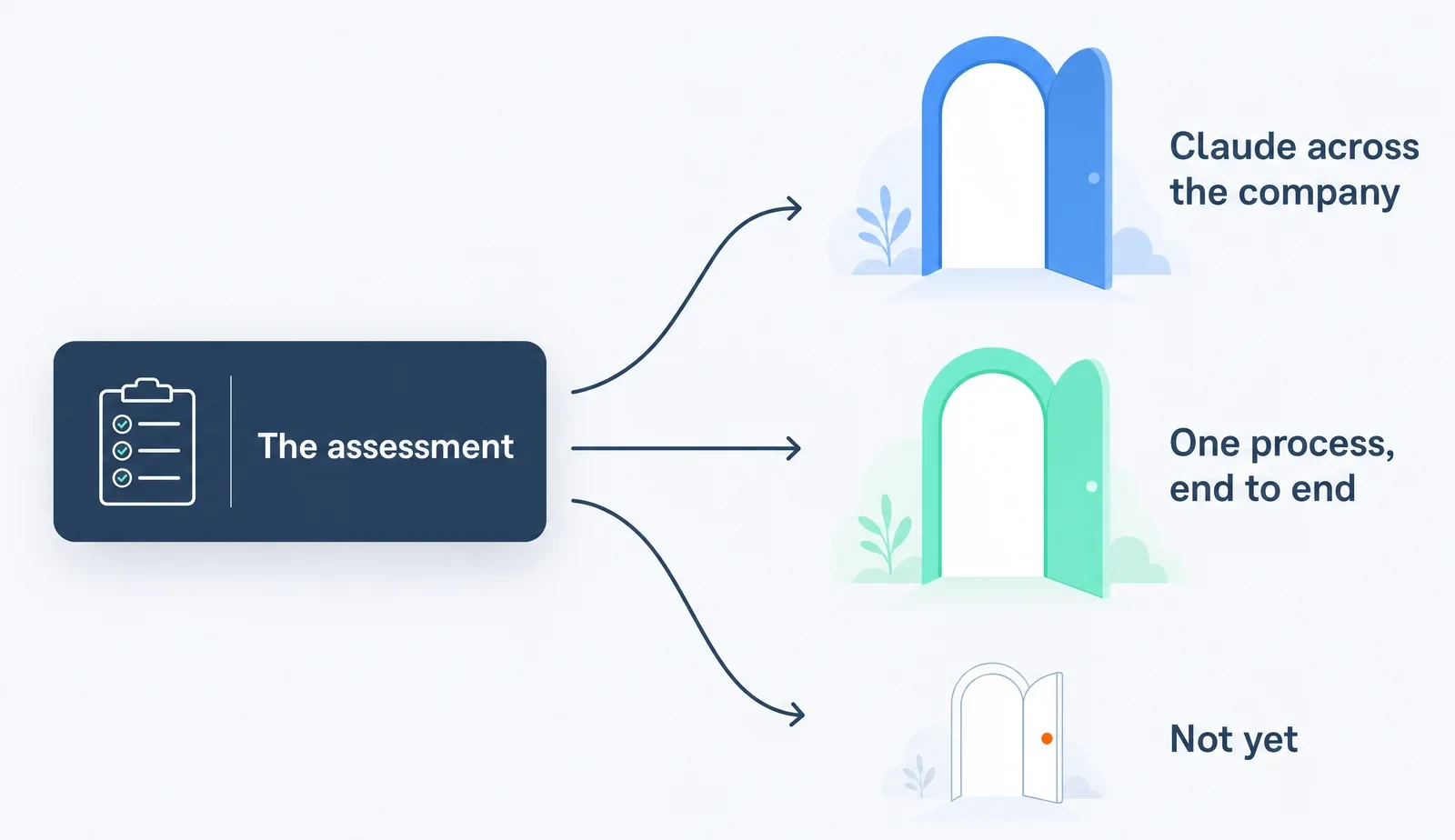
One of two, and occasionally neither. If the opportunity is broad and spread across teams, the answer is a governed Claude deployment. If it is one expensive process, the answer is to automate that process end to end. If neither pays back, we tell you to keep your money.
| Route | Best when | What it looks like | First step |
|---|---|---|---|
| Claude across the company | The opportunity is spread across several teams, people are already using AI tools without governance, and the win is hours back per person per week | A governed Claude Enterprise deployment: single sign-on, audit logs, retention you control, connectors into the tools you already run, and training per department. Phase 1 is a 2 to 3 week strategy and migration map | Claude Enterprise then Strategy and Roadmap |
| One process, automated end to end | There is a single named process with real volume and a real cost, usually document handling, intake, review or scheduling | An agent or pipeline built on your stack and connected to your data, with exceptions routed to a human. Priced against the process cost, with a payback line | AI Automation then Process Discovery |
| Neither, for now | The volume is too low, the data is not there, or an off-the-shelf tool already does it | We write down why, what would have to change for the answer to flip, and what to do instead | Nothing. Keep the assessment and come back when the picture changes |
Not sure which one you are? Find your starting point asks four questions and routes you.
Are Softblues vendor-neutral?
No, and be careful with anyone who tells you they are. We are an OpenAI Select Partner, Certified in the Claude Partner Network, a Google Cloud partner at Services Select tier, and a member of the Microsoft AI Cloud Partner Program. That is a bias, so here is how we handle it in the open.
Every consultancy that sells implementation has a preferred stack. The honest version of this is not to claim neutrality, it is to show your working.
So every recommendation we make comes with the alternatives we considered and why we set them aside. If your company runs on Microsoft 365 and the use case is document work inside Office, Copilot is very likely the right answer and we will say so. If you are a Google Workspace shop, Gemini is worth a serious look. If your requirement is image generation, none of what we do is the right fit.
The question worth asking any consultant, including us: which tool did you talk a client out of using in the last three months, and why? We will answer it on the call.
What does generative AI consulting cost?
Discovery is priced up front: Mapping and Strategy £2,000 to £5,000, Full Discovery with strategy and business case £7,000 to £12,000. The build is priced in the proposal that follows, in GBP. The assessment is paid and scoped before it starts.
The shape is the same on every engagement. A paid, scoped first step. Then a build priced in the proposal, with a payback line. Then an optional retainer if you want one.
The payback line is the part that matters at budget time. It is not the price divided by a monthly figure: nothing comes back during the three months it is being built, we credit nothing for the three after that while people are still learning it, and the running cost goes out throughout. A £20,000 build returning £4,000 a month from month seven, with £700 a month to run from month four, crosses in month thirteen rather than month five. You can put your own numbers in before we speak.
How Softblues pricing works and the process automation ROI calculator.
What does this look like when it has been done?
Three examples, at three different stages, described honestly. One is our own company, one is in production, and one is a proposal that came straight out of an assessment like this.
We run our own company on it
Six of our departments run on connected Claude agents: finance, sales, marketing, delivery, strategy and recruitment. It is the reason we can be specific about what changes in week one and what still needs a human. We use it before we sell it.
Softblues Claude Operating SystemLumono.ai, clinical research
A nine-agent pipeline turns a plain-English research question into a publication-ready analysis. Work that ran to 12 to 18 months compresses into weeks. In production, currently in beta.
Clinical research platformCompliance file review, financial advice
A four-stage monthly compliance file review with human sign-off at the end, designed to run inside the client's own EU tenant. This one is a proposal that came out of a discovery, not a live deployment, and it is a fair picture of what an assessment produces.
Compliance file review automationAll eight of our featured builds are on the case studies page, including the ones still at proof-of-concept stage. We label the stage on every one.
When is generative AI the wrong answer?
More often than the market admits. Here are the five situations where we tell people not to buy, including from us.
The process is not written down anywhere. Fix that first. It costs nothing and it is frequently where the saving turns out to be, with no model involved.
The volume is too low to pay back. A task that happens four times a month will not repay a build, however well the demo goes.
The knowledge lives in one person's head, or in scanned paper with no budget to digitise it. There is nothing for a model to read.
You need image or video generation. That is not what we do, and other tools are better at it.
You want a one-off prompt engineering workshop with no deployment behind it. We do not sell those. Training is part of a deployment, because training without a system in place wears off in about a month.
How do you handle governance, data and UK compliance?
Data stays where your rules say it has to. Governance is designed in the assessment rather than bolted on afterwards, and a named human signs off anything a model produces that goes to a client or a regulator.
The assessment covers where your data can legally and practically live, what the model is allowed to see, how long anything is retained, and who reviews the output. Where a client needs it, the system runs inside their own tenant rather than ours.
Our security is built around ISO 27001 principles. We are not ISO certified, and we will not imply otherwise. For UK organisations the two references worth reading alongside our recommendations are the ICO guidance on AI and data protection and, if Claude is in scope, Anthropic's own security and compliance documentation.
More on how we handle this: Security and Trust.
Who runs the engagement?
Ivan Pylypchuk leads the assessment, with the delivery team that would build the result sitting in the same sessions. You are not handed from a consultant to a stranger at contract signature.
Ivan Pylypchuk
CEO, co-founder and AI Architect at Softblues
Fifteen years in tech. Founded and exited multiple SaaS and e-commerce platforms, including Premmerce, acquired in 2022. Architect of the "disruption without the drama" approach that runs through everything we deliver.
Ivan on LinkedInBehind the engagement sit 30+ AI specialists.
Common questions about generative AI consulting
- What is generative AI consulting?
- Generative AI consulting is paid advisory work that decides which generative AI use cases are worth building, whether the organisation's data can support them, and what the first build costs against what it saves. A good engagement ends with a ranked list, a data verdict and a price. A weak one ends with a slide deck.
- What is the difference between generative AI consulting and implementation?
- Consulting decides what to build and whether it pays back. Implementation builds it. Softblues do both, which is why our assessment ends with a costed plan rather than a recommendation to go and get quotes. You are free to take the plan elsewhere, and some clients do.
- How much does generative AI consulting cost?
- Discovery is priced up front: Mapping and Strategy £2,000 to £5,000, Full Discovery with strategy and business case £7,000 to £12,000. The build is priced in the proposal that follows, in GBP. What we will commit to up front is the shape: a paid scoped first step, then a build priced in the proposal with a payback line, then an optional retainer. As a rule of thumb, a £20,000 build that saves £4,000 a month pays for itself in about five months.
- How long does a generative AI consulting engagement take?
- Two to three weeks from kick-off to the plan. Days 1 to 5 map the work and its cost, days 6 to 10 test the shortlist against your data, days 11 to 15 produce the architecture, the phased plan and the price. If a proof of concept is added, we agree its milestones and acceptance criteria in the scope.
- Are Softblues vendor-neutral?
- No. We are an OpenAI Select Partner, Certified in the Claude Partner Network, a Google Cloud partner at Services Select tier, and a member of the Microsoft AI Cloud Partner Program. Rather than claim neutrality we show the working: every recommendation lists the alternatives we considered and why we set them aside. If you are a Microsoft 365 shop and the use case is document work in Office, we will point you at Copilot. If you are on Google Workspace, Gemini is worth a look.
- Do you build the solution as well, or only advise?
- Both, and the same people do both. The engineers who would build the system sit in the assessment sessions, so the plan is written by the people who have to deliver it. Delivery milestones, price and any refund terms are agreed in the contract.
- What do we need to have ready before we start?
- Less than most people expect. Access to the people who do the work, a rough sense of volumes, and someone who can authorise access to the systems the data sits in. If your process is not documented, that is a normal starting point and part of what the assessment produces.
- Which generative AI use cases actually pay back?
- In our experience the reliable ones share a shape: high volume, structured or semi-structured input, a repeatable decision, and a human sign-off at the end. Document intake, compliance and file review, research and reporting, candidate and case assessment, and scheduling all fit it. Open-ended creative work and anything happening a handful of times a month rarely pays back.
- How do you handle data protection and UK GDPR?
- The assessment defines where data can live, what the model is allowed to see, retention, and who signs off on output. Where a client requires it, the system runs inside their own tenant. Softblues security is built around ISO 27001 principles; we are not ISO certified. For UK organisations we work alongside the ICO's guidance on AI and data protection.
- What is Softblues' status in the Claude Partner Network?
- Softblues is Certified in the Claude Partner Network, and is based in London. We also run our own company on Claude, across six departments, which is where a good deal of what we recommend comes from.
Want to know which use case to build first?
Book a discovery call. Twenty minutes, no pitch. We will tell you whether an assessment is worth doing and what it would cover. We respond within 24 hours.
Last updated: July 2026