

AI Automation · By industry
Customer support automation
Customer support automation uses AI agents to handle the front line of support: answering common questions, resolving routine issues, raising a ticket in your helpdesk, and passing anything beyond its scope to a person with the full context attached. Voice is one way customers reach it; the value is the automated work behind the conversation. Softblues builds these systems in production, connected to the helpdesk you already run.
- OpenAI Select Partner
- Google Cloud Services Partner
- Claude Partner Network Certified
- Member of the Microsoft AI Cloud Partner Program
The queue grows faster than the team
Most inbound contacts are routine: the same questions, the same known issues, answered by hand. As volume climbs the queue grows, turnaround slips, and the team spends its day on repetition instead of the cases that actually need a person. Automating the front line, and escalating the rest with context, is what keeps the queue short.
What we build
What can we automate?
The front line of support, by voice or chat, with a person on anything beyond its scope.

How it runs
How we build a support automation
Three steps, mapped to how your support runs, connected to your helpdesk, with a person on the escalations.
Process Discovery
A short, paid engagement that maps how your support actually runs today.
- We map your volume and contact flows
- We agree what the agent resolves and when it escalates
- You get a fixed-price plan with the payback line
The build
Built on the helpdesk and CRM you already run, by voice or chat, not a new platform.
- Connected to HubSpot, Zendesk or your stack
- Tickets raised and updated automatically
- Escalation paths that carry full context
Run it
It goes live with monitoring and an SLA, so it keeps resolving as volume grows.
- Evals and monitoring in place
- An SLA as volume grows
- Money back if the proof of concept fails
Evidence
Where this has worked
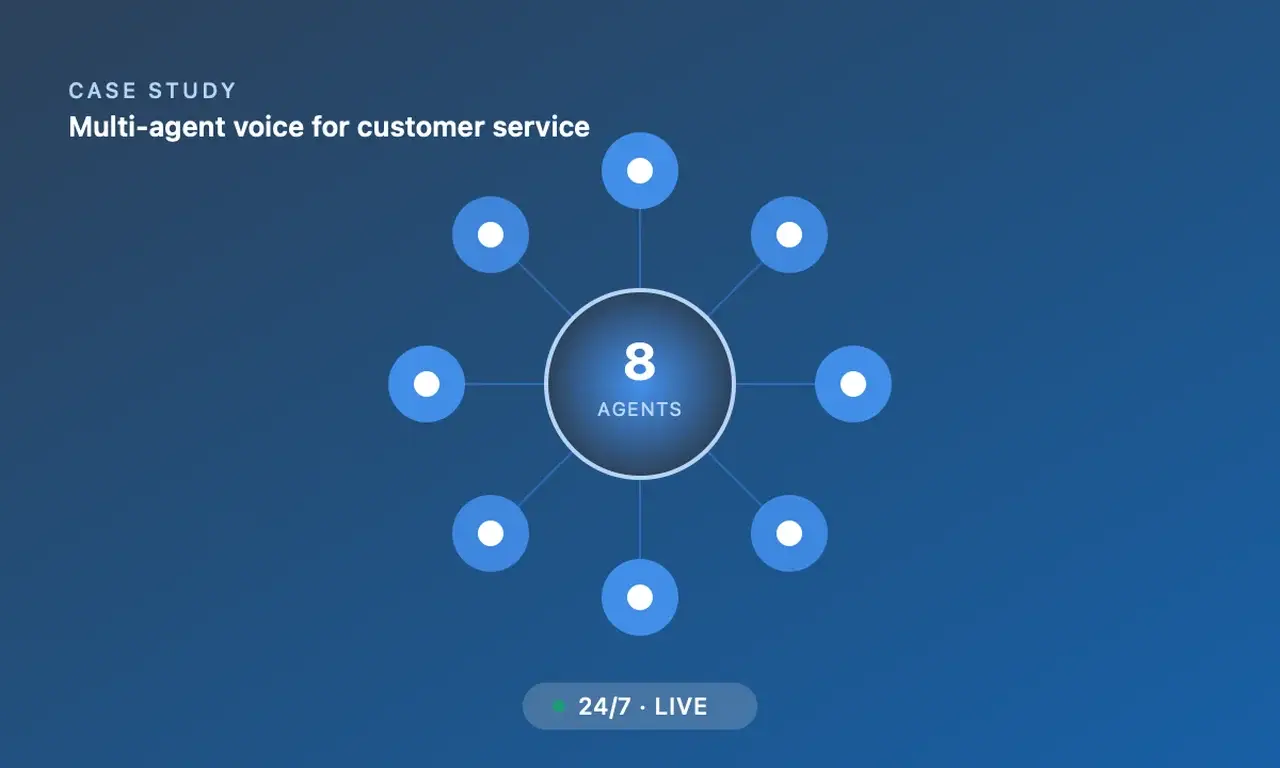
In production
Roof Maker, customer support
24/7 voice support that answers, troubleshoots, raises a HubSpot ticket automatically and escalates to a person when needed.
- 24/7
- Voice support coverage
- Auto-ticket
- Raised in HubSpot
The investment
What does it cost?
Price agreed after a paid Process Discovery, with a payback estimate based on your assumptions. Estimate payback using the full cost, the adoption ramp and when benefits begin. Released hours count as capacity until there is a specific route to a financial return.
Key facts
Customer support automation: at a glance
- What
- AI agents that handle support intake, triage, resolution and ticketing, in production.
- For
- Support and operations teams with high inbound volume handled manually.
- Workflows
- Answer and resolve common queries 24/7, triage and route, auto-create and update tickets, escalate with full context.
- Interface
- Voice or chat; voice is a capability inside the automation, not a standalone product.
- How
- Paid Process Discovery, fixed-price build connected to your helpdesk, then evals, monitoring and an SLA.
- Delivery
- Timeline, price and acceptance criteria agreed for the scoped engagement.
- Proof
- Roof Maker runs 24/7 support on a Softblues agent, in production; 50+ AI projects delivered.
- Based in
- London-based, working with mid-market firms.
Common questions about support automation
Does it replace our support team?
No. It removes the repetitive volume, the routine questions and known issues, and escalates everything else to a person with the full context. Your team stays on the cases that need judgement, with a shorter queue in front of them.
Which helpdesks do you connect to?
HubSpot, Zendesk and others, through native connectors or a custom integration. Roof Maker's agent raises tickets in HubSpot automatically. We connect to the helpdesk and CRM you already run.
What happens when the agent cannot resolve something?
It escalates to a person and hands over the history, the customer record and what it has already tried, so the case continues without the customer repeating themselves.
Is this voice or chat?
Either. Voice is the interface in cases like Roof Maker, but the automation behind it, the triage, resolution and ticketing, is the same whether the customer calls or types.
How long until it is live?
The timeline depends on scope, integrations and validation. We agree it in the discovery plan.
How do you keep our data secure?
Builds run with role-based access, audit logging and data handling built around ISO 27001 principles, on the platform you already trust. We work with the platform that fits your workflow and data requirements.
Where to go next
Scope your support automation
Start with a paid Process Discovery. We map how your support actually runs and come back with a fixed-price build, connected to your helpdesk, with a person on the escalations.