

Implementation guide · Free PDF · 21 slides
Claude Implementation Guide for AI Native
Use this Softblues guide to assess Claude for document work and repeatable procedures. Name who will maintain those procedures and include their time alongside licences and usage.
From Softblues, a London-based AI consultancy. Platform details in the guide carry their own verification dates.

What is inside the guide?
Claude is the platform we run our own company on, and this is the version of the argument we give a firm that has chosen it. Part A is the platform baseline before any agent. Part B is eleven worked examples across four tiers. Part C is the order to do them in, and where Claude is the wrong tool.
Every price, feature and regulatory date was checked against vendor documentation 1 to 3 September and re-checked 1 and 8 October 2026.
The business case, before the seats
Price is rarely what sinks a Claude case. The slide works the chain instead: the objective, the workflow that has to change, the measurement that shows it did, and what that is worth. The closing ask is a baseline on one workflow.
Part A: the platform baseline
Which licence, the governance switches to set on day one, the Microsoft 365 connector and the single Entra consent behind it, and the residency position written the way a board paper needs it.
Part B: eleven worked examples
Across four tiers, from a policy assistant built in an afternoon to real-time monitoring that is a build. Each with the effort, the owner and the honest limit.
Part C: the order, and the limits
The sequence that works, what to measure, and the three cases where Claude is the wrong tool, said out loud rather than sold around.
What it does not do
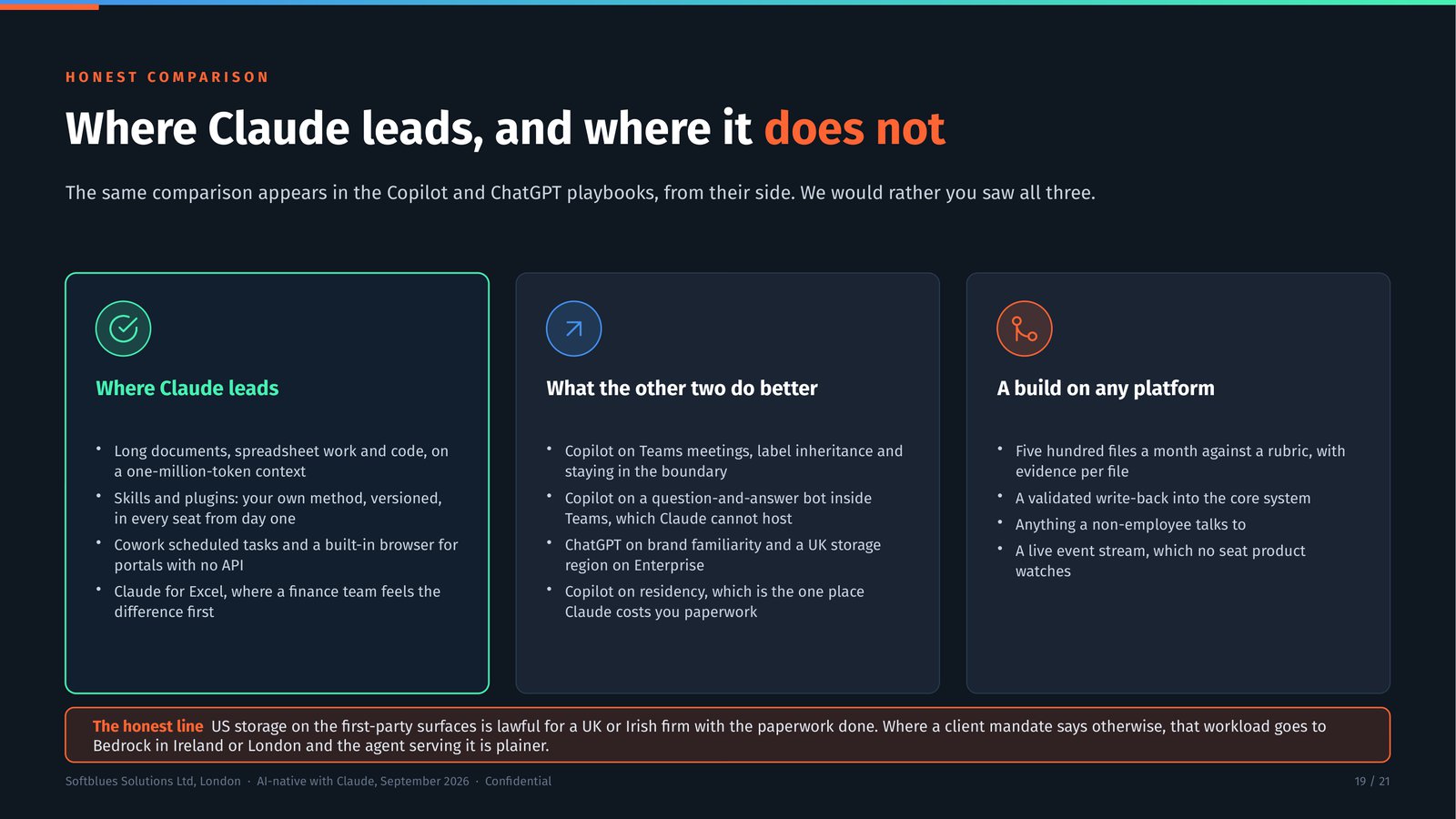
Claude does not replace Copilot inside Word and Outlook, there is no Claude Teams app, and Anthropic models inside Microsoft 365 Copilot process outside the EU Data Boundary.
Get the deck
Twenty-one slides on making your firm AI-native with Claude: what you buy, the day-one governance, the eleven worked examples, the sequence and the fee bands. Free, with no obligatory follow-up. The 47-page Claude playbook behind it is what we bring to the conversation.
01 · WHAT IT MEANS
What does AI-native mean on Claude?
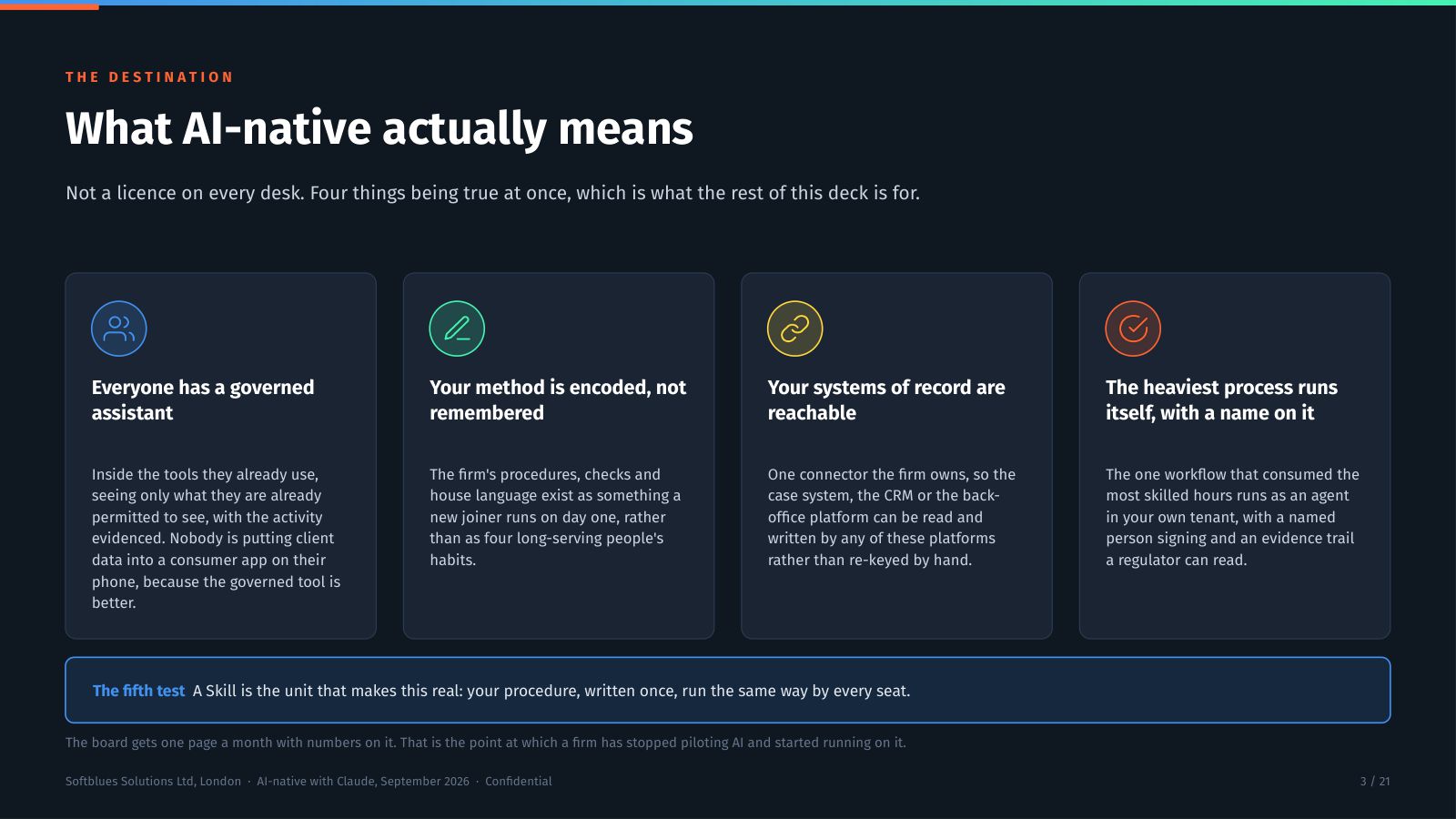
Four things true at once. Everyone has a governed assistant inside the tools they already use. The firm's procedures exist as something a new joiner runs on day one rather than as four long-serving people's habits. Your systems of record are reachable. And the heaviest process runs itself, with a named person signing and an evidence trail a regulator can read.
02 · THE ANSWER
What does a firm actually buy to run on Claude?
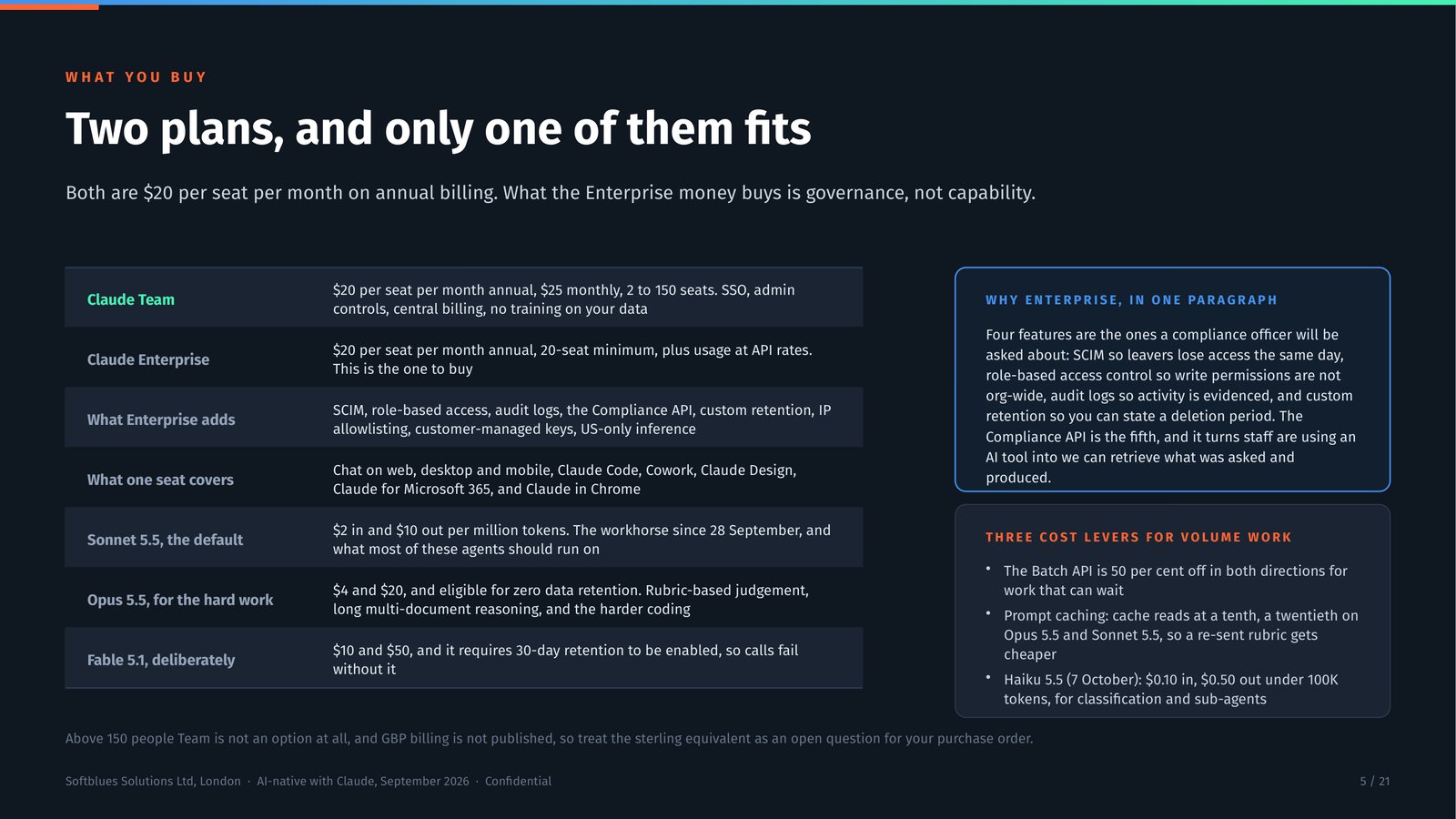
Both Team and Enterprise are $20 per seat per month on annual billing. What the Enterprise money buys is governance rather than capability: SCIM so leavers lose access the same day, role-based access control, audit logs and custom retention. Those are the four a compliance officer will ask about. Team also stops at 150 seats. As verified 1 to 3 September and re-checked 1 and 8 October 2026.
03 · THE WORK
What does the work look like on Claude?
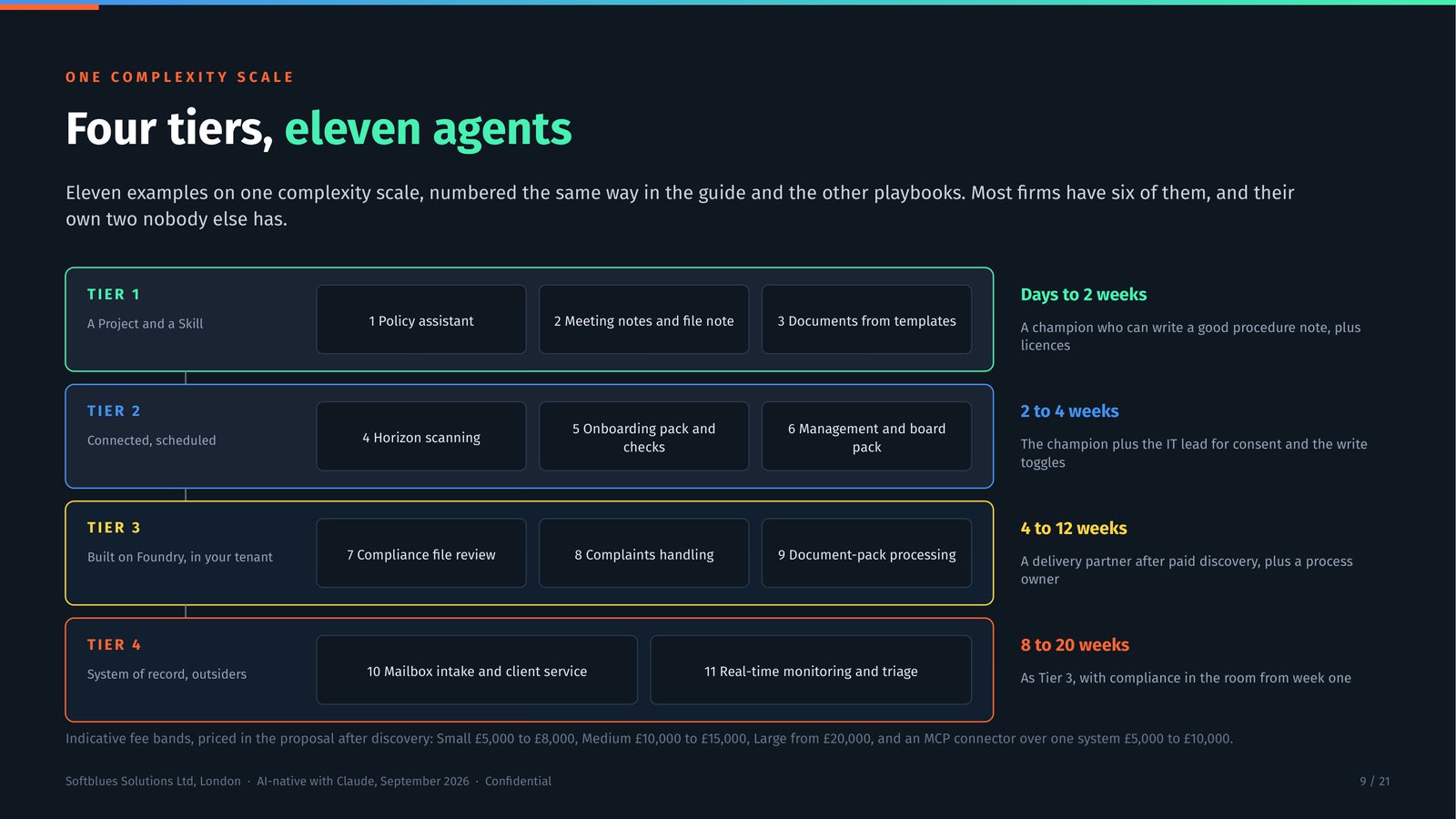
Eleven worked examples on one complexity scale, numbered the same way in the guide and in every playbook. Most firms recognise six of them, plus two of their own that nobody else has. Tier 1 is a champion and a Skill. Tier 4 is a build in your own tenant, with compliance in the room from week one.
04 · THE HONEST PART
Where is Claude the wrong tool?
Claude does not replace Copilot inside Word and Outlook, and there is no Claude Teams app, so anything staff-facing in the upper tiers needs a bot built on the Microsoft 365 Agents SDK. Cowork sits outside Anthropic's BAA, so patient-identifiable work goes elsewhere. And no seat product on any platform processes a live event stream.
How will you judge whether it is worth the investment?
Hours released are capacity, not automatically profit. Name how that capacity will be used, establish a baseline and include implementation, training and running costs. Benefits start when people adopt the workflow, while some costs start earlier.
Compare equivalent completed work, including human review and exceptions. Count shared costs once and keep cash savings separate from estimates of capacity or reduced risk.
Where can you take this next?
The case describes its own platform and project stage. Use it to understand the approach, then assess the fit for your team.
If you want to discuss that fit, book a discovery call about AI adoption.
Common questions
What does a firm actually buy to run on Claude?
Claude Enterprise, at $20 per seat per month on an annual plan with a 20-seat minimum, plus usage at API rates. Enterprise rather than Team, because the four things a compliance officer will ask about are Enterprise-only: SCIM so leavers lose access the same day, role-based access control so write permissions are not organisation-wide, audit logs so activity is evidenced, and custom retention so you can state a deletion period in your record-keeping policy. The Compliance API is the fifth. Team also stops at 150 seats. As verified 1 to 3 September and re-checked 1 and 8 October 2026.
Is Claude allowed under FCA rules if the data sits in the United States?
Yes. Neither the FCA nor the Central Bank of Ireland prohibits it. Data on the first-party surfaces is stored in the United States, which is lawful for a UK or Irish firm under Anthropic's data processing agreement with Standard Contractual Clauses and the UK Addendum, recorded in a DPIA and a transfer risk assessment. It bites where a client mandate or a public-sector contract requires UK or EU-only processing, or where health data is involved. For those workloads the routes are Bedrock in Ireland or London, or Vertex in the EU, at a premium and with features missing, and for a UK-only clause Opus 5.5 and Sonnet 5 now run in-region in AWS London. Position as verified 1 to 3 September and re-checked 1 and 8 October 2026.
Does Claude replace Microsoft 365 Copilot?
No, and a proposal that says otherwise is selling rather than advising. Copilot is native to Word, Excel, Outlook and Teams, grounded in Microsoft Graph, and governed by the Purview and Entra controls you already run. Claude sits alongside it for the people whose work is long documents, spreadsheet models, encoded procedures or code. There is also no Claude Teams app, so Teams stays Copilot's surface. Anthropic models inside Microsoft 365 Copilot are a separate question and a separate governance decision, because they process outside the EU Data Boundary.
Can Claude read and write our SharePoint and Outlook?
Yes, through the Microsoft 365 connector, which is available on every plan. An Entra Global Administrator grants tenant consent once, and all permissions are delegated, so Claude sees only what the signed-in user can already see. It searches and analyses SharePoint and OneDrive documents and can create and update files there, and it searches, drafts, sends and manages Outlook mail and calendar. Write actions need an expanded consent and an admin toggle, settable per user group. One limit is worth knowing: Claude cannot attach files to Outlook drafts it creates. It can now post Teams chat and channel messages, but only with write actions enabled and each messaging tool allowed by an admin, and there is still no Claude app for Teams.
Where is Claude the wrong tool?
Three cases, stated straight. Patient-identifiable work cannot run in Cowork, because Cowork sits outside Anthropic's BAA, so that work goes to a build with a tenant-resident runtime. A live event stream is not a job for any seat product on any platform, so real-time monitoring is a build and the seat is the review surface. And where a client mandate or a public-sector contract requires UK or EU-only processing, the residency routes that satisfy it remove the Agent Skills, connector or Files API features most of this guide depends on, so split the work rather than pretending.
How long before people are actually using it properly?
Seats are days, with one Entra consent for the Microsoft 365 connector. Getting real value takes longer and depends on one thing: whether the firm's procedures are written down. If the policies and templates are not under version control, fix the library first, or the assistant will cite the wrong document with complete confidence. The sequence in the deck runs the three in-seat examples first, because they need a champion rather than a build, then the connected work, then one build once the firm has learned how it wants to review agent output.
Is the deck really free?
Yes. Complete the download form with your name, work email, company and role. The thank-you page provides the free 21-slide PDF. The longer companion document is not included in this download.