

AI Automation · By industry
Financial services process automation
Financial services process automation uses AI agents to run the repetitive review and checking work a firm does every month: reading the files, applying the rules, and handing a person the cases that need a decision. Softblues builds these systems in production, with a human kept in the loop for sign-off, designed to run in your own tenant.
- OpenAI Select Partner
- Google Cloud Services Partner
- Claude Partner Network Certified
- Member of the Microsoft AI Cloud Partner Program
The cost is in the checking
Every month a team reads the same files, applies the same rules and records the same evidence by hand. It is slow, it is expensive, and under load the quality drifts. The work has to be done, and done consistently, which is exactly what makes it worth automating with a person kept on the decisions that matter.
What we build
What can we automate?
Repetitive review and checking work where the rules are known, with a person on the exceptions.

How it runs
How we build a compliance automation
Three steps, mapped to a regulated review process, with your team on sign-off throughout.
Process Discovery
A short, paid engagement that maps your review process file by file, with your compliance team in the room.
- We map the review end to end
- We agree the rules and the sign-off points
- You get a costed plan with the payback line
The build
Built to run in your own tenant, around the files and systems you already use, not a new platform.
- Runs in your own tenant, EU where required
- A reviewer signs off every exception
- Every check logged for the audit trail
Run it
It goes live with the monitoring and the consistent record an auditor expects.
- Evals and monitoring in place
- A consistent record, file by file
- Price and scope agreed in the proposal before the build starts
Evidence
Where this has been designed
Designed pre-discovery
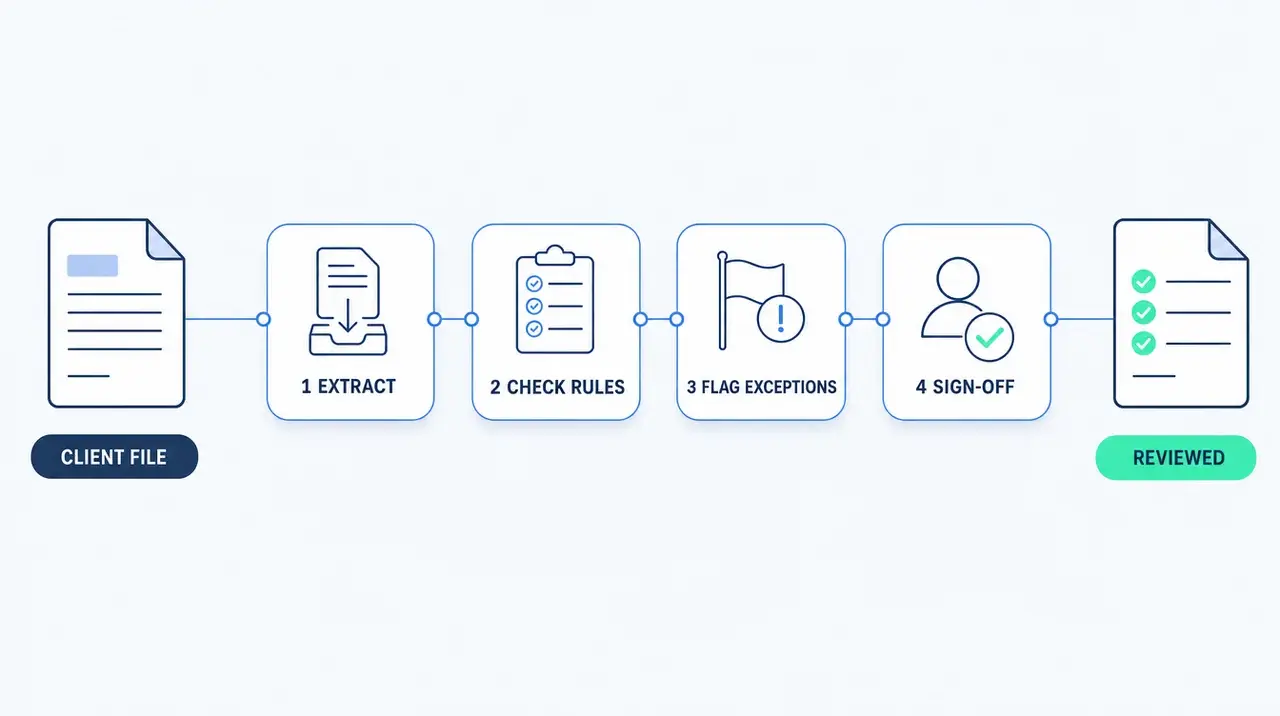
Monthly compliance file review
A four-stage review with human sign-off for a financial-advice firm (anonymised), designed to run in the client's own EU tenant. Proposed build, scoped pre-discovery.
- 4 stages
- Review with human sign-off
- EU tenant
- Data residency
The investment
What does it cost?
Price agreed after a paid Process Discovery, with a payback estimate based on your assumptions. Estimate payback using the full cost, the adoption ramp and when benefits begin. Released hours count as capacity until there is a specific route to a financial return.
Key facts
Financial services automation: at a glance
- What
- AI agents that run repetitive financial-services review and checking work in production, with human sign-off.
- For
- Compliance, operations and risk leaders at advisory, wealth, insurance and accountancy firms.
- Workflows
- File and suitability review, KYC and AML, document checking, reconciliations.
- How
- Paid Process Discovery, a build priced in the proposal, in your own tenant with human sign-off, then evals, monitoring and an audit trail.
- Delivery
- Timeline, price and acceptance criteria agreed for the scoped engagement.
- Data residency
- Designed to run in your own tenant, including an EU tenant where required.
- Proof
- Softblues runs its own company on six Claude agents; 50+ AI projects delivered.
- Based in
- London-based, working with mid-market firms.
Common questions about financial services automation
What financial-services processes can you automate?
Repetitive review and checking work where the rules are known: file and suitability review, KYC and AML, document checking and reconciliations. We automate the reading and the rule-applying, and keep a person on the cases that need a decision.
Where does our data sit, and can it stay in the EU?
The system is designed to run in your own tenant, including an EU tenant where data residency requires it. Your files stay in your environment; we build around it rather than moving your data out.
How does this hold up to a regulator or an auditor?
Every check is logged: what was reviewed, which rule applied, what was flagged and who signed it off. That audit trail is the point. It supports obligations like FCA Consumer Duty and SMCR accountability by recording the review consistently, file by file, rather than on a sample.
Will this replace our compliance team?
No. It removes the repetitive reading and checking and keeps your people on judgement and sign-off. A human stays in the loop on every exception, and accountability stays with your firm. To train your teams on Claude first, see Claude training for financial services.
How accurate is it, and what if it gets a file wrong?
The agent prepares the decision; a person makes it. Exceptions are escalated rather than auto-approved, monitoring catches drift, and we tune the rules during discovery and after go-live. We do not present it as a system that decides on its own.
How long until it is live?
The timeline depends on scope, integrations and validation. We agree it in the discovery plan. To connect assistants to your back-office or CRM, see MCP connectors.
Scope your compliance automation
Start with a paid Process Discovery. We map the real review process and come back with a build priced in the proposal, a payback line, and a human kept on sign-off.