

AI Automation · Solutions
Document and knowledge automation
Document and knowledge automation uses AI agents to read your documents, pull out the facts that matter, check them against your rules, and answer questions from your own knowledge with the source attached. The answers are grounded in your documents and cite where each one came from, and a person signs off where the stakes are high. Softblues builds these systems in production, connected to the document stores you already use. Your data stays in your environment.
- OpenAI Select Partner
- Google Cloud Services Partner
- Claude Partner Network Certified
- Member of the Microsoft AI Cloud Partner Program
The answer is in your documents. Finding it is the job.
The facts your team needs are buried across contracts, forms, emails and policy, read by hand, one document at a time. It is slow, it is inconsistent, and the same questions get asked of the same files every week. Reading the documents, checking them against your rules and answering with the source attached is what gives that time back.
What we build
What can we automate?
Reading, checking and answering from your own documents, with a citation and a person on the high-stakes calls.

How it runs
How a document automation build works
Three steps, connected to your document stores, with your data kept in your environment.
Process Discovery
A short, paid engagement that maps the documents, the questions and the accuracy you need.
- We map the documents and the questions
- We prove accuracy on your own files
- You get a costed plan with the payback line
The build
Built connected to SharePoint, Drive or your DMS, with your data kept in your own environment.
- Connected to your document stores
- Your data stays in your environment
- A person signs off high-stakes outputs
Run it
It goes live with citations and an audit trail on every answer, plus monitoring.
- Evals and monitoring in place
- Citations and an audit trail on every answer
- Price and scope agreed in the proposal before the build starts
Evidence
Where this has been built
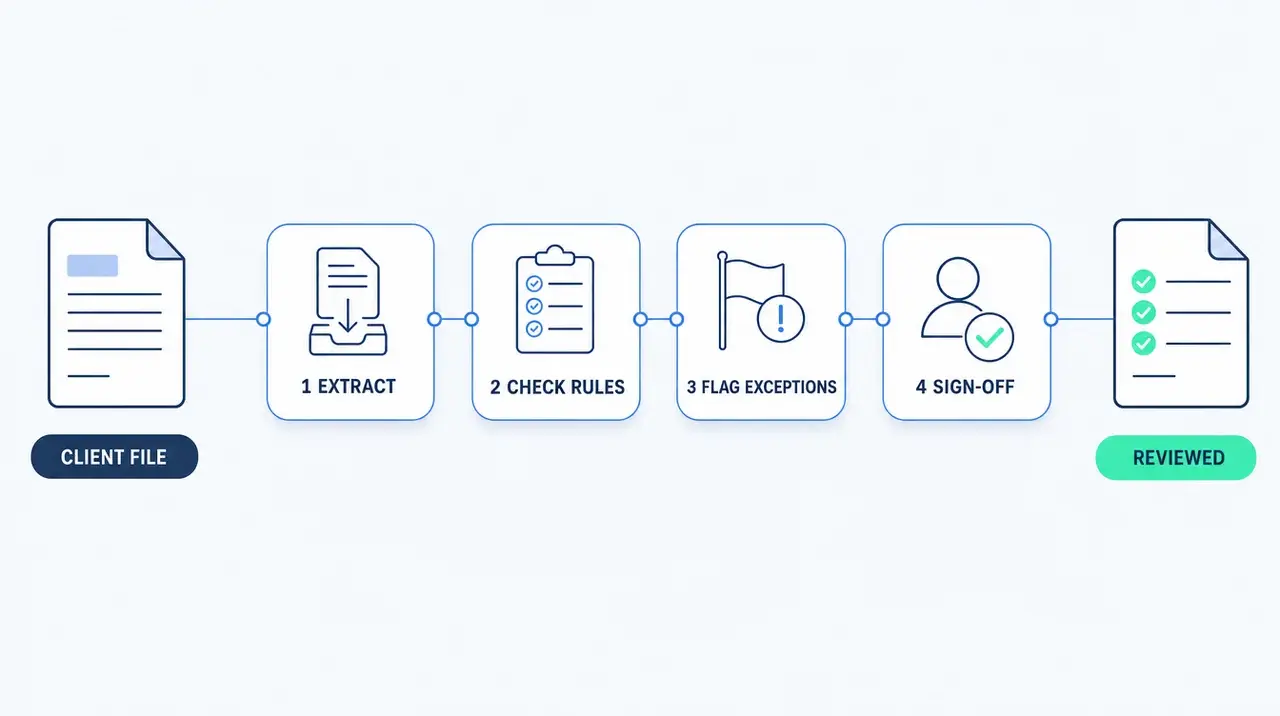
Designed pre-discovery
Compliance file review (financial advice, anonymised)
A four-stage system that reads each client file, checks it against the rules, and routes it to an adviser for sign-off, designed to run in the client's own environment.
- 4 stages
- Review with human sign-off
- Own tenant
- Data residency
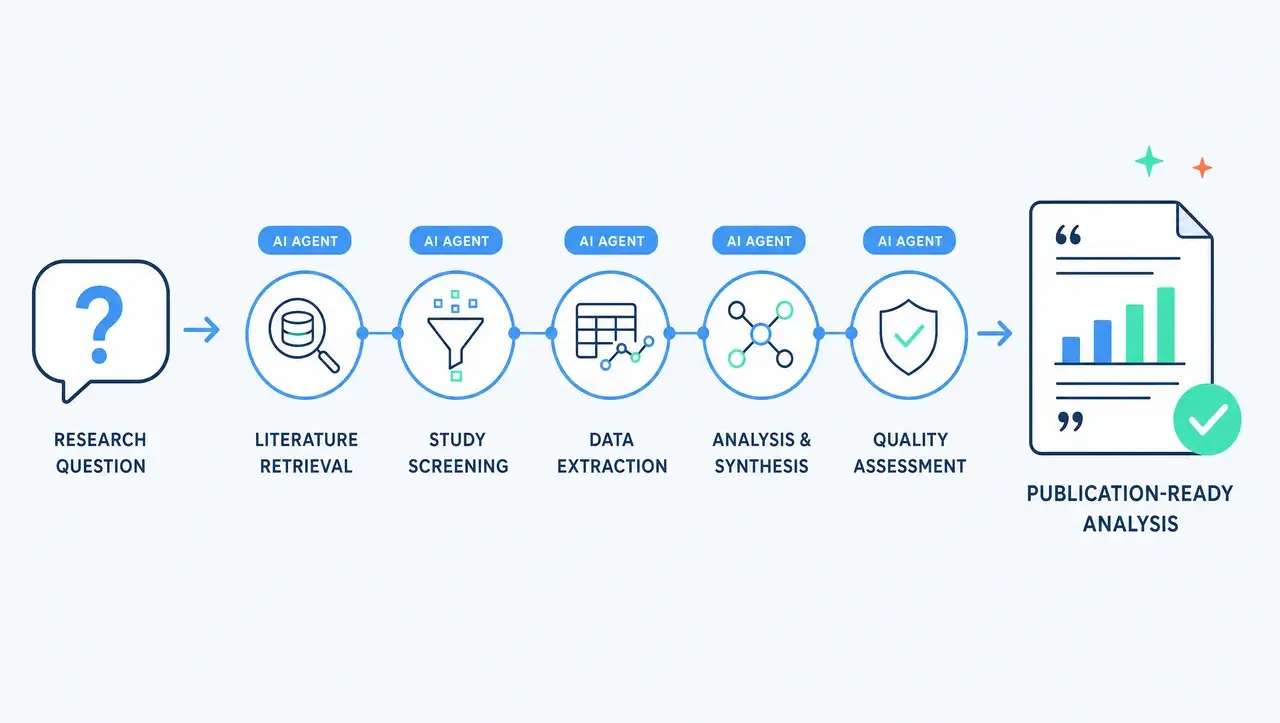
In production (beta)
Clinical research synthesis (Lumono.ai)
A pipeline that turns scattered evidence into a structured, publication-ready synthesis, with the sources attached and an expert reviewing the output.
- Citations
- On every claim
- 9 agents
- Specialised pipeline
The investment
What does it cost?
Price agreed after a paid Process Discovery, with a payback estimate based on your assumptions. Estimate payback using the full cost, the adoption ramp and when benefits begin. Released hours count as capacity until there is a specific route to a financial return.
Key facts
Document and knowledge automation: at a glance
- What
- AI agents that read your documents, check them against your rules, and answer from your knowledge with citations.
- For
- Teams with a heavy documentation load and knowledge spread across systems, especially regulated professional services.
- Workflows
- Extract and structure data, check against rules, answer from your knowledge, keep an audit trail.
- How
- Paid Process Discovery, a build priced in the proposal and connected to your document stores, then evals, monitoring and an SLA.
- Accuracy
- Answers are grounded in your documents and cite their source; a person signs off high-stakes outputs.
- Delivery
- Timeline, price and acceptance criteria agreed for the scoped engagement. Your data stays in your environment.
- Proof
- Softblues runs its own company on six connected Claude agents; 50+ AI projects delivered.
- Based in
- London-based, working with mid-market firms.
Common questions about document automation
Does it make things up? How do you handle hallucination?
Answers are grounded in your own documents and cite the source, so a reader can check each one against the original. Where the stakes are high, a person reviews the output before it is acted on. The system is built to say when it cannot find an answer rather than guess.
Where does our data live?
In your environment. We connect to the document stores you already run, and the documents and the processing stay on the platform you control. We do not move your data to ours.
Which document systems do you connect to?
SharePoint, Google Drive, and common document management systems, plus email and shared drives, through native connectors or a custom integration with proper authentication and audit logging.
How accurate is the extraction?
It depends on the documents and the rules, which is why we scope it in Process Discovery and prove it on your own files before the full build. Where accuracy matters most, a person confirms the output, and the audit trail records what was checked.
How long until it is live?
The timeline depends on scope, integrations and validation. We agree it in the discovery plan.
How do you keep our data secure?
Builds run with role-based access, audit logging and data handling built around ISO 27001 principles, in your own environment. We work with the platform that fits your workflow and data requirements.
Scope your document automation
Start with a paid Process Discovery. We map the documents and the questions, prove accuracy on your own files, and come back with a build priced in the proposal that keeps your data in your environment.