

AI Automation · Solutions
AI agents, built for production
An AI agent is software that does multi-step work on its own: it reads the inputs, uses your tools, takes actions, and asks a person when judgement is needed. Softblues builds agents that run on the platform you already use, Microsoft, Google Cloud or Anthropic, connected to your own data, with guardrails and monitoring from day one. We run six of our own departments on Claude agents, so we build from doing.
- OpenAI Select Partner
- Google Cloud Services Partner
- Claude Partner Network Certified
- Member of the Microsoft AI Cloud Partner Program
A chatbot answers. An agent does the work.
Most AI tools stop at a conversation. An agent goes further: it reads the inputs, uses your systems, completes the task, and asks a person when judgement is needed. That is the difference between a demo and something that actually takes work off your team, every day, in production.
What we build
What does an AI agent actually do?
Four things, combined to run a real task end to end, with a person on the decisions that matter.

How it runs
How we build an agent
Three steps, from a paid discovery to a monitored agent in production on your own stack.
Process Discovery
A short, paid engagement that maps the task and the tools the agent needs to do it.
- We map the task and the tools it needs
- We scope the guardrails and where a person steps in
- You get a costed plan with the payback line
The build
Built on Microsoft, Google Cloud or Anthropic, connected to the data you already hold.
- Runs on the platform you already use
- Scoped tool permissions on every action
- A human in the loop where a mistake is costly
Run it
It goes live with evals before launch and monitoring after, so you can trust what it does.
- Evals before launch, monitoring after
- Every action logged and checkable
- Price and scope agreed in the proposal before the build starts
Evidence
Agents we have built
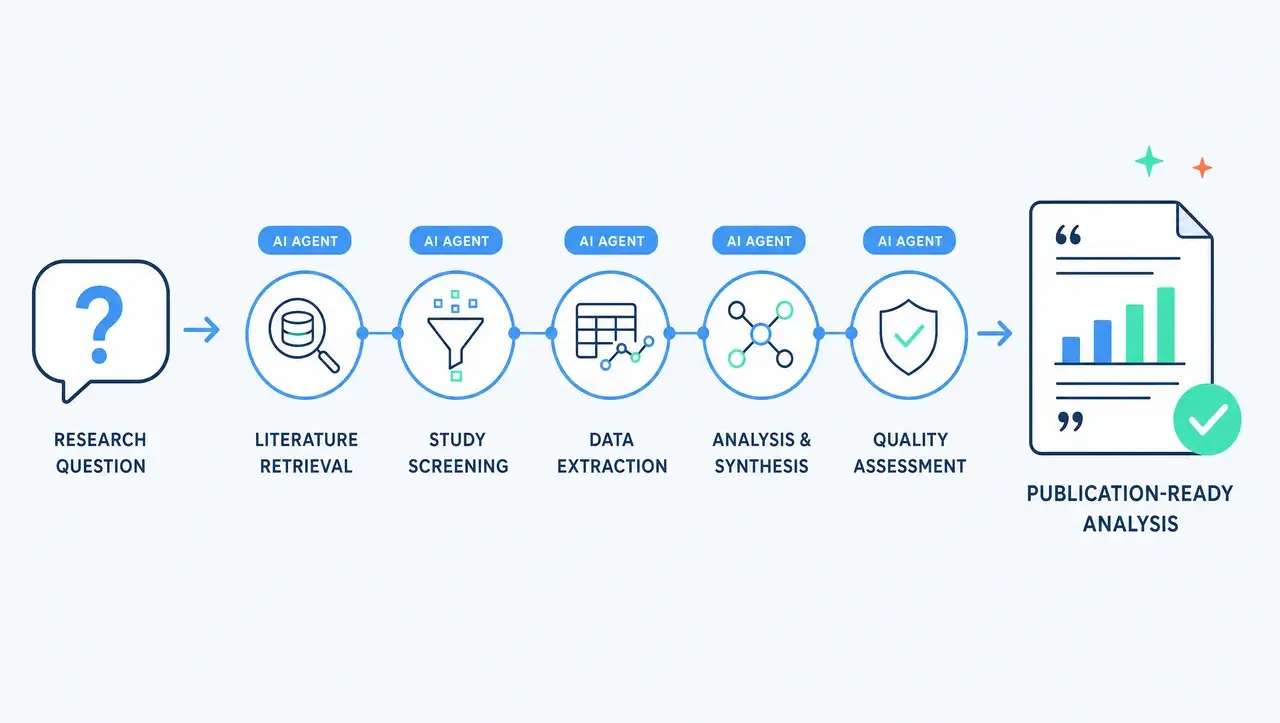
In production (beta)
Nine-agent research pipeline (Lumono.ai)
A plain-English research question turned into publication-ready analysis with citations, compressing months of work into weeks, with an expert reviewing the output.
- Months → weeks
- Research synthesis
- 9 agents
- Specialised pipeline
The investment
What does an agent cost?
Price agreed after a paid Process Discovery, with a payback estimate based on your assumptions. Estimate payback using the full cost, the adoption ramp and when benefits begin. Released hours count as capacity until there is a specific route to a financial return.
Key facts
AI agents: at a glance
- What
- Production AI agents that do multi-step work, not chatbots.
- Runs on
- Anthropic Claude, Google Cloud (Vertex AI), or Microsoft Azure and 365, your choice.
- Connects to
- Databases, SharePoint, Google Drive, CRM, ERP and ticketing, via connectors or a custom integration.
- Controls
- Scoped tool permissions, audit logging, human-in-the-loop, evals before launch, monitoring after.
- Delivery
- Timeline, price and acceptance criteria agreed for the scoped engagement.
- Proof
- A nine-agent research pipeline delivered; Softblues runs six of its own departments on Claude agents.
- Based in
- London-based, working with mid-market firms.
Common questions about AI agents
What is the difference between an AI agent and a chatbot?
A chatbot responds with text. An agent takes actions: it uses your tools, updates your systems, and completes a task, escalating to a person when needed.
Can the agents run in Microsoft or Google environments?
Yes. We build on Microsoft Azure and 365, on Google Cloud with Vertex AI, or on Anthropic Claude. We choose the stack around your workflow and data requirements.
How do agents connect to our data?
Through native connectors where they exist, or a custom integration we build with scoped permissions, authentication and audit logging. Data stays in your environment.
How do you stop an agent doing the wrong thing?
Permissions are scoped to each action, a human stays in the loop where the cost of a mistake is high, and every action is logged and checkable. We test against real cases before launch and monitor after.
Do we need to move off our current tools?
No. The point of building on your stack is that you keep it. If an off-the-shelf tool already does the job, we will say so.
How long does an agent take to build?
The timeline depends on the workflow and its integrations. We agree delivery milestones and acceptance criteria in the discovery plan.
Scope your first agent
Start with a paid Process Discovery. We map the task, scope the guardrails, and come back with a build priced in the proposal, a payback line, and an agent that runs on your own stack.