

Implementation guide · Free PDF · 21 slides
Making your firm AI-native with ChatGPT
Use this Softblues guide to assess ChatGPT for governed team use. Price the implementation and ongoing usage, then measure accepted work and human review effort against a baseline.
From Softblues, a London-based AI consultancy. Platform details in the guide carry their own verification dates.
What is inside the guide?
ChatGPT is the product your people already know, and at rollout that is worth more than most feature comparisons admit. This is what a regulated firm actually buys, where the UK region stops, and what to build on given a product line that has changed shape four times in twelve months.
Everything here was checked against OpenAI and Microsoft documentation 1 to 3 September and re-checked 1 and 8 October 2026.
The business case, before the plan
The objective first, then the workflow that has to change, then the measurement that shows it did, then the value that follows. The deck ends by asking for a baseline on one workflow rather than a call.
Business or Enterprise, decided honestly
The six gaps that make Business the wrong plan for a regulated firm, and what the Enterprise control surface actually contains.
Where the UK region stops
Storage in the UK, processing elsewhere, and what that means for the DPIA and the board paper.
The build primitives that will still exist
Agent Builder and the Evals platform shut on 30 November 2026. What to build on instead, and where to host it so the answer survives an audit.
Eleven worked examples on ChatGPT
Projects, Workspace Agents, Company Knowledge and ChatGPT Work, with the five cases where ChatGPT is the wrong tool named out loud.
Get the deck
Twenty-one slides on making your firm AI-native with ChatGPT: what you buy, the day-one governance, the eleven worked examples and the sequence. Free, with no obligatory follow-up. The 46-page ChatGPT playbook behind it is what we bring to the conversation.
01 · WHAT IT MEANS
What does AI-native mean on ChatGPT?
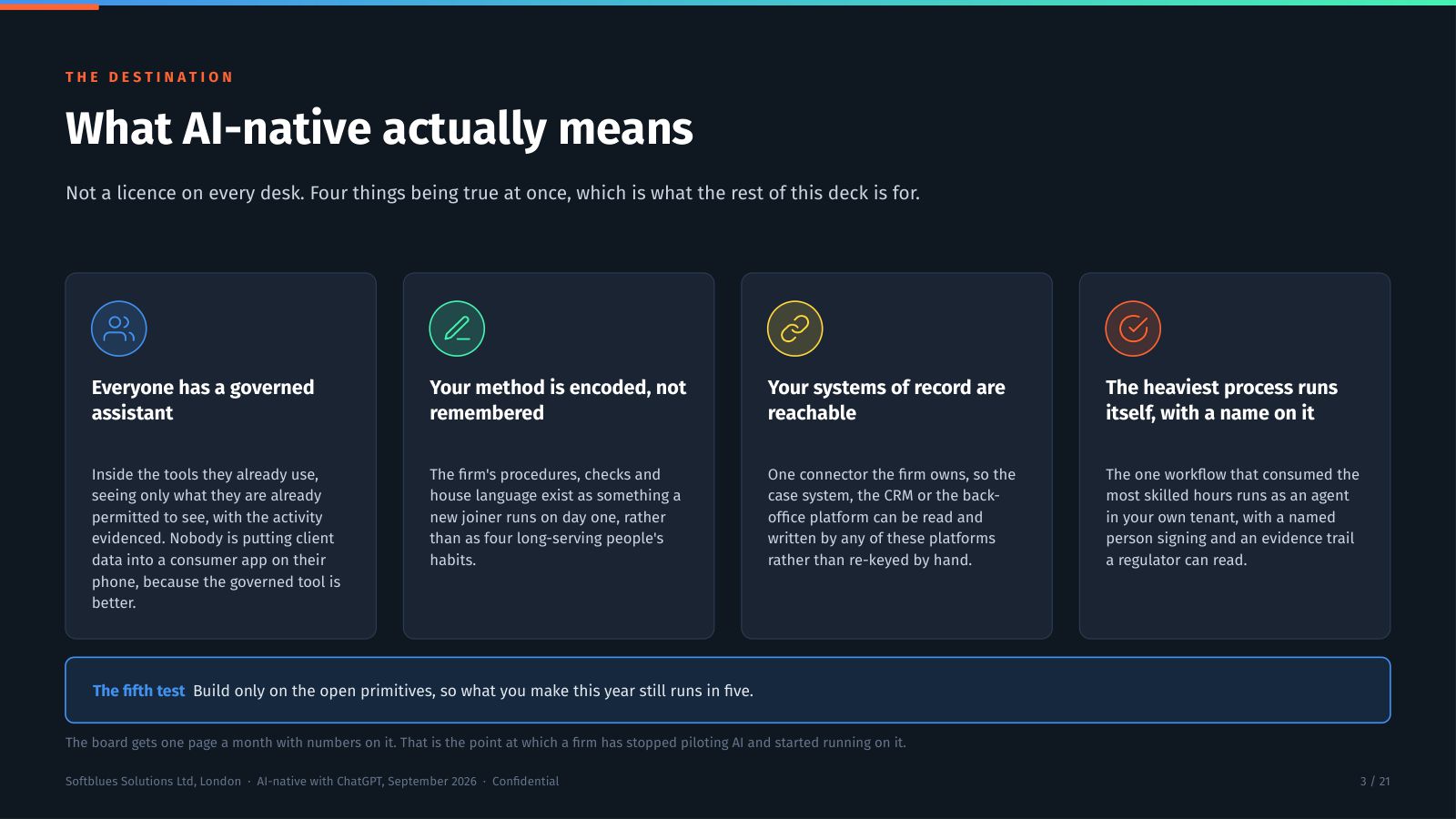
Four things true at once. Everyone has a governed assistant inside the tools they already use. The firm's procedures exist as something a new joiner runs on day one. Your systems of record are reachable through one connector you own. And the heaviest process runs itself, with a named person signing and an evidence trail a regulator can read.
02 · THE ANSWER
What does a regulated firm actually buy on ChatGPT?
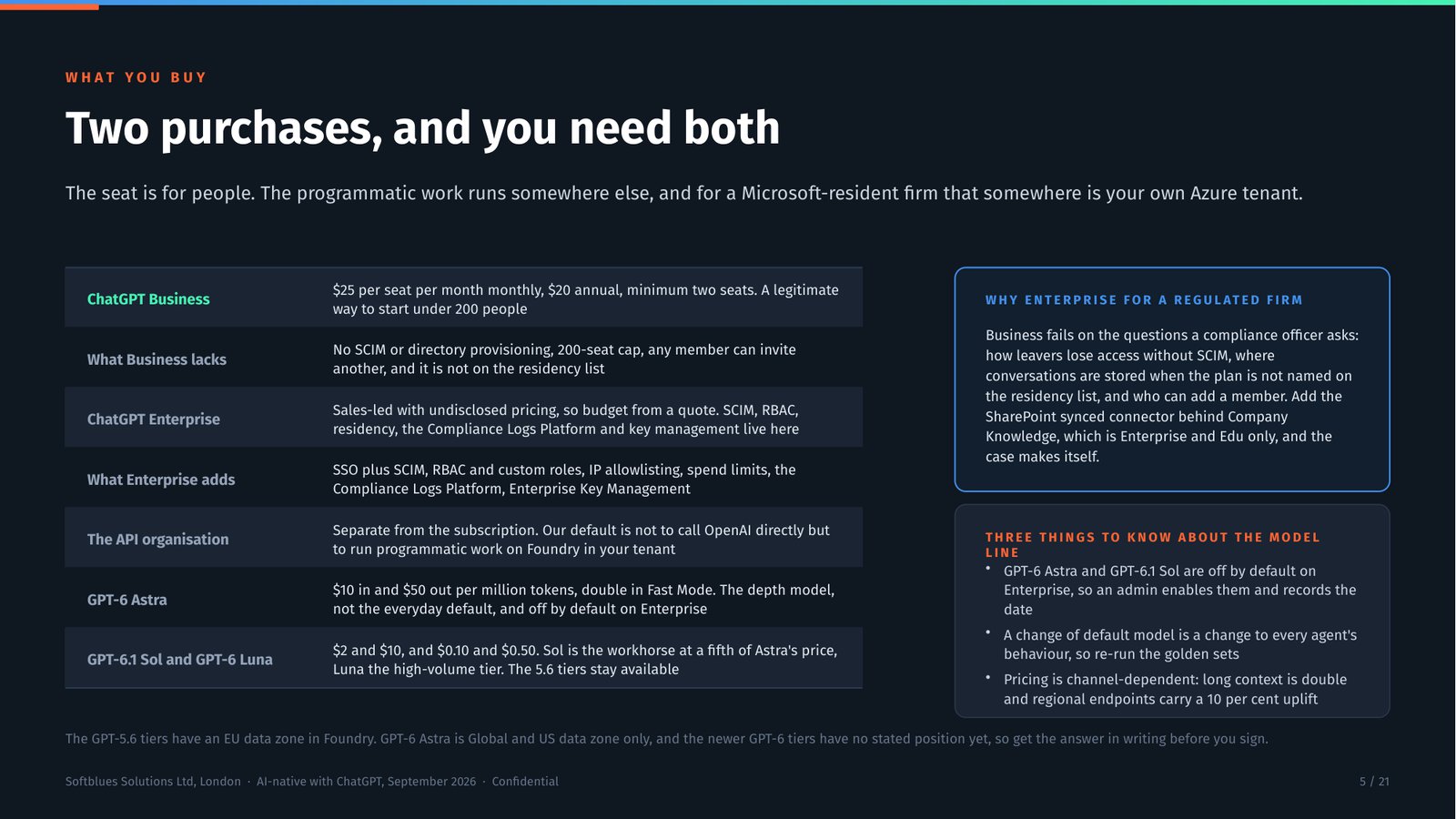
Two purchases, and you probably need both. Business at $20 a seat fails a regulated bar: no SCIM, a 200-seat cap, and no place in OpenAI's data residency list. Enterprise is the control surface. Then a separate API organisation, although for a Microsoft-resident firm we run programmatic work on Foundry in your own Azure tenant instead. As verified 1 to 3 September and re-checked 1 October 2026.
03 · THE WORK
What does the work look like on ChatGPT?
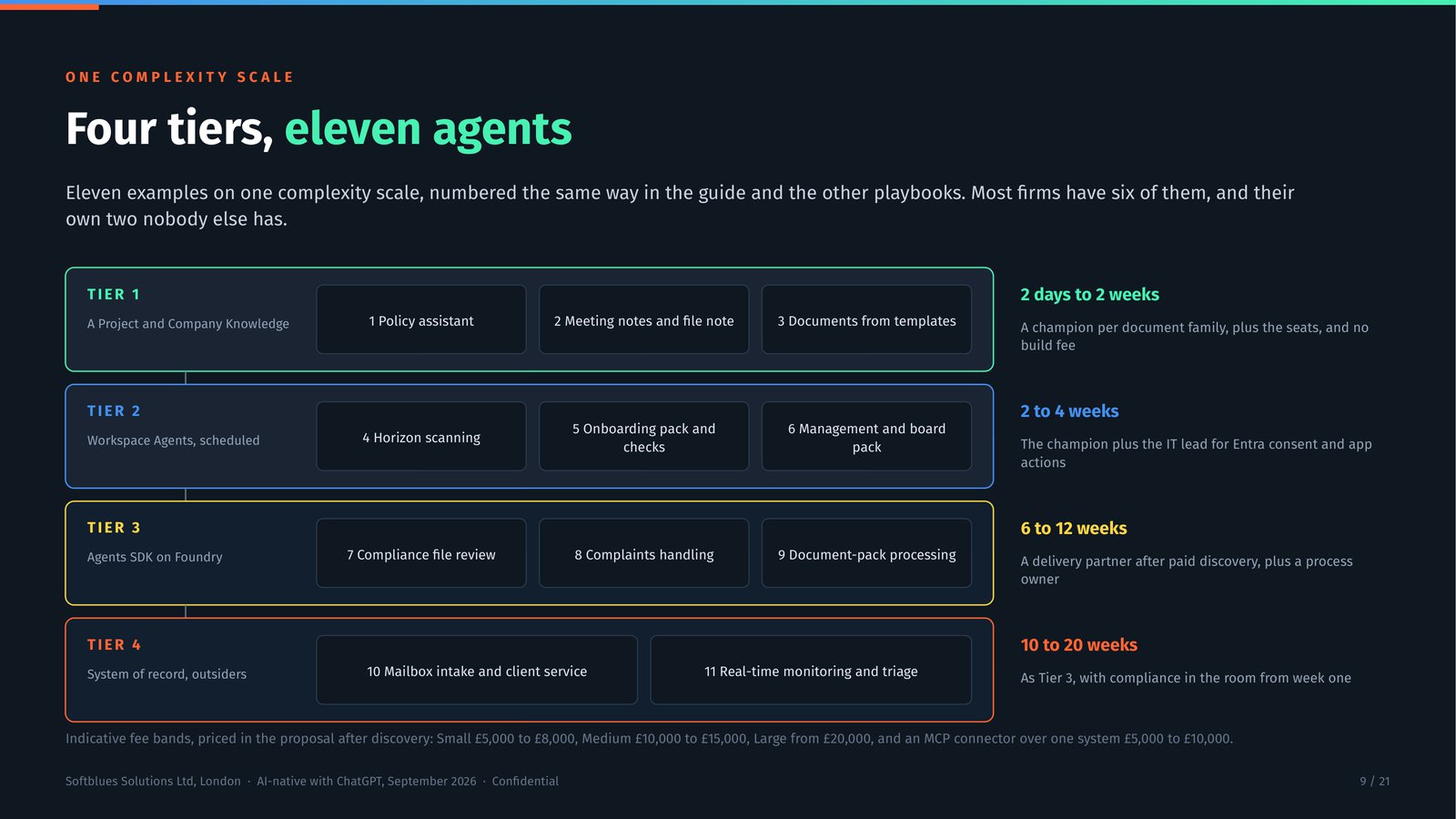
Eleven worked examples on one complexity scale, built on Projects, Workspace Agents, Company Knowledge and ChatGPT Work. Tier 1 a champion does unaided. By Tier 3 the work belongs on the Agents SDK and the Responses API, hosted in your own Azure tenant, because those are the primitives that will still exist in five years.
04 · THE HONEST PART
Where is ChatGPT the wrong tool?
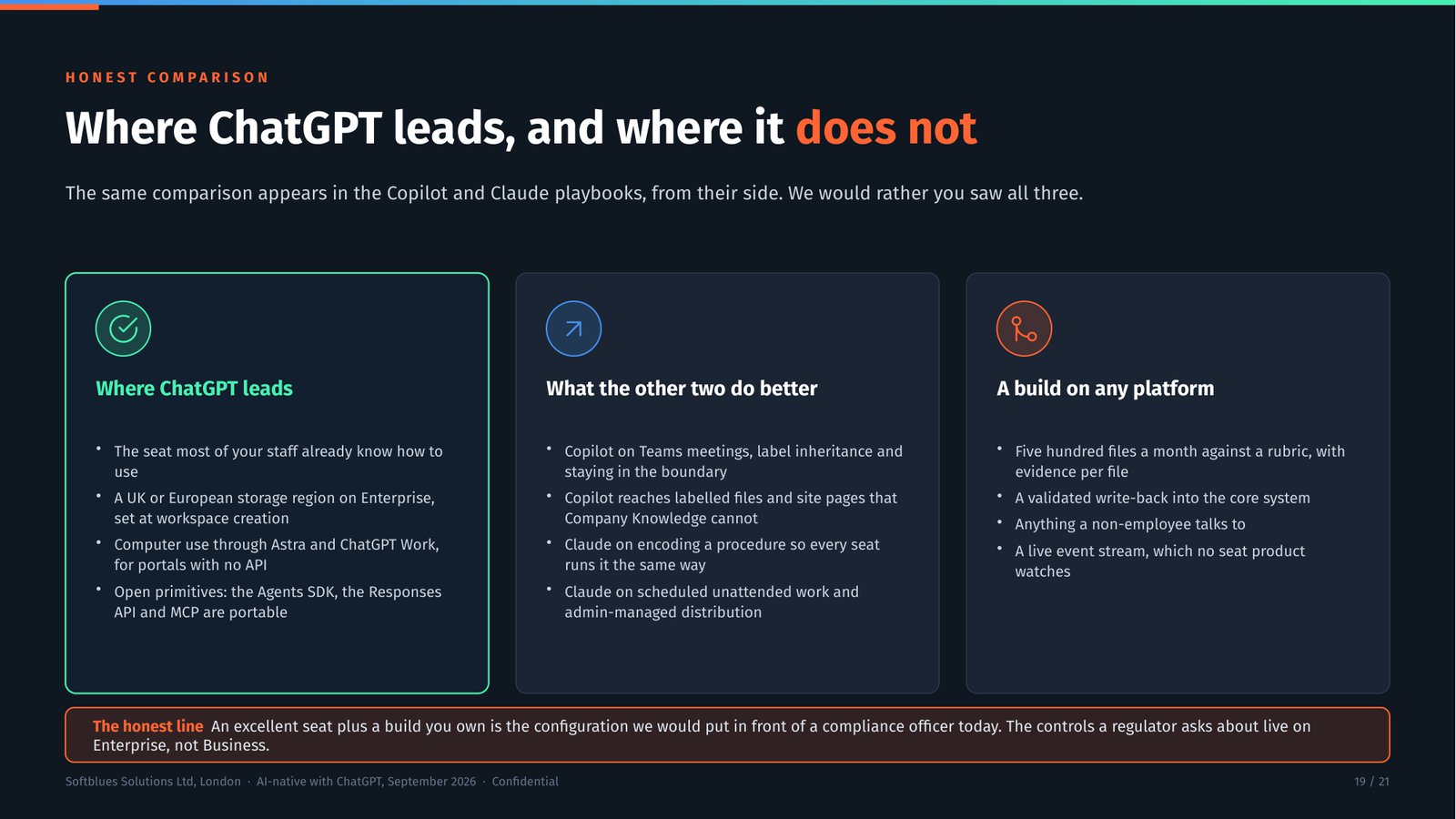
Record mode is macOS only, so in-person capture on a Windows firm goes to Teams instead. The synced connector excludes Purview-labelled files and does not index SharePoint pages. MCP developer mode is web only. And Agent Builder shuts on 30 November 2026, which is the reason to build only on the open primitives.
How will you judge whether it is worth the investment?
Hours released are capacity, not automatically profit. Name how that capacity will be used, establish a baseline and include implementation, training and running costs. Benefits start when people adopt the workflow, while some costs start earlier.
Compare equivalent completed work, including human review and exceptions. Count shared costs once and keep cash savings separate from estimates of capacity or reduced risk.
Where can you take this next?
The case describes its own platform and project stage. Use it to understand the approach, then assess the fit for your team.
If you want to discuss that fit, book a discovery call about AI adoption.
Common questions
Is ChatGPT Business enough for a regulated firm?
Usually not. Business has no SCIM, no synced groups and no directory provisioning, so joiners and leavers are a manual list somebody has to keep. It caps at 200 paid seats. Any member can invite another member while seats are available, and OpenAI states plainly that this cannot be restricted. It has no SharePoint synced connector, because the admin-managed sync behind Company Knowledge is Enterprise and Edu only. And it is not named in OpenAI's data residency list. Enterprise is the configuration that clears the bar. As verified 1 to 3 September and re-checked 1 October 2026.
Does ChatGPT store our data in the UK?
On Enterprise there is a UK region and it covers storage only. Processing happens elsewhere. That is a lawful position for a UK or Irish firm on the usual transfer route, recorded in a DPIA and a transfer risk assessment, but it is not the same as in-country processing and a board paper should not imply that it is. Business is not named in the residency list at all. Position as verified 1 to 3 September and re-checked 1 October 2026.
What happened to Agent Builder, and what should we build on instead?
Agent Builder and the Evals platform both launched in October 2025 and both shut on 30 November 2026. That is not a reason to avoid OpenAI. It is a reason to build only on the Agents SDK, the Responses API and MCP, which are open and portable, and to host in your own Azure tenant on Foundry Agent Service. A proposal that does not name those primitives is a 2025 proposal.
How does ChatGPT connect to our Microsoft 365 tenant?
Through the synced connector behind Company Knowledge on Enterprise and Edu. Two limits shape the design. The connector excludes files restricted by Purview sensitivity labels and does not index SharePoint site pages, and it caps files at 100 MB. Company Knowledge is now a plugin, invoked with @Company Knowledge or called by the model. Write actions into Microsoft 365 are admin-gated and shallow. If the excluded content is the content that matters, Copilot's native Graph grounding will reach what ChatGPT cannot.
Where is ChatGPT the wrong tool?
Five cases. In-person meeting capture on a Windows firm, because Record mode is macOS only with a four-hour cap. A policy estate that is heavily labelled or lives on SharePoint pages, because the synced connector excludes both. Anything approved from a phone, because MCP developer mode is web only. A live event stream, because no seat product on any platform processes events at that latency. And anything that needs a visual builder to survive a five-year audit, given the 30 November 2026 shutdown.
Which model should our people be using?
In ChatGPT your staff see effort settings rather than model names, so the choice that matters commercially is the one your build makes per call. GPT-6.1 Sol is the workhorse for judgement work at normal volume, at $2 per million input tokens and $10 per million output on the API, and GPT-6 Luna the high-volume, latency-sensitive tier at $0.10 and $0.50. GPT-6 Astra, at $10 and $50, is the depth model behind GPT-6 Pro on Pro, Business and Enterprise seats rather than the everyday default, and it is off by default on Enterprise. The GPT-5.6 tiers stay available. GPT-6.1 Sol was released on 29 September, so treat the published benchmarks as a reason to test rather than a reason to promise. Prices as verified 1 to 3 September and re-checked 1 October 2026.
Is the deck really free?
Yes. Complete the download form with your name, work email, company and role. The thank-you page provides the free 21-slide PDF. The longer companion document is not included in this download.