Claude AI Operating System · our own company
We don't demo the Claude Operating System. We run our company on it.
The Softblues Claude Operating System, six connected spaces
One agent per function, each with its own operating manual, tools and routines, joined through a shared hub. It is the same system we sell, running live on us.
- Client
- Softblues (our own company)
- Sector
- Our own proof case
- Stage
- Live, in-house
- Build
- 5 spaces plus a shared hub
- Stack
- Claude + Cowork
The problem
AI bolted onto everything, joined to nothing#
Most companies buy AI a seat at a time. A chatbot in the CRM, another in the docs, a third in the inbox. Each is useful on its own, and none of them share anything: no common memory, no shared context, no idea what the others are doing. Sensitive numbers get pasted into tools that were never meant to hold them.
We wanted the opposite. Not a pile of assistants, but one system: each function run by an agent that knows its job, uses its own tools, and stays in step with the rest of the company.
We use it before we sell it, so we can show it live, not in a slide deck.
The idea
An operating system, not a pile of chatbots#
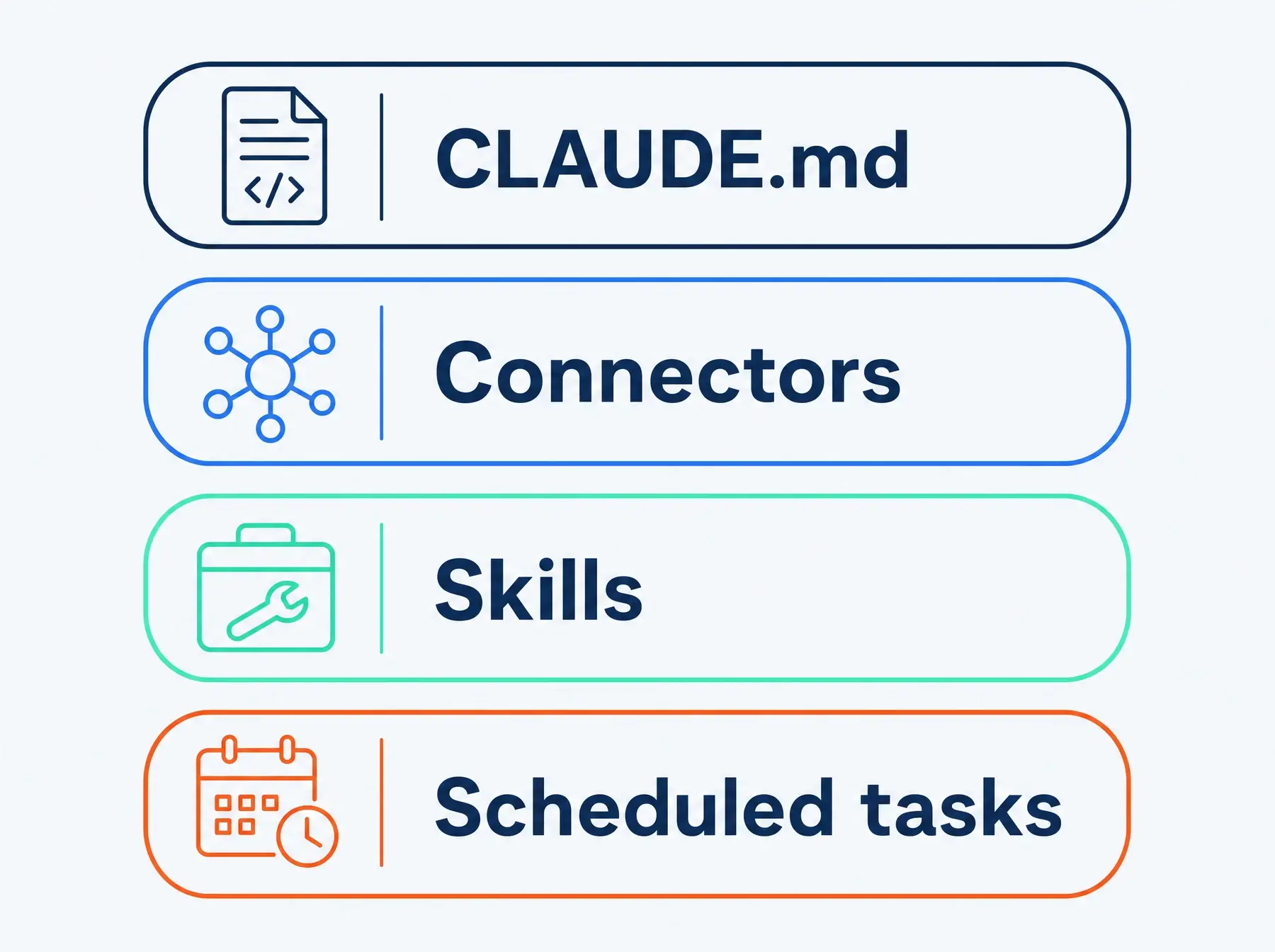
Each function is its own space on its own drive, run by a Claude agent. The agent reads an operating manual first, a CLAUDE.md that says how that function works, uses only the connectors it is allowed to touch, runs its routines as packaged skills, and fires them on schedule. A person reviews and decides; the agent does the work.
The manual is the system. A new hire opens the space, reads the manual, and starts. There is nothing bespoke to learn.
The system
Five agents, one shared hub
- 1
Strategy agent
Holds the vision, direction and targets, and reads every other function's brief before setting them. The space the others align to.
- 2
Finance agent
Runs the numbers: P&L, balance, payroll and the monthly close, wired to Xero. Access-restricted, it publishes only a sanitised affordability signal to the hub, never raw figures.
- 3
Sales agent
Works the pipeline in Attio: qualification, deal hygiene and the weekly sales review, with one open next step per deal and won-deal handoffs to Delivery.
- 4
Delivery agent
Tracks live client projects, risk and capacity from Attio and Gmail, and confirms delivered revenue so Finance and Sales see the real picture.
- 5
Marketing agent
Runs demand generation end to end: SEO, the blog, outreach and lead tracking, wired to Attio, Supabase and the website, publishing straight to softblues.io.
- 6
System hub
The shared contract between the agents. It holds the map, the templates and each function's status brief, and nothing sensitive: no P&L, no rates, no client commercials.
Coordination
How the agents stay in step#
Each space publishes a short status brief to the hub. Before any agent plans, it reads the briefs it depends on, so sales, delivery, finance and the rest work from one picture. Writes are one way: no space ever edits another's drive.
That is also how sensitive data stays put. Finance and HR are restricted, and Finance shares only a sanitised signal, runway comfortable or tight, never the raw P&L.
On a cadence
What runs on its own
The recurring rituals run on schedule, without waiting for someone to start them.
| Routine | Cadence | Space |
|---|---|---|
| Weekly sales review | Weekly | Sales |
| Weekly delivery status | Weekly | Delivery |
| Monthly close | Monthly | Finance |
| Weekly marketing review | Weekly | Marketing |
Built with
- Platform
- Claude (Anthropic) · Cowork
- Agent building blocks
- Per-space CLAUDE.md operating manuals · Skills · Scheduled tasks · Status Briefs
- Connected tools
- Google Drive · Attio CRM · Gmail · Xero · Supabase · BigQuery · Smartlead · Expandi
What it adds up to
One company, run on agents
Functions run by agents
With no dedicated person
A month to run all six
Of conventional staffing cost
Sensitive data stays put
Finance and HR are access-restricted and share only sanitised signals, so coordination never means exposing the numbers.
Onboarding in minutes
A new hire opens their space and reads the manual. There is no bespoke system to learn, because the manual is the system.
The value
What it was worth#
Since March 2026 six functions have run as agents rather than as people: sales, marketing, lead generation, recruitment, finance and executive assistance. Our COO supervises all six. They do not map one to one onto the spaces above. Lead generation runs inside the marketing space, and recruitment inside the restricted HR one.
Two of the four routes in the method behind our AI ROI calculator apply here, and they are worth separating because most firms blur them. Three of those functions no longer have a dedicated person, which is cost removed. The other three are roles we have not added as the business has grown, which is cost avoided and never appears in the accounts at all. Staffed the conventional way at UK market rates, the six together would cost us in the region of £20,000 a month. That is our own estimate of what we would be paying, not a saving we can point to in a ledger.
Running all six costs about £470 a month, a little over two per cent of that estimate.
Our accounts over the same period, comparing the six months to August 2026 against the six before, show the salaries line down 66%, with a result that moved from a loss to a profit.
Now the honest part, because this page would be worth nothing if we exempted ourselves from our own method. Our mix of work changed over those same six months, towards projects we deliver ourselves rather than subcontract. Two things moved at once and we have not isolated them. That means we cannot claim those percentages as an agent result, and we do not. What we can claim is the shape: six functions running without six people, supervised by one, for about £470 a month.
What we can claim
What changed, and what we can attribute#
Running our own company on it is the setup rather than the proof. The proof is what changed, and how much of it we are prepared to attribute.
We can attribute the shape: six functions running without six people, supervised by one, for about £470 a month against an estimated £20,000 to staff them conventionally. We cannot attribute the percentages in our accounts, because our mix of work moved at the same time and we have not isolated the two.
We apply that same distinction to a client's numbers in the AI ROI calculator for your whole firm.
The same pattern, in production
The agents that run our company are the same pattern we build for clients: a function split into specialised agents, wired to real tools, with a person in charge of the call.
Frequently asked questions
It is how we run our own company: five function spaces (strategy, finance, sales, delivery, marketing) plus a shared hub, each with its own operating manual, tools and routines. Six business functions run as agents across them. It is also the system we deploy for clients under the same name.
Each function is a space on its own Google Drive with a CLAUDE.md operating manual the agent reads first, the connectors it is allowed to use (Attio, Gmail, Xero, Drive, Supabase), the skills that package its routines, and scheduled tasks that run them. The agent runs that function's work, with a person reviewing and deciding.
Each space publishes a short status brief to a shared hub. Before any agent plans, it reads the briefs it depends on, so sales, delivery, finance and the rest work from one picture. Writes are one way: no space ever edits another's drive.
Each function has its own drive with its own access control. Finance and HR are restricted, and Finance publishes only a sanitised signal (for example 'runway: comfortable') to the hub, never raw P&L or client commercials.
The recurring rituals: a weekly sales review, a weekly delivery status, the monthly close across the first few days of the month, and a weekly marketing review, each as a scheduled task in its own space.
We know the shape held: six functions run without six people, supervised by one, for about £470 a month against an estimated £20,000 a month to staff them conventionally. We do not know how much of the change in our accounts to credit to the agents, because our mix of work moved over the same period and we have not isolated the two. Our business case method treats that as a counterfactual problem, and so do we.
Yes. This is the Claude AI Operating System we offer: we map your functions, connect your tools, package your routines as skills, and stand up the agents, usually starting with one function and an audit. We run it on ourselves first, which is why we can show it live, not in a slide deck.
Want this for your company?
We map your functions, connect your tools, package your routines as skills, and stand up the agents, usually starting with one function and an audit. Book a call and we will show you ours running first.
Explore Other Projects
Discover more AI solutions delivering measurable results across industries