
Enterprise AI Agents: Use Cases That Actually Ship in 2026
Gartner expects over 40% of agentic AI projects to be cancelled by 2027. The enterprise AI agents that actually ship in 2026 are bounded, governed and keep a human in the loop. Here is what works, and what stays a demo.

By Ivan Pylypchuk (opens in a new tab), CEO of Softblues. Has led Claude and Gemini implementations for finance, legal and healthcare teams across the UK and Ireland.
The enterprise AI agents that reach production in 2026 share three traits: a narrow job, a system of record they read from and write to, and a human who signs off the consequential step. The ones that stay stuck in a demo try to do everything, touch nothing real, and answer to no one. That gap is why Gartner expects over 40% of agentic AI projects to be cancelled by the end of 2027 (Gartner, Jun 2025).
At Softblues, a Claude implementation partner working with regulated mid-market companies across the UK and Ireland, we build these systems for a living. This is the honest version of what ships, what does not, and how to tell the difference before you spend the budget.
Key facts
- An enterprise AI agent is software that uses a language model to decide and act across your tools, not just answer a question. Anthropic's own framing is useful: with a workflow you own the plumbing, with an agent the model owns it (Anthropic, 2024).
- Gartner expects 40% of enterprise apps to embed task-specific AI agents by the end of 2026, up from under 5% in 2025 (Gartner, Aug 2025).
- The blocker is rarely the model. IDC research finds around 88% of AI pilots never reach production, failing on governance, data readiness and observability.
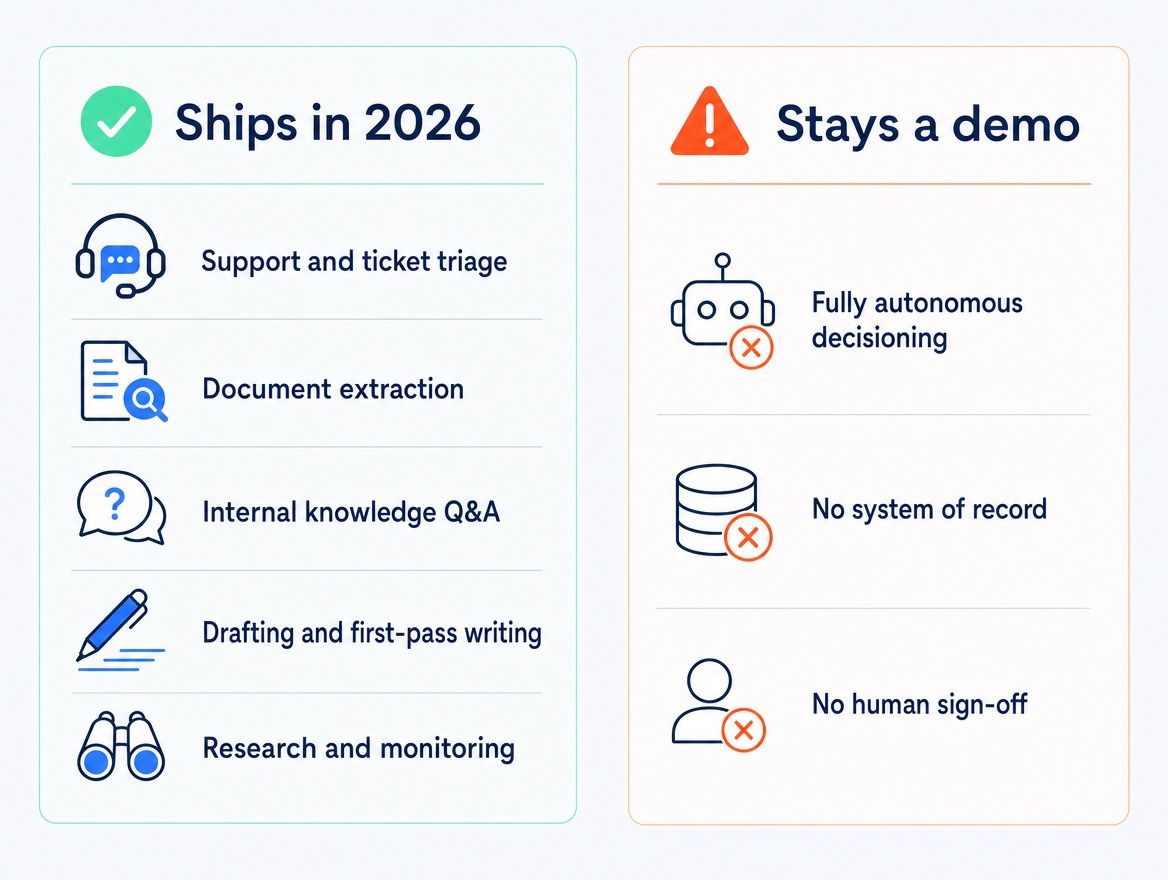
- The use cases that ship are bounded and reversible: ticket triage, document extraction, drafting, research, internal Q&A. The ones that stall are open-ended and high-consequence with no human gate.
- "Agent washing" is real. Gartner reckons only about 130 of the thousands of self-described agentic vendors are the genuine article. Ask what the agent actually decides.
What is an enterprise AI agent, really?
An enterprise AI agent is a system where a language model directs its own steps and tool use to complete a task, rather than following a script you wrote line by line. The distinction matters because most things sold as agents are workflows, and that is often the right answer.
A workflow runs the model through predefined paths: extract these fields, route on this rule, draft from this template. An agent decides the path itself: read the request, choose which tools to call, loop until done. Anthropic, whose Claude models we deploy, makes the same point and adds a discipline we follow: start with the simplest thing that works, and only add agency when the task genuinely needs it (Anthropic, 2024).
In practice the systems that survive a security review are mostly workflows with a small amount of agency at the edges, not fully autonomous agents roaming your stack.
Why do so many agent projects fail to ship?
Because the demo is the easy 80% and production is the hard 20% that actually carries the risk. A model that looks brilliant in a sandbox meets messy data, real permissions, and a compliance lead who wants to know who is accountable when it gets something wrong.
Gartner is blunt about the causes: escalating costs, unclear business value, and inadequate risk controls, made worse by hype and "agent washing" where assistants and old RPA get rebranded as agents (Gartner, Jun 2025). The pattern we see is the same one behind the wider pilot failure rate: teams pick a glamorous, open-ended use case, skip the boring governance work, and have nothing to put in front of a regulator.
Which enterprise AI agent use cases actually ship in 2026?
The ones that win share a shape: bounded scope, a clear system of record, a measurable outcome, and a human in the loop for anything irreversible. Here are the patterns we see reach production in mid-market firms.
1. Support and ticket triage. An agent reads an incoming ticket, classifies it, drafts a reply from your knowledge base, and routes the hard ones to a person. It ships because the worst case is a draft a human edits, not a wrong answer sent blind.
2. Document extraction and processing. Pulling fields from invoices, contracts or claims into a structured record, with low-confidence items flagged for review. Reversible, measurable, and it pays for itself in hours saved.
3. Internal knowledge Q&A. A retrieval-grounded assistant that answers staff questions from your policies and handbooks, with citations, and says "I don't know" instead of inventing. The grounding is what makes it safe.
4. Drafting and first-pass writing. Proposals, reports, RFP responses and variance commentary, drafted from your data and templates for a person to finish. Human-by-design, which is why it sails through review.
5. Research and monitoring. Watching regulatory changes, summarising filings, or compiling a briefing. The agent gathers and summarises, a person decides.
The common thread: each has an owner, a number it moves, and a point where a human can stop it. None of them hands the model a company credit card.
| Use case | Why it ships | Watch out for |
|---|---|---|
| Support and ticket triage | Drafts and routes; a person edits before anything is sent | Auto-sending replies with no review |
| Document extraction | Structured output, low-confidence items flagged for a human | Trusting low-confidence fields unchecked |
| Internal knowledge Q&A | Grounded in your own documents, with citations | Letting it answer beyond the sources |
| Drafting and first-pass writing | A person always finishes the work | Publishing the draft unedited |
| Research and monitoring | Gathers and summarises; you make the decision | Acting on a summary without checking the source |
To see what one of these agents would give back in your firm, use our process automation ROI calculator.
What architecture actually makes it to production?
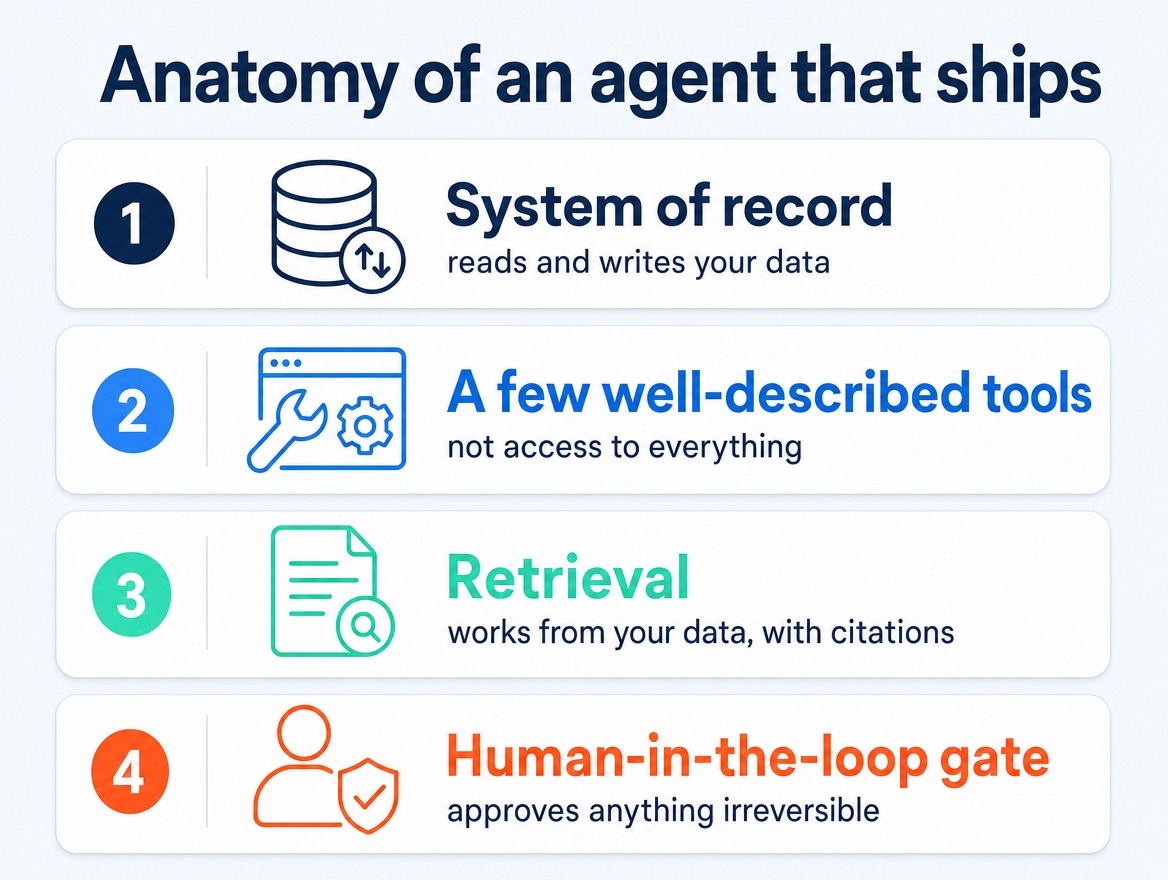
A pattern, not a product. The agents that ship sit on four things: a system of record they read from and write to, a small set of well-described tools, retrieval so the model works from your data rather than its training, and a human-in-the-loop gate on any step that moves money, sends externally, or changes a record of consequence.
What does this look like in a regulated sector?
The use case is the same, but the gate gets stricter as the regulator gets closer. In finance, expect FCA expectations and the Senior Managers and Certification Regime (SM&CR) to decide who is accountable for an agent-assisted decision. In law, the SRA in England and Wales and client confidentiality govern what can pass through a model. In healthcare, CQC in England and clinical-safety standards such as DCB0129 and DCB0160 apply, and you check whether the tool counts as a medical device under MHRA rules. Across all of them, UK GDPR and the ICO set the data terms.
A worked example, anonymised and illustrative. A mid-market finance team wanted to cut the hours spent answering routine internal policy questions. We scoped one workflow: a retrieval-grounded Q&A agent over their approved policies, citations on, no write access to any system. It ran as a four-week pilot with a target response-accuracy bar agreed up front, then moved to production once their compliance lead signed off the data path. The lesson is the order, not the number: bound it, ground it, gate it, then scale.
What are the red flags?
A few patterns reliably predict a project that will not ship. The vendor leads with autonomy and demos rather than your problem and your data. They cannot say what the agent actually decides versus what a human still approves. There is no system of record in the architecture, so nothing is auditable. They have no answer on permissions, data residency or roll-back. And they describe an old chatbot or RPA flow as an "agent" without anything agentic underneath.
Questions to ask before you green-light an agent
- "What exactly does this agent decide, and what does a human still approve?" A good answer names the gate precisely.
- "Which system of record does it read and write, and what's the audit trail?" A good answer is specific, not "it integrates with everything".
- "How do we measure whether it's working, and what's the roll-back?" A good answer has a number and a stop button.
- "Is this an agent or a workflow, and why?" A good answer defends the simpler choice where it fits.
- "Where is our data processed, and is it used for training?" A good answer is precise on region and the contractual position.
Frequently asked questions
What is an enterprise AI agent?
Software that uses a language model to decide and act across your tools to complete a task, rather than only answering a question. It differs from a workflow, where the steps are scripted in advance, because the model directs its own path within limits you set.Are AI agents different from chatbots and RPA?
Yes, though many vendors blur the line. A chatbot answers; RPA follows fixed rules; an agent decides which steps and tools to use for a goal. Gartner calls the rebranding of old tools "agent washing", so ask what the system actually decides.Why do most enterprise AI agent projects fail?
Not because of the model. They fail on governance, unclear value, runaway cost and missing risk controls, which is why Gartner expects over 40% of agentic projects to be cancelled by the end of 2027. The fix is bounded scope and a human-in-the-loop gate from day one.Which use cases are safest to start with?
Bounded, reversible ones: support triage, document extraction, internal knowledge Q&A, drafting, and research or monitoring. Each has an owner, a measurable outcome, and a point where a person can intervene.How long does it take to put an agent into production?
A scoped pilot is usually a few weeks, and a first production deployment commonly runs six to twelve weeks once integration, permissions and sign-off are done. Most of the time goes on the unglamorous governance and integration work, not the model.Do we need a consultancy, or can we build it ourselves?
If you have the engineering capacity and the governance discipline, build it. Many mid-market teams bring in a partner for the first one to get the architecture, guardrails and adoption right, then take it in-house.Next step
If you are weighing up an agent and want to know whether it will ship or stall, we will walk through the use case, the architecture and the guardrails with you and tell you honestly which it is. It is a conversation, not a pitch. Book a discovery call.
You can also see how we connect AI safely to the systems you already run in our business process automation work.
Work out your numbers
One key process
Process automation ROI calculator
Five questions about one process. See the hours an AI agent frees up, what they are worth and how much becomes profit.
Work out your numbersYour whole firm
AI ROI calculator
Five questions about your firm. See the time AI frees up, what it is worth and when it pays for itself.
Work out your numbers
Free. No sign-up. Your answers stay in your browser.
See it in production
Systems we have built and run for clients, with the numbers that came out of them.