How to Choose an AI Consulting Firm in the UK: A 12-Point Buyer's Checklist
Choosing an AI consulting firm in the UK comes down to twelve checks. Here is the buyer's checklist we wish every client used, with UK pricing and regulator detail.
By Ivan Pylypchuk (opens in a new tab), CEO of Softblues. Has led Claude and Gemini implementations for finance, legal and healthcare teams across the UK and Ireland.
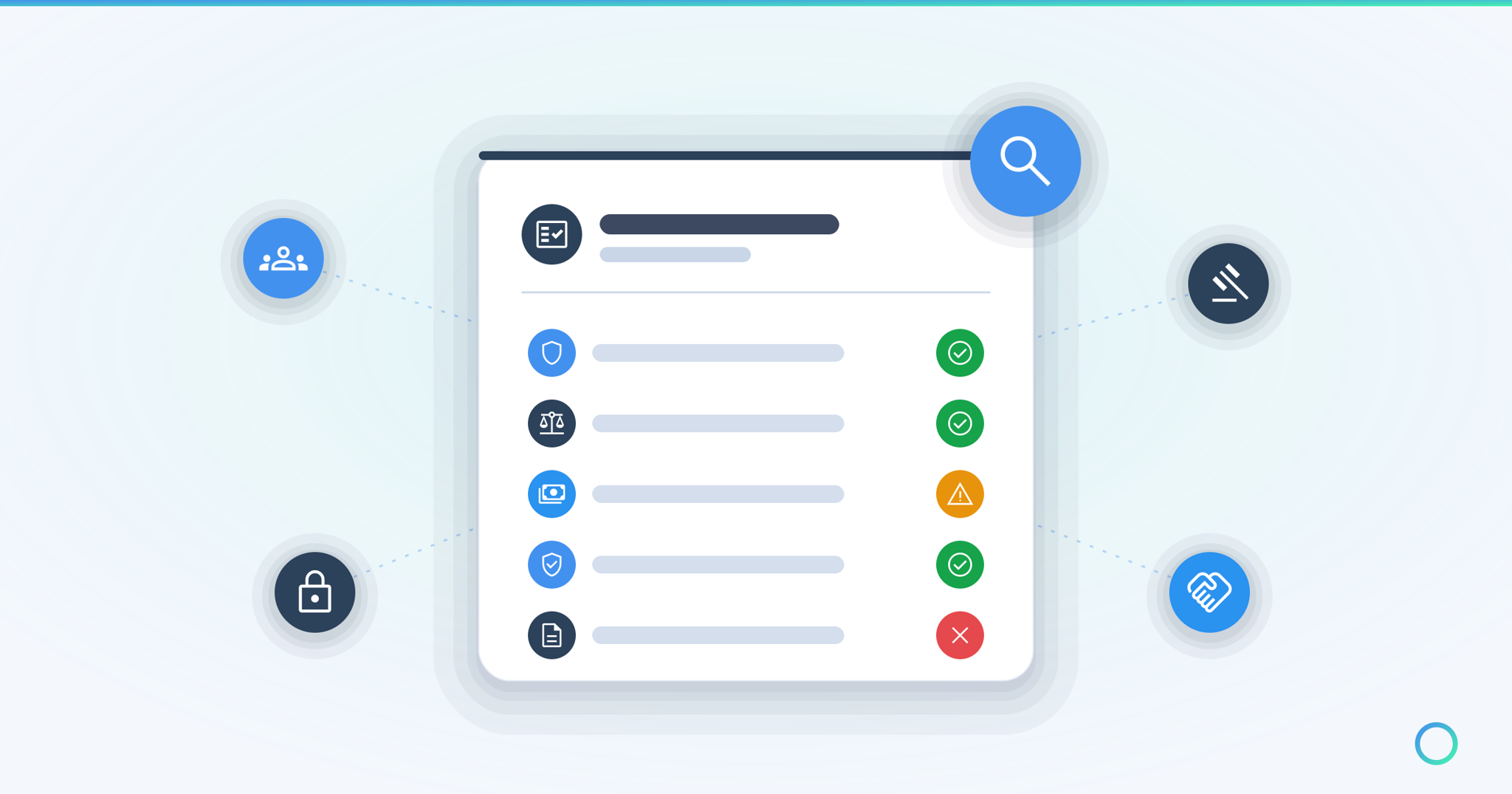
Choosing an AI consulting firm in the UK comes down to twelve checks: sector proof, the actual delivery team, vendor neutrality, data governance, security on paper, regulatory fluency, a scoped pilot, honest pricing, knowledge transfer, adoption support, references with numbers, and clean commercial terms. Work through them in order and most firms drop out fast.
At Softblues, an AI consulting firm working with regulated mid-market companies across the UK and Ireland, we sit on both sides of this table. We deliver these projects, and we have also been the buyer choosing a partner. This checklist is the one we wish every buyer used, because it would make our own sales calls shorter and more honest.
Key facts
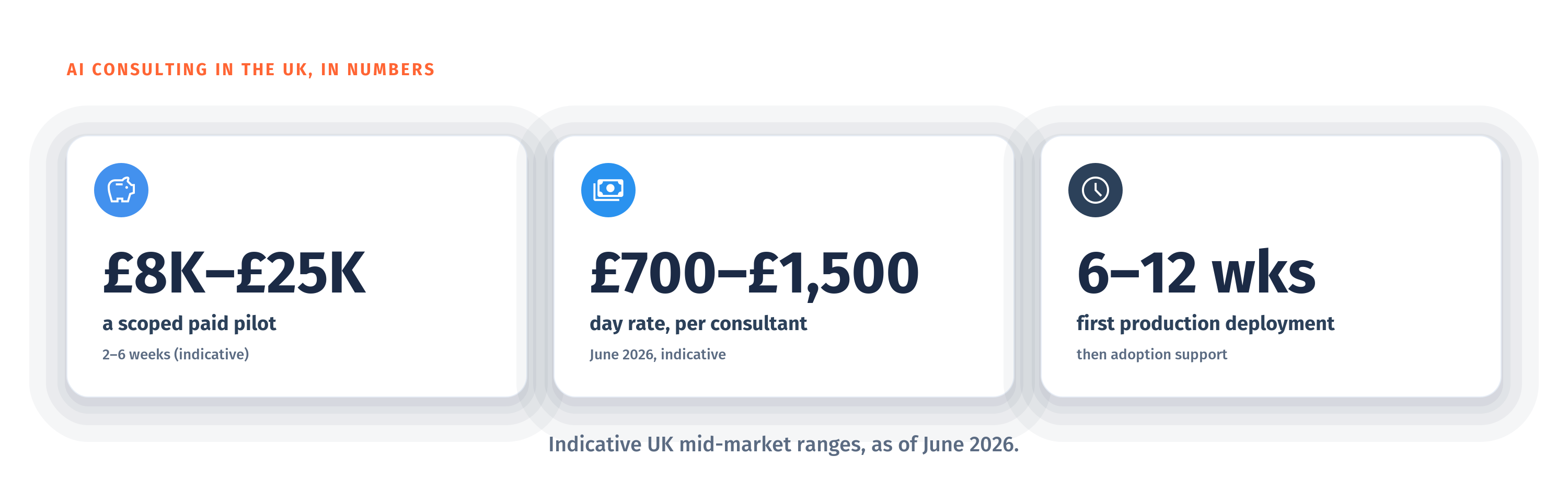
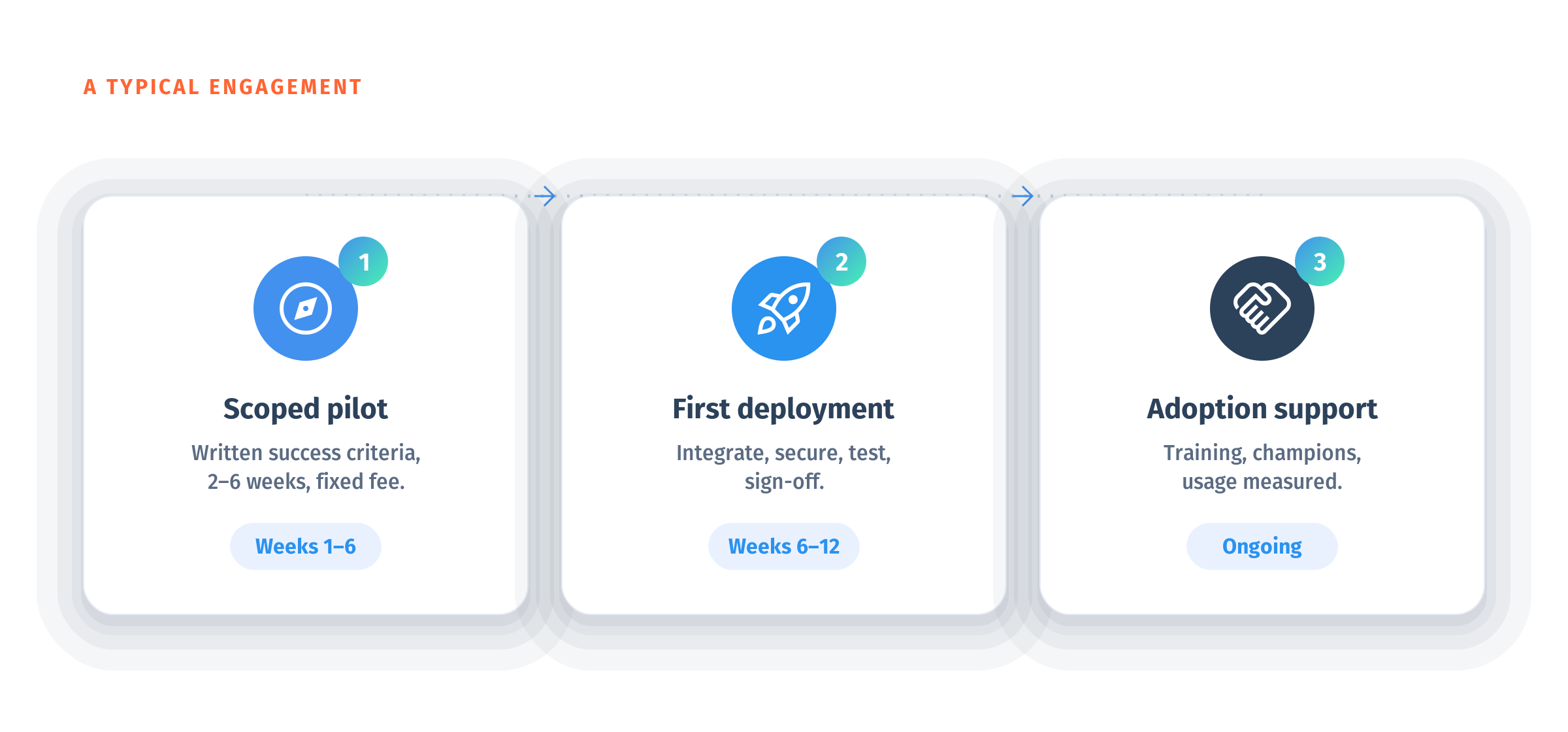
- A serious engagement usually starts with a 2 to 6 week paid pilot (roughly £8K to £25K) before any larger build. Be wary of a jump straight to a six-figure annual contract.
- Day rates for UK AI consultants sit roughly £700 to £1,500 as of June 2026, with regulated-sector work at the upper end. Treat these as indicative ranges, not a published benchmark.
- A common failure is bait-and-switch staffing: a senior team pitches, junior contractors deliver. Name the delivery team in the contract.
- Regulated buyers should expect the firm to speak their regulator's language: FCA for finance, SRA for law in England and Wales, CQC for care in England.
- You should own the outputs: prompts, agent configurations, documentation and data. No lock-in is a contract term, not a promise.
Why is buying AI consulting different from buying software?
Because you are buying judgement, not a licence. With most software you trial the product and read reviews. With AI consulting services you pay a team to make decisions on your behalf, and you cannot read those decisions in advance.
Two things raise the stakes. First, the technology moves monthly, so a certified expert from last year can already be behind. Second, a poor implementation can do real damage: leak data, embed bias, or break a process you depend on. That is why the checks below lean so hard on evidence and ownership.
It is worth naming the failure rate plainly. MIT's 2025 study found that 95% of generative AI pilots deliver no measurable business impact, and the cause is rarely the model. It is the gap between a clever demo and a governed, adopted system.
The 12-point checklist for choosing AI consulting services in the UK
Work through these in order. The early points filter out most firms quickly.
1. Sector proof, beyond general AI proof. Ask for a named project in your industry, at your size. "We did a chatbot for a retailer" tells you nothing about a 200-person regulated firm.
2. The team that pitches is the team that delivers. Get the names, seniority and day allocation in writing. Bait-and-switch staffing is the most common complaint we hear about other firms.
3. Vendor neutrality. A good firm picks the model for the job (Claude, Gemini, OpenAI models, open-weight) and can explain the trade-off. A single-vendor reflex is a warning sign.
4. Data governance you can explain to your DPO. Where does your data go, is it used for training, what is the retention, and is it processed in the UK or EU? You should get specifics, not "enterprise-grade".
5. Security on paper. Cyber Essentials at minimum, ISO 27001 for anything sensitive, and a Data Processing Agreement. Ask to see the certificates, not the adjectives.
6. Regulatory fluency for your regulator. Finance buyers should hear FCA and the Senior Managers and Certification Regime (SM&CR). Legal should hear SRA (England and Wales). Care should hear CQC (England) and clinical-safety standards.
7. A scoped pilot before a big commitment. A 2 to 6 week paid pilot with written success criteria de-risks the whole engagement. A confident firm welcomes it.
8. An honest pricing model. Day rate, fixed-price project or retainer, with a clear view of what drives the number up or down. Vague pricing now means scope arguments later.
9. Knowledge transfer and no lock-in. You should end up owning the prompts, configurations, documentation and data, able to run or re-tender without being held hostage.
10. Adoption and change management. Most projects fail on adoption, not technology. Ask what happens after go-live: training, internal champions, and how usage gets measured.
11. References with numbers. A real reference call and at least one case study with before-and-after figures. "Clients love us" is not evidence.
12. Clean commercial terms. A clear statement of work, sensible IP terms, and an exit clause. Read a statement-of-work template before your first call so you know what good looks like.
How should AI consulting services be priced?
There is no single rate, but the model tells you a lot about the engagement. The ranges below are indicative, drawn from our own UK mid-market work as of June 2026, not a market benchmark.
| Pricing model | Typical UK range (2026) | Best for | Avoid if |
|---|---|---|---|
| Paid pilot / PoC | £8K–£25K, 2–6 weeks | Testing fit before committing | You already have a proven, scoped build |
| Day rate | £700–£1,500 / day | Advisory, audits, ad-hoc expertise | Scope is unclear and could sprawl |
| Fixed-price project | £20K–£120K+ | A defined deliverable with acceptance criteria | Requirements still move weekly |
| Monthly retainer | £6K–£20K / month | Ongoing build plus adoption support | You only need a one-off piece |
Specialist regulated-sector work usually sits at the upper end, because the security and sign-off work is real.
How long does an AI consulting project take?
A pilot is usually 2 to 6 weeks. A first production deployment commonly runs 6 to 12 weeks, then adoption support continues for a month or two after go-live. Anyone promising production in days is selling a demo.
Most of the calendar goes on the unglamorous parts: getting access to the right systems, agreeing what "good" looks like, security and data sign-off, and testing against real cases.
Consultant, consultancy or in-house: which model fits?
Pick the model by what you are short of: expertise, delivery capacity, or long-term ownership.
An independent consultant suits advisory work, a second opinion or an audit. It is the cheapest option for small scopes, but capacity is limited and it is a single point of failure. A consultancy suits a full build plus governance and adoption, where you need a team and accountability rather than one pair of hands. An in-house hire makes sense once AI is core and continuous, though a good AI engineer is hard to find, slow to hire, and expensive to keep current.
A sensible path is to run a consultancy-led pilot, then decide whether to keep outsourcing, hire, or do both. You learn what the role actually needs before you commit to it.
What does this look like in regulated sectors?
The checklist is the same, but the evidence you demand gets stricter as the regulator gets closer to the work.
In finance, ask about FCA expectations and SM&CR, and who is accountable if an AI-assisted decision goes wrong. In legal, ask how the firm handles SRA obligations in England and Wales and client confidentiality when documents pass through a model. In healthcare, ask about CQC context in England and clinical-safety standards such as DCB0129 and DCB0160, plus whether the tool counts as a medical device under MHRA rules.
A worked example, with figures illustrative and anonymised. A 180-person accountancy practice wanted to cut the time spent answering routine client queries. The pilot scoped one workflow, set a target, and ran for four weeks. It moved to production only once the data path and sign-off were agreed with their compliance lead. The point is not the number, it is the order: scope, govern, then scale.
What are the red flags when choosing an AI consultancy?
A few patterns reliably predict a painful engagement. They lead with the technology and the logos, not your problem. They cannot name the delivery team, or the names change after you sign. They promise specific outcomes with no shown calculation. They are evasive about where your data is processed. There is no pilot option, only a large annual commitment. And they have no opinion on your regulator.
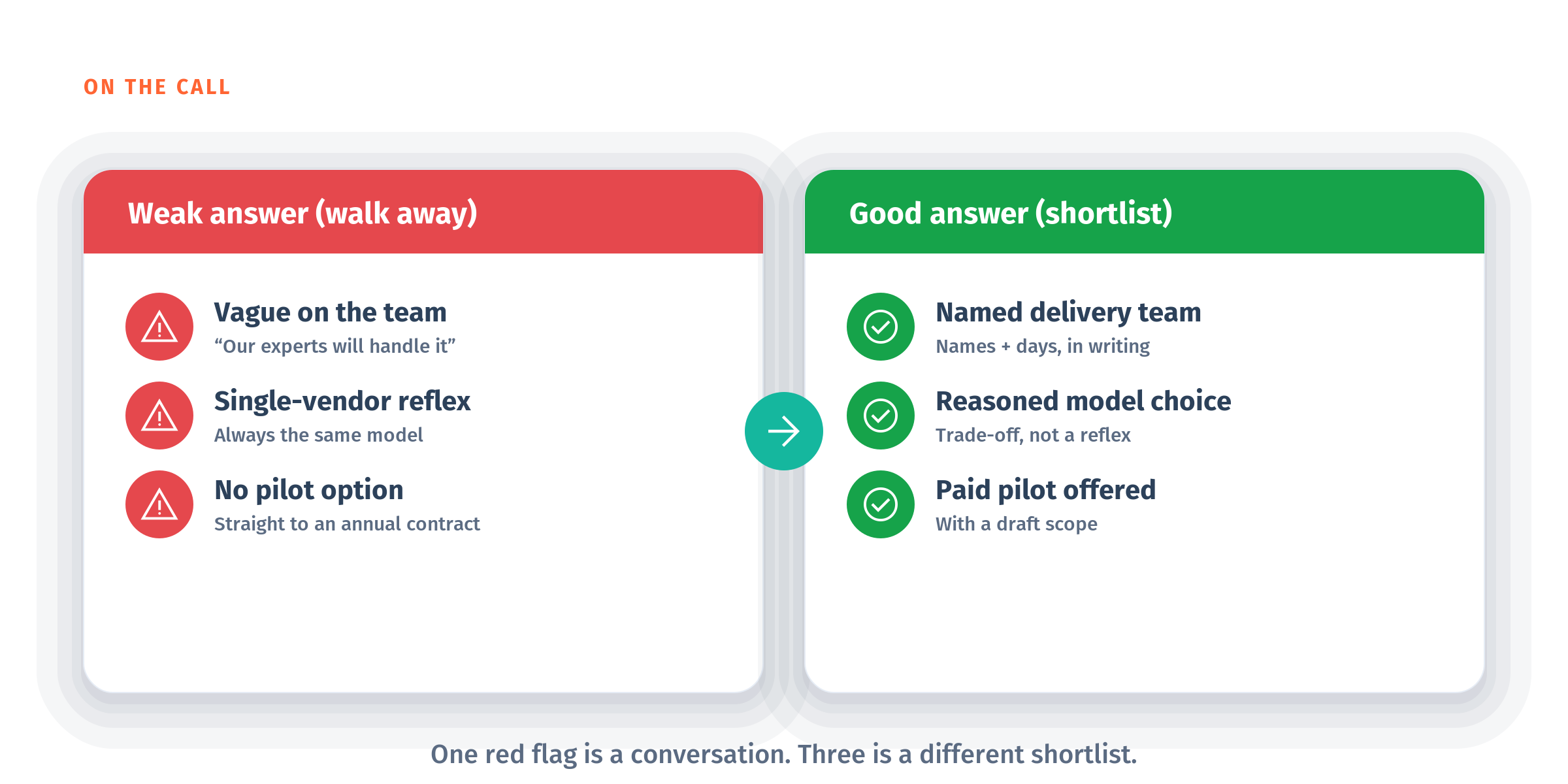
Questions to ask on the call, and what a good answer sounds like
Use these five on the first call. The quality of the answer tells you more than any brochure.
- "Who, by name, will do the work, and how many days each?" A good answer gives specific names and an allocation, without hesitation.
- "Which model would you use here, and why not the others?" A good answer is a reasoned trade-off, not a single-vendor reflex.
- "Where is our data processed, and is it used for training?" A good answer is precise about the region and the contractual position.
- "Can we start with a paid pilot with written success criteria?" A good answer is yes, with a draft scope.
- "What do we own at the end?" A good answer is everything, and they put it in the statement of work.
Frequently asked questions
How much do AI consulting services cost in the UK?
Most mid-market engagements start with a paid pilot of £8K to £25K, then move to a fixed-price project (£20K to £120K+) or a monthly retainer (£6K to £20K). Day rates run roughly £700 to £1,500 as of June 2026. Treat these as indicative ranges.How long does an AI consulting project take?
A pilot is usually 2 to 6 weeks. A first production deployment commonly runs 6 to 12 weeks depending on integrations and sign-off, with adoption support continuing afterwards.Should we hire a consultant, use a consultancy, or build in-house?
It depends on cost, speed and knowledge retention. A consultant suits advisory work, a consultancy suits a full governed build, and an in-house hire suits AI that is core and continuous. Many firms start with a consultancy-led pilot and decide afterwards.Do we need an AI consultant if we already use ChatGPT or Copilot?
Often yes. Buying a licence is not the same as a governed, integrated deployment with adoption and risk controls, which is where most of the value and most of the risk sit.How do we check an AI consulting firm is legitimate?
Ask for a sector reference, a named delivery team, security certifications (Cyber Essentials, ISO 27001) and a paid pilot. Verify references by phone, not by reading testimonials.What should be in an AI consulting contract?
A clear statement of work, a named team, data-processing terms, IP ownership in your favour, and an exit clause.Next step
If you are drawing up a shortlist, our team can walk through these twelve checks with you and leave you with a scorecard you can take into any vendor call, including ours. It is a conversation, not a pitch. Book a discovery call.
You can also see how we put this into practice with business process automation if you want a sense of how we work before you get in touch.
Once you have the twelve checks, apply them to real names: the best AI consulting companies in the UK, compared.
Work out your numbers
Your whole firm
AI ROI calculator
Five questions about your firm. See the time AI frees up, what it is worth and when it pays for itself.
Work out your numbersOne key process
Process automation ROI calculator
Five questions about one process. See the hours an AI agent frees up, what they are worth and how much becomes profit.
Work out your numbers
Free. No sign-up. Your answers stay in your browser.
See it in production
Systems we have built and run for clients, with the numbers that came out of them.