MCP for Business: How UK Companies Connect Claude to the Systems They Already Run
MCP reached more than 10,000 public servers in its first year. Here is what it means for a UK business: what it costs to connect Claude to the systems you already run, and the four controls to get right first.
By Ivan Pylypchuk (opens in a new tab), CEO of Softblues. Has led Claude and Gemini implementations for finance, legal and healthcare teams across the UK and Ireland.
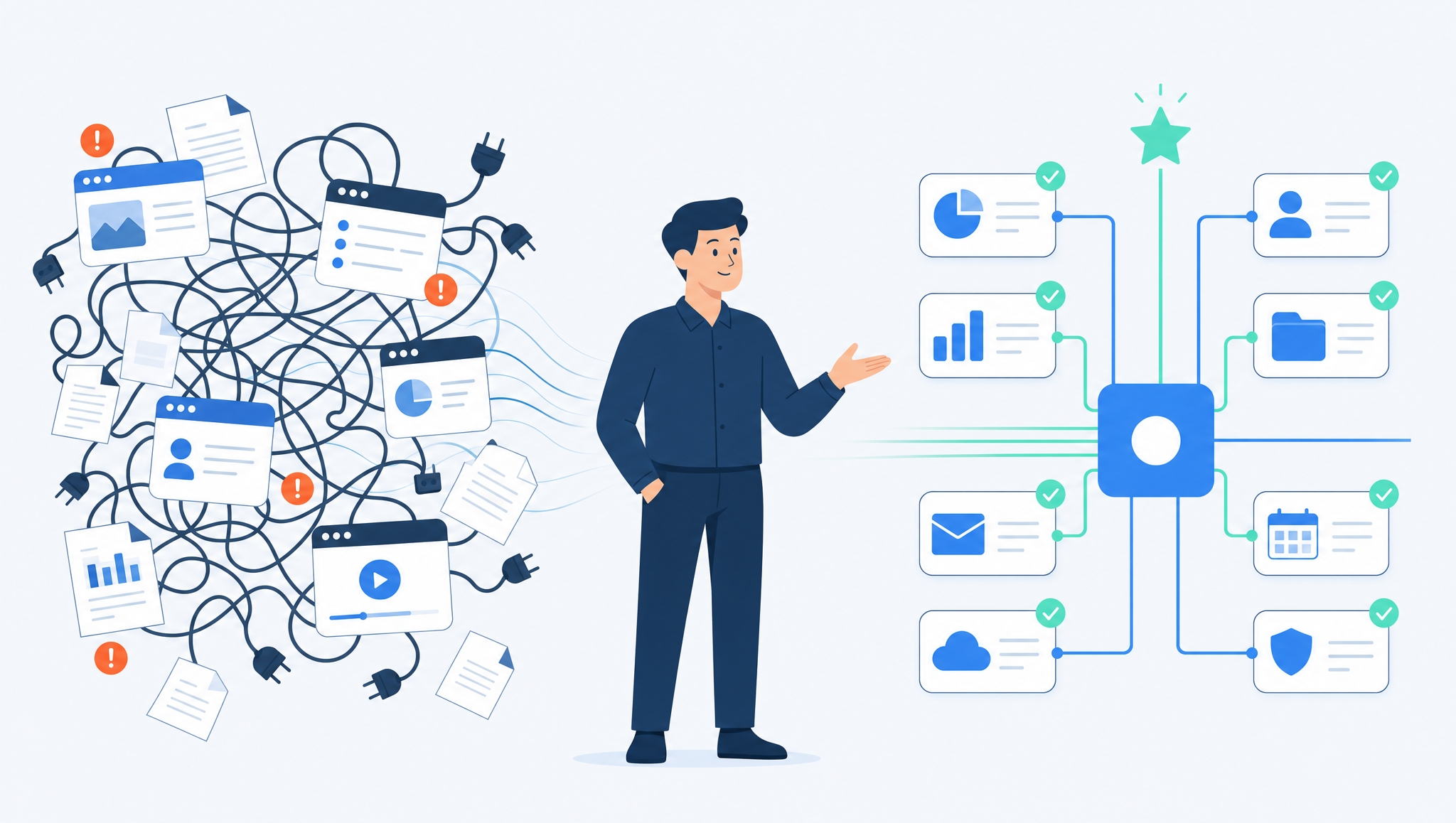
MCP, the Model Context Protocol, is an open standard that lets an AI assistant read from and act inside the systems you already run, using one connection format instead of a bespoke integration for every tool. For a business, that is the difference between an assistant that can talk about your work and one that can actually look things up and do it.
The protocol stopped being a niche developer curiosity some time ago. In its first year MCP reached more than 10,000 active public servers and 97 million monthly SDK downloads, and in December 2025 Anthropic donated it to the Agentic AI Foundation, a directed fund under the Linux Foundation co-founded with Block and OpenAI (Anthropic, 9 December 2025). At Softblues, an AI consulting firm working with regulated mid-market companies across the UK and Ireland, we now treat MCP as the default way to wire Claude into a client's stack, because it is the part of an AI project that used to eat the budget.
Key facts
- MCP is one open protocol for connecting an AI application to tools and data, replacing a custom integration per system. Anthropic donated it to the Linux Foundation's Agentic AI Foundation on 9 December 2025 (Anthropic).
- Scale as of December 2025: more than 10,000 active public MCP servers, and 97 million monthly SDK downloads across Python and TypeScript (Anthropic).
- It is not a Claude-only standard. ChatGPT, Cursor, Gemini, Microsoft Copilot and Visual Studio Code have all adopted MCP, with deployment support from AWS, Cloudflare, Google Cloud and Microsoft Azure (Anthropic).
- Claude's own connector directory lists more than 75 connectors built on MCP, so common systems often need no custom work at all (Anthropic).
- Typical UK engagement cost with us: £2,000 to £5,000 for Mapping and Strategy and £7,000 to £12,000 for a Full Discovery, then implementation priced in the proposal (our prices, October 2026).
- The risk is rarely the protocol. It is permissions. A connector inherits whatever the credential you hand it can already do.
Who this is for, and who it isn't
This is written for an operations, finance or IT lead at a 50 to 500 person UK or Ireland firm that has Claude or another assistant in the building, and has noticed that staff still copy and paste data into it by hand. If your systems are SharePoint, Xero, Sage, Salesforce, Jira, a SQL warehouse or an in-house line-of-business app, this applies to you.
Skip it if you are a developer looking for a spec walkthrough. The official MCP documentation is better than anything we would write here. Skip it too if you have no assistant deployed yet, because connectors are the second problem, not the first.
What does MCP actually do for a business?
It gives the assistant hands. A language model on its own can only work with what someone pastes into the window. An MCP server sits between the model and a system, publishes a small list of things that system can do (search invoices, read a policy document, create a ticket), and the assistant calls them when a task needs them.
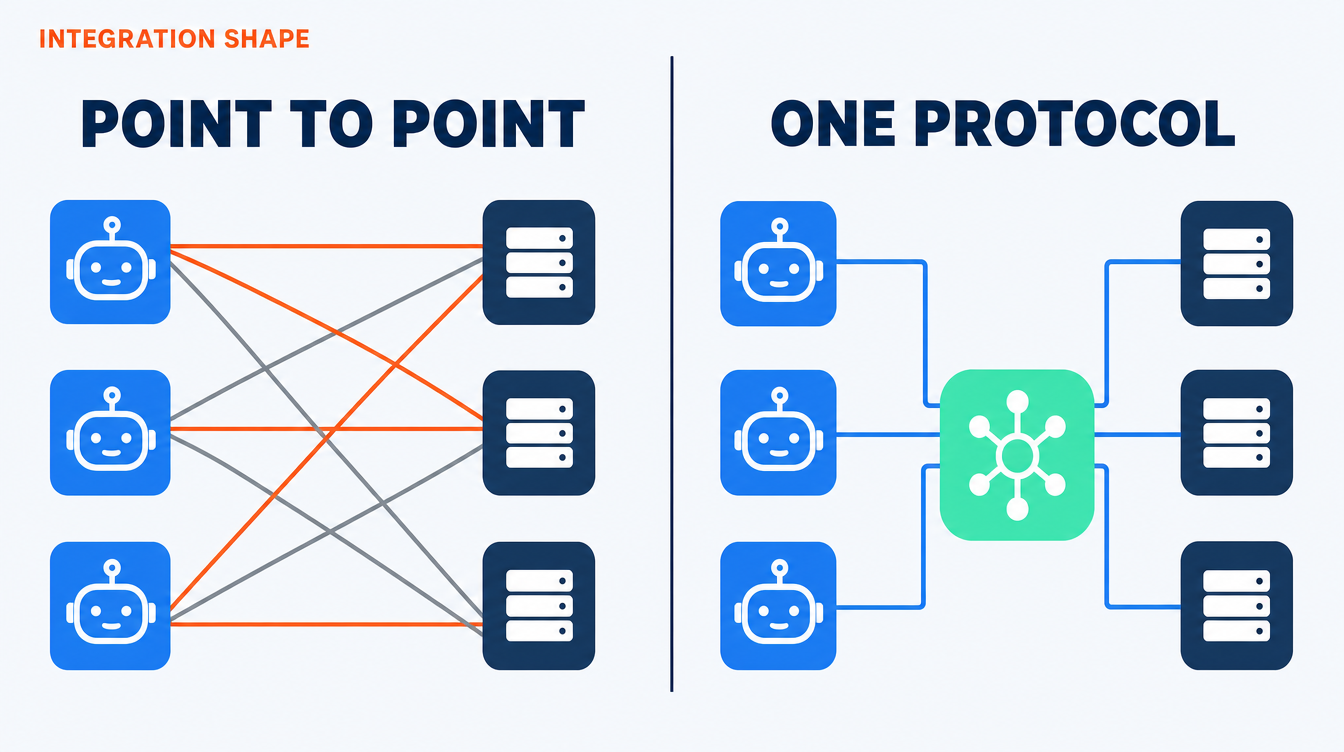
The important part for a buyer is the shape of the work, not the protocol. Before MCP, every pairing of an assistant and a system was its own small project with its own auth, its own error handling and its own maintenance bill. Change the assistant and you rebuilt the lot. With MCP, the connector is written once against the standard and any MCP-capable client can use it.
Which of your systems can you connect today?
Most mid-market stacks split into four patterns. The pattern matters because it drives cost and it drives how much of the work is engineering rather than configuration.
| Pattern | What it covers | Effort with us | Watch out for |
|---|---|---|---|
| Directory connector | Systems already in Claude's connector directory, such as major SaaS suites and storage | Configuration, usually days | Licence tier gating the API |
| Vendor MCP server | The software vendor ships its own MCP server | Days to two weeks | Scope of the vendor's own permissions model |
| Custom MCP server over an existing API | Your CRM, ERP, practice-management or warehouse has a REST API | Two to four weeks per system | Rate limits, and stale field documentation |
| Legacy or no API | On-premise systems, mainframes, screen-scraped tools | Four weeks and up | This is where budgets go. Fix the data access first |
Two things surprise people. The first is that the connector is usually the cheap part and the permissions design is the expensive part. The second is that you need fewer connectors than you think. Four well-chosen systems normally cover the majority of a team's daily questions.
What does it cost to connect Claude to your systems?
Here are the bands we quote in the UK. Everything below is our own pricing, indicative as of July 2026, and it traces to our rate card rather than to any published market benchmark.
| Stage | What you get | Indicative price (our data, July 2026) |
|---|---|---|
| Discovery | Use-case selection, systems and permissions map, connector plan, success criteria | £2,000 to £5,000 for Mapping and Strategy, then £7,000 to £12,000 for a Full Discovery |
| Implementation retainer | Connectors built and deployed, assistant configured, governance and training, iteration | Set in the proposal after the discovery |
| Ongoing support | Monitoring, connector maintenance as vendor APIs change, new use cases | Scoped after production |
Model usage sits on top and is billed by the platform, not by us. Budget for it separately, because an agent that reads documents consumes far more tokens than a chat user does. We scope it in a paid discovery and give you the timeline and the price in the proposal before any build starts. The wider picture of what an AI programme costs over a year, licences and internal time included, is in our breakdown of AI total cost of ownership for UK mid-market companies.
How long does an MCP integration take?
| Phase | Typical duration (our data) | What has to be true to finish it |
|---|---|---|
| Use case and permissions design | 1 to 2 weeks | A named owner per system, and agreement on what the assistant may change |
| First connector, read-only | 1 to 3 weeks | API credentials issued, test environment available |
| Pilot with a real team | 2 to 4 weeks | Ten to twenty users who will actually use it daily |
| Write actions and approvals | 2 to 4 weeks | Sign-off on which actions need a human in the loop |
| Production and handover | 2 weeks | Logging, monitoring and a runbook your IT team accepts |
The dates slip for one reason more than any other, and it is not engineering. It is waiting for credentials from a system owner who was never told the project existed. Get that list on day one.
What are the security questions you should be asking?
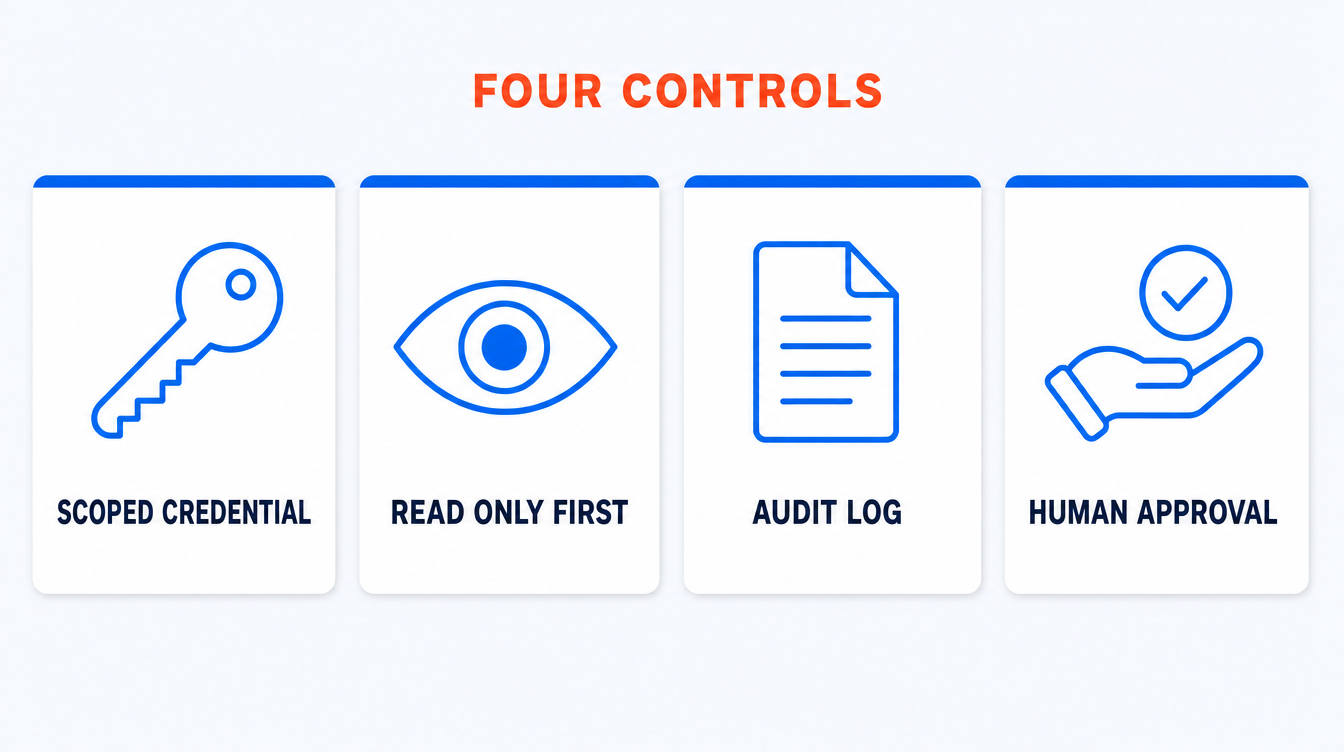
MCP does not create new categories of risk so much as it concentrates old ones. Four controls do most of the work.
1. Scope the credential, not the intention. A connector can only do what its token allows. Issue a dedicated service identity per connector with the narrowest scope that makes the use case work, and never reuse a human's credentials.
2. Read before write. Ship every connector read-only first. Add write actions individually, each with its own approval decision.
3. Log every call. You need a record of which user prompted which action against which record, retained where your auditors can see it. If a connector cannot produce that, it is not ready for a regulated process.
4. Keep a human where the consequence lands. Sending a client email, posting a journal or amending a record deserves a person's confirmation. We wrote about drawing that line in human-in-the-loop AI workflows.
There is also a genuine new class of problem to name honestly. Because an assistant reads content from your systems, hostile text inside a document or an inbound email can attempt to instruct it. That is prompt injection, and it is why write permissions and untrusted content should not meet without a control between them.
On the data-protection side, connecting an assistant to systems holding personal data is processing, with everything that follows. The ICO's guidance on AI and data protection is the right starting point, and your DPO should see the connector list before the pilot, not after. Financial services firms should walk the same list past their SM&CR accountability map, and legal practices in England and Wales past their SRA obligations.
What this looks like when it is running
We run six of our own departments on Claude, connected to our own systems through MCP, which is the honest version of a case study because it is us. Finance close, sales research, marketing publishing and recruitment screening all sit on connectors rather than on people pasting data between tabs. You can read how that is put together in our write-up of the Softblues Claude operating system.
Across client engagements, the pattern we see with document-heavy processes is processing times cut by up to 75% and internal search up to 85% faster (our data, and it varies a lot by client). The gains come from removing the retrieval step, not from the model being clever. Someone who used to spend eleven minutes finding the right version of a contract now asks a question.
Red flags when someone pitches you MCP work
A fixed price for "connecting your systems" before anyone has listed the systems is guesswork wearing a suit. So is a proposal with no permissions matrix in it, or one where every connector is quoted at the same effort regardless of whether the target has a modern API.
Be wary of a partner who wants write access in week one, who cannot tell you where the audit log goes, or who describes MCP as proprietary to one vendor. It is an open standard under the Linux Foundation, and a partner who does not know that has not done this work. Our fuller list of procurement questions sits in the AI vendor security questionnaire for UK buyers.
Questions to ask on the call, and what a good answer sounds like
Which of our systems already has an MCP server, and which needs one built? A good answer names your actual software and separates directory connectors from custom work, with different effort for each.
What identity will each connector use? You want to hear "a dedicated service account per connector, scoped to these specific operations", not "we will use an admin key to keep it simple".
How will we know it is answering correctly? A good answer describes an evaluation set of real questions with known answers, run before and after each change.
What happens when the vendor changes their API? Connector maintenance is a real running cost. A partner who has done this in production will quote for it rather than look surprised.
Where does this stop being the right tool? If nobody will tell you that, they are selling. A Microsoft 365-native shop with no appetite for custom work is often better served by Copilot, and we will say so. Our honest comparison of Claude Enterprise, ChatGPT Enterprise and Microsoft Copilot sets out where each one wins.
Frequently asked questions
Is MCP the same thing as an API?
No. An API is how a system exposes its functions. MCP is a standard way to describe those functions to an AI model, including what they do and what arguments they take, so the model can choose the right one. Most MCP servers are a thin layer over an API you already have.
Do we need Claude specifically to use MCP?
No. MCP has been adopted across ChatGPT, Cursor, Gemini, Microsoft Copilot and Visual Studio Code (Anthropic, December 2025). That portability is the commercial argument for it: connectors you build are not stranded if you change assistant later.
Can an MCP connector change data in our systems, or only read it?
Both are possible, and that is the decision to make deliberately. We ship read-only first and add each write action as its own approval, so nobody discovers after the fact that an assistant could raise credit notes.
Is it safe to connect an assistant to systems holding client data?
It can be, with scoped credentials, logging and a lawful basis for the processing. Treat it as a data-protection change with your DPO involved from the start, using the ICO's AI and data protection guidance as the reference. It is not safe if you hand a connector an unrestricted admin token, which is the most common mistake we are called in to fix.
How many connectors does a mid-market firm actually need?
In our engagements, four to six covers the majority of daily questions for a given department. Teams that try to connect everything at once spend the budget on integrations nobody uses.
What does this cost to run once it is live?
Two lines. Platform and model usage, billed by the vendor and driven by how much your agents read. Connector maintenance, because vendor APIs change. Our figures for the full year, including internal time, are in the AI total cost of ownership breakdown.
Where should we start if we have nothing connected yet?
Pick the one question your team asks most often that requires opening two systems to answer. Connect those two, read-only, and measure whether the answers hold up. That is a two to three week piece of work, and it tells you more than a strategy document will.
We build this for a living, and we use it before we sell it: our own departments run on Claude and MCP, in production, not in a slide deck. If you want to know which of your systems are worth connecting first and what that would cost, book a discovery call and we will map it with you. For where an MCP connector sits in a Claude rollout, or the same connector serving Copilot and ChatGPT together, both guides treat it as the reusable asset: build it once over the system most work touches, and every later build speaks to it.
If the work you have in mind is broader process automation rather than assistant connectors, start with our business automation service instead.
Work out your numbers
Your whole firm
AI ROI calculator
Five questions about your firm. See the time AI frees up, what it is worth and when it pays for itself.
Work out your numbersOne key process
Process automation ROI calculator
Five questions about one process. See the hours an AI agent frees up, what they are worth and how much becomes profit.
Work out your numbers
Free. No sign-up. Your answers stay in your browser.
See it in production
Systems we have built and run for clients, with the numbers that came out of them.
Related Articles
AI Integration Services: Connecting AI to the Systems You Already Run
Automated Document Processing: Turning Chaos into Actionable Data