AI Integration Services: Connecting AI to the Systems You Already Run
Gartner expects 60% of AI projects without AI-ready data to be abandoned through 2026. The model is rarely the problem. Integration is. Here is what AI integration services actually cover, and what they cost in the UK.
By Ivan Pylypchuk (opens in a new tab), CEO of Softblues. Has led Claude and Gemini implementations for finance, legal and healthcare teams across the UK and Ireland.
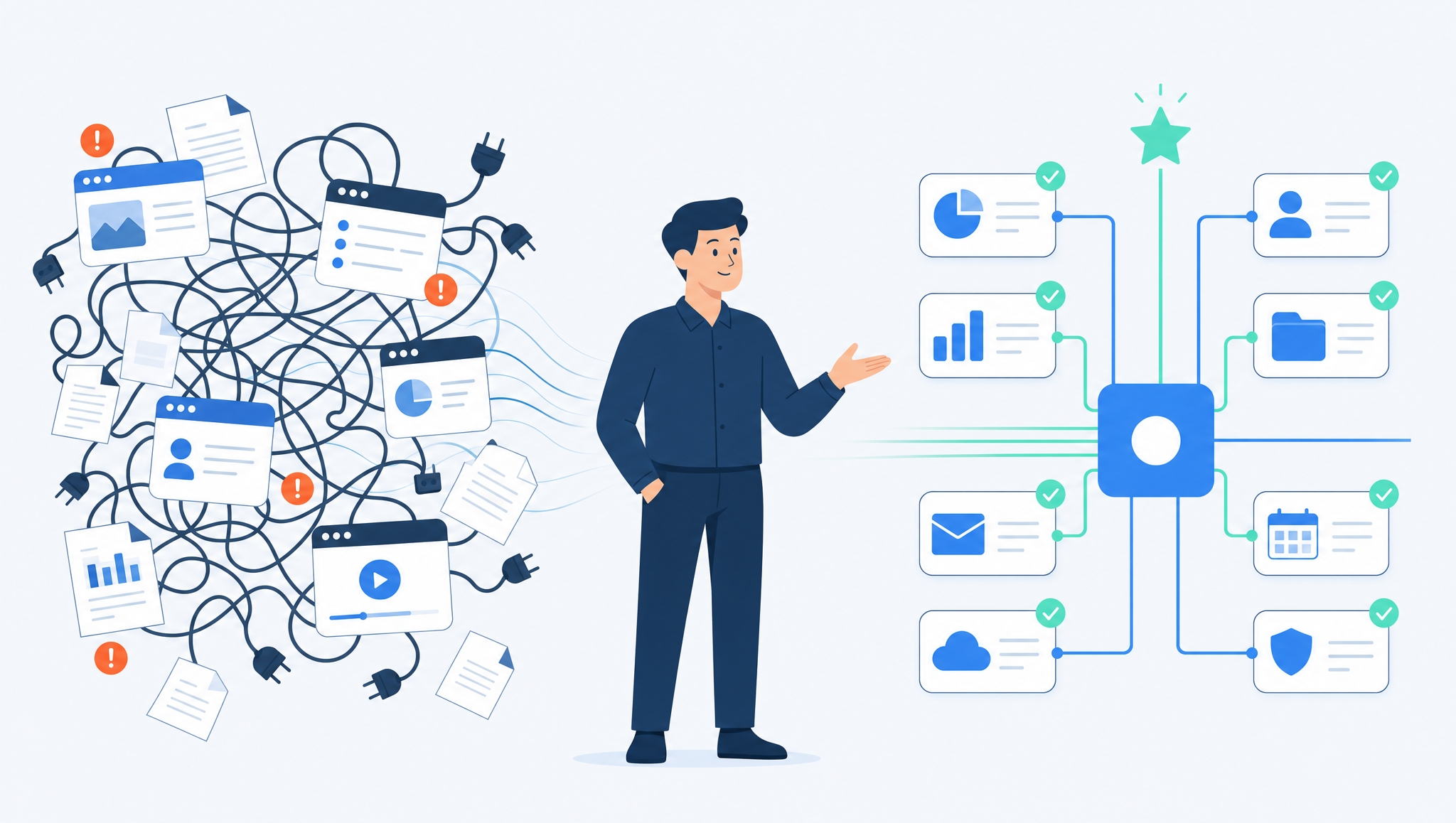
AI integration services connect a large language model to the systems your business already runs on, so the AI can read your real data, take actions in your tools, and fit your security rules. The model is rarely the hard part. The integration is. Buying a Claude or ChatGPT licence gives your team a clever chatbot in a separate window; integration is what turns that into something that drafts from your contracts in SharePoint, pulls figures from Xero, and updates a record in your CRM without a person copying text between tabs.
At Softblues, an AI consulting firm working with regulated mid-market companies across the UK and Ireland, we spend most of a project on the unglamorous middle layer: data access, permissions, and the connections between the model and your line-of-business systems. This guide explains what AI integration services actually cover, the four patterns we use, what they cost, how long they take, and what to ask a partner before you sign.
Key facts
- AI integration is the work of connecting an AI model to your data and tools through APIs, retrieval, and agent connectors, governed by your existing security and permission rules.
- Most failed AI projects fail at integration and data readiness, not at the model. Gartner predicts that through 2026, organisations will abandon 60% of AI projects that are not supported by AI-ready data (Gartner, Feb 2025).
- There are four common patterns: direct API, retrieval (RAG), agents with tool connectors (MCP), and embedded in an existing app. Most real systems combine two or three.
- Our pricing follows two stages: Mapping and Strategy at £2,000 to £5,000 and a Full Discovery at £7,000 to £12,000, then implementation priced in the proposal, as of October 2026.
- A first production integration usually takes 6–12 weeks, with data readiness, not coding, the most common cause of delay.
- Integration must respect your access controls. The AI should see only what the signed-in user is allowed to see, under UK GDPR and your information-security policy.
What "AI integration" actually means
Integration is everything between the model and your business. A licence to Claude, ChatGPT or Copilot gives you a model that can reason over text you paste in. That is useful, but it knows nothing about your clients, your contracts, or last month's numbers, and it cannot do anything in your systems.
AI integration services close that gap. The work breaks into three layers. Data access is connecting the model to where your information lives: SharePoint, a shared drive, Xero or Sage, a case-management system, your CRM. Actions is letting the model do things on your behalf: raise a draft, file a record, send a message for approval. Governance is the layer that keeps both safe: authentication, permissions, logging, and the rules about what the AI may and may not touch.
The four integration patterns, and when to use each
Almost every AI integration is built from four patterns. A real system usually combines two or three, but it helps to know them on their own.
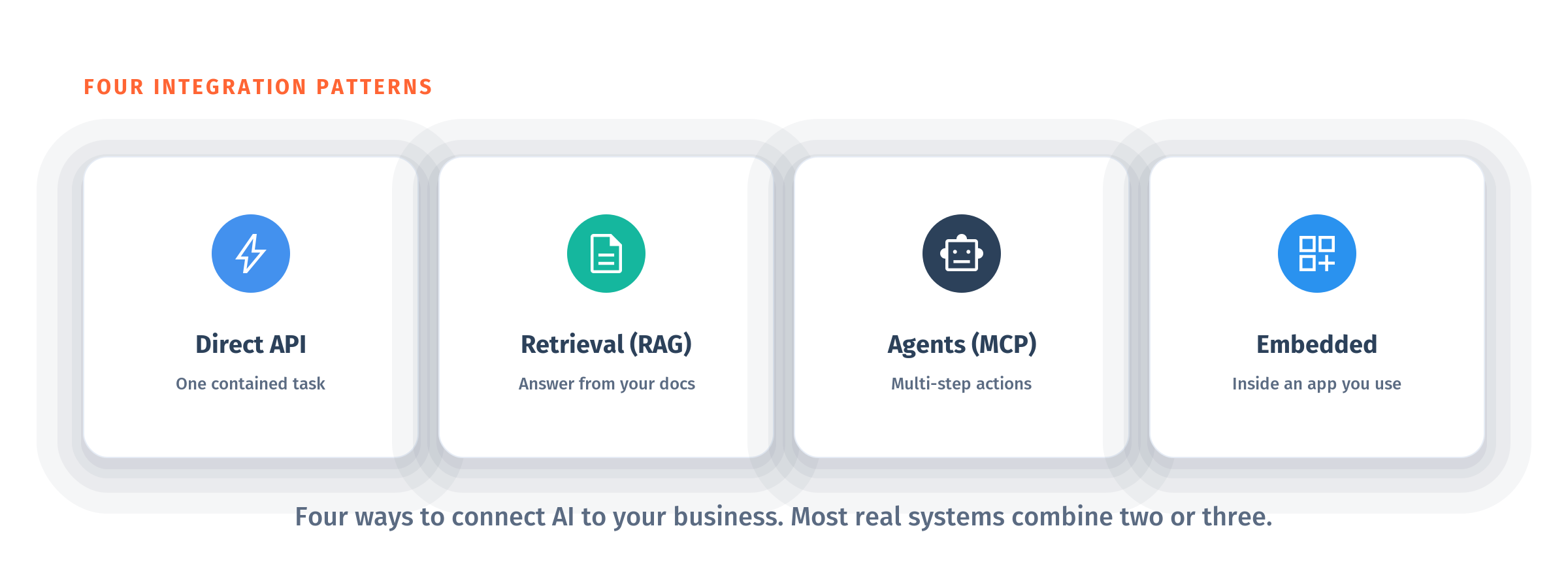
Direct API. The simplest pattern. Your application sends text to the model's API and gets text back, for a single contained task such as classifying an email or summarising a document. Fast to build, cheap to run, limited in scope.
Retrieval, or RAG. Retrieval-augmented generation lets the model answer from your own documents. You index your content, and at question time the system finds the relevant passages and gives them to the model to answer from, with citations. This is the pattern behind a policy assistant or a "search our knowledge" tool, and it is how you stop the model guessing.
Agents with tool connectors. Here the model is given tools it can call: read a record, check a calendar, draft a reply, update a system. The open standard for this is the Model Context Protocol (MCP), introduced by Anthropic in November 2024 and now supported across the major model vendors (Anthropic, 2024). MCP gives you one consistent way to connect a model to many tools, which is why it has become the default for multi-step automation.
Embedded in an existing app. The AI lives inside software your team already uses, so there is no new window to learn. A drafting button in your document system, a summariser in your helpdesk. The integration effort goes into the host application rather than a standalone interface.
Why integration, not the model, is where projects fail
The uncomfortable truth of this market is that the model almost always works. What breaks is everything around it. Gartner found that 63% of organisations either lack the right data management practices for AI or are unsure whether they have them, and predicts 60% of unsupported AI projects will be abandoned through 2026 (Gartner, Feb 2025).
Data readiness is the usual culprit. The model can only be as good as what it can reach, and in most mid-market companies the relevant information is scattered across a shared drive with no structure, a CRM half the team forgets to update, and three spreadsheets that disagree with each other. Before any clever automation, someone has to decide where the source of truth is and make it reachable. That is integration work, and it is why a serious partner spends the first weeks on your data rather than on prompts.
The second culprit is permissions. An AI that can read everything is a data-protection incident waiting to happen. The system has to inherit your existing access rules, so the assistant shows a given user only what that user is already allowed to see.
What AI integration services cost in the UK
Pricing depends on how many systems you connect, how clean your data is, and whether the AI only reads or also takes actions. Most UK partners, us included, work in two stages: a fixed-price discovery to scope the integration, then a monthly implementation retainer to build and run it. The bands below are indicative for UK mid-market work as of June 2026, not a published benchmark.
| Stage | Indicative fee (2026) | What it covers |
|---|---|---|
| Mapping and Strategy, then Full Discovery | £2,000 to £5,000, then £7,000 to £12,000, fixed | Mapping the workflow, systems and data sources, the integration design, and a costed plan |
| Implementation | Set in the proposal after the discovery | Building the integration, wiring retrieval or tools, permissions and approvals, then pilot and rollout |
| Data-readiness groundwork | Folded into the above where needed | Structuring and cleaning sources before integration, where the data is not ready to use |
Best for a contained, single-workflow integration: a team with one clear, painful workflow and reasonably tidy data who want a quick, provable win before committing further. Usually a discovery plus one or two months of build.
Best for an agent across your stack: a company that has already proved value on a smaller integration and wants the AI to act across finance, operations or client systems. A longer retainer.
Avoid paying anyone if you have not yet identified a specific workflow and a measurable outcome. An open-ended "AI platform" with no named process is the fastest way to join the 60% that get abandoned.
How long an AI integration takes
A first production integration usually takes 6–12 weeks. The phases are predictable, and coding is rarely the long pole.
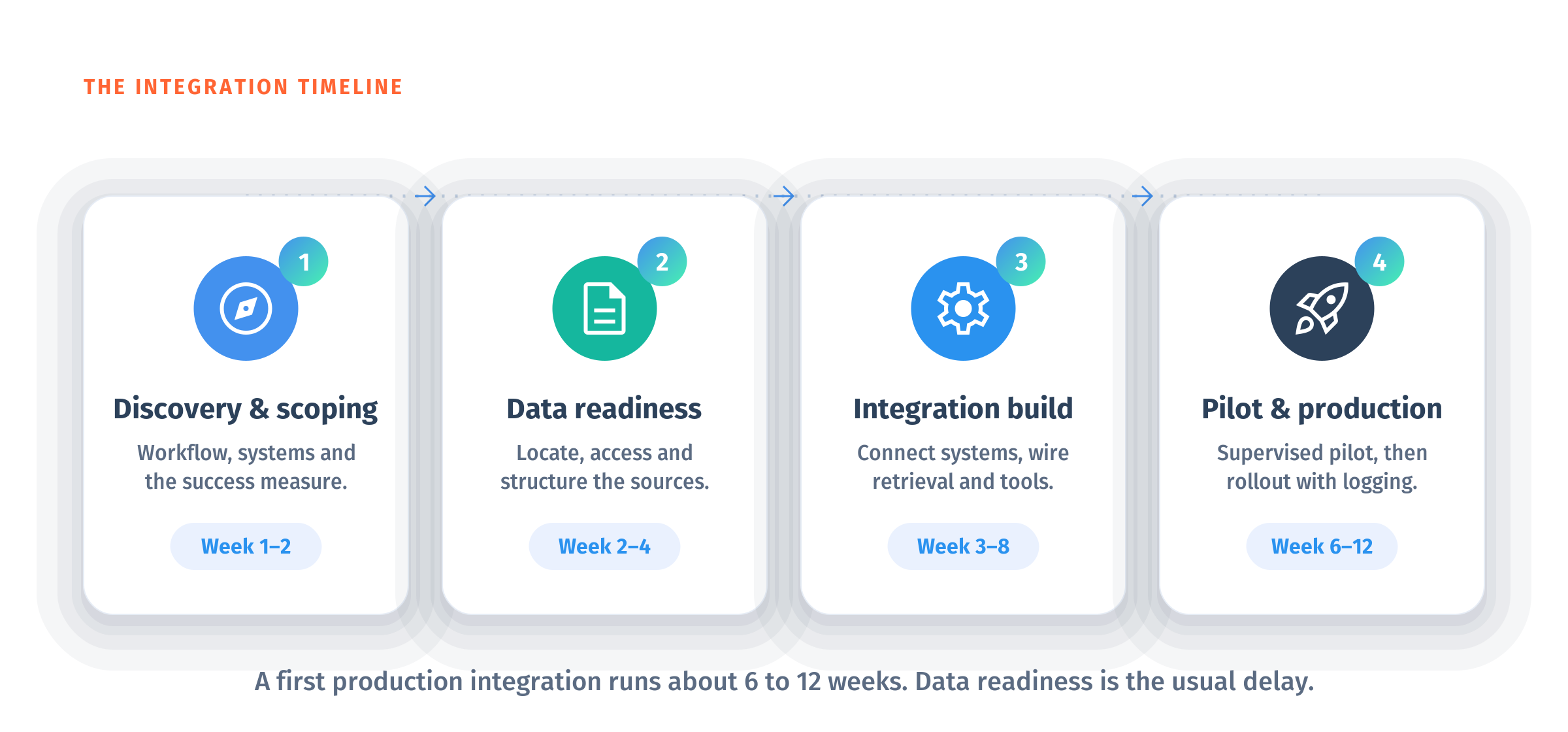
1. Discovery and scoping. One to two weeks to pin down the workflow, the systems involved, the success measure, and the data sources. This is where a fixed scope is agreed.
2. Data readiness. Two to four weeks, and the most common cause of delay. Sources are located, access is arranged, and content is structured enough for the model to use reliably.
3. Integration build. Three to eight weeks of connecting systems, wiring retrieval or tools, and building the permission and approval logic.
4. Pilot. Two to four weeks of running the integration with a small group under supervision, measuring accuracy and time saved, and correcting before wider release.
5. Production and monitoring. Rollout with logging, error handling, and a feedback route, so issues are caught rather than discovered by a client.
What it looks like in regulated sectors
Integration in regulated industries carries extra obligations. You are connecting systems, and you are doing it in a way you can explain to a regulator.
In UK financial services, the FCA and the Senior Managers and Certification Regime (SM&CR) mean a named person is accountable for the AI's outputs, so human review and an audit trail are not optional. In legal, the SRA (England and Wales) expects client confidentiality and supervision, which shapes what an AI may draft unsupervised and what data it may touch. In healthcare, the CQC (England) and clinical-safety standards DCB0129 and DCB0160 apply, and if the software influences clinical decisions it may fall under MHRA medical-device rules. Across all of them, UK GDPR and the ICO set the data-protection baseline.
A short, anonymised example. A mid-market professional-services firm wanted an assistant to answer staff questions from its internal policies. We integrated a retrieval system over their SharePoint, scoped to the documents each team was already permitted to see, with every answer citing its source document. Staff queries that used to take a manager around 15 minutes to answer dropped to under a minute, and because every answer carried a citation, the compliance team could check the source rather than trust the model. No client data left their tenancy.
Red flags when choosing an integration partner
No questions about your data. A partner who quotes before asking where your information lives and how clean it is, is selling you a model, not an integration.
Model-first pitches. If the conversation is all about which model is cleverest and nothing about permissions, logging and your systems, the hard 80% of the work is being skipped.
No security or access plan. Any serious partner will raise authentication, permission inheritance and UK GDPR early. If you have to bring it up, be careful.
Lock-in by design. Bespoke connectors that only the vendor can maintain, with no documentation and no handover, leave you stranded. Open standards such as MCP and a documented handover protect you.
Vague pricing and no fixed scope. Open-ended time-and-materials with no defined outcome is how budgets disappear. Expect a fixed scope tied to a named workflow.
Questions to ask on the call, and what a good answer sounds like
1. Which integration pattern would you use for our problem, and why? A good answer names a specific pattern, ties it to your workflow, and explains the trade-off. A weak answer describes a generic platform.
2. How will the AI respect our existing permissions? You want to hear that the system inherits your access rules so each user sees only what they already can. Anything vaguer is a risk.
3. What happens if our data is not ready? A good partner has a data-readiness phase and will tell you honestly if groundwork is needed before integration pays off.
4. How do we audit what the AI did? Expect logging, citations on retrieved answers, and a clear record of any actions taken. In regulated sectors this is non-negotiable.
5. What do we own at the end, and can we maintain it? Look for documented integrations, open standards where possible, and a handover. If only the vendor can keep it running, you have bought a dependency.
Frequently asked questions
What is the difference between AI integration and just buying an AI tool?
Buying a tool gives you a model in its own window, separate from your data and systems. AI integration connects that model to your real information and lets it act inside your tools, under your security rules. The licence is the easy, cheap part; the integration is where the value and most of the cost sit.
Do we need our data to be perfect before we start?
No, but you need to know where the source of truth is. A good partner runs a data-readiness phase to structure and clean the relevant sources before building. Trying to skip this is the single most common reason integrations underperform.
Is our data safe if we connect an AI to our systems?
It can be, if integration is done properly. The AI should authenticate as the signed-in user and see only what that user is permitted to see, with full logging, under UK GDPR. Reputable model providers also offer enterprise terms that exclude your data from training. Insist on this in writing.
What is MCP, and does it matter to us?
The Model Context Protocol is an open standard, introduced by Anthropic in 2024, for connecting AI models to tools and data in a consistent way. It matters because it reduces lock-in: connectors built to an open standard are easier to maintain and move than bespoke ones only your vendor understands.
How much does AI integration cost in the UK?
As a rough guide for 2026, our work follows a two-stage model: Mapping and Strategy at £2,000 to £5,000 and a Full Discovery at £7,000 to £12,000 to scope the integration, then implementation, priced in the proposal, to build and run it. Figures are indicative, not a published benchmark, and depend on how many systems you connect and how ready your data is.
How long before we see results?
A first production integration typically takes 6–12 weeks, including a supervised pilot. You can often prove value on one contained workflow within that window before committing to wider rollout.
Can you integrate with our existing systems like Xero, SharePoint or our CRM?
Usually yes. Common UK business systems either expose APIs or have ready connectors, and the open MCP standard is widening that further. The real question is not whether a connection is possible but whether your data behind it is structured enough to be useful.
We are Certified in the Claude Partner Network and a Google Cloud partner at Services Select tier, and we work as practitioners rather than slide-deck consultants: we put Claude into production in your systems, on a fixed scope, and measure the result. If you want a straight answer on whether AI integration would pay back for a specific workflow in your business, book a discovery call or read how we approach business process automation.
Work out your numbers
Your whole firm
AI ROI calculator
Five questions about your firm. See the time AI frees up, what it is worth and when it pays for itself.
Work out your numbersOne key process
Process automation ROI calculator
Five questions about one process. See the hours an AI agent frees up, what they are worth and how much becomes profit.
Work out your numbers
Free. No sign-up. Your answers stay in your browser.
See it in production
Systems we have built and run for clients, with the numbers that came out of them.
Related Articles
MCP for Business: How UK Companies Connect Claude to the Systems They Already Run
Automated Document Processing: Turning Chaos into Actionable Data