AI business case for insurance brokers: a worked example
Build an AI business case for a UK insurance broker: compare two hiring scenarios, check capacity against profit, and test the assumptions with your data.
An AI business case for an insurance broker connects work removed from the team to a financial decision. It estimates usable time, identifies which planned hires or costs could change, and compares the resulting benefit with the full cost. The result depends on adoption, review effort and where the time becomes available.
Softblues, at softblues.io, is a London-based AI adoption partner working with UK and Irish firms. This example uses our whole-firm calculator to show what a leadership team should check before committing a budget. Softblues is Certified in the Claude Partner Network.
What are the key facts in this example?
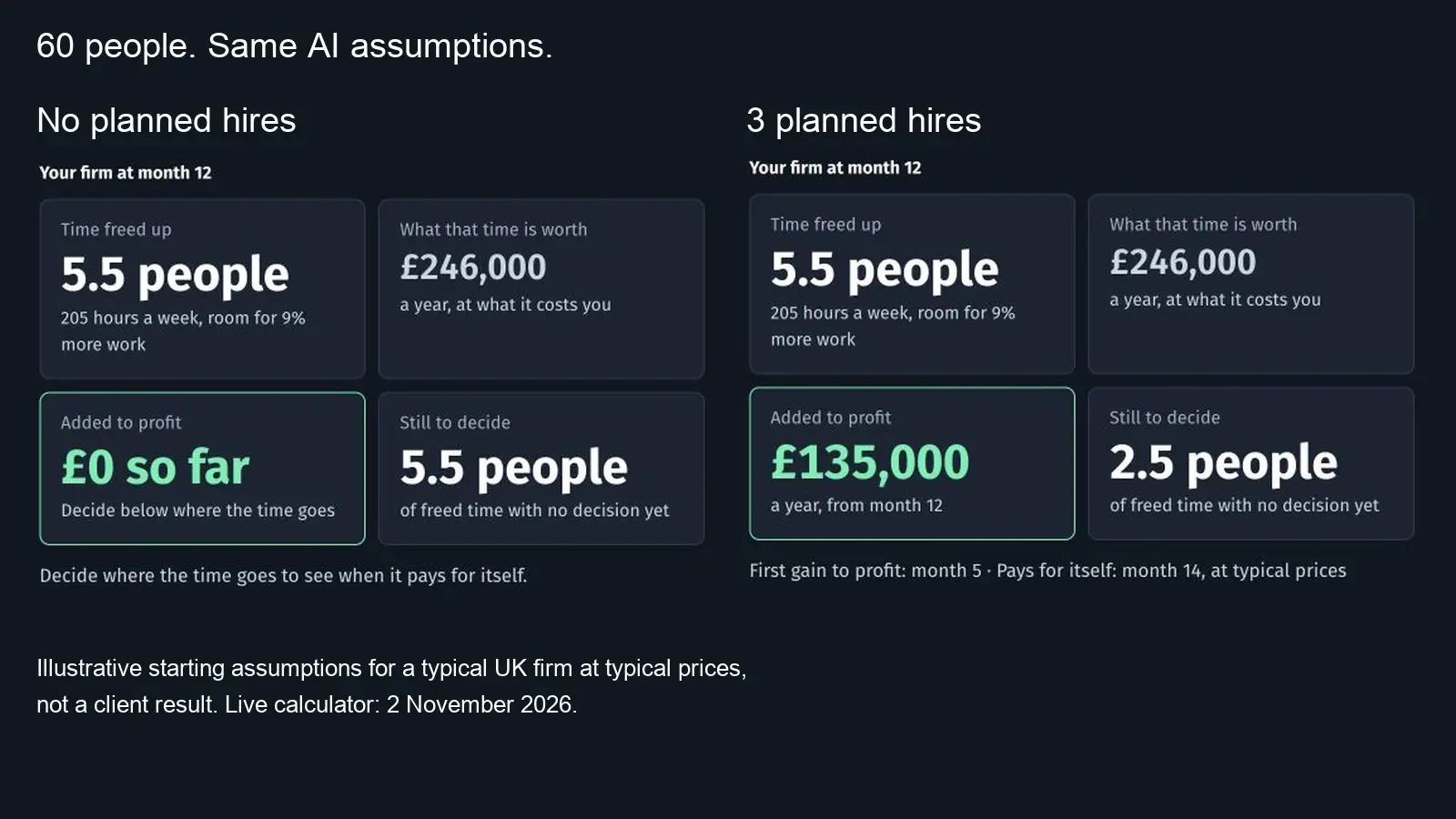
The figures below are illustrative starting assumptions for a typical UK firm at typical prices, not a client result. They were read from the live calculator on 2 November 2026.
- The example has 60 people working mainly at computers, using the financial-services-and-insurance preset.
- Both scenarios free the time of 5.5 people, or 205 hours a week, by month 12.
- That time is worth £246,000 a year at the model's assumed staff cost. This is a capacity valuation.
- With no planned hires and no other use of the time selected, the model shows £0 added to profit and no payback within 24 months.
- With three planned hires that can wait, it shows £135,000 a year added to profit from month 12 and payback in month 14 at typical prices.
Use the whole-firm AI ROI calculator to replace these assumptions. Its financial-services preset covers a broad category. It is not a measured operating model for insurance brokers or MGAs.
Where does the time go in a broker?
Start with the work moving between people, documents and systems. New submissions, renewal packs and policy checks can involve repeated reading and re-keying before somebody makes a decision.
Our core guide uses fixed agent numbers to distinguish these patterns. The mapping below is a way to scope a broker's work, not a claim that every task needs a separate build.
| Broker workflow | Relevant pattern in the guide | Human check |
|---|---|---|
| New submissions and returned onboarding documents | Agent 5, onboarding pack and completeness check | Decide whether the information is sufficient and the client can proceed |
| Renewal letters and requests for missing information | Agent 3, standard documents from house templates | Confirm the facts and approve the outgoing document |
| Policy schedules and supporting documents | Agent 9, document-pack processing into the core system | Check extracted fields and resolve contradictions before write-back |
| Questions about the firm's own procedures | Agent 1, policy and procedure assistant | Follow the cited current procedure and escalate gaps |
| Client and insurer mailbox intake, including loss notifications | Agent 10, shared-mailbox intake and client-facing service | Own exceptions and substantive decisions |
| Reports to insurers, including bordereaux | Agent 9 for structured extraction; Agent 6 for reconciled reporting | Reconcile source records and sign off the report |
Policy wording needs particular care. Extracting an expiry date and deciding whether cover applies are different tasks. A useful first scope can prepare the evidence while leaving the judgement with the authorised person.
For a narrower discussion of incoming work, see AI for insurance submissions and claims triage. Here the decision is whether adoption across the firm has a business case.
What do the five calculator inputs mean?
Use information the firm already has before introducing estimates. Each answer changes the model's starting point, so record who supplied it and when.
Industry. Choose financial services and insurance, then inspect the suggested teams and processes. A commercial broker, a personal-lines broker and an MGA will not have the same workload. Adjust the team shape before relying on the output.
People working mainly at computers. Use the relevant headcount, not every person on the payroll. Ask operations or finance for the current number and identify teams with materially different work. This example uses 60.
Planned hires over the next year. Take the approved or proposed hiring plan. Separate a real vacancy driven by workload from an aspiration to grow. A role counts as avoidable only when the work it would cover can actually be absorbed elsewhere in that team.
AI today. Check what people already use and which licences the firm pays for. The example selects “Nothing official yet”. If your staff already use AI, the incremental benefit may be smaller. Counting existing productivity again would overstate the case.
The work taking most skilled hours. Ask the process owner rather than choosing the most interesting demonstration. We retained the preset's compliance file review for both runs. Your broker might choose a different process; changing it would create a different comparison.
The DWP evaluation of Microsoft 365 Copilot, published on 29 January 2026, is one source behind the calculator. It studied government staff, not brokers, and reports limitations including self-reported outcomes and no pre-trial baseline. It does not validate the insurance example.
Keep all other assumptions fixed when testing one decision. Otherwise you cannot tell whether a better result came from hiring, a different process or a more optimistic adoption assumption.
What changes between the two scenarios?
Only planned hiring changes. Both runs use the same industry, headcount, starting AI position and heavy process. Neither adds savings from cancelled spending, extra demand or avoided losses.
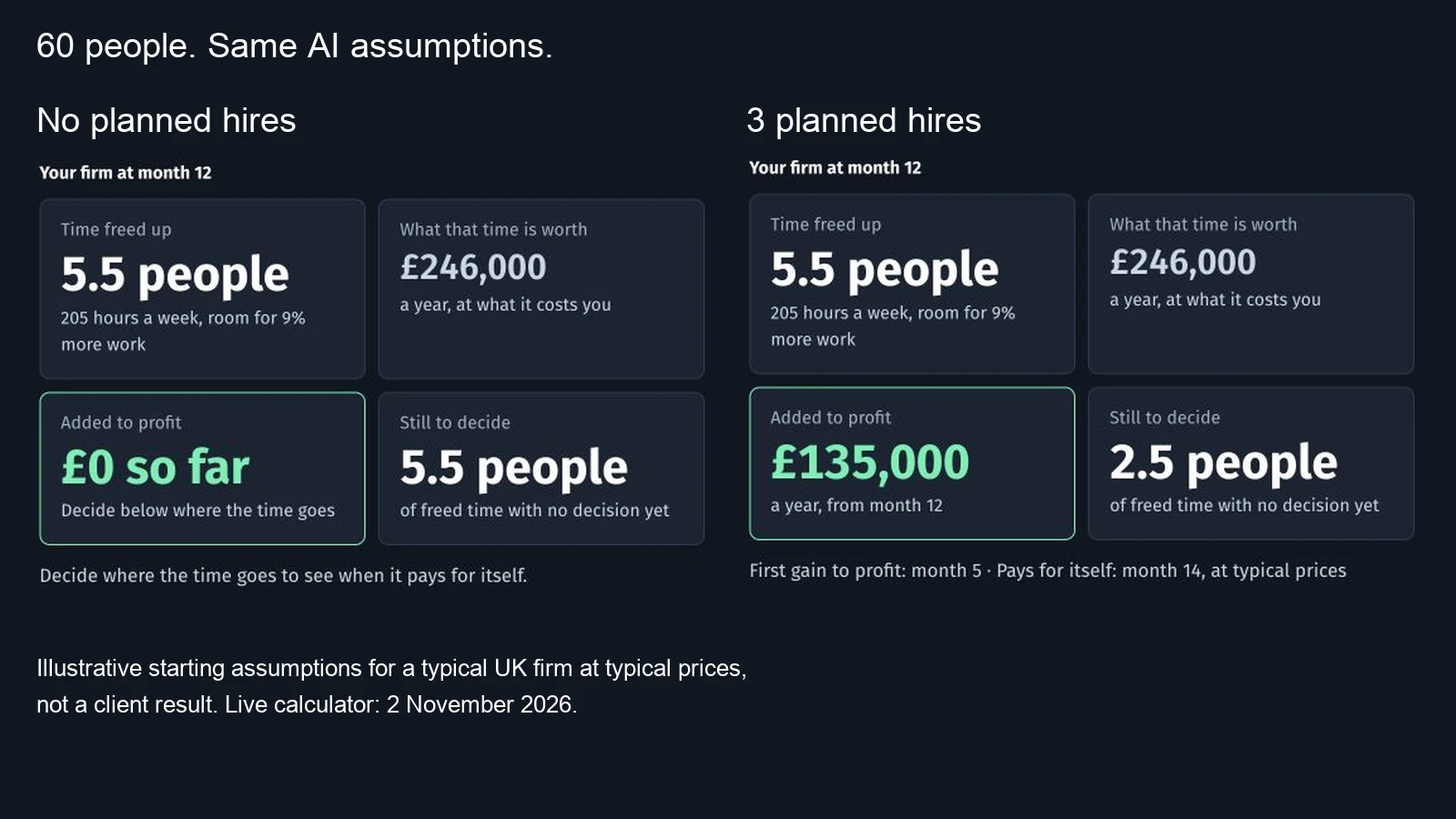
Illustrative starting assumptions for a typical UK firm at typical prices, not a client result. Live calculator reading: 2 November 2026.
| Result | No planned hires | Three planned hires |
|---|---|---|
| Time freed at month 12 | 5.5 people; 205 hours a week | 5.5 people; 205 hours a week |
| What that time is worth a year | £246,000 | £246,000 |
| Added to profit | £0 so far | £135,000 a year, from month 12 |
| Pays for itself by | Not within 24 months | Month 14, at typical prices |
| Time still to decide how to use | 5.5 people | 2.5 people |
The second result assumes the freed time allows the planned hires to wait. It does not require removing existing employees. It also does not mean the whole firm's spare hours can cover any vacancy: the capacity must land in the right team and match the work.
The annual profit figure is the model's rate from month 12, not a cash saving accumulated during the first year. The payback month is a separate cumulative calculation. Keep those two measures separate in a board paper.
How do capacity, realised benefit and full cost differ?
Capacity is time available for other work. Realised benefit requires an observable change, such as a postponed hire, cancelled external spend or additional work completed at a known margin.
A broker may use the time to improve client service. That can be a good decision, but it should not automatically become a payroll saving in the financial model. Write down the intended outcome and how you will measure it.
Avoid double counting. If the same hours cover a planned role, they are no longer available to support an additional revenue assumption. Extra demand must exist, and the financial benefit from serving it is margin after associated costs.
Full cost includes licences, configuration or development, model usage, training, checking outputs, maintenance and governance. Internal staff time is an economic cost even where it produces no new cash payment.
The live calculator shows internal time separately and excludes it from cash payback. Its month-14 result should therefore not be described as a return after every economic cost. A board decision should inspect both the cash view and the internal effort required to deliver it.
For the measurement method on a single workflow, see how to measure AI implementation ROI. A firm-wide estimate helps prioritise; a process baseline tests whether the proposed improvement is real.
What should you check before trusting the number?
Measure one normal week of one process, including corrections and handovers. Record the volume, human minutes and acceptable output before testing AI on the same kind of work.
Include difficult files in the sample. Missing documents, unclear scans, conflicting dates and unusual policy wording are often where a quick demonstration stops representing the actual workload. Keep sensitive material inside an approved environment.
Name the reviewer and count their time. A draft produced quickly can still create more work if someone must trace every statement back to a source. Compare accepted output, not the speed of the first answer.
Then test the hiring decision with the team manager. Which role could wait, from what date, and what evidence would reverse that decision? If there is no defensible answer, keep the hours as capacity and leave the financial benefit unclaimed.
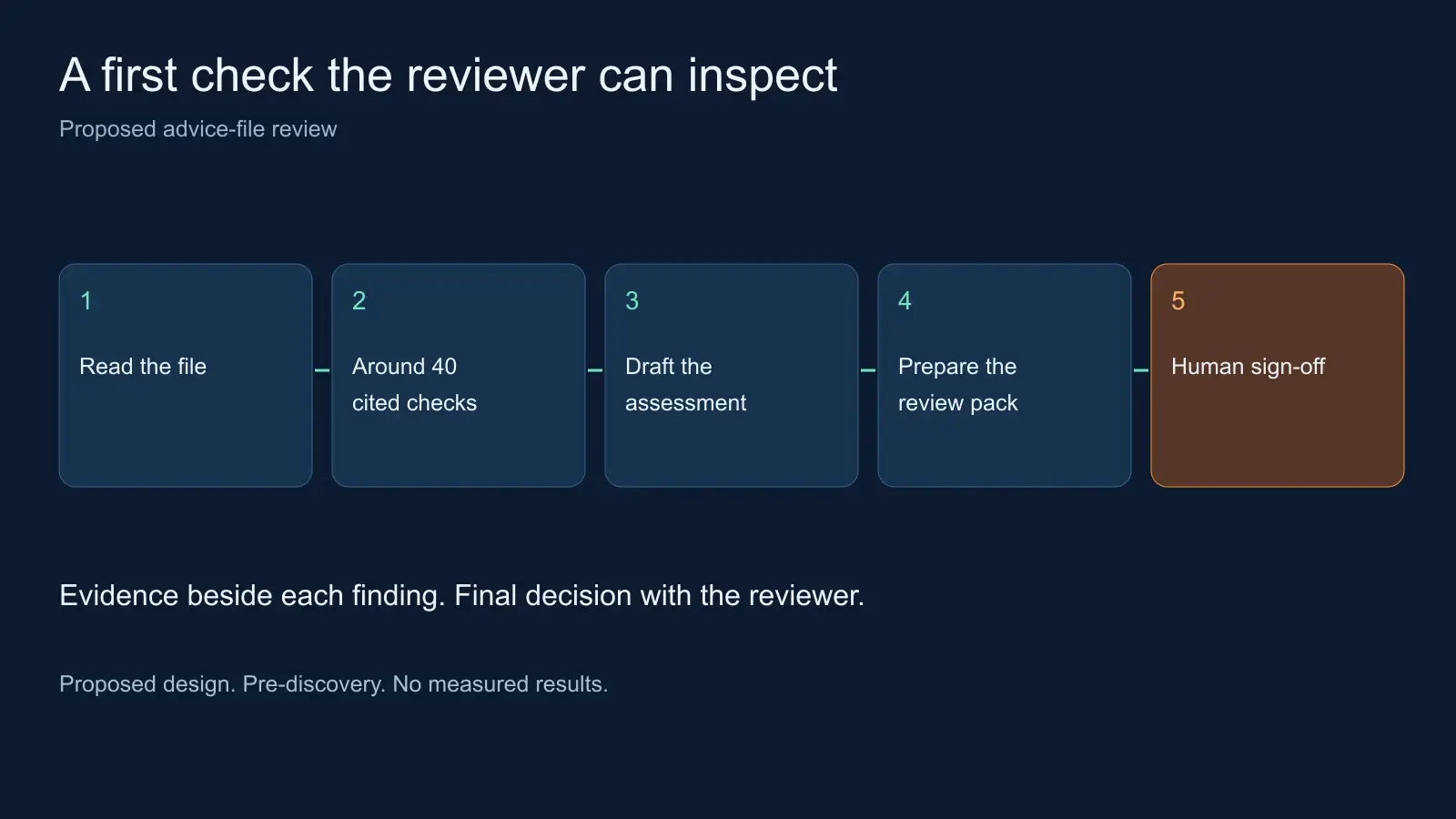
Our financial-advice compliance review example illustrates a related proposal-stage workflow with human review. It is not an insurance deployment or evidence of realised savings.
What should AI not decide on its own?
Keep underwriting decisions, client rejection and claims-settlement decisions with the responsible authorised person. AI can organise source material, identify missing information and draft a review pack for them.
Agree the boundary before connecting live systems. Define what must be escalated, what evidence the reviewer needs and who may approve a write-back or external message. Check the proposed use with your compliance lead; this example is not a regulatory assessment.
What is the cheapest useful next step?
Open the hiring plan and mark roles linked to work you could measure. That costs nothing and exposes whether the financial case has a decision behind it.
Next, measure a process and use the calculator with your own assumptions. Compare the expected case with a cautious version before discussing a wider rollout.
Read Four ways to make a regulated firm AI-native to compare adoption through existing tools with connected workflows and custom agents. If the evidence warrants further work, discuss your discovery scope. A paid discovery replaces the starting assumptions with your firm's baseline and a scoped proposal.
Frequently asked questions
How long before AI pays back for an insurance broker?
There is no universal payback period. The Softblues example shows month 14 with three planned hires that can wait, and no payback within 24 months when no financial use of the time is selected. Both are illustrative outcomes under the same starting assumptions.
Do we need a custom build, or are Claude or Copilot seats enough?
Start by testing the work in an approved existing tool. Drafting from a house template may need a better procedure and review process. Unattended work across systems, with exceptions and an evidence trail, can justify a connected workflow or build. Softblues scopes that distinction before recommending implementation.
What data leaves the firm?
That depends on the chosen service, configuration and connections. Confirm processing, storage, permissions and retention with IT and compliance before using client documents. This calculator comparison does not establish a platform's suitability for your data.
What should we measure first?
Choose a frequent process with a named owner and a clear definition of an acceptable result. Measure volume and human time, including checking and rework. Softblues uses that baseline to compare the proposed approach with the current one.
Does saved time count as money?
It has a capacity value, but it becomes financial benefit only through a supported decision. Record which cost disappears or which additional margin becomes possible. Keep improvements to service quality visible without automatically treating them as cash savings.
Work out your numbers
One key process
Process automation ROI calculator
Five questions about one process. See the hours an AI agent frees up, what they are worth and how much becomes profit.
Work out your numbersYour whole firm
AI ROI calculator
Five questions about your firm. See the time AI frees up, what it is worth and when it pays for itself.
Work out your numbers
Free. No sign-up. Your answers stay in your browser.
See it in production
Systems we have built and run for clients, with the numbers that came out of them.