
AI for Insurance Claims Triage: How to Route Submissions Faster
UK motor insurers paid £11.9bn across 2.5 million claims in 2025. Here is how AI first-pass triage reads and routes submissions in minutes, and where a human handler still has to sit.
By Ivan Pylypchuk (opens in a new tab), CEO of Softblues
UK motor insurers paid out £11.9bn across 2.5 million claims in 2025 (ABI, Feb 2026). Every one of those claims started with a first notice of loss that someone had to read, understand and route to the right place. When that first step is slow, the whole claim is slow, and under Consumer Duty a slow claim is now a compliance question as well as a cost one.
This guide is about using AI for the first pass: reading a submission or claim as it arrives, checking it is complete, and routing it to the right queue. It is a walkthrough for operations leaders in broking, MGAs and claims teams, and it is honest about where the human still has to sit.
What does AI first-pass triage actually do?
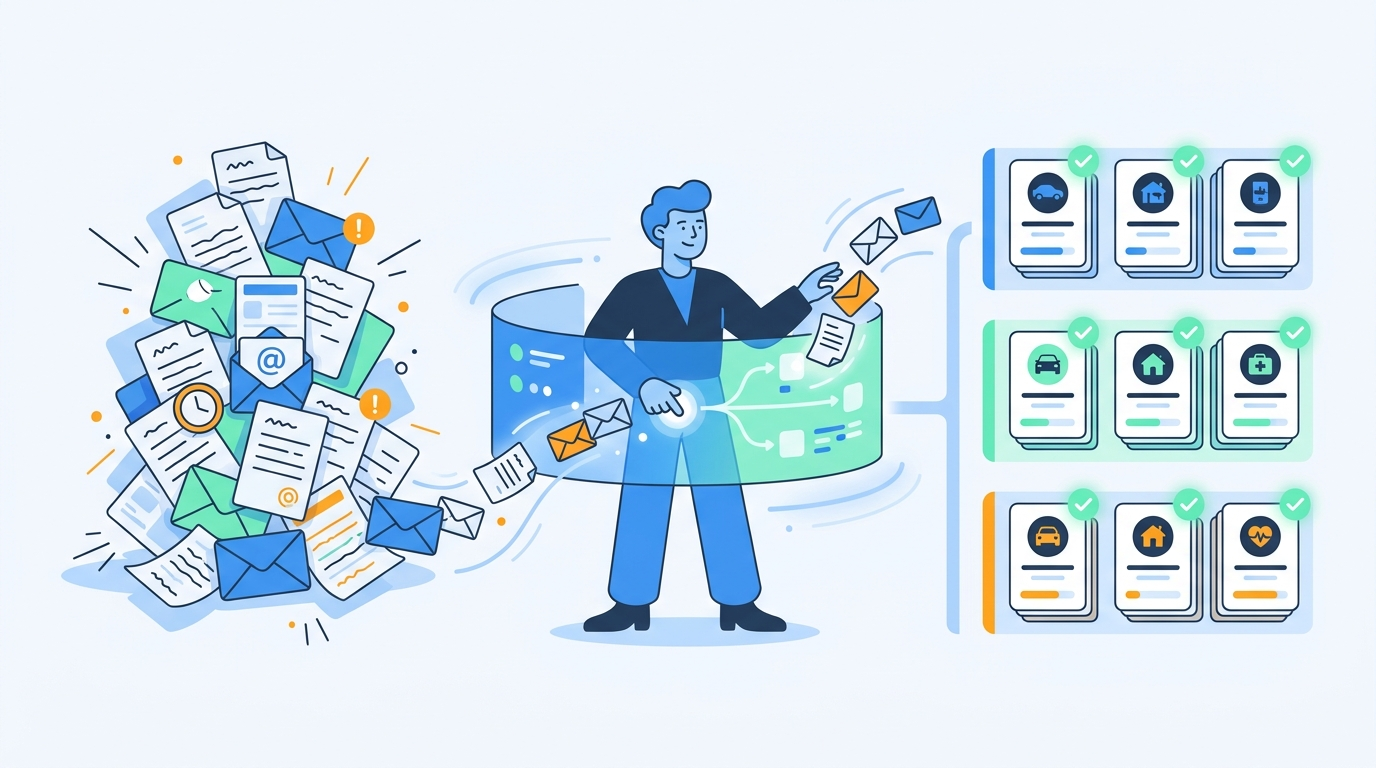
When a submission or a claim arrives, whether by email, form or portal, the model reads it and does four things. It pulls the key details into structured fields. It checks whether anything mandatory is missing. It classifies the type and rough complexity. Then it routes the case to the right queue, with a draft summary for the handler.
The handler still owns the decision. What changes is that they open a tidy, complete case with the obvious work already done, instead of a raw email they have to decode from scratch.
Why is manual intake so expensive?
Because the first few minutes of a claim shape everything after it. Every minute a person spends collecting information, re-keying it and deciding where it goes is loss-adjustment expense, and it happens on every single case. Multiply that by 2.5 million motor claims in a year and small inefficiencies become large numbers.
Manual triage also introduces delay and inconsistency. A complex case that sits in a general queue for two days is a case where costs quietly grow and the customer experience slips. When the same triage is applied to every submission in minutes, the urgent cases surface early and the simple ones stop clogging the queue.
What should stay with your people?
This is the honest part. AI is good at the mechanical first pass. It should not decide whether a policy covers a loss, set a reserve, or authorise a payment. Those are judgement and liability decisions.
Extraction and structuring: safe to automate. Completeness and validation checks: safe to automate, with clear rules. Classification and routing: safe to automate, with a confidence flag. Coverage, reserving and settlement: keep with a qualified handler, every time.
How to build claims triage with AI (a practical walkthrough)
Start narrow, prove it, then widen. Here is the order.
1. Pick one high-volume intake channel. Choose your busiest, most standardised submission type first. Do not start with the messy edge cases.
2. Define the fields and the rules. Agree what "complete" means for that channel: which fields are mandatory, what a valid value looks like, and what should trigger a human review.
3. Extract and validate. The model reads each incoming submission, fills the structured fields, and flags anything missing or inconsistent against your rules.
4. Classify and score. It tags the type and a rough complexity, and attaches a confidence score so you can route the uncertain ones to a person.
5. Route with a summary. Each case lands in the right queue with a plain-English summary and the source attached, ready for the handler.
6. Keep humans on coverage. Reserving, coverage and settlement stay manual. The triage layer sets them up; it does not make them.
This is the same order-to-action pattern we used in our order-to-schedule automation for a secure-logistics operator: read the incoming request, structure it, route it, and leave the judgement calls with the team. The proof-of-concept scoped the workflow before anything went near production.
Build, buy, or hire it out?
| Approach | Best for | Watch out for |
|---|---|---|
| Off-the-shelf claims platform | Firms wanting standard FNOL intake fast, with common lines | Generic extraction; limited fit for niche products or your own routing rules |
| Custom AI triage layer | Brokers, MGAs and claims teams with specific products and their own systems | Needs clear rules and a review step; you own the upkeep and the audit trail |
| Keep it fully manual | Very low volumes, or highly bespoke claims | Cost per case stays high; hard to scale without adding headcount |
Most mid-market teams land on a custom layer that sits in front of the systems they already run, rather than replacing them. It reads the intake, does the first pass, and passes clean cases to the existing workflow.
Where does the compliance angle come in?
Under Consumer Duty, firms have to deliver good outcomes promptly. A submission that sits unread for days is a poor outcome you can now be asked to explain. A triage layer that timestamps every case, applies the same checks to all of them, and keeps an audit trail helps you show that intake is consistent and fast. Speed and fairness stop being in tension.
If you want the wider view on governed automation in regulated firms, our guide to AI in financial services and our piece on where to start with back-office automation both cover the controls side.
Red flags to avoid
Auto-settling anything. If the tool can progress a claim to payment without a human, stop. That is not triage, that is unmanaged risk.
No confidence score. Without one, you cannot route the uncertain cases to a person, and the model's mistakes become your mistakes.
No audit trail. Every triage decision needs a record: what the model saw, what it did, and who reviewed it.
Starting with the hard cases. Prove the workflow on your cleanest, highest-volume channel before you point it at the complex claims.
Frequently asked questions
Will AI triage reject valid claims?
Not if it is built correctly. The model does not accept or reject claims. It reads, checks completeness and routes. Coverage decisions stay with a handler, so a triage layer cannot decline a claim on its own.
Can it read claims that arrive by email and attachments?
Yes. A capable model can read free-text emails, forms and common document formats, pull the details into structured fields, and flag what is missing. Unusual or low-quality documents get routed to a person.
Is our data safe going through an AI model?
It can be, with an enterprise setup where your data is not used to train the model, with an audit trail and confirmed security arrangements. We build our workflows around ISO 27001 information-security principles.
How much manual work does it actually remove?
It removes the reading, re-keying and routing on your standardised, higher-volume intake. The judgement work stays with your team. The gain is that handlers open complete, tidy cases instead of raw submissions.
How long before it is running?
A first version handling one high-volume channel can be live in weeks. Widening it to more products and edge cases is done in stages once the first channel is proven.
What does it cost?
It depends on your volumes and how many channels you cover. Our first paid session, Mapping and Strategy, where we scope the workflow for your products and systems, costs £2,000 to £5,000. If an off-the-shelf platform would serve you better, we will say so.
Does it work for insurance beyond motor?
Yes. The same first-pass pattern applies to property, commercial and specialty submissions. The rules and fields change; the approach of extract, check, classify, route does not.
Softblues is an OpenAI Select Partner, Certified in the Claude Partner Network, a Google Cloud partner at Services Select tier, and a member of the Microsoft AI Cloud Partner Program. We build for regulated firms in the UK and Ireland. We put governed AI into production after a paid discovery, with the timeline and the price in the proposal before any build starts. We run these workflows in our own operations before we sell them, so we can be straight with you about where they help and where they do not.
If you want to see what a triage layer would look like for your submissions and your systems, book a discovery call or read more about our business automation work.
Work out your numbers
One key process
Process automation ROI calculator
Five questions about one process. See the hours an AI agent frees up, what they are worth and how much becomes profit.
Work out your numbersYour whole firm
AI ROI calculator
Five questions about your firm. See the time AI frees up, what it is worth and when it pays for itself.
Work out your numbers
Free. No sign-up. Your answers stay in your browser.
See it in production
Systems we have built and run for clients, with the numbers that came out of them.
Related Articles
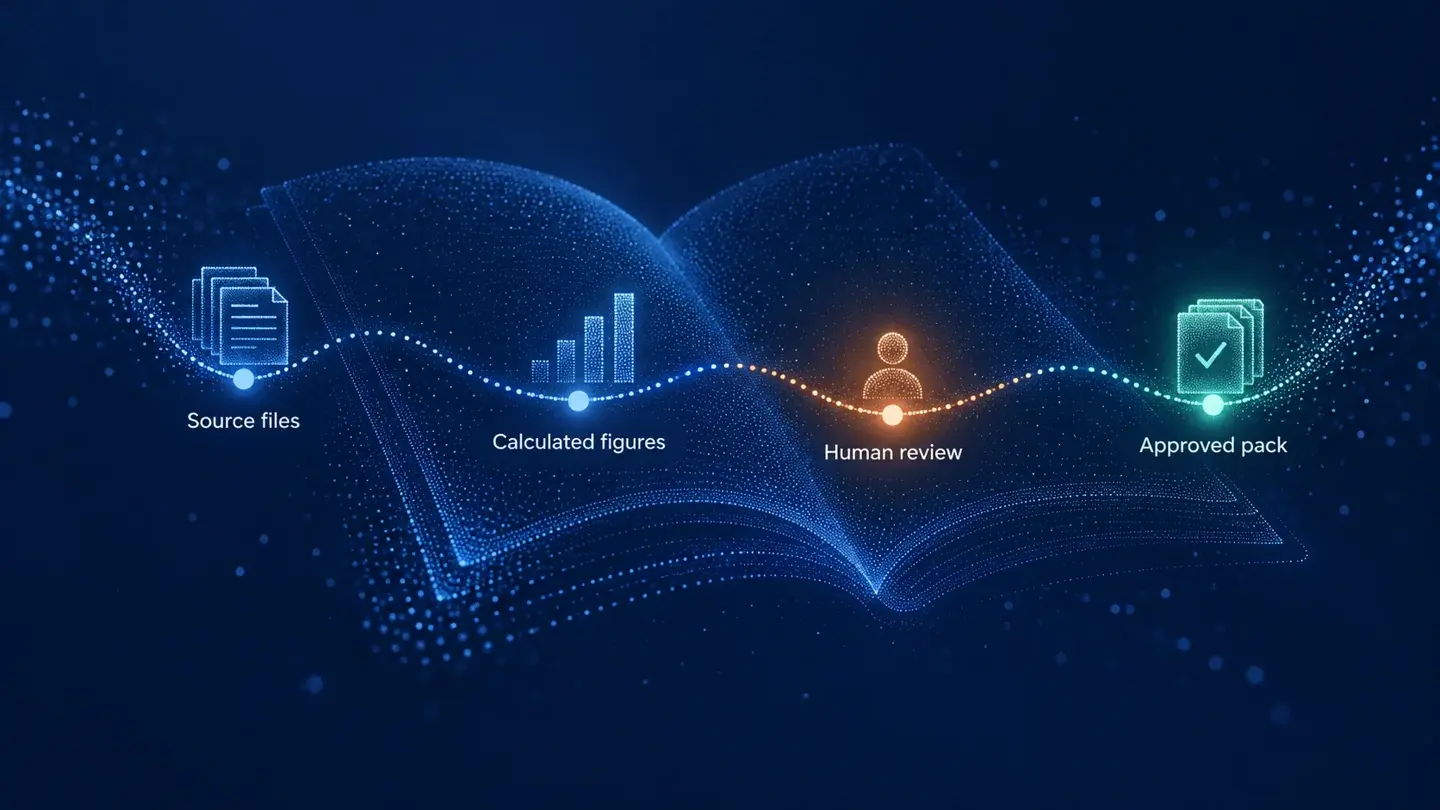
Claude in Excel for the month-end pack: what AI prepares and finance signs

AI meeting notes: the client file workflow for UK firms