AI meeting notes: the client file workflow for UK firms
Turn AI meeting notes into an approved client record. Compare Teams, Claude and ChatGPT, with a practical review, filing and retention procedure.

By Ivan Pylypchuk (opens in a new tab), CEO of Softblues. Last checked: 29 September 2026.
AI meeting notes can turn an approved transcript into a draft client file note and follow-up actions. A responsible professional still checks what was said, confirms the advice and approves the record. For a Microsoft-first firm, start with Teams and Copilot, then test another assistant only where the note needs more work.
Softblues is a London software company helping UK and Irish firms become AI-native. This procedure is Agent 2, Meeting notes, actions and client file note, at P1, the in-seat tier, in our AI adoption guides. It needs a governed assistant and an agreed process before it needs a custom build.
What should you know before choosing a tool?
Key facts, checked 29 September 2026.
| Platform or authority | Key fact | Primary source |
|---|---|---|
| Microsoft Teams | The default recording and transcript expiry is 120 days; expiry is not a compliance retention policy. | Microsoft recording options |
| ChatGPT | Record is available in the macOS desktop app; its transcript and notes follow workspace retention settings. | OpenAI Record documentation |
| ChatGPT Enterprise/Edu | Eligible workspaces can select UK storage; UK inference residency is not offered. | OpenAI residency documentation |
| Claude commercial products | Anthropic states that data is stored in the US; processing and routing are a separate question. | Anthropic Privacy Center |
| SRA | Professionals remain accountable for AI-assisted work and must protect client confidentiality. | SRA warning notice |
The distinction worth taking into procurement is between storage, processing and retention. A UK storage location tells you neither how long every copy survives nor who approved the final note. Ask for those answers separately.
How do you measure the job your firm does today?
Start with the complete journey from meeting end to an approved, retrievable record. An adviser may dictate a note, an assistant may tidy it, and someone else may enter actions into the client system. Faster drafting helps only if checking and filing also work.
There is no reliable universal time saving to apply to your firm here. Sample comparable meetings from your own practice. Record preparation minutes, correction minutes, filing time and any later rework. Keep elapsed waiting time separate from working time.
For a pilot, compare the same type of meeting and the same standard of accepted note. Track missing decisions, wrong owners, unsupported statements and unresolved questions. Count a note as complete only when the responsible person has approved it and another authorised colleague can retrieve it. These are proposed measurement criteria, not results from a Softblues deployment.
Get the deck. Four ways to make a regulated firm AI-native compares the routes and eleven worked examples, including Agent 2. The free 21-slide PDF is available through a short form; the longer research document supports a discovery conversation.
What is the procedure from meeting to client file?
Use the firm's approved file-note template. This example assumes an ordinary client meeting that may be transcribed under the firm's policy. Specialist recording rules must be built into the process first.
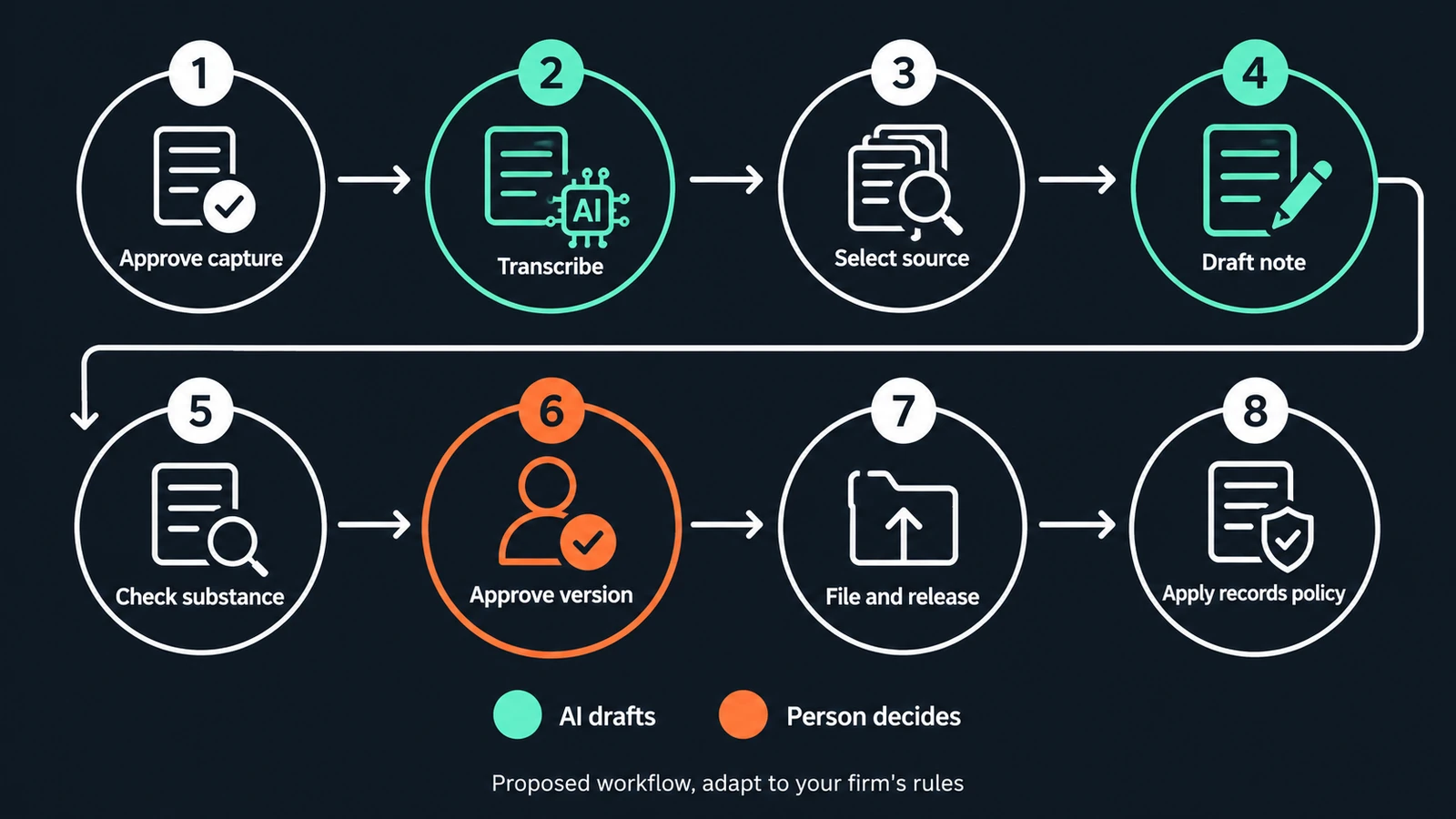
1. A person approves the capture method. Before the meeting, confirm whether recording is necessary, the lawful basis, confidentiality restrictions and required notices or consents. If written minutes are sufficient, use them. Explain the purpose and retention arrangements to participants.
2. AI transcribes the permitted source. Capture through the approved tool and account. The meeting owner checks attendance and speaker names. Mark unclear passages for review instead of allowing the assistant to guess who accepted an action.
3. A person selects the material for drafting. Supply the authorised transcript or notes, the current template and the correct client or matter identifier. Keep unrelated documents out. Confirm that the selected assistant is approved for this information before copying anything into it.
4. AI drafts the note and proposed actions. Ask for attendees, topics, advice actually given, risks discussed, decisions and actions with owners and dates. Require a source reference for material statements. Missing evidence must appear as an unresolved item, never as a completed field invented by the model.
5. A person checks the substance. The adviser compares the draft with the source and their own knowledge of the meeting. For example, "we could send this on Friday" must not become "the client agreed a Friday deadline". Resolve ambiguity with the relevant person and record the correction.
6. The responsible professional approves. This is the approval point. Save the approver, date and approved version. AI must not approve its own account of the advice, send the follow-up or silently turn a suggested action into a client commitment.
7. A person files and releases the approved work. Put the note in the client or matter system, check permissions and verify the identifier. Send the approved follow-up and assign confirmed actions. An assistant may prepare these items; automated writes need separately tested permissions and approval controls.
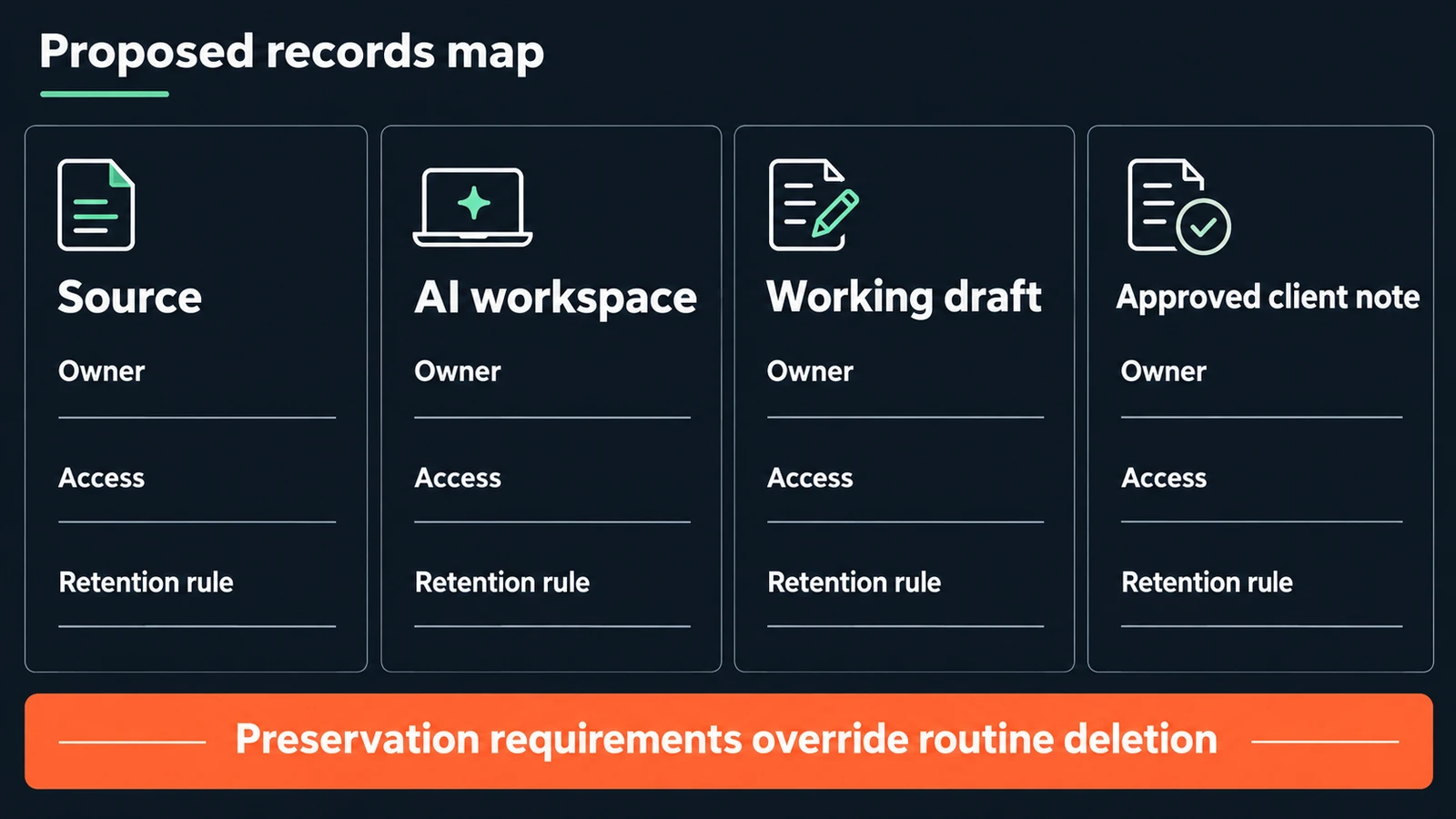
8. A person applies the records policy. Check the recording, transcript, AI conversation, draft and filed note against the applicable retention and preservation rules. Test retrieval and authorised disposal. A hold or other preservation requirement takes precedence over routine deletion.
For the downstream handoff, our meeting notes to CRM guide covers turning the approved output into operational actions. Keeping approval before that handoff prevents an uncertain sentence becoming an instruction elsewhere.
Which platform should a Microsoft-first firm use first?
Try the tools already approved for Teams and Office first. Our recommendation is about reducing handoffs, not a measured ranking of summary quality. Test the same permitted source and template before adding another subscription.
| Decision | Teams and Copilot | Claude | ChatGPT |
|---|---|---|---|
| What it does here | Uses meeting context to draft summaries and actions; export the working draft for review. Microsoft | Drafts from approved source material against the firm's instructions; an authorised Microsoft 365 connector can supply accessible files. Anthropic | Record transcribes and summarises audio; review and reshape the resulting note. OpenAI |
| What needs enabling | Appropriate licence, meeting policy and transcription configuration. Microsoft | Approved business workspace; Microsoft admin consent and user access for the connector route. Anthropic | Supported plan and macOS app for Record; workspace controls must permit it. OpenAI |
| Where the record ends up | Recap and source remain in Microsoft services; our procedure files the approved note in the client system. Microsoft | Our procedure explicitly files the approved output; a chat response is not the client record. | Record notes and transcripts remain in chat/workspace history; our procedure separately files the approved note. OpenAI |
| Honest limit | Meeting expiry does not enforce the firm's retention obligations. Microsoft | Test access to the actual source; a Teams connection does not prove every recap is retrievable. | Mac-only Record is not a Windows capture route. Transcription errors still need checking. OpenAI |
Filing and approval in this table are our proposed procedure. If your approved assistant already produces an acceptable note, keep it. Add Claude or ChatGPT when a controlled trial shows a useful improvement in the completed work.
What do the SRA, FCA and ICO expect?
The SRA's warning notice emphasises accuracy, supervision and confidentiality. Paying for a tool does not establish that its safeguards are appropriate. For a solicitor in England and Wales, review the contractual and technical arrangements before processing client material, and keep professional judgement with the responsible person. The SRA does not prescribe this particular eight-step template. SRA, checked 29 September 2026.
FCA SYSC 9 requires records that support regulatory supervision, with scope and detailed requirements depending on the firm's business. Do not assign one retention period to every financial-services meeting. Have compliance map the relevant activity and record type to the applicable rules, then configure and test the systems accordingly. A neat summary alone does not demonstrate that obligation was met. FCA SYSC 9, checked 29 September 2026.
The ICO says to consider less intrusive alternatives, justify the lawful basis and tell participants the recording purpose, use and retention. Consent is not the only possible lawful basis under UK GDPR; any separate professional or contractual consent requirement still matters. Irish firms need their own regulatory mapping rather than treating SRA and FCA rules as Irish law. ICO, checked 29 September 2026.
What can you do this week, cheapest first?
Start without new software spend: ask the process owner, "Show me where the approved note lives and who can retrieve it." A good answer identifies the client record, approval evidence and applicable policy. Fix gaps in that route before adding AI.
Next, use existing approved licences where available. Ask IT, "Can we test one permitted meeting type through drafting, approval and filing?" A good answer includes the source, access controls and a retrieval check, with any additional licence or usage charge identified first.
Consider extra tooling only if the trial exposes a specific limitation. Ask the supplier to repeat the same job and show correction effort and the final record. Judge the whole process before commissioning automated filing. Our rollout and training approach follows that sequence.
Softblues helps firms establish the working procedure and choose the smallest suitable implementation. Our anonymised financial-advice compliance file-review case describes discovery and a proposed approach, not claimed production savings.
Frequently asked questions
Can a law firm use AI meeting transcription?
Potentially, where the firm establishes an appropriate lawful basis and safeguards for the information involved. Follow applicable confidentiality duties, recording notices and consent requirements, then have a responsible professional review the output.
Are AI meeting transcripts discoverable?
In England and Wales, a transcript can fall within the broad document definition in CPR Part 31. Disclosure depends on the applicable procedure, relevance and privilege. Preserve material when required and seek matter-specific advice.
Does Copilot meeting recap retention match the client file?
Do not assume it does. Microsoft distinguishes recording expiry from compliance retention controls, so test the actual policy for each relevant artefact and the filed note.
Does UK data storage mean UK processing?
No. OpenAI lists UK storage for eligible Enterprise/Edu workspaces but no UK inference-residency option. Check the product, feature and contract separately rather than applying a workspace setting to every integration.
Book a discovery call to assess one meeting-to-file workflow and the controls it needs.
Sources and verification date
Primary vendor and regulator pages are linked beside their claims. Checked 29 September 2026: Microsoft meeting recap, recording options and recording compliance; Anthropic connector and server-location documentation; OpenAI Record and residency documentation; SRA misuse-of-AI notice; FCA SYSC 9; ICO data-sharing advice. The workflow and trial criteria are Softblues recommendations, not measured savings.
Work out your numbers
One key process
Process automation ROI calculator
Five questions about one process. See the hours an AI agent frees up, what they are worth and how much becomes profit.
Work out your numbersYour whole firm
AI ROI calculator
Five questions about your firm. See the time AI frees up, what it is worth and when it pays for itself.
Work out your numbers
Free. No sign-up. Your answers stay in your browser.
See it in production
Systems we have built and run for clients, with the numbers that came out of them.
Related Articles
Claude in Excel for the month-end pack: what AI prepares and finance signs
AI Automation Pricing UK 2026: What Providers Actually Charge