
AI for Credit Control: How UK Companies Chase Overdue Invoices Without Adding Headcount
Chasing money you are already owed costs a UK business owner 86 hours a year. Here is what AI can safely take off a credit controller's desk, where the human has to stay, and what the Commercial Payments Bill changes.

By Ivan Pylypchuk (opens in a new tab), CEO of Softblues
Chasing money you are already owed costs a UK business owner 86 hours a year, and the country 133 million staff hours (Department for Business and Trade, March 2026). None of those hours create anything. They recover cash that was contractually yours 30 days ago.
Credit control is one of the few finance jobs where the work is genuinely repetitive, the data already sits in your accounting system, and nobody enjoys doing it. That makes it a good first automation, and a bad place to hand over judgement. The distinction matters, so this post separates the two.
The short answer for a UK mid-market finance team: let AI draft and time the chasing, keep a human on every decision that affects the customer relationship, and measure it in days sales outstanding rather than emails sent.
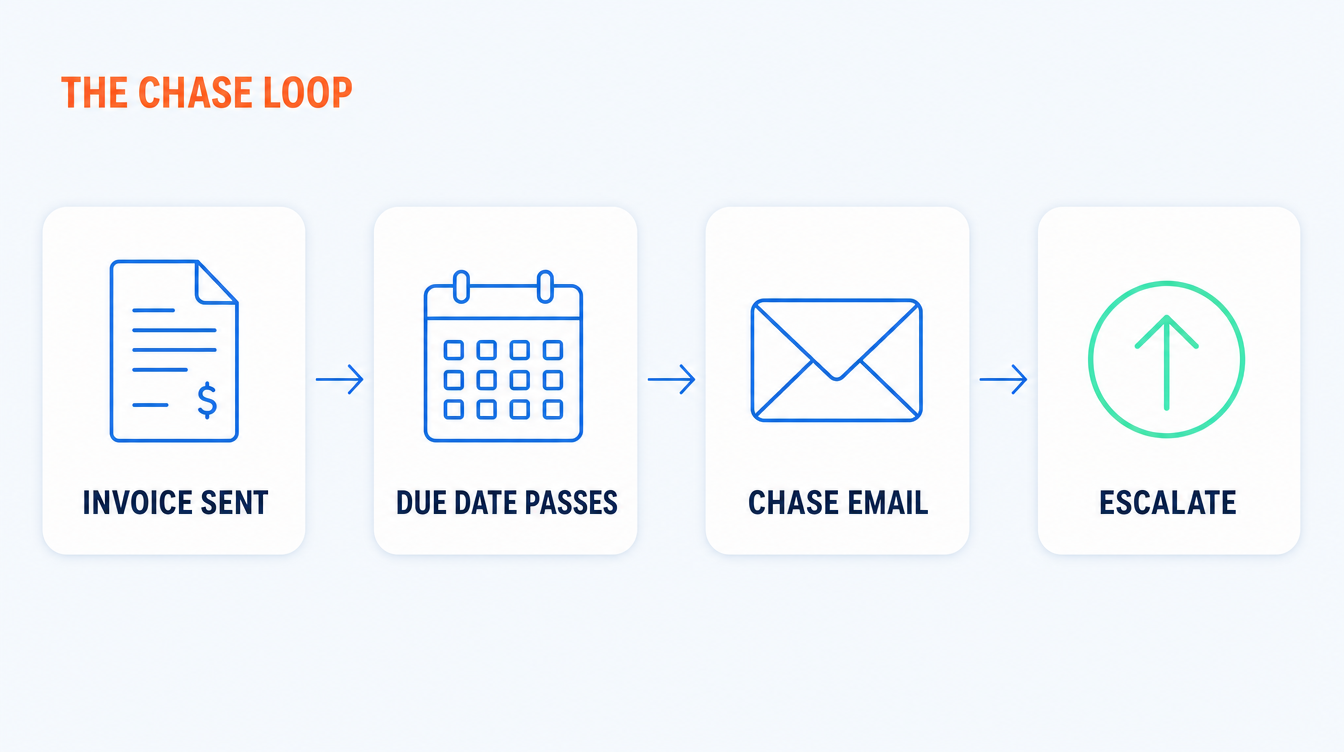
Key facts
- Late payments cost the UK economy £11 billion a year and close 38 UK businesses every day (Department for Business and Trade, May 2026).
- Business owners affected by late payment lose 86 hours a year chasing invoices, or 133 million staff hours nationally (DBT consultation response, March 2026).
- Over 1.5 million businesses, around 28% of UK businesses, are affected by late payment each year (same source).
- In Q1 2026 there were 17.48 million overdue invoices on UK books, up 3% year on year, spread across 1.57 million businesses (R3 Business Health, via Credit Connect, April 2026).
- The Commercial Payments Bill entered Parliament in May 2026. It caps B2B payment terms at 60 days and mandates interest on late payments at 8% above the Bank of England base rate (DBT, May 2026).
- The bill also gives the Small Business Commissioner power to investigate persistent late payers, adjudicate disputes outside court, and impose financial penalties (same source).
Why is credit control still manual in most mid-market companies?
Because the work is easy to describe and hard to systemise. Sage, Xero or NetSuite will tell you who is overdue. What they will not do is read the last four emails from that customer, notice that the finance director promised payment on the 14th, check whether the delay is a genuine dispute over a delivery note, and write a chase that reflects all of it.
So a person does that. They open the aged debtors report, work down it, and write each message from memory. On a book of 400 accounts that is a full day a week, and the quality drops as they go. The accounts at the bottom of the list get a template.
There is a second reason, less often admitted. Credit control is relationship work. Send the wrong tone to your largest customer and you have created a commercial problem to solve a cash problem. Most finance leaders would rather absorb the manual cost than risk that, and they are right to be cautious. The answer is not to remove the human. It is to remove the typing.
What can AI actually do in credit control?
Four things well, and they are all preparation rather than decision.
It reads the account before you do. Given the ledger, the invoice history and the email thread, a model can produce a short brief: how much is outstanding, how far past terms, what was last promised and by whom, whether there is an open dispute, and how this customer has behaved over the last year. That brief is what a good credit controller builds in their head. Having it written takes the research time to near zero.
It drafts the chase in the right register. A first reminder to a reliable customer who is four days late should not read like a final notice to a serial offender. A model that has the account history can pitch the tone, reference the specific invoice numbers and amounts, and quote the promise the customer already made. A human then approves or edits and sends.
It notices the pattern you would miss. Payment behaviour drifts before it breaks. A customer who paid on day 32 for a year and is now paying on day 55 is telling you something. Reading that across hundreds of accounts is exactly the sort of pattern work that suits a model and bores a person.
It keeps the record straight. Every promise, dispute and callback logged against the account, in a consistent format, without anyone remembering to write it up. That record is what makes the next chase good, and what you need if the debt ever goes further.
What it should not do is decide. Whether to put an account on credit hold, whether to accept a payment plan, whether to instruct a solicitor: those are commercial calls with consequences that outlast the invoice.
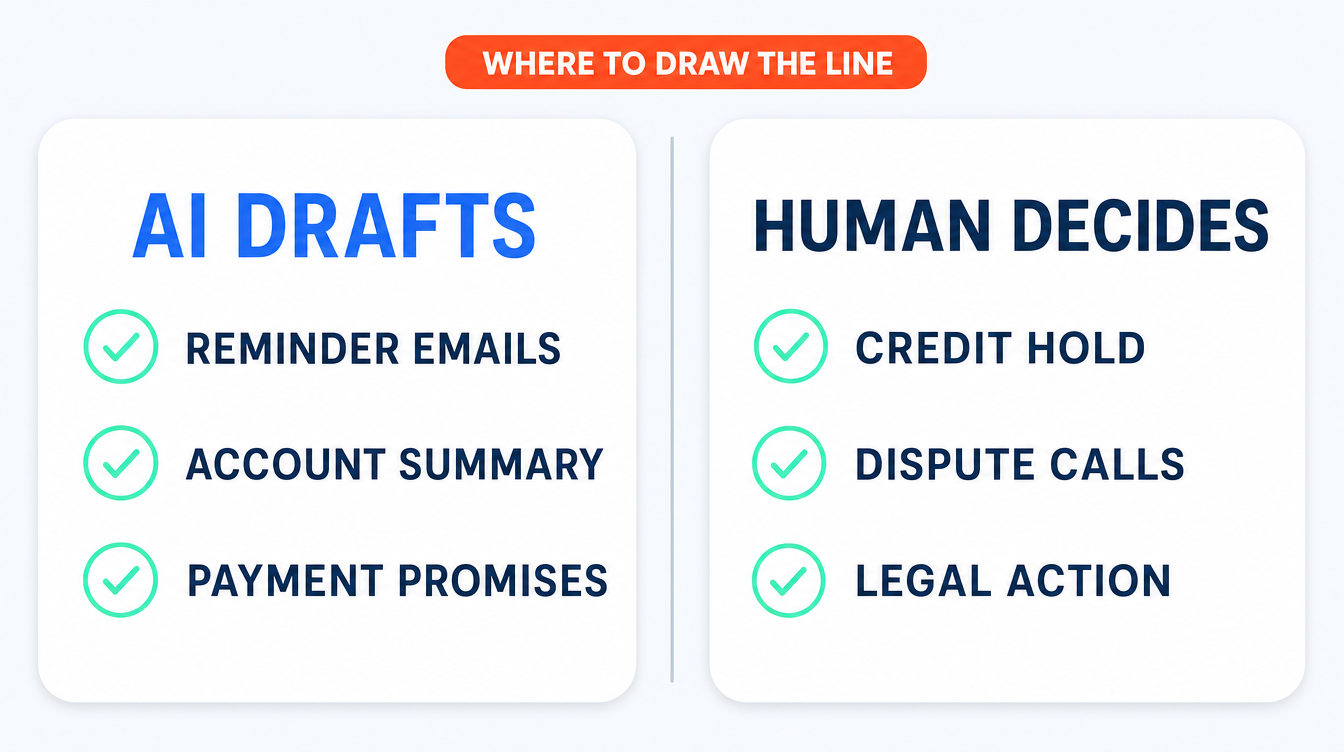
Where should the human stay in the loop?
At the point where the action changes the commercial relationship. In practice that means a human approves anything that stops supply, anything that concedes money, and anything that goes to a lawyer. Everything before that can be drafted, queued and sent under a rule the finance director set.
A workable split looks like this. First and second reminders go out automatically once approved as a batch, because they are routine and the cost of an error is an apology. From the third contact onward, the model prepares the message and a human sends it. Credit holds, payment plans and escalation always sit with a named person. We wrote up the general principle in where the human belongs in an automated workflow, and credit control is close to the textbook case: high volume, low individual value, occasional high-consequence exceptions.
The practical test is whether your controller can explain, in one sentence, why each automatic message went out. If they cannot, the rule is too clever.
How does AI credit control compare with the alternatives?
Four routes, and three of them are sometimes right.
| Route | Best for | Avoid if | Cost shape |
|---|---|---|---|
| Hire another credit controller | Books with heavy phone work, complex disputes, or a genuine need for relationship depth | Your problem is volume of routine emails rather than difficult conversations | Salary, NI and pension, fixed monthly, whatever the workload |
| Collections agency | Genuinely aged debt you have already given up on internally | The account is a customer you want to keep next year | Percentage of what they recover, so it only pays on old debt |
| Accounts-receivable SaaS | Standard ledgers in a mainstream accounting system, plain reminder sequences | Your chasing depends on context the tool cannot see, such as email threads and contract terms | Per-user or per-invoice monthly licence, plus setup |
| AI workflow on your own stack | Mid-market books where context lives across ledger, email and contracts, and you want the rules to be yours | You have fewer than about 100 open accounts, where a person and a spreadsheet still win | Build once, then model usage. See our AI total cost of ownership breakdown |
The honest position: if you run a clean Xero ledger and your late payers just need a nudge on a schedule, buy the receivables tool and stop reading. The custom route earns its keep when the reason an invoice is late lives outside the accounting system, which for most B2B mid-market firms it does.
What does the Commercial Payments Bill change for your process?
More than most finance teams have priced in. The bill caps B2B payment terms at 60 days with narrow exemptions, mandates interest on late payment at 8% above base rate, and gives suppliers a right to a fixed sum when a purchaser raises a late or unsubstantiated dispute (DBT, May 2026). Large companies will also have to report the interest they have paid and the interest they owe.
Two consequences for your workflow. First, mandated interest turns accurate day counting into money, so the arithmetic has to be right on every invoice rather than roughly right on the big ones. Second, if you are the purchaser, raising a vague dispute to buy time becomes expensive, which means your own approval and query process needs to produce a specific reason quickly.
Both of those are record-keeping problems, and record keeping is what automation is genuinely good at. The government has said there will be a lead-in period and a transition before the powers come into force, so there is time. Not a lot of it.
How would you build this in 90 days?
1. Fix the data first. Pull the aged debtors report and check it against reality. Duplicate accounts, credit notes never applied, invoices sent to a person who left: this is normally where a fifth of the overdue balance hides. Our AI data readiness guide covers what "ready" means in practice.
2. Write the escalation rules on one page. Day 3, day 10, day 21, day 35, and what happens at each. Who signs off a hold. What the maximum payment plan is without a director. If your team disagrees about any line, you have found the thing that was slowing them down.
3. Connect the model to the systems, read-only. The accounting ledger, the shared finance inbox, and wherever contract terms live. Read-only at first, so the worst possible failure is a bad draft nobody sent. This is what MCP connections are for.
4. Run it in shadow mode for three weeks. The model produces the daily chase list and the drafts. Your controller works as normal and compares. You are measuring one thing: what proportion of drafts they would have sent unchanged.
5. Turn on the low-risk half. First and second reminders send after a batch approval. Everything from the third contact stays manual. Watch days sales outstanding, not email volume.
6. Review the exceptions monthly. Every draft the controller rewrote is a rule you got wrong. Fix five of them a month and the system gets better; ignore them and it silently stops being used.
What goes wrong
Automating the tone. A reminder that sounds like a machine gets forwarded round the customer's office as a joke, and your credit controller spends a week repairing it. Every message that leaves the building should read like it came from a person, because a person approved it.
Sending on volume rather than value. It is tempting to chase everything equally because the system now can. Your top 20 accounts by exposure deserve a phone call from a human being, and always did.
Skipping the dispute path. A good share of late payment comes down to an unresolved query rather than reluctance to pay. If your automation cannot recognise "we are not paying because the delivery was short" and route it to someone who can fix it, you will annoy customers who were never the problem.
Measuring the wrong thing. Emails sent is not a result. Days sales outstanding, cash collected inside terms, and controller hours released are results.
Frequently asked questions
Will AI credit control damage customer relationships? It will if you let it send unreviewed messages to accounts that matter. Used properly it improves relationships, because chases become accurate and specific rather than generic. The rule we apply is that a human approves anything past the second reminder, and always for your largest accounts.
Do we need to replace our accounting system? No. The point of this pattern is that your ledger stays where it is. The model reads from Xero, Sage, NetSuite or whatever you run, alongside the finance inbox, and writes back a log. Replacing a finance system to enable automation is the expensive way round.
Is this the same as accounts-receivable software? Not quite. Receivables tools automate the sequence: send reminder one on day 5, reminder two on day 12. They work from ledger data. The pattern here adds the context that sits outside the ledger, mainly email threads and contract terms, and drafts accordingly. If your chasing needs no context, the off-the-shelf tool is cheaper and you should use it.
How long before we see a change in cash? Expect to see draft quality plateau in about three weeks of shadow running. Days sales outstanding moves more slowly, because it is measured against payment behaviour that has months of habit behind it. One full quarter is a fair first read.
What about GDPR and customer data? You are processing business contact details and payment history you already hold, for a purpose you already have a lawful basis for. What changes is where the data flows, so the model needs to run under your own tenancy with retention and access controls set by you, not through a personal chatbot account. Our AI governance guide covers the policy side.
Can it handle a customer in genuine difficulty? It can spot one earlier than a person will, from the pattern of slipping payment dates and part-payments. What to do about it is a commercial decision, and it should stay with your finance director.
Does this work for a smaller book? Under roughly 100 open accounts, probably not worth building. The manual cost is a few hours a week and a good controller with a decent template will beat the setup effort. The economics turn somewhere in the low hundreds of accounts.
What do we do about the Commercial Payments Bill right now? Check your standard terms against a 60-day cap, and make sure you can calculate statutory interest per invoice accurately rather than approximately. Both are worth doing before the powers come into force, whatever you decide about automation.
We are Certified in the Claude Partner Network and a Google Cloud partner at Services Select tier, and we build this kind of workflow into the systems a finance team already runs rather than around them. We have done the same pattern for a regulated file-review process, written up in our compliance file review automation case study, which was scoped as a discovery and proposal rather than a live deployment. If you want the honest version of what fits your ledger, including the case for buying a receivables tool instead, that is the conversation to have. More on the general approach on our business automation page.
Give your people the boring hours back. Book a call.
Work out your numbers
One key process
Process automation ROI calculator
Five questions about one process. See the hours an AI agent frees up, what they are worth and how much becomes profit.
Work out your numbersYour whole firm
AI ROI calculator
Five questions about your firm. See the time AI frees up, what it is worth and when it pays for itself.
Work out your numbers
Free. No sign-up. Your answers stay in your browser.
See it in production
Systems we have built and run for clients, with the numbers that came out of them.
Related Articles

Claude in Excel for the month-end pack: what AI prepares and finance signs

AI meeting notes: the client file workflow for UK firms