AI Data Readiness: How UK Mid-Market Companies Prepare Data for Automation
Gartner expects 60% of AI projects without AI-ready data to be abandoned. The model is rarely why automation fails. The data is. How to check whether yours is ready, and fix it before you build.
By Ivan Pylypchuk (opens in a new tab), CEO of Softblues
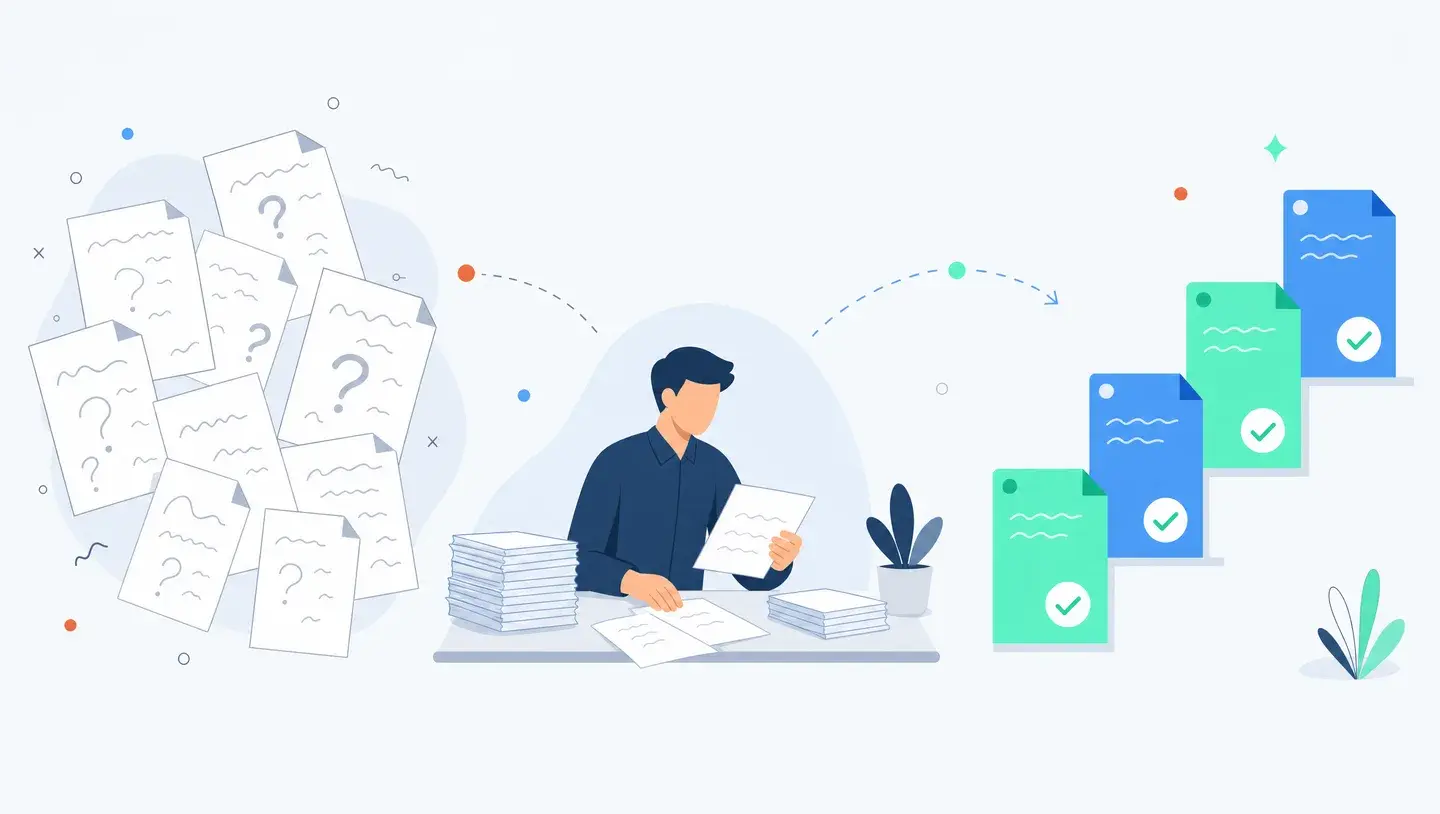
Gartner expects organisations to abandon 60% of AI projects that are not supported by AI-ready data through 2026 (Gartner, Feb 2025). The model is rarely the reason an automation project fails. The data feeding it is.
If you are a UK mid-market company planning to automate a process, invoice handling, client intake, month-end reporting, the question that decides success is not "which AI tool?" It is "is our data ready?" This guide explains what AI-ready data means in practice, how to tell whether yours is, and how to close the gap without a two-year data programme.
Key facts
- 60% of AI projects unsupported by AI-ready data will be abandoned through 2026 (Gartner, Feb 2025).
- 63% of organisations either do not have, or are unsure they have, the right data management practices for AI (Gartner survey of 248 data-management leaders, Q3 2024).
- At least 30% of generative AI projects will be abandoned after proof of concept by the end of 2025, with poor data quality a leading cause (Gartner, Jul 2024).
- AI-ready data is data that is aligned to a specific use case, governed at the asset level, and continuously quality-assured. It is not simply "data you have" (Gartner, Feb 2025).
What does "AI-ready data" actually mean?
AI-ready data is data prepared for a specific job: aligned to the use case, governed so you know where it came from and who can use it, quality-assured, and reachable through a reliable pipeline. It is not the same as "we have a lot of data." A CRM full of duplicate contacts and blank fields is data. It is not AI-ready data.
The distinction matters because AI amplifies whatever it is given. Feed an automation clean, consistent, well-labelled records and it produces reliable output. Feed it the messy reality of most mid-market systems, the same supplier spelled four ways, invoices in five formats, a "notes" field doing the work of ten proper fields, and it produces confident nonsense. The tool is not broken. The input is.
Why do so many AI projects fail on data?
Because teams pick the tool before they check the input. The 60% abandonment figure is not about weak models. It is about projects that ran into unusable data after the budget was committed. Gartner's own read is blunt: 63% of organisations do not have, or are unsure they have, the data management practices AI needs.
Three failure patterns show up again and again in mid-market automation.
Scattered sources. The data a process needs lives in a CRM, an accounting package, a shared drive and three inboxes. Nothing joins it up, so the AI only ever sees part of the picture.
Inconsistent formats. The same fact is recorded differently in each system. A human reconciles it by instinct. An automation cannot, unless you make the rules explicit.
No ground truth. Nobody can say which record is correct when two disagree, so the automation has nothing reliable to learn from or check against.
Each of these is fixable. But they are far cheaper to fix before you build than after a failed pilot has burned the goodwill.
How do you know if your data is ready?
Run a short readiness check on the specific process you want to automate, not your whole data estate. Ask five questions.
1. Is it accessible? Can the data be reached through an API or export, or is it locked in a system nobody can get data out of? If a human has to copy and paste it, so will the automation.
2. Is it consistent? Are suppliers, customers, dates and amounts recorded the same way across systems? List the mismatches. They become your cleanup rules.
3. Is it complete enough? Do the fields the use case needs actually get filled in, or are the important ones blank half the time?
4. Is it governed? Do you know where each dataset came from, who owns it, and what it may be used for? This is where compliance and AI readiness meet.
5. Is there a source of truth? When two systems disagree, is there a rule for which wins? Without one, the automation has no anchor.
A process that passes all five is ready to automate now. One that fails two or three is a data-preparation project first. Knowing which is true before you commit budget is the single highest-return hour you will spend.
AI-ready data vs "data you happen to have"
| Data you happen to have | AI-ready data | |
|---|---|---|
| Scope | Everything, undifferentiated | Aligned to a specific use case |
| Consistency | Same fact recorded many ways | Standardised, with explicit rules |
| Access | Locked in systems, manual export | Reachable through a reliable pipeline |
| Governance | Unclear ownership and lineage | Owned, traceable, permissioned |
| Trust | No source of truth | A rule for which record wins |
| Result | Automation that guesses | Automation you can rely on |
The gap between the two columns is the work that decides whether your project joins the 60% that get abandoned or the 40% that ship.
How to close the gap without a two-year programme
You do not fix an entire data estate. You make one process's data ready, ship the automation, then reuse what you learned on the next one. The disciplined sequence:
1. Pick one process, not the platform. Choose a single high-value, well-bounded task: invoice processing, client intake, a reporting pack. Scope the data it touches and nothing else.
2. Map the sources. List every system the process reads from and writes to. This is usually shorter than teams expect, and it exposes the joins that matter.
3. Fix consistency at the edges. Write explicit rules for the mismatches: supplier names, date formats, amount fields. You are not cleaning everything, only what this use case needs.
4. Set a source of truth. Decide which system wins for each field when they disagree. Document it. The automation now has an anchor.
5. Build the pipeline, then the automation. With clean, reachable, governed data, the AI layer is the easy part. Start with a proof of concept and a clear success measure so you know whether it is working. The discipline that turns pilots into production is covered in our guide to running an AI proof of concept that reaches production.
Frequently asked questions
What is AI-ready data?
Data prepared for a specific use case: accessible, consistent, complete enough, governed, and with a clear source of truth. It is not the same as simply having a lot of data.
Why do most AI projects fail?
Gartner attributes much of the failure to data, not models, expecting 60% of AI projects unsupported by AI-ready data to be abandoned through 2026. Teams pick the tool before checking the input, then hit unusable data after committing budget.
Do we need to clean all our data before using AI?
No. You only need the specific data a use case touches to be ready. Fixing one process's data is a project you can finish. Cleaning the whole estate first is how projects stall.
How do we check if our data is ready for automation?
Run a five-point check on the target process: is the data accessible, consistent, complete enough, governed, and is there a source of truth? Passing all five means you can automate now. Failing two or three means data preparation comes first.
What is a "source of truth" and why does it matter?
It is the rule for which system or record wins when two disagree. Without it, an automation has no reliable anchor and will produce inconsistent output.
How long does getting data ready take?
For a single well-scoped process, weeks, not years. Most of the effort is mapping sources and writing consistency rules. Trying to make an entire data estate ready at once is what takes years and rarely finishes.
Is data readiness a technical or a business problem?
Both. The consistency and pipeline work is technical, but deciding the source of truth and who owns each dataset is a business decision. The projects that succeed treat it as both.
Softblues is an OpenAI Select Partner, Certified in the Claude Partner Network, a Google Cloud partner at Services Select tier, and a member of the Microsoft AI Cloud Partner Program. We are practitioners, not slide-deck consultants. We help UK and Ireland mid-market teams automate real processes, starting with the unglamorous data work that decides whether the automation holds up. If you want to know whether a process is ready to automate, and what to fix first, see how we approach business automation or read our companion guide on where mid-market operations should automate first.
Work out your numbers
One key process
Process automation ROI calculator
Five questions about one process. See the hours an AI agent frees up, what they are worth and how much becomes profit.
Work out your numbersYour whole firm
AI ROI calculator
Five questions about your firm. See the time AI frees up, what it is worth and when it pays for itself.
Work out your numbers
Free. No sign-up. Your answers stay in your browser.
See it in production
Systems we have built and run for clients, with the numbers that came out of them.
Related Articles
Claude in Excel for the month-end pack: what AI prepares and finance signs

AI meeting notes: the client file workflow for UK firms