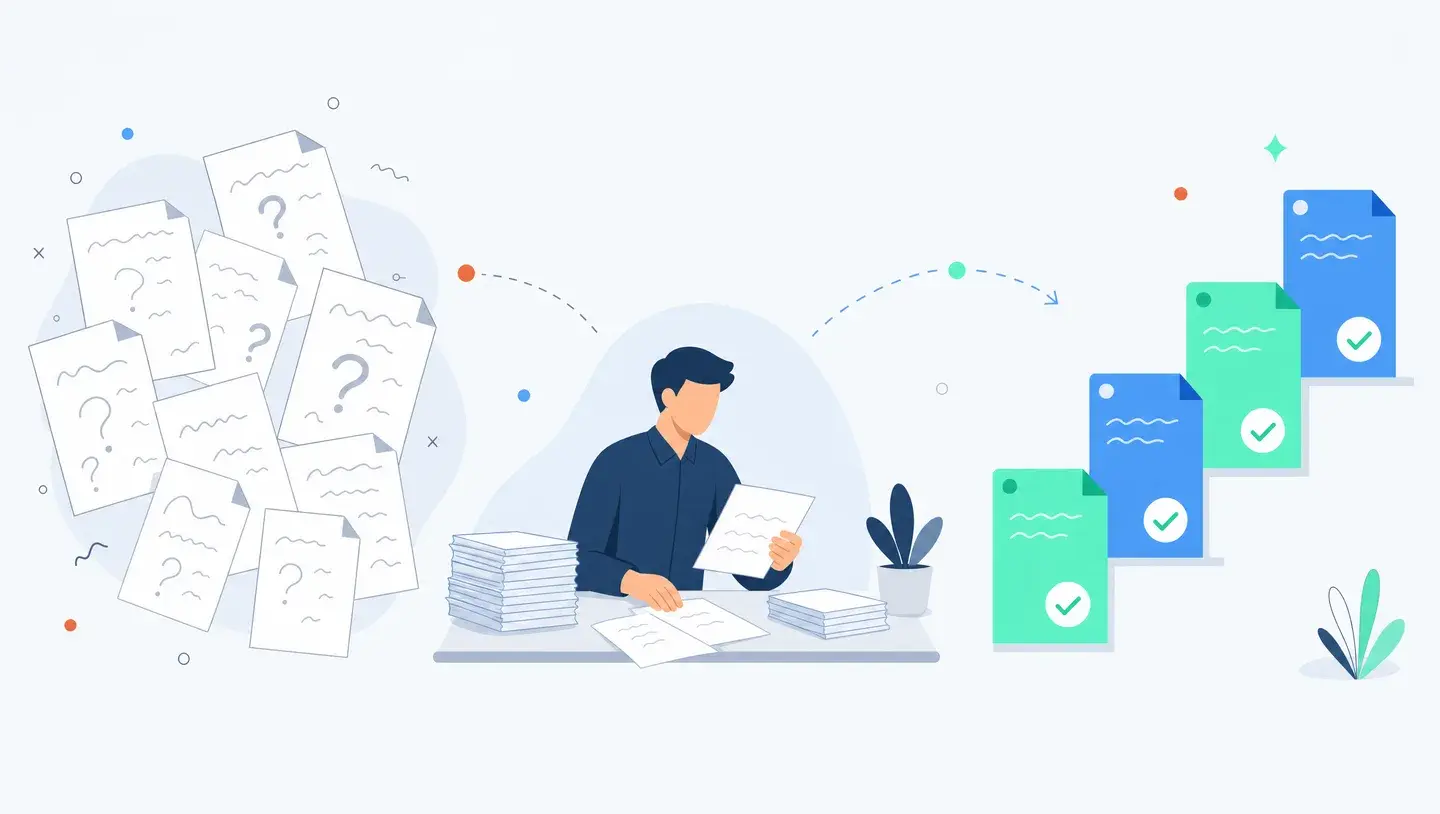
AI for Mid-Market Operations: Where Automation Pays Back First
MIT found 95% of enterprise AI pilots showed no measurable return, with the best results in the back office. Here is where mid-market companies should point AI first, and how to prove the payback within a quarter.
By Ivan Pylypchuk (opens in a new tab), CEO of Softblues. Has led Claude and Gemini implementations for finance, legal and healthcare teams across the UK and Ireland.
Mid-market companies get the fastest payback from AI in high-volume, rule-heavy back-office work: finance operations, document processing and internal knowledge. Independent research puts the best returns there, not in sales and marketing. Start with one measurable workflow, prove it in a few weeks, then scale it using the same controls.
That single decision, where to point AI first, separates the companies that see a return from the ones that spend a year on pilots and quietly stop. In 2025, MIT's State of AI in Business study found that 95% of enterprise generative AI pilots delivered no measurable impact on profit and loss, and that the highest returns came from back-office automation rather than the sales and marketing projects that soak up most budgets (Fortune on MIT NANDA, Aug 2025). At Softblues, an AI implementation firm working with regulated mid-market companies across the UK and Ireland, we treat "where to start" as the most important call in the whole programme.
Key facts
- Back-office automation produces the highest returns. MIT's 2025 study found roughly 50% to 70% of AI budgets go to sales and marketing pilots, which succeed less often than back-office work (Fortune, Aug 2025).
- Finance work is unusually automatable. McKinsey estimates current technology can fully automate about 42% of finance activities and mostly automate a further 19% (McKinsey).
- Manual document work is expensive. Processing a single supplier invoice by hand costs around $12.88 on average, against about $2.88 for the most automated teams (market benchmark, Ardent Partners, 2025).
- Most pilots stall without a payback case. Gartner expects at least 30% of generative AI projects to be abandoned after proof of concept, citing unclear business value and escalating cost (Gartner, Jul 2024).
- Prioritise by impact and effort, not by novelty. The first workflow should have high volume, clear rules and readable data, so you can prove the return in weeks.
Who this is for, and who it isn't
This guide is for a 50 to 500-person UK or Ireland company that runs real back-office volume, an operations, finance or IT leader deciding where to spend a limited AI budget for the first time. If that is you, the order you pick matters more than the model you pick.
It is not for a solo founder wanting a weekend prototype, or a team chasing a headline "AI transformation" with no single workflow in mind. If you cannot name the process, the volume and the person who owns it, you are not ready to start, and no tool will fix that.
Where does AI actually pay back first in a mid-market company?
In the back office. The pattern is consistent: the work that pays back fastest runs at high volume and follows clear rules, with a data trail you can already measure. That describes finance operations, document handling and internal knowledge far better than it describes creative or sales work, where output is harder to judge and easier to get wrong.
AI is not worse at marketing. Back-office work just has a scoreboard. You can count invoices processed, hours saved on a month-end close, or the share of support queries resolved without a person. When the return is measurable, the pilot survives its first budget review. When it is a vague productivity story, it becomes one of the 30% Gartner expects companies to abandon.
Which operations should you rank first? An impact and effort view
Use a simple impact and effort read across your operating areas. High impact plus low effort is where you start. The table below is the pattern we see most often in mid-market firms; your own volumes will shift the order.
| Operating area | Typical first workflow | Payback | Effort | Data readiness | Start here? |
|---|---|---|---|---|---|
| Finance ops | Invoice capture, month-end close prep | High | Low–medium | Usually good (ERP data) | Yes |
| Document ops | Contract and document data extraction | High | Medium | Good if documents are digital | Yes |
| Support ops | First-line query handling and triage | High | Medium | Good (ticket history) | Often |
| Knowledge ops | Policy and handbook question answering | Medium | Low | Depends on document quality | Often |
| HR ops | Onboarding steps and joiner paperwork | Medium | Medium | Mixed | Later |
| Sales and marketing | Content drafting, lead research | Variable | Low | Weak feedback loop | Later |
(Pattern from our own UK and Ireland engagements, indicative, July 2026. Volumes and data quality decide the real order for your firm.)
Sales and marketing are not off-limits. They should just rarely be first, because the feedback loop is slow and the "did it work" question stays subjective. Finance and document work give you a clean, countable result inside a quarter.
You can see the finance end of this in more detail in our guides to automated invoice processing for mid-market finance teams and month-end close automation, and the document end in AI document processing and workflow automation.
Should you build it yourself or buy a tool?
Both, in the right places. MIT's 2025 research found that buying from specialist vendors and partnering succeeded about 67% of the time, while internal builds succeeded roughly a third as often (Fortune, Aug 2025). For a mid-market team without a standing AI engineering group, that is a strong argument against building from scratch on your first project.
The practical rule we use: buy for common, well-solved problems where a product already fits your systems, and build or configure with a partner where the workflow is specific to how your firm operates and touches your own data and controls. Most mid-market programmes are a mix, with a bought tool for one process and a configured Claude workflow for another. What you should not do is build a bespoke platform to solve a problem an off-the-shelf tool already handles.
A roadmap for your first automation
You do not need a two-year programme to prove value. You need one workflow, in production, in about a quarter. This is the shape we run.
1. Weeks 1 to 2, choose and measure. Pick one high-volume, rule-based workflow. Write down today's cost in hours and pounds and the target. Agree who owns the result.
2. Weeks 3 to 6, build and connect. Configure the workflow against real data, connect it to the systems you already run, and put a person in the loop on every output.
3. Weeks 7 to 10, run in parallel. Run AI and the current process side by side. Compare accuracy and time. Fix the edge cases the pilot surfaces.
4. Weeks 11 to 13, cut over and set the gate. Move to production for the cases that clear your accuracy bar, keep a human review on the rest, and set the governance gate that decides what scales next.
| Phase | Weeks | Goal | Governance gate |
|---|---|---|---|
| Choose and measure | 1–2 | One workflow, a baseline, an owner | Named owner and success metric agreed |
| Build and connect | 3–6 | Working flow on real data | Data access and access controls signed off |
| Run in parallel | 7–10 | Proven accuracy and time saved | Accuracy bar met on live cases |
| Cut over | 11–13 | In production, measured | Sign-off to scale to the next workflow |
If you want the full version of this, phase by phase, our AI implementation roadmap for UK companies goes deeper on pilot selection, success criteria and the governance gates that keep a project from stalling.
What does this look like in a regulated firm?
The order still holds, but the controls come earlier. In UK financial services you are answerable to the FCA and to the Senior Managers and Certification Regime, so a named person owns the outcome of any automated step. In legal work the SRA expects supervision of automated output. In healthcare the CQC and the clinical-safety standards DCB0129 and DCB0160 apply, and if software influences a clinical decision the MHRA may treat it as a medical device. For any personal data, UK GDPR and the ICO set the rules. None of this blocks automation. It means a human stays accountable and you can show your working.
A short worked example. For a UK financial-advice firm we scoped a monthly client-file review, the kind of repetitive checking a compliance team does by hand. The design put an AI first pass over each file to flag gaps, with a compliance reviewer signing every case. On the volumes discussed, most of the routine reading moved to the first pass while the judgement stayed with a named person. It was a scoped design rather than a live deployment, and we have kept it anonymised; you can read the shape of it in our financial-advice compliance file-review case study. The order-to-schedule work in our secure logistics case study follows the same back-office-first logic.
Red flags that a project will not pay back
- No baseline. Nobody can state today's cost in hours or pounds, so no return can be proved.
- No owner. The workflow belongs to "the AI project", not to a named operations or finance lead.
- Front-office first. The first pilot is a marketing or sales idea with a slow, subjective feedback loop.
- Custom build for a solved problem. A bespoke platform is being commissioned where a product already fits.
- A demo, not a workflow. The goal is an impressive proof of concept rather than a process in production with a governance gate.
Frequently asked questions
Where should a mid-market company use AI first?
In high-volume, rule-based back-office work with a clear data trail: finance operations such as invoice processing and month-end prep, document extraction, and internal knowledge. Independent research points to back-office automation for the best returns, not sales and marketing.How do we choose between competing workflows?
Rank them on impact and effort. The first workflow should have high volume, clear rules, readable data and a stated baseline cost, so you can prove the return within a quarter rather than argue about it.Should we build our own AI or buy a tool?
Buy or configure with a partner for common, well-solved problems, and reserve custom build for a workflow that is genuinely specific to your firm. Research shows bought and partnered solutions reach value far more often than internal builds.How long before we see a return?
A focused first workflow can be in production within a few months. The return should be visible in the parallel-run phase, weeks 7 to 10, when you compare AI against the current process on live cases.Is our data good enough to start?
For finance and document workflows, usually yes, because the data already sits in your ERP or document store. Knowledge and HR workflows depend more on how well your policies and records are written and organised.What about regulated work?
Automate it, but keep a named person accountable for each output and involve compliance from the design stage. Name the relevant regulator early: the FCA in finance, the SRA in legal, the CQC in healthcare, the ICO for personal data.We are Certified in the Claude Partner Network and a Google Cloud partner at Services Select tier, and we run our own company on Claude. We use it before we sell it, so the order above is how we work, not theory. We put a workflow into production and measure it, rather than sell a year of strategy.
If you want a straight answer on where AI would pay back first in your operations, book a discovery call. You can also see how we scope back-office automation on our business automation solutions page.
Work out your numbers
One key process
Process automation ROI calculator
Five questions about one process. See the hours an AI agent frees up, what they are worth and how much becomes profit.
Work out your numbersYour whole firm
AI ROI calculator
Five questions about your firm. See the time AI frees up, what it is worth and when it pays for itself.
Work out your numbers
Free. No sign-up. Your answers stay in your browser.
See it in production
Systems we have built and run for clients, with the numbers that came out of them.
Related Articles
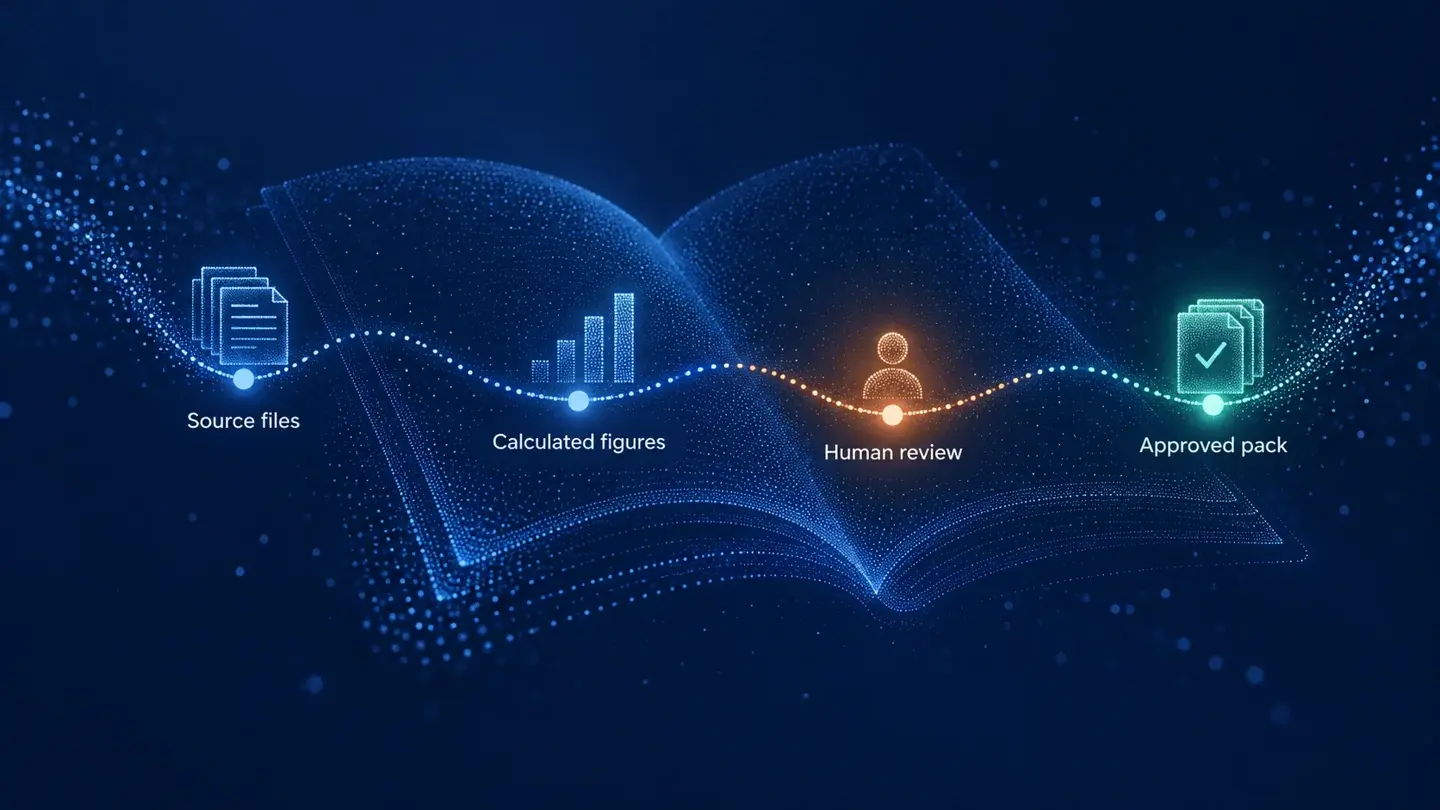
Claude in Excel for the month-end pack: what AI prepares and finance signs

AI meeting notes: the client file workflow for UK firms