
Month-End Close Automation: A Practical Checklist for Finance Teams
Only 18% of finance teams close in three days. A practical month-end close automation checklist: where AI helps (reconciliations, commentary, evidence) and where sign-off must stay human.

By Ivan Pylypchuk (opens in a new tab), CEO of Softblues. We put Claude and process automation into production for finance, legal and healthcare teams across the UK and Ireland.
Month-end close automation uses software to speed up the recurring work of closing the books: reconciliations, accrual prompts, variance commentary, evidence collection and tracking who has done what. It does not replace sign-off or judgement. Used well, it moves a finance team from a six-day close toward a three-to-four-day close without weakening controls.
Half of finance teams still take six or more business days to close their books, and only 18% manage a three-day close (Ledge, 2025). The most-cited benchmark, APQC's study of 2,300 organisations, puts the median close at 6.4 business days, with top performers at 4.8 and the slowest at 10 (APQC, via Numeric). At Softblues, a UK and Ireland automation partner working with regulated mid-market finance teams, we see the same pattern: the close drags not because the team is slow, but because the manual, repetitive parts pile up at the start of every month.
This is a practical guide to the month-end close process and where automation genuinely shortens it, with a checklist you can lift into your own close, and a clear line on what must stay human.
Key facts
- Median month-end close: 6.4 business days, top performers 4.8, slowest 10 (APQC, via Numeric).
- Only 18% of finance teams close in three days; half take six or more (Ledge, 2025).
- AI helps most on five tasks: reconciliations, accrual and journal prompts, variance (flux) commentary drafts, evidence collection, and close tracking.
- Sign-off, estimates and judgement stay with people. Automation prepares the work; a qualified person still reviews and approves.
- The win is the critical path. Compress the reconciliations and commentary that block everything else, not the tasks that already finish on day one.
- Smaller teams feel it most. Understaffed teams gain the most from automating the repetitive first days of the close.
Who this is for, and who it isn't
This is for a 50–500-person UK or Ireland finance team that closes monthly, runs Xero, QuickBooks, Sage or NetSuite, and loses the first week of every month to reconciliations and chasing. If your close slips past five or six days and your team is doing the same manual steps every month, this is for you.
It is not for a public-reporting group that needs a full close-management and consolidation platform with statutory controls baked in. And it is not a way to close faster by skipping review. If a shortcut weakens sign-off, it is not automation, it is risk.
What is month-end close automation?
The month-end close process is the set of steps a finance team runs after each period to make sure the numbers are complete and correct: reconciling accounts, posting accruals and adjustments, reviewing variances, and producing the management accounts. Month-end close automation is using software to do the repetitive parts of that work, so people spend their time on review and judgement rather than data gathering.
It is not one product. It is a layer over your accounting system that pulls data, flags discrepancies, drafts commentary, tracks the checklist and keeps the audit trail, while your ledger stays the system of record.
How long should a month-end close take?
There is no single right answer, because complexity, team size and reporting obligations all move the number. The honest benchmark is this: a healthy mid-market close lands in roughly five to seven calendar days, top performers reach 4.8 business days, and a three-day close is still rare at 18% of teams (Ledge, 2025).
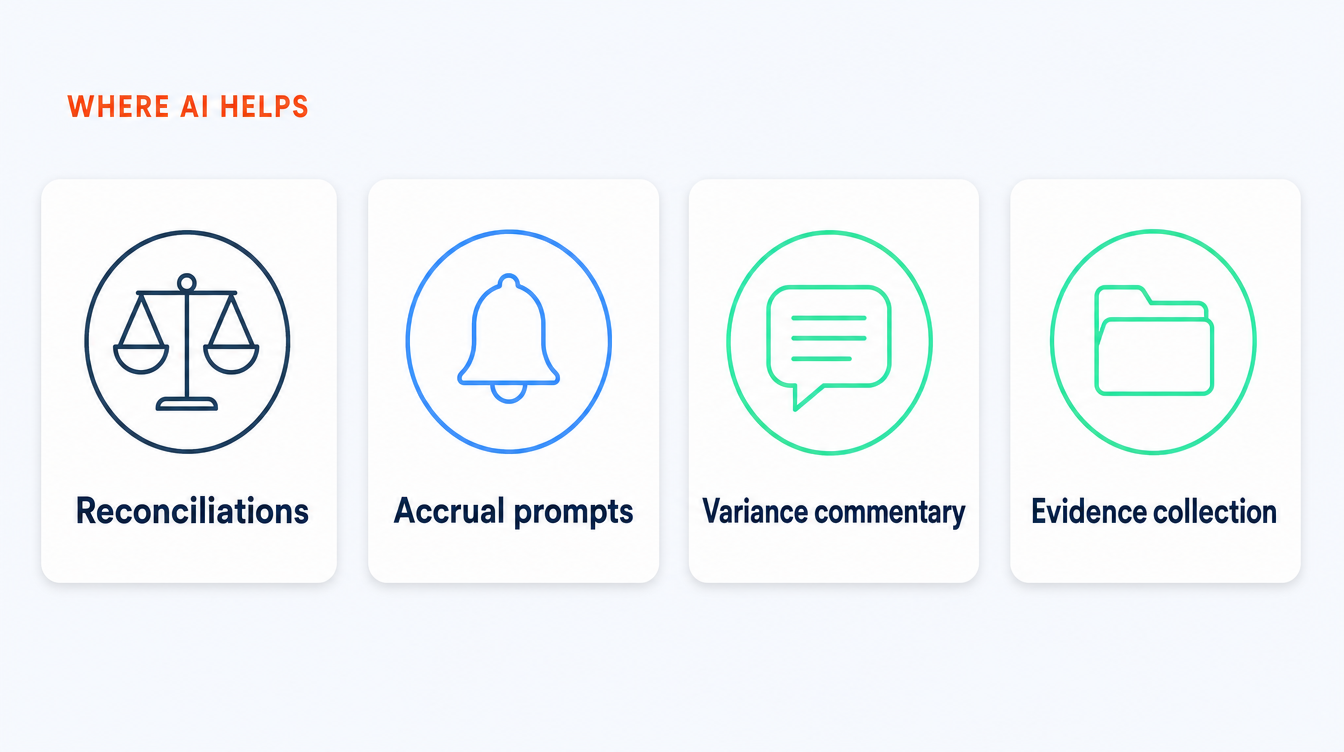
Where does AI actually help in the close?
Five tasks, in the order they usually block the close. These are the safe, high-return places to start.
1. Reconciliations. Matching bank, card, intercompany and control accounts is repetitive and rules-based. Software flags the breaks; the team investigates only what does not match.
2. Accrual and journal prompts. AI can surface likely accruals and recurring journals from prior periods and contracts, so nothing is missed, but a person still approves and posts.
3. Variance and flux commentary. Drafting first-pass commentary on why a line moved month on month is slow and formulaic. A model can draft it from the figures; the controller edits and owns it.
4. Evidence collection. Gathering the support for each balance and each journal is a quiet time sink. Automation assembles the pack and links it to the audit trail.
5. Close tracking. Knowing who owns each task and what is blocking the close is half the battle. A shared checklist with status beats a spreadsheet emailed around the team.
To see what an agent on month-end work would free up in your team, use our process automation ROI calculator.
Where must automation not weaken controls?
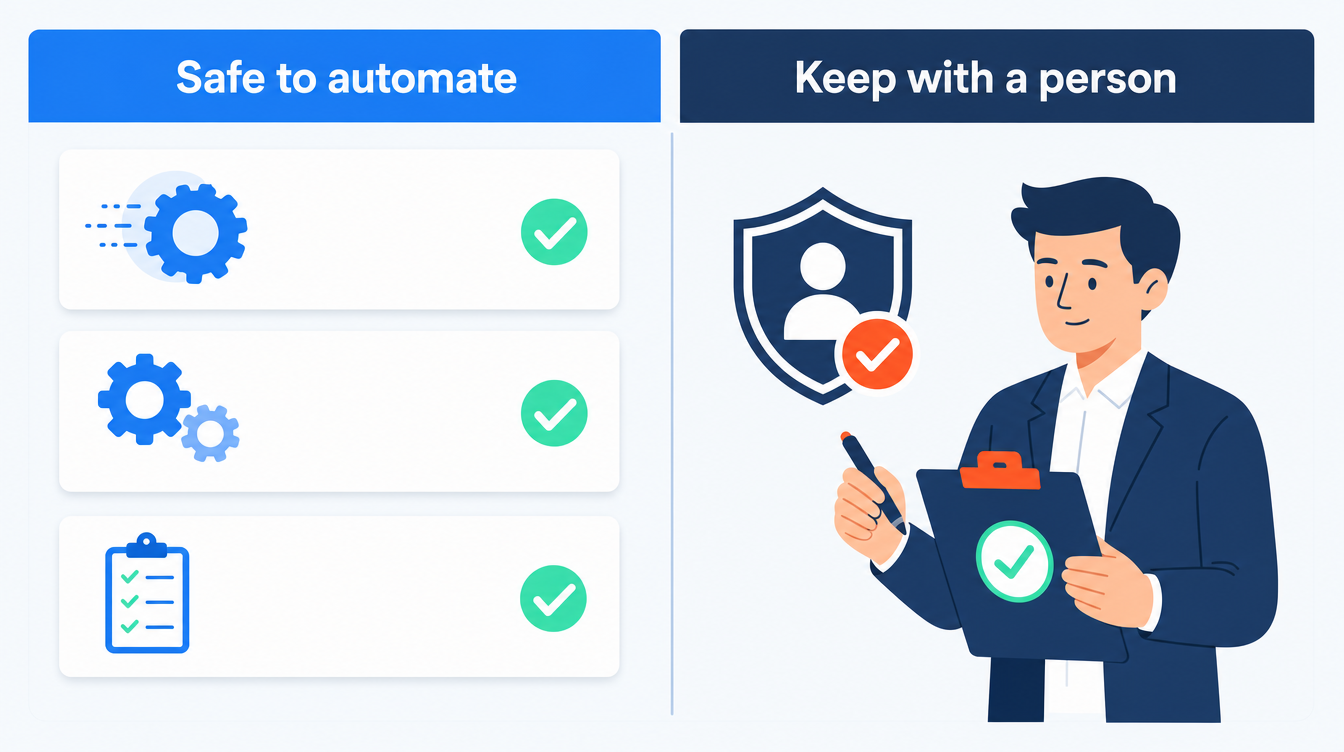
Anywhere a judgement is made or a number is signed off. Estimates, provisions and accounting treatments are decisions, not data tasks. Approval of journals and reconciliations must stay with a qualified person, with segregation of duties intact: the person who prepares is not the person who approves.
| Safe to automate | Keep with a person |
|---|---|
| Bank and control-account reconciliations | Sign-off and final review |
| Recurring journal and accrual prompts | Estimates, provisions, accounting treatments |
| First-draft variance commentary | Ownership of the explanation |
| Evidence gathering and audit trail | Judgement on materiality |
| Checklist and status tracking | Approval and segregation of duties |
A practical month-end close automation checklist
Run it in three passes. Phase the automation the same way, so you compress the critical path first.
1. Before period end. Confirm the close calendar and owners. Automate recurring journal and accrual prompts so they are queued, not remembered. Pull early data feeds.
2. First days of the close. Run automated reconciliations on bank, card, intercompany and control accounts. Investigate only the flagged breaks. Assemble evidence packs as you go.
3. Review and report. Generate first-draft variance commentary for the controller to edit and own. Track every task to done on a shared checklist. Sign off with segregation of duties intact, then produce the management accounts.
Which tools should you consider, and should you build or buy?
Most mid-market teams should start with what their accounting system already offers, then add a dedicated close tool if the critical path is still long. Build custom only when you want one automation layer across several finance processes, not just the close.
| Approach | What it is | Best for | Avoid if |
|---|---|---|---|
| Native ERP close features (Xero, QuickBooks, Sage, NetSuite) | Built-in reconciliation and checklist tools | Smaller teams, single entity, simpler close | You need multi-entity consolidation or heavy controls |
| Dedicated close-management platform | Specialist reconciliation, checklist and flux tooling | Teams whose close drags past six days | Your close already lands in three to four days |
| Custom / AI-built workflow | Automation built around your exact close, often LLM-based for commentary and evidence | One layer across close, AP and reporting | A configurable product already fits |
What about controls, audit and regulated sectors?
A faster close is only valuable if it is still a correct, well-controlled close. Keep segregation of duties, approval limits and a complete audit trail through every automated step. For financial-services firms, your SM&CR accountabilities apply to the close process and the tools that support it (FCA). UK reporting still follows the applicable framework, typically FRS 102 under UK GAAP, and personal data in the close sits under UK GDPR.
A regulated firm we worked with, anonymised, asked us to scope automation of a recurring monthly file-review and evidence process. We mapped it as a discovery engagement first, separating the steps that could be automated from the sign-off that had to stay with their qualified reviewers. You can read the anonymised compliance file-review automation case study; it began as scoping and design, not a live deployment.
Red flags when automating the close
1. Speed pitched over control. A faster close that bypasses review is a liability, not a result.
2. No audit trail. If you cannot show who approved what and on what evidence, the tool has failed.
3. Weak ERP integration. Reconciliation tools that cannot read your ledger cleanly create more work than they save.
4. One big-bang rollout. Automating the whole close at once hides which change actually helped. Phase it.
Questions to ask a vendor, and what a good answer sounds like
Ask "which close tasks do you automate, and which stay with my team?" A good answer draws the line clearly and leaves sign-off with people. Ask "how do you keep the audit trail and segregation of duties?" A good answer is specific about approvals and evidence. Ask "how does this read from our ledger?" A good answer names your system. If a vendor promises a one-day close with no mention of controls, walk away.
Frequently asked questions
What is the month-end close process?
It is the set of steps after each period to make the numbers complete and correct: reconciling accounts, posting accruals and adjustments, reviewing variances and producing management accounts. Automation speeds the repetitive parts without replacing sign-off.
How long should a month-end close take?
A healthy mid-market close lands in about five to seven calendar days, with top performers at 4.8 business days. Only 18% of teams reach a three-day close (Ledge, 2025), so most have room to improve.
What parts of the close can AI automate safely?
Reconciliations, recurring accrual and journal prompts, first-draft variance commentary, evidence collection and close tracking. Estimates, judgement and sign-off should stay with a qualified person.
Will automation weaken our controls?
It should strengthen them. Done properly, automation keeps a complete audit trail and segregation of duties while removing manual data work. Reject any tool that auto-approves journals or sign-off without human review.
Does close automation work with Xero, QuickBooks, Sage or NetSuite?
Yes. Native features, dedicated close platforms and custom workflows all integrate with these systems. Confirm the tool reads your ledger cleanly rather than relying on manual exports.
How do we start without disrupting a live close?
Phase it. Automate one part of the critical path, usually reconciliations, prove it over a cycle or two, then add accrual prompts and variance commentary. We scope it in a paid discovery and give you the timeline and the price in the proposal before any build starts.
Month-end close automation works when you treat it as compressing the critical path, not as closing faster by cutting corners. Automate the reconciliations, prompts, commentary drafts and evidence gathering; keep the judgement and the sign-off with your people. As an OpenAI Select Partner, Certified in the Claude Partner Network, we build these workflows as practitioners and measure them against the benchmarks above.
If invoices are part of what slows your close, start upstream with automated invoice processing for mid-market finance teams, and see how we connect AI to your finance stack in AI integration services. When you want to map your own close, book a discovery call. You can also explore our approach to business process automation.
Work out your numbers
One key process
Process automation ROI calculator
Five questions about one process. See the hours an AI agent frees up, what they are worth and how much becomes profit.
Work out your numbersYour whole firm
AI ROI calculator
Five questions about your firm. See the time AI frees up, what it is worth and when it pays for itself.
Work out your numbers
Free. No sign-up. Your answers stay in your browser.
See it in production
Systems we have built and run for clients, with the numbers that came out of them.
Related Articles

Claude in Excel for the month-end pack: what AI prepares and finance signs

AI meeting notes: the client file workflow for UK firms