AI for Procurement: Where UK Mid-Market Teams Should Automate Supplier Onboarding, Spend and Renewals
Top procurement teams get 3.2x ROI on AI, the rest get 1.5x. The difference is where they automate. A practical guide to supplier onboarding, spend and renewals for UK mid-market teams.
By Ivan Pylypchuk (opens in a new tab), CEO of Softblues
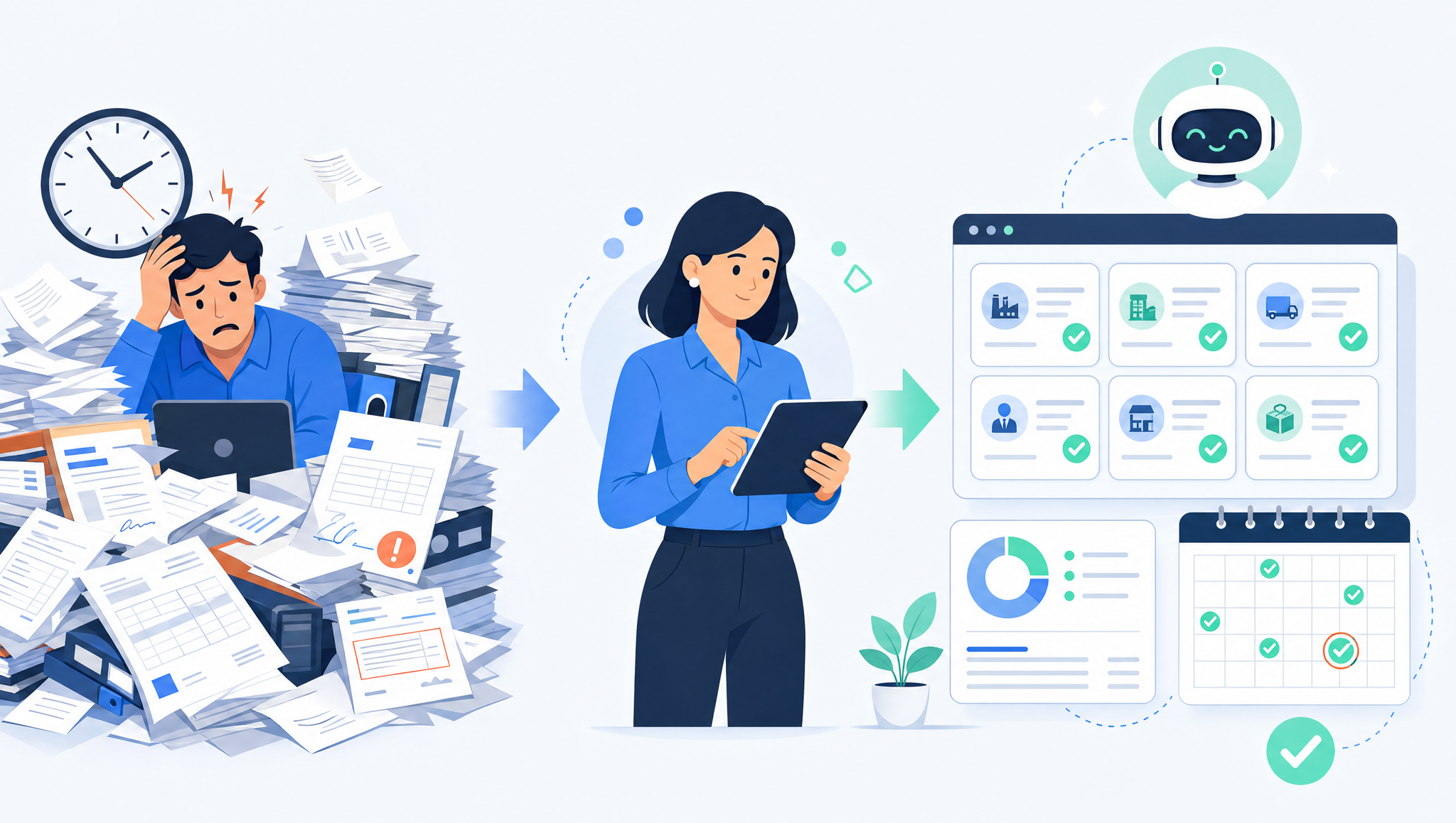
Procurement is quietly becoming one of the best places in a mid-market company to put AI to work, and the leaders already know it. In Deloitte's 2025 Global Chief Procurement Officer Survey, the top-performing procurement teams reported an average 3.2x return on their generative-AI investment, against roughly 1.5x for everyone else (Deloitte, Aug 2025). The same "Digital Masters" are now putting up to 24% of their budget into procurement technology, nearly double what they spent in 2023.
The catch: those returns do not come from buying one more platform. They come from automating the repetitive, deadline-driven admin that sits between a supplier and a signed, well-managed relationship. This is a guide to where UK and Ireland mid-market teams should start.
Key facts
- Top procurement teams report 3.2x ROI on generative AI; the rest see about 1.5x (Deloitte 2025 Global CPO Survey, 250+ CPOs across 40 countries).
- Leading teams allocate up to 24% of budget to procurement technology, nearly double 2023, and project 26% next year (Deloitte, 2025).
- The top barriers to value are not technical: siloed ways of working (57%) and the talent gap (34%) rank highest (Deloitte, 2025).
- The best early wins are in supplier onboarding, spend visibility, and renewal and contract management: high-volume, rules-based work.
- AI belongs on the drafting, extraction, and monitoring steps. A human still approves the supplier, the spend, and the renewal.
Where should mid-market procurement start with AI?
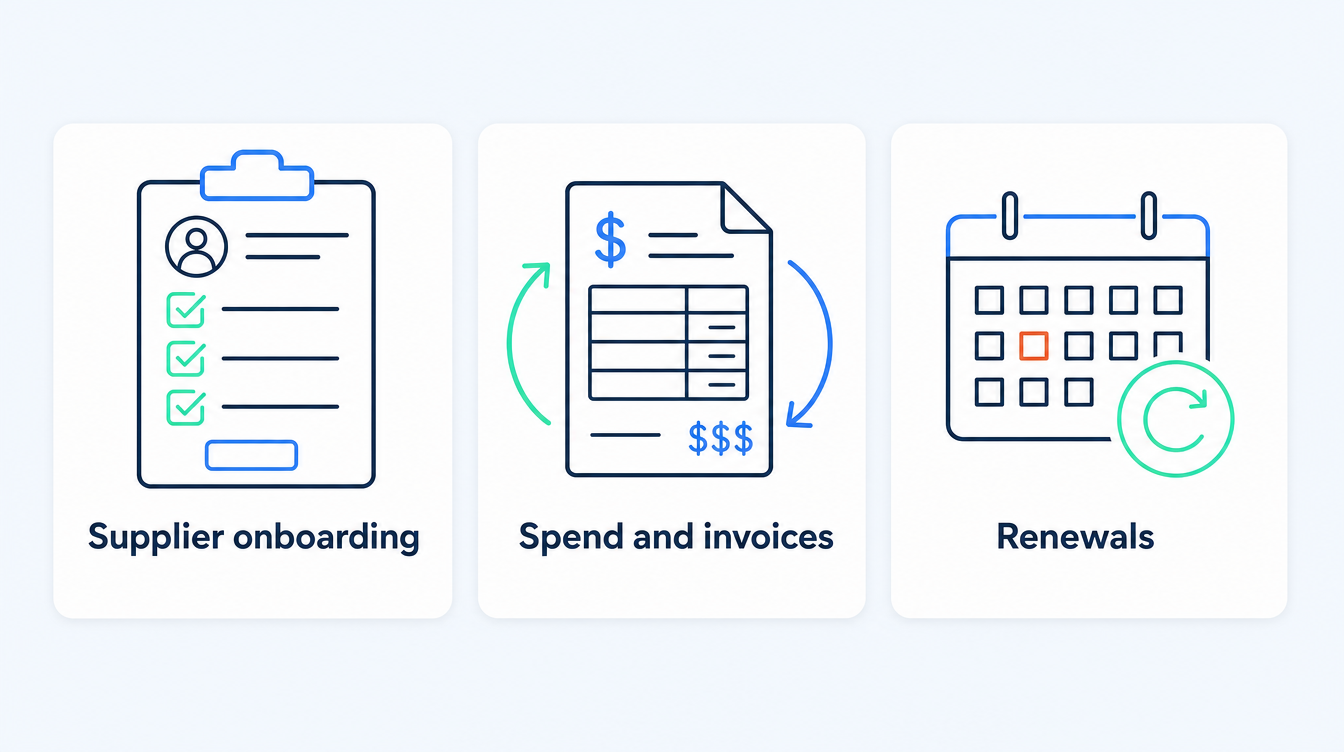
Not everything in procurement is worth automating. The wins cluster where work is high-volume, rules-based, and slowed down by document handling. Three areas pay back first.
Supplier onboarding. New-supplier setup is a paperwork bottleneck: collecting details, checking documents, running basic due diligence, and keeping records for audit. AI can read incoming documents, extract the fields you need, flag what is missing, and pre-fill the record, so a buyer reviews and approves rather than retypes. Our walkthrough on automating client and matter intake with AML/KYC checks covers the same pattern applied to onboarding.
Spend visibility and invoice matching. Spend data lives in inconsistent formats across suppliers and systems. AI is good at normalising it, classifying spend, and matching invoices to purchase orders so exceptions surface instead of hiding. This connects directly to automated invoice processing for finance teams, which is often the fastest single win in the finance-procurement overlap.
Renewals and obligations. After a contract is signed, renewal dates, price changes, and notice periods drift into inboxes and shared drives. AI can extract those obligations, track the dates, and prompt the owner before a deadline. See contract management automation after signature for the full approach.
What should stay with a human?
This is where honest procurement automation differs from the software pitch. AI handles the reading, drafting, and monitoring. People keep the judgement calls.
AI vs the status quo in procurement
| Task | Manual today | With AI in the loop | Best for |
|---|---|---|---|
| Supplier onboarding | Buyer collects and rekeys documents, chases missing items | AI extracts fields, flags gaps, pre-fills the record for review | High volume of new suppliers |
| Spend classification | Analyst tags spend by hand across formats | AI normalises and classifies, human confirms edge cases | Fragmented spend across systems |
| Invoice-to-PO matching | Finance matches line by line, exceptions get lost | AI matches and surfaces only the exceptions | Teams with high invoice counts |
| Renewal tracking | Dates live in inboxes; deadlines missed | AI extracts obligations and prompts the owner in advance | Portfolios with many active contracts |
| Supplier approval | Human decision on documents | Human decision on cleaner, complete documents | Always keep this human |
A worked example: order-to-schedule in logistics
The pattern is easier to see in a real workflow. In a discovery engagement with a secure-logistics operator, we mapped how inbound orders turned into scheduled work, a chain of manual reading, data entry, and coordination that AI could compress by handling the extraction and routing while a person kept control of the schedule.
You can read the approach in our secure logistics order-to-schedule automation case study. It is an honest example: a discovery and design engagement, not a claim of a finished production system. That is the point. Procurement automation earns trust by scoping tightly and proving one workflow before expanding.
How do you know it is working?
Pick one process, measure it the old way for a fortnight, then measure it again after the AI step is in. Useful measures for procurement:
1. Onboarding time. Days from first contact to an approved supplier record.
2. Exception rate. Share of invoices or documents that need manual intervention.
3. Missed-deadline count. Renewals or notice periods that slipped in the last quarter versus this one.
4. Hours returned. Buyer and analyst time freed from rekeying and chasing.
If none of those move within a couple of months, the workflow design is wrong, not the idea. Fix the scope before adding more tools.
Frequently asked questions
What procurement tasks are best suited to AI?
High-volume, rules-based, document-heavy work: supplier onboarding, spend classification, invoice-to-PO matching, and tracking contract renewals and obligations. Strategic sourcing and final supplier decisions stay with people.
Do we need a dedicated procurement AI platform?
Not to start. Deloitte's data shows the return comes from automating specific workflows, not from tool count. Many mid-market teams get their first win by adding AI to the systems they already run rather than buying a new suite.
Can AI approve suppliers or release payments automatically?
It should not. Keep approval, payment release, and contract acceptance with a named person. Use AI to prepare complete, checked information and to flag exceptions, so the human decision is faster and better informed.
What is the realistic ROI on AI in procurement?
Deloitte's 2025 CPO Survey found top procurement teams average 3.2x return on generative AI, versus about 1.5x for the rest. The difference is execution: leaders embed AI into workflows and invest in the people using it.
Where do procurement automation projects usually fail?
On organisation, not technology. Deloitte's respondents named siloed working (57%) and the talent gap (34%) as the top barriers. Projects stall when no one owns the change or when the scope is too broad to prove.
How do we start without disrupting live procurement?
Choose one process, baseline it for two weeks, add the AI step for review-and-approve only, and measure the result. Expand to the next process only once the first one holds.
Softblues is an OpenAI Select Partner, Certified in the Claude Partner Network, a Google Cloud partner at Services Select tier, and a member of the Microsoft AI Cloud Partner Program. We build business process automation for UK and Ireland mid-market teams. We are practitioners who scope tightly, keep the human in the loop, and prove one workflow before expanding. If supplier admin is eating your buyers' week, that is exactly the kind of work AI handles well.
Work out your numbers
One key process
Process automation ROI calculator
Five questions about one process. See the hours an AI agent frees up, what they are worth and how much becomes profit.
Work out your numbersYour whole firm
AI ROI calculator
Five questions about your firm. See the time AI frees up, what it is worth and when it pays for itself.
Work out your numbers
Free. No sign-up. Your answers stay in your browser.
See it in production
Systems we have built and run for clients, with the numbers that came out of them.
Related Articles
Claude in Excel for the month-end pack: what AI prepares and finance signs

AI meeting notes: the client file workflow for UK firms