AI Implementation Roadmap: How UK Companies Move from Pilot to Production
95% of enterprise AI pilots deliver no measurable return (MIT, 2025). This is the phased AI implementation roadmap UK companies use to move a pilot past the demo and into production.
By Ivan Pylypchuk (opens in a new tab), CEO of Softblues. Has led Claude and Gemini implementations for finance, legal and healthcare teams across the UK and Ireland.
An AI implementation roadmap is the phased plan that takes an AI idea from a small pilot to a production system your team relies on every day. For UK companies it usually runs across five stages: choose the pilot, set success criteria, build and integrate, pass governance gates, then scale and run. The gates matter more than the model, because that is where most projects quietly stop.
Here is the number that should shape the whole plan. In 2025, MIT's State of AI in Business study found that 95% of enterprise generative AI pilots delivered no measurable impact on profit and loss, and only about 5% created significant value (Fortune on MIT NANDA, Aug 2025). At Softblues, an AI implementation firm working with regulated mid-market companies across the UK and Ireland, we read that as a design problem, not a technology problem. A pilot that was never built to reach production almost never does.
Key facts
- Most pilots deliver nothing measurable. MIT's 2025 study found 95% of enterprise generative AI pilots had no measurable P&L impact, with only about 5% creating significant value (Fortune, Aug 2025).
- A third are abandoned after the demo. Gartner expects at least 30% of generative AI projects to be dropped after proof of concept, citing poor data quality, weak risk controls, escalating cost and unclear business value (Gartner, Jul 2024).
- Buying and partnering beats building alone. MIT found bought and partnered solutions reached value about 67% of the time, roughly three times the success rate of internal builds (Fortune, Aug 2025).
- Back office pays back first. The same study found the strongest returns in back-office automation, not the sales and marketing pilots that absorb most budgets.
- A focused first workflow can reach production within a few months, if the pilot is chosen for volume, clear rules and a measurable baseline rather than for how it demos.
Who this is for, and who it isn't
This is for a 50 to 500-person UK or Ireland company, often in a regulated sector, that has run one or two AI experiments and now needs a repeatable way to get them into production and governed. If your pilots keep impressing people and then stalling, the roadmap below is the fix.
It is not for a team looking for an "AI strategy" slide deck, or for a solo founder prototyping over a weekend. This is an operating plan for putting working software in front of real users, with the controls a regulated firm needs.
Why do most AI pilots never reach production?
Because they were built as demonstrations, not as workflows. A demo is judged on whether it looks impressive in a meeting. A production system is judged on accuracy, integration, cost per use and whether a named person can stand behind its output. Those are different bars, and a pilot designed for the first rarely clears the second.
Gartner's list of why projects get abandoned is instructive: poor data quality, inadequate risk controls, escalating cost and unclear business value. Notice that none of those is "the model was not clever enough". They are all planning gaps, the kind a roadmap with governance gates is designed to close before you have spent the budget.
What does a phased AI implementation roadmap look like?
Five stages, each with a gate you must pass before spending more. Writing them as gates, rather than a wish list, is what stops a project drifting.
1. Choose the pilot. Pick one workflow with high volume, clear rules and a data trail you can measure. Favour back-office work, where returns land first. Reject anything you cannot baseline.
2. Set success criteria. Write down today's cost in hours and pounds, the accuracy bar, and the number that means "this worked". Agree who owns that number.
3. Build and integrate. Configure the workflow against real data and connect it to the systems you already run. Integration is where pilots die, so treat it as part of the pilot, not a later phase.
4. Pass the governance gates. Confirm data access, access controls, human review, and the regulator-facing checks for your sector. No gate, no scale.
5. Scale and run. Move proven cases to production, keep a human in the loop where judgement is needed, measure the result, and use the same pattern for the next workflow.
| Stage | Typical duration | Goal | Governance gate | Exit criteria |
|---|---|---|---|---|
| Choose the pilot | Week 1–2 | One measurable workflow, named owner | Owner and success metric agreed | Baseline cost documented |
| Set success criteria | Week 2 | Accuracy bar and target defined | Sign-off on what "worked" means | Metric agreed in writing |
| Build and integrate | Week 3–6 | Working flow on real data and systems | Data access and access controls signed off | Flow runs end to end |
| Pass governance gates | Week 6–9 | Controls and sector checks in place | Compliance and risk review passed | Approved for live cases |
| Scale and run | Week 9–13+ | In production, measured, repeatable | Sign-off to scale to next workflow | Return demonstrated on live cases |
(Indicative timeline from our own UK and Ireland engagements, July 2026. The real timeline for your firm is set in the proposal after a paid discovery.)
How do you choose the right first pilot?
Score candidates on four things: volume, clarity of rules, data readiness and how easily you can measure the result. A monthly finance close, invoice handling or document extraction usually scores well on all four. A "make our sales team more creative" idea usually scores badly on measurement, which is why it stalls.
Our companion guide, where AI pays back first in mid-market operations, sets out an impact-and-effort matrix across finance, document, support, knowledge and HR operations. Use it to rank candidates before you commit to one. The best first pilot is rarely the most exciting idea in the room; it is the one you can prove.
Should you build, buy, or partner?
For a first production system, the evidence favours buying or partnering over building alone. MIT found bought and partnered solutions reached value about 67% of the time, roughly three times the rate of internal builds. That does not mean never build; it means match the approach to the workflow.
| Approach | Best for | Avoid if | Notes |
|---|---|---|---|
| Buy a product | Common, well-solved problems that fit your systems off the shelf | Your workflow is specific to how your firm operates | Fastest to value; least control over the details |
| Partner to configure | A workflow specific to your data and controls, where you lack a standing AI team | You have deep in-house AI engineering already | Highest success rate for regulated mid-market firms |
| Build in-house | A genuine differentiator you must own end to end | You are solving a problem a product already solves | Lowest success rate on a first project; needs real capacity |
The trap is building a bespoke platform to solve a problem a product already handles, then never finishing it. Default to buying or partnering, and reserve in-house build for the workflow that is genuinely yours. Our AI consulting vendor shortlist guide covers how to compare partners on delivery risk rather than day rate.
How long does it take, and what does it cost?
A focused first workflow can reach production within a few months, and the proposal after discovery sets the date. The cost driver is scope, not licences: the number of workflows, how much integration each needs, and the depth of governance your sector requires. A single finance workflow with clean ERP data is quick; a multi-system workflow touching personal data in a regulated sector takes longer because the controls take longer, not because the model does.
We work to a fixed scope agreed up front rather than an open-ended day rate, so the price is known before the work starts. For a view of what should be written down before you sign, see what belongs in an AI consulting proposal or statement of work and the Claude Enterprise implementation checklist for the platform-side controls.
To see this roadmap as numbers for a firm like yours, use our AI ROI calculator for your whole firm.
What does the roadmap look like in a regulated sector?
The stages are the same; the governance gate is heavier and comes earlier. In UK financial services the FCA and the Senior Managers and Certification Regime require a named person to own the outcome of an automated step. In legal, the SRA expects supervision of automated output. In healthcare, the CQC and clinical-safety standards DCB0129 and DCB0160 apply, and the MHRA may treat software as a medical device if it influences a clinical decision. For personal data, UK GDPR and the ICO set the rules. Build these checks into stage four and the project moves faster overall, because you are not re-opening decisions after go-live.
A short worked example. We run our own company on Claude, from operations to delivery, which is the clearest proof we have that a phased approach reaches production rather than stopping at a demo. You can read how that is put together in our Claude operating system case study. It is our own environment, so we can be specific about what worked and what we changed.
Questions to ask on the call, and what a good answer sounds like
- "How will we know the pilot worked?" A good partner answers with a specific metric and a baseline, not "you'll see the value". If they cannot define the number, the project has no exit criteria.
- "How does this connect to our existing systems?" They should treat integration as part of the pilot. If integration is "phase two", the pilot is a demo.
- "Who is accountable for an automated output in a regulated step?" The answer should name a role and a human review, not the tool.
- "What happens if it fails the accuracy bar?" A good answer describes a human-in-the-loop fallback and a clear go or no-go gate, not a promise that it will not fail.
- "Is the price fixed?" You want a known scope and price before work starts, not an open day rate that grows with the project.
Frequently asked questions
What is an AI implementation roadmap?
It is a phased plan that moves an AI idea from pilot to production: choosing a measurable workflow, setting success criteria, building and integrating, passing governance gates, then scaling and running it. The gates decide what progresses, which is why most stalled projects lack them.Why do so many AI projects fail?
MIT found 95% of enterprise generative AI pilots delivered no measurable P&L impact, and Gartner expects at least 30% to be abandoned after proof of concept. The causes are planning gaps: no baseline, weak integration, unclear value and missing controls, rather than weak models.How long does AI implementation take in the UK?
A focused first workflow can reach production within a few months. Timelines lengthen with the number of workflows, the amount of system integration, and the depth of governance a regulated sector requires.Should we build our own AI or buy?
For a first production system, buying or partnering usually wins: MIT found those routes reached value about 67% of the time, roughly three times the rate of internal builds. Reserve in-house build for a workflow that is a genuine differentiator.What is the biggest mistake companies make?
Building a demo instead of a workflow. A demo is judged on how it looks in a meeting; production is judged on accuracy, integration, cost and accountability. Decide the production bar before the pilot, not after.How do we handle AI governance in a regulated firm?
Name the relevant regulator early, the FCA in finance, the SRA in legal, the CQC in healthcare, the ICO for personal data, keep a named person accountable for each automated output, and build the controls into the build stage rather than bolting them on after go-live.We are Certified in the Claude Partner Network and a Google Cloud partner at Services Select tier, and we run our own company on Claude, so this roadmap is how we deliver, not a theory we sell. We put a workflow into production and measure it, rather than bill a year of strategy. Past the pilot, into daily use.
If you want a phased plan for moving your own AI pilot to production, book a discovery call. You can also see how we scope this work on our business automation solutions page.
Work out your numbers
Your whole firm
AI ROI calculator
Five questions about your firm. See the time AI frees up, what it is worth and when it pays for itself.
Work out your numbersOne key process
Process automation ROI calculator
Five questions about one process. See the hours an AI agent frees up, what they are worth and how much becomes profit.
Work out your numbers
Free. No sign-up. Your answers stay in your browser.
See it in production
Systems we have built and run for clients, with the numbers that came out of them.
Related Articles
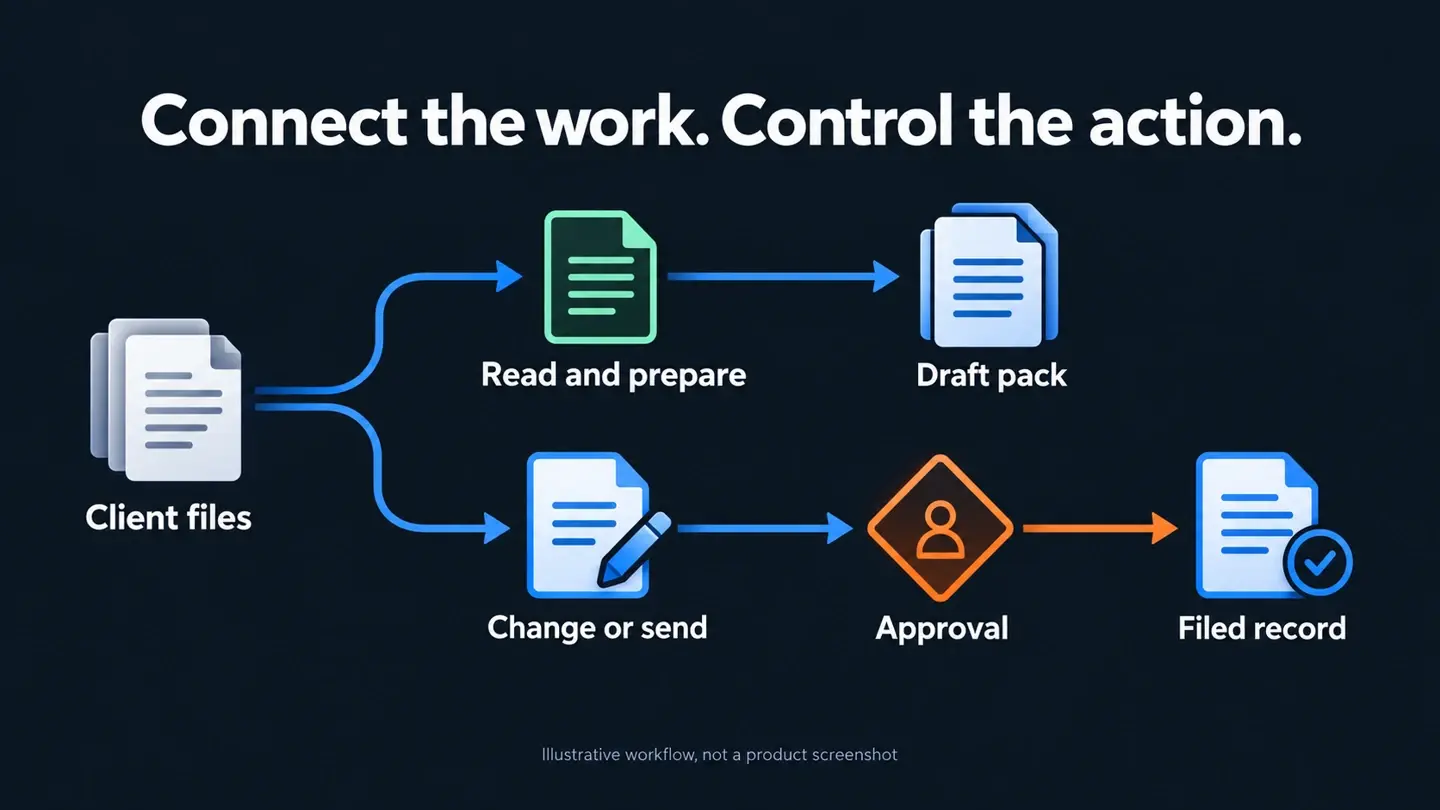
MCP server access: Claude, ChatGPT and Copilot in Microsoft 365
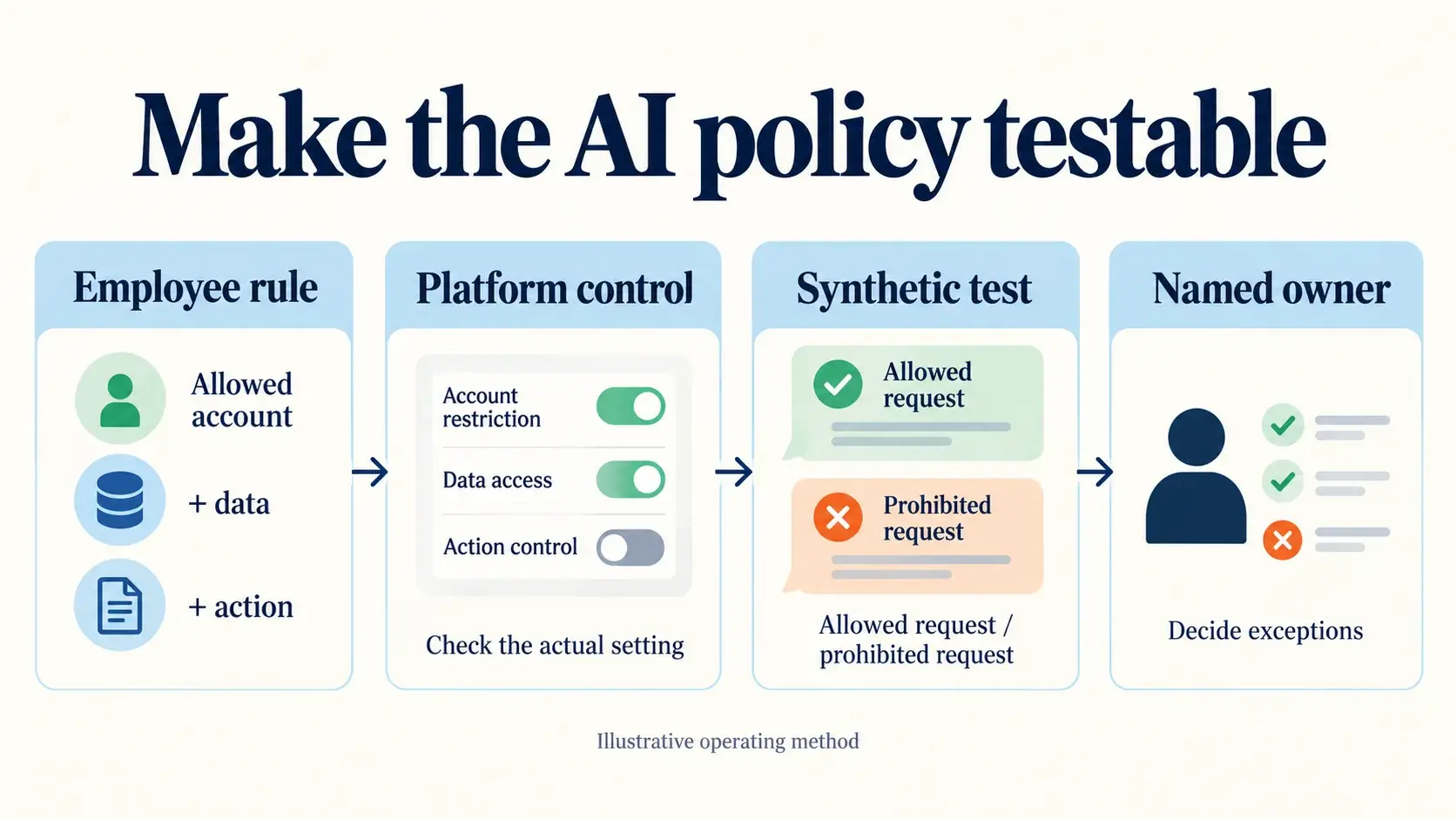
AI governance framework: a UK employee policy template