
Claude for business: training staff on their own work
Nine weekly training sessions, practical exercises and 35 of 45 staff using Claude several times a week. What the reported adoption shows, and what remains a proposal.
By Ivan Pylypchuk (opens in a new tab), CEO of Softblues. Updated 14 October 2026.
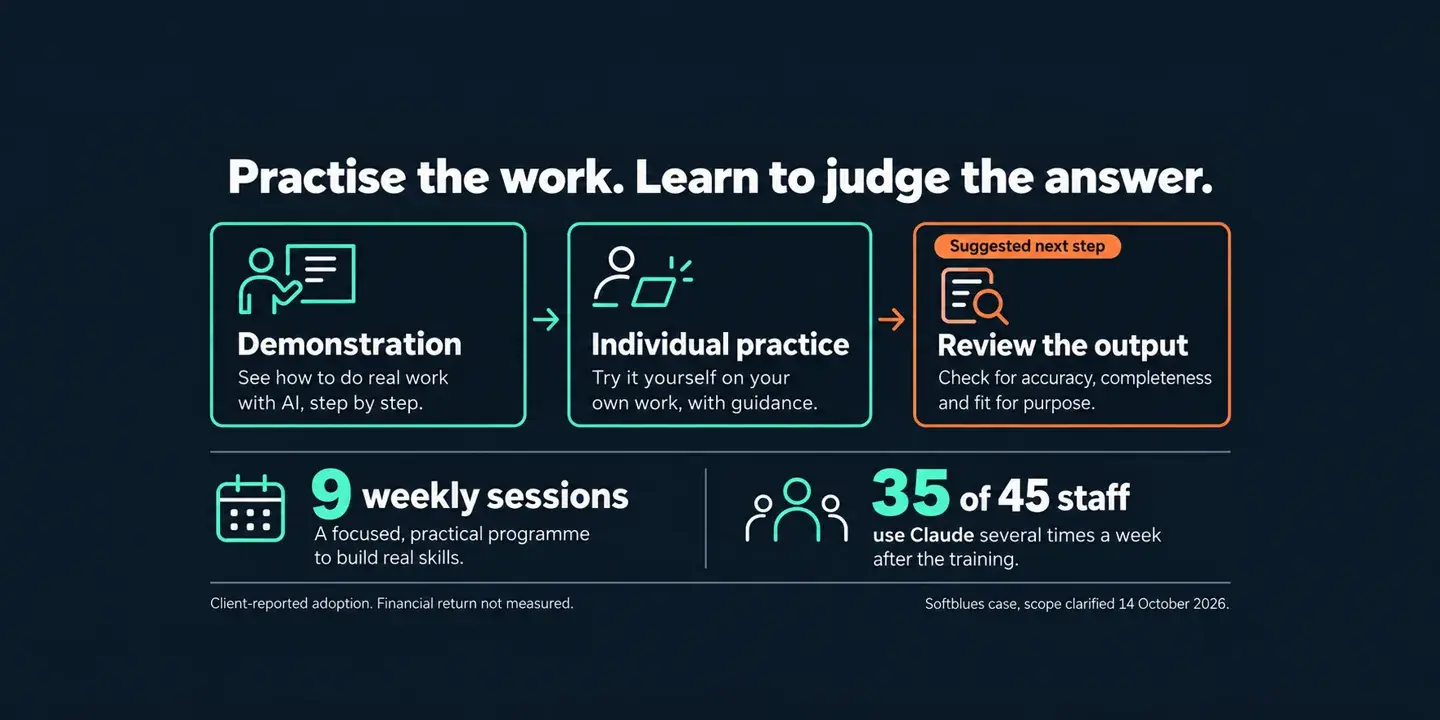
Claude for business becomes useful when staff can apply it to their own work and judge the result. At Key Capital, an Irish corporate finance and investment management firm, Softblues provided advice and delivered a training programme built around that work. The firm reports that 35 of its 45 staff use Claude several times a week. Time savings, cost savings and financial return were not measured in this case.
Softblues, at softblues.io, helps UK and Irish firms develop practical AI working habits through consulting and training. Softblues is Certified in the Claude Partner Network.
Key facts
- Softblues delivered nine weekly training sessions designed for corporate finance.
- Every member of the firm's staff participated.
- Sessions paired demonstrations with individual exercises.
- The firm reports 35 of 45 staff using Claude several times a week and a training score of 4.3 out of 5.
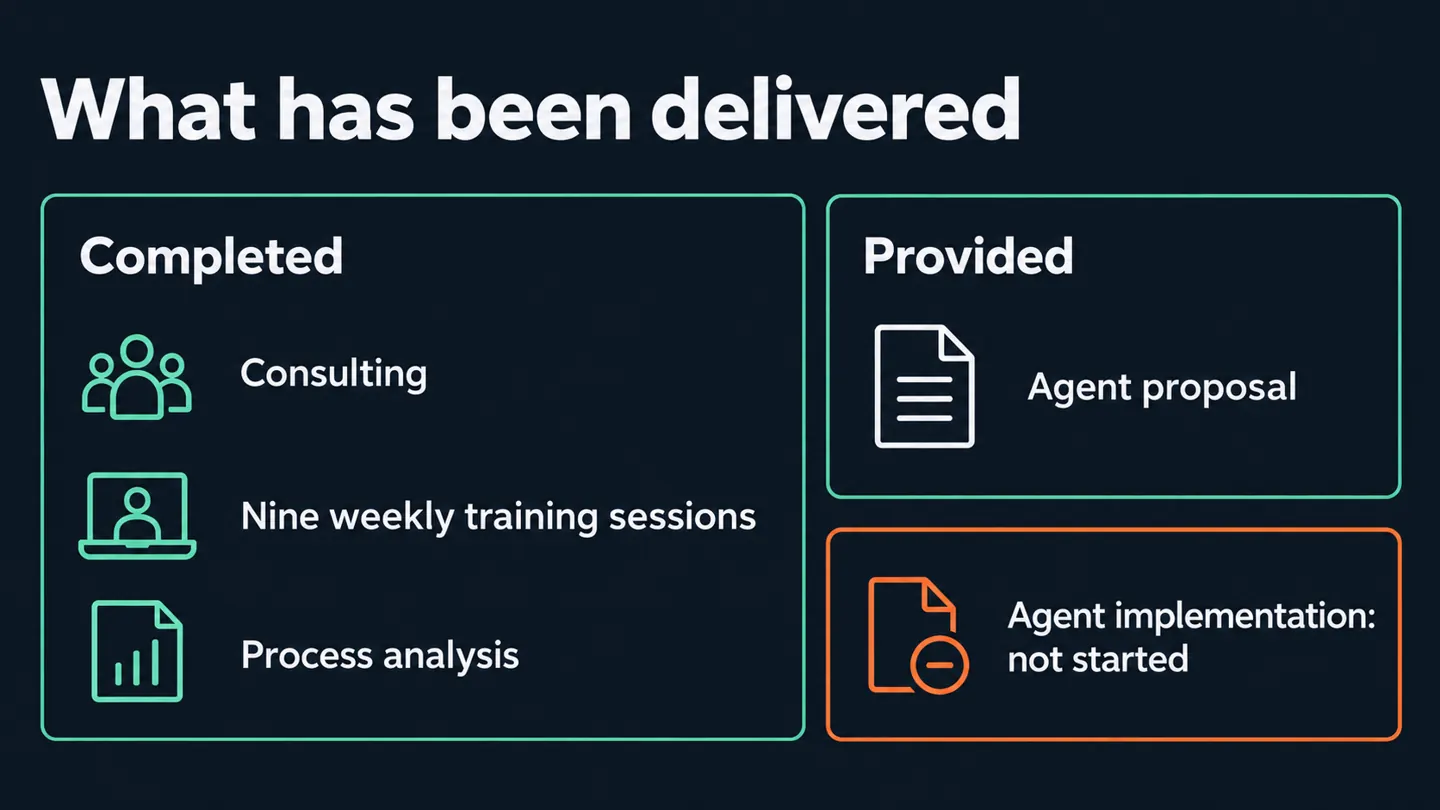
- Softblues also analysed processes and provided an agent proposal. Agent implementation has not started.
The adoption and training figures were approved by the client for publication in September 2026. Delivery scope was clarified by Ivan Pylypchuk on 14 October 2026: our role was consulting and, primarily, training.
What did the firm want people to learn?
The firm wanted staff to use AI in work where judgement and personal relationships matter. That makes the quality of someone's review as important as their ability to produce a draft.
Before training, only a small proportion of staff used generative AI for work. The firm serves high-value clients and wanted to preserve the personal quality of those relationships as it adopted new tools.
Its platform choice included a concrete test: relationship managers needed help writing to clients while keeping their own individual voices. In the firm's own comparison, staff preferred Claude for that work. This is a finding about one firm's needs and preferences, not a general ranking of platforms.
For training, that provides a much clearer objective than asking everyone to become better at prompting. A person can read a draft and decide whether it sounds like them, whether its facts are supported and whether it is appropriate for the recipient.
Those checks also make the limits visible. Fluent wording alone cannot tell a relationship manager whether a statement is correct or whether the message should be sent. The person remains responsible for deciding what to use.
How was the training organised?
Softblues designed and led nine weekly sessions for the whole team. The content was written for corporate finance, and sessions combined demonstrations with individual exercises.
The delivery pattern matters because watching someone else use a tool and using it yourself are different learning experiences. A demonstration can introduce an approach. An exercise asks the participant to make choices, inspect an answer and decide what needs changing.
The case does not publish the detailed curriculum or the contents of individual exercises. We therefore do not claim that a particular client document, workflow or review checklist was used in a particular session.
| Part of the programme | Responsibility | Evidence or boundary |
|---|---|---|
| Consulting on AI adoption | Softblues | Advice on AI adoption |
| Industry-specific training | Softblues | Nine weekly sessions for corporate finance |
| Participation and practice | All staff, with Softblues leading the sessions | Demonstrations and individual exercises |
| Policy and staff expectations | The firm | Its own acceptable-use policy and explanation of the change |
| Process analysis | Softblues | Analysis completed; separate from agent implementation |
| Agent proposal | Softblues | Proposal provided; implementation has not started |
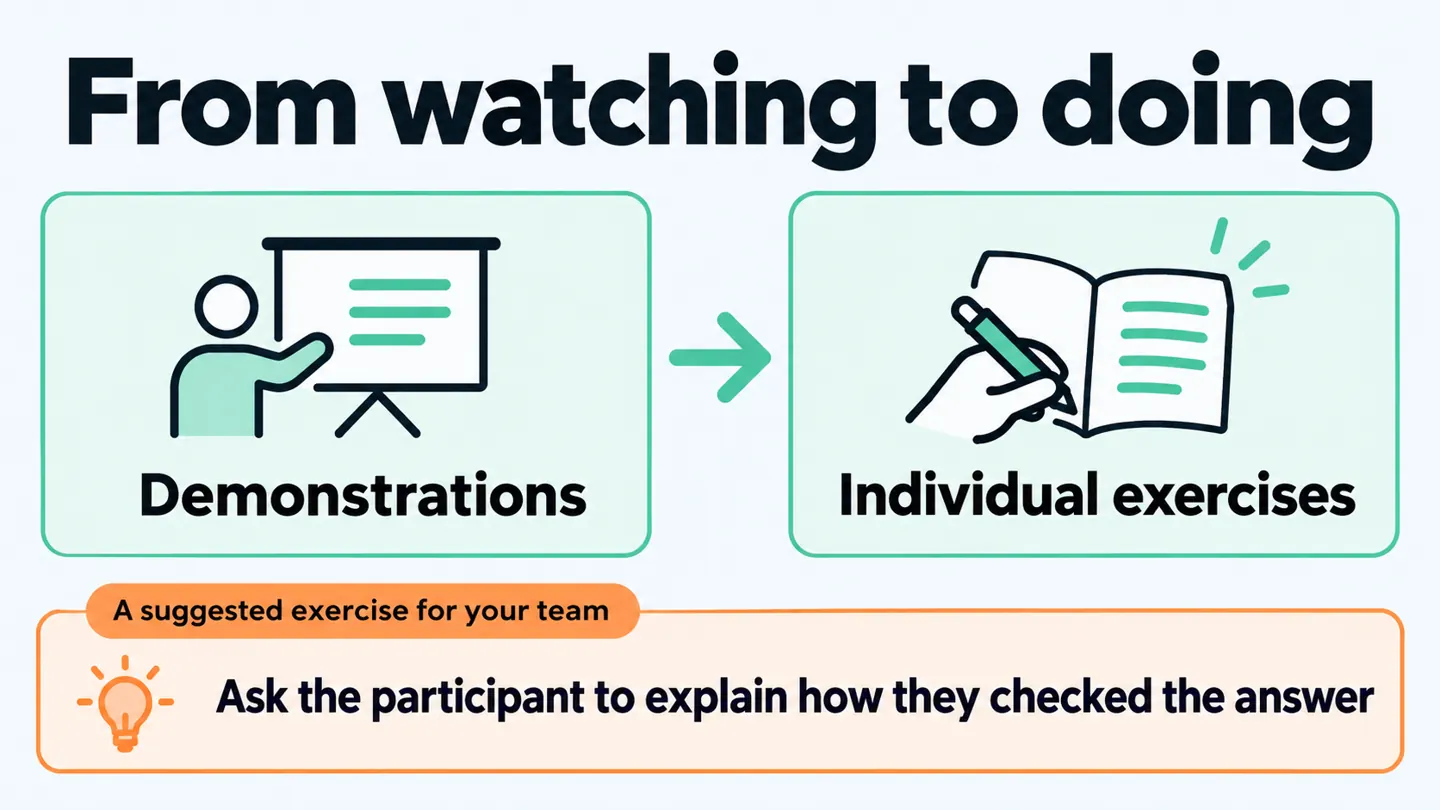
For another firm, the useful question is what participants will be able to do after a session. That might be preparing a draft they can check confidently, or recognising when the tool lacks enough evidence to answer. These are suggested training objectives, not additional outcomes measured at Key Capital.
The number of sessions should follow those objectives and the team's needs. This case documents nine sessions. It does not establish nine as a standard programme for every business.
Plan the learning around the work. Get the AI adoption guide for the wider choices around governed access, working practices and human ownership. Our AI adoption overview explains how training fits into a broader programme.
What did the firm contribute?
The firm wrote its own acceptable-use policy, explained why it was introducing AI and set expectations for staff. Those responsibilities stayed with the organisation that owns the work.
That gives training a practical boundary. Participants need to know what material they may use and what review is expected before an output enters normal business work. A trainer can help people apply the approach, while the firm remains responsible for its rules.
For a UK or Irish professional-services business, the policy should be usable at the point where someone is deciding what to do. If the answer depends on the type of document or the intended recipient, that distinction needs to be clear to the person doing the task.
Our recommendation is to use approved, sanitised material for learning exercises and agree in advance how participants will check their answers. This is advice for readers planning training, not a description of an unpublished client exercise or a legal conclusion about their data.
What changed after the programme?
The client reports that 35 of its 45 staff use Claude several times a week. Staff rated the training 4.3 out of 5.
Those figures describe different things. Use frequency indicates how many people have brought the tool into their work. The score records how participants rated the training. Neither measures the quality of every output or the amount of review it needs.
The earlier baseline is also limited. The case says a small proportion of staff used generative AI for work before training, but gives no precise count. There is no sound basis for calculating a percentage increase from that description.
We have not measured time savings, cost savings or financial return in this case. Nor does the evidence isolate the effect of training from every other factor in adoption. It is reasonable to report the programme and the client's subsequent usage figures together, while keeping those limits visible.
If you are building a financial case for your own programme, the whole-firm AI ROI calculator can help organise assumptions. Its estimates need to be tested against your own baseline and accepted work; they are not results from this client.
Where do process analysis and agents fit?
Softblues also analysed the firm's processes and provided a proposal for agents. Implementation has not started.
This is a separate piece of work from the training already delivered. A proposal describes potential future work. It is not evidence of a live agent, a deployed workflow or a financial result.
For another firm, consulting can help identify which recurring tasks deserve closer attention. Training can help staff use approved assistants with more confidence. A subsequent agent project needs its own agreed scope and decision to proceed.
Keeping those stages clear makes the next conversation more useful. You can discuss what people have learned and what they now need without treating every possible automation as a commitment already made.
What can your team try this week?
Start with one recurring task and a sanitised example. Use a tool your firm already approves, and define what an acceptable answer would look like before anyone asks the assistant to produce one.
A client-email draft is one possible exercise. Ask the participant to check factual statements against the supplied material and edit the wording into their own voice. Keep the decision to send outside the exercise. This is a suggested example, not a claim about the client's training curriculum.
Have the participant explain their edits. That reveals more than asking whether they liked the answer: you can see what they noticed, what they missed and where the source material was insufficient.
Give people an opportunity to try the approach in their normal, permitted work. At the next session, use the difficulties they encountered to decide what needs more practice. A new software feature is useful only when it helps with a problem the team actually has.
For the broader adoption discussion, see why teams do not use the AI tools they already have. Keep the immediate training objective small enough that a manager can recognise progress.
How can Softblues help?
Softblues provides AI adoption consulting, practical training and process analysis. Where an agent could address a defined need, we can propose that work separately, with implementation scope agreed after discovery.
Get the AI adoption guide or discuss AI adoption. Bring a task your team needs to perform and the questions they struggle to answer when using the tools.
Frequently asked questions
What did Softblues deliver for Key Capital?
Our main contribution was consulting and training, including nine weekly sessions designed for corporate finance. We also analysed processes and provided a proposal for agents. Agent implementation has not started.
What makes Claude training useful for staff?
Give participants practice on work they recognise and a clear way to judge the output. In this programme, Softblues paired demonstrations with individual exercises. The detailed curriculum is not public, so suggested exercises in this article are advice for readers.
Does frequent use prove a financial return?
No. The firm reports 35 of 45 staff using Claude several times a week, but time savings, cost savings and financial return were not measured. Softblues would treat those as separate measures requiring their own evidence.
Should training begin with an agent project?
An agent project is not a prerequisite for learning to use an approved assistant. Start with the work people need to do and the judgement required to check it. Any proposed agent implementation needs a separate scope and decision to proceed.
Sources and evidence date
The client-reported participation, usage and training figures come from the Key Capital training case, checked 14 October 2026. Delivery scope was checked on the same date: consulting, primarily training, process analysis and an agent proposal. Agent implementation has not started.
Work out your numbers
One key process
Process automation ROI calculator
Five questions about one process. See the hours an AI agent frees up, what they are worth and how much becomes profit.
Work out your numbersYour whole firm
AI ROI calculator
Five questions about your firm. See the time AI frees up, what it is worth and when it pays for itself.
Work out your numbers
Free. No sign-up. Your answers stay in your browser.
See it in production
Systems we have built and run for clients, with the numbers that came out of them.
Related Articles

AI for Logistics and Supply Chain Operations: Where UK Mid-Market Teams Start

AI for Legal Teams: What's Safe to Automate (and What Isn't)