AI for Logistics and Supply Chain Operations: Where UK Mid-Market Teams Start
UK transport and storage firms using AI jumped from 16.1% to 27.1% in one quarter. Here is where a mid-market logistics team should actually start, and why it is the paperwork, not the routing.
By Ivan Pylypchuk (opens in a new tab), CEO of Softblues. Has led Claude and Gemini implementations for finance, legal and healthcare teams across the UK and Ireland.
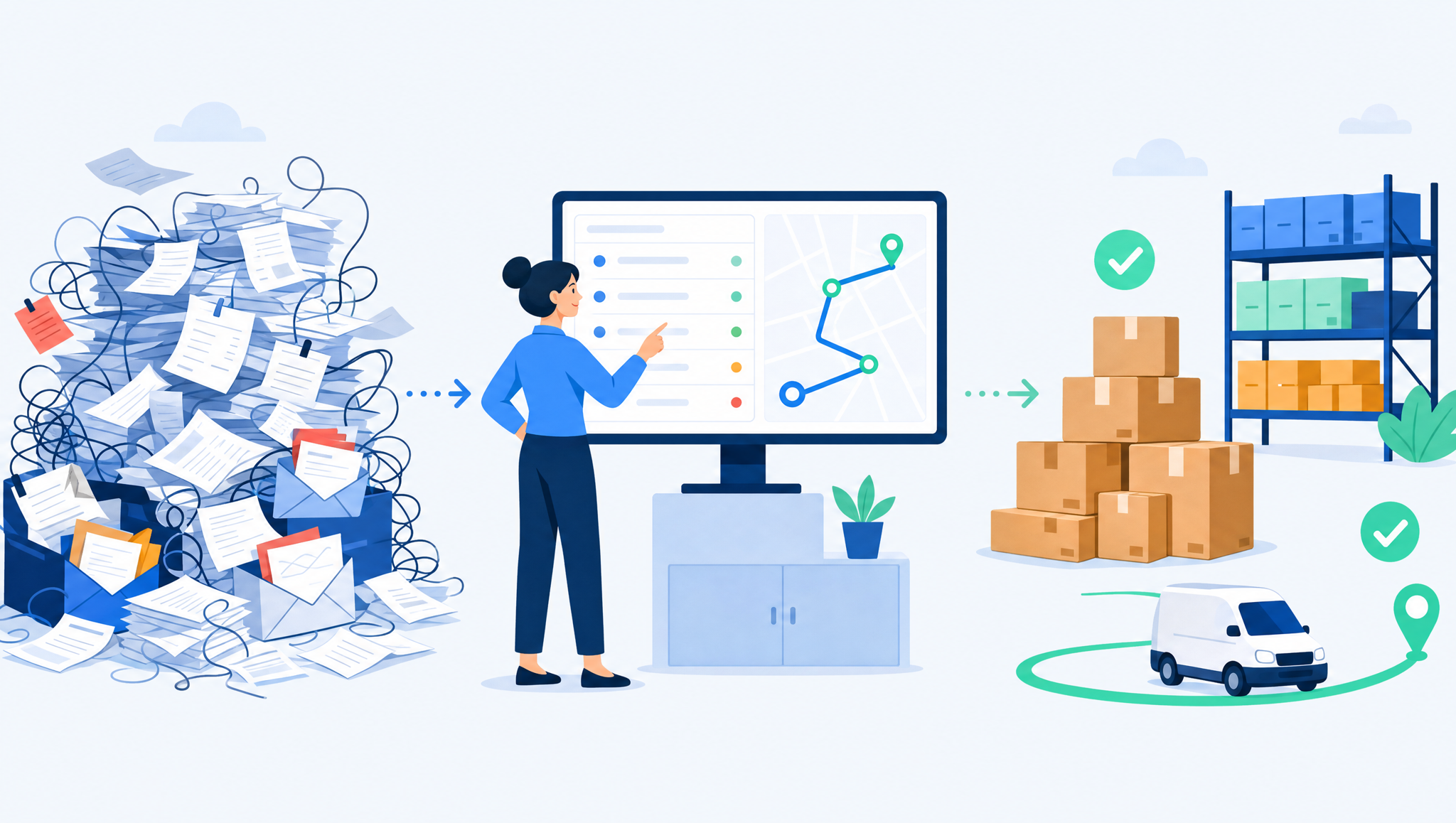
For a UK mid-market logistics or supply chain team, the place to start with AI is not routing or forecasting. It is the paperwork around each shipment: reading orders, matching them to schedules, chasing missing details and updating systems. That is where most of the manual hours sit, the data already exists, and a first project can pay back without touching a vehicle or a warehouse robot.
At Softblues, an AI consulting firm working with regulated mid-market companies across the UK and Ireland, we scope these projects by following the paperwork, not the technology, because that is where the hours and the errors actually are.
The urgency is real. The proportion of UK transport and storage firms using AI leapt from 16.1% to 27.1% in the first three months of 2026, an 11 percentage point rise in a single quarter, with over 20% of the rest planning to adopt within the next quarter (Parcelhero, analysing ONS data, Jul 2026). Early movers are pulling ahead on cost and service, and the gap is widening fast.
Key facts
- Start with documents and coordination, not physical automation: order intake, scheduling, exception handling and system updates.
- UK adoption is climbing fast: transport and storage firms using AI rose from 16.1% to 27.1% in Q1 2026 (Parcelhero / ONS, Jul 2026).
- Route optimisation is delivering around a 10% cut in costs and a 15% improvement in on-time delivery where it is applied (Parcelhero, Jul 2026).
- Foundations first. Legacy systems, batch data and manual workflows are the main thing holding firms back, not the AI itself.
- 56% of businesses have already put AI into at least one operational function (McKinsey, cited by Parcelhero, Jul 2026).
- Keep data compliant: shipment and customer data sits under UK GDPR and the ICO; confirm handling with your own compliance team.
Who this is for, and who it isn't
This is for an operations or IT leader at a 50 to 500-person UK or Ireland logistics operator, 3PL, freight forwarder or distribution business that runs on email, spreadsheets and a transport or warehouse management system, and where staff retype the same shipment details into several systems a day.
It is not for a global carrier with a data science team already in place, and it is not a guide to autonomous vehicles or robotics. If your order and shipment data still lives only in inboxes and PDFs, this is exactly where to begin. If it is already clean and structured in one system, you are ready for the harder optimisation work sooner.
Why is logistics different from other back-office automation?
Logistics runs on documents that arrive in every format imaginable: purchase orders, booking emails, delivery notes, customs paperwork, proof of delivery. The same shipment detail gets read and retyped by several people into several systems, and a small error early on becomes a missed delivery or a failed customs entry later.
That makes it a strong fit for AI, because the work is high volume, rules-based at the edges and judgement-based in the middle. It also makes the foundations matter more than the model. Many firms are held back not by the technology but by what sits beneath it: batch-processed data and manual workflows that cannot feed the real-time flows AI needs (Parcelhero, Jul 2026). Getting the data plumbing right is as important as choosing the tool.
Where should a mid-market team start?
Pick a process that is high volume, painful and measurable. Four candidates come up in almost every operation.
1. Order and booking intake. Read incoming orders and booking emails, extract the shipment details, and turn them into a structured record in your transport or warehouse system. This removes the retyping that starts most errors.
2. Scheduling and allocation. Match orders to slots, vehicles or carriers against your rules, and flag the ones that need a human decision. The aim is to clear the routine 70% so planners spend their time on the hard 30%.
3. Exception handling. Watch for the things that break service: missing paperwork, address problems, late collections, stock mismatches. Surface them early with the context to act, rather than discovering them at the door.
4. System updates and status. Keep the customer, the portal and the internal systems in step by drafting the updates and writing back the routine changes, so status is current without a person copying it across.
Where routing and forecasting fit in comes later, and it can be significant: AI-driven route optimisation is already delivering around a 10% reduction in costs and a 15% improvement in on-time delivery rates where firms apply it (Parcelhero, Jul 2026). But it depends on the clean, real-time data that the four processes above create.
What does the impact look like by use case?
| Use case | What it removes | What to measure | Effort |
|---|---|---|---|
| Order and booking intake | Retyping orders across systems | Hours per week, entry error rate | Low to medium |
| Scheduling and allocation | Manual matching of routine jobs | Share auto-allocated, planner time | Medium |
| Exception handling | Late discovery of problems | Failed deliveries, chase time | Medium |
| System and status updates | Copying status between systems | Update lag, customer queries | Low |
| Route optimisation | Suboptimal manual routing | Cost per drop, on-time rate | High (needs clean data) |
Start at the top of that table, not the bottom. The low-effort, document-heavy processes pay back first and produce the structured data the harder work needs.
What does this look like as a real project?
We scoped an order-to-schedule automation for a secure logistics operator (anonymised, and a discovery engagement rather than a live deployment): incoming orders arrived by email and portal in inconsistent formats, and staff rekeyed them into the scheduling system before allocating slots. The design read each order, extracted the fields, validated them against the operator's rules, created the scheduling record and flagged only the exceptions for a human. The measurable targets were retyping hours removed, entry errors avoided and time from order received to slot booked.
You can read how we approached it in our secure logistics order-to-schedule case study. It sits alongside the wider question of what a mid-market operation should tackle first, which we cover in AI for mid-market operations and what to automate first in the back office.
What about compliance and risk?
Shipment records carry personal and commercial data, so handling sits under UK GDPR and the oversight of the Information Commissioner's Office. Keep a human decision point where service or safety is at stake, log what the system did, and confirm data handling and retention with your own compliance team before go-live. Where the work touches operator licensing or driver hours, treat the AI output as an input to a human decision, not the decision itself. This is guidance on what to check, not legal advice.
What should you ask a partner on the call?
"Will you follow our documents or sell us a platform?" A good answer starts with your order and shipment paperwork and the hours around it, not a product demo.
"What state does our data need to be in first?" An honest partner is straight about the foundations, and treats data structuring as part of the project rather than pretending the model fixes everything.
"What is the single process we start with, and how do we measure it?" Look for one high-volume process, a baseline, and a metric agreed before build.
"What happens if it does not hit the target?" The target, the timeline and the price are agreed in the proposal after a paid discovery, before any build starts, so you know what you are buying and how it will be measured.
We are Certified in the Claude Partner Network and a Google Cloud partner at Services Select tier, and we work as practitioners: we design around the paperwork you actually process, prove one workflow, then extend. You can see the shape of that on our business automation page.
Frequently asked questions
Where should a logistics company start with AI?
Start with the documents and coordination around each shipment: order and booking intake, scheduling, exception handling and system updates. These are high volume, the data already exists, and they pay back before you touch routing, forecasting or physical automation.Do I need clean data before using AI in logistics?
Largely, yes. The main thing holding UK firms back is legacy systems and batch data rather than the AI itself. A good first project structures your order data as a by-product, which is what later scheduling and routing work depends on.How much does AI cut logistics costs?
Where route optimisation is applied, firms report around a 10% cut in costs and a 15% lift in on-time delivery (Parcelhero, Jul 2026). Document and coordination automation pays back through removed retyping and fewer failed deliveries. Measure it against your own baseline rather than a headline figure.Is AI adoption in UK logistics actually happening?
Yes, quickly. The share of UK transport and storage firms using AI rose from 16.1% to 27.1% in the first quarter of 2026, with over 20% of the rest planning to adopt within the following quarter (Parcelhero / ONS, Jul 2026).Will AI replace logistics jobs?
The evidence so far points to reskilling over redundancy: 31% of AI-adopting transport and storage firms reported no change in headcount, and definite job cuts were too few to register (Parcelhero / ONS, Jul 2026). The routine coordination work shrinks; the exception and judgement work stays with people.What compliance rules apply to AI in logistics?
Shipment and customer data falls under UK GDPR and the ICO. Where work touches operator licensing, driver hours or safety, keep a human decision point and treat AI output as an input. Confirm specifics with your own compliance team.Can smaller 3PLs and hauliers use this, or is it only for large carriers?
Smaller and mid-market operators are often the better fit for a first project, because the manual retyping and coordination are so visible. You do not need a data science team; you need one painful, high-volume process and the data that already flows through it.If shipment paperwork and coordination are eating your team's day, we will help you pick one process, baseline it and prove it before extending. Book a discovery call.
Work out your numbers
One key process
Process automation ROI calculator
Five questions about one process. See the hours an AI agent frees up, what they are worth and how much becomes profit.
Work out your numbersYour whole firm
AI ROI calculator
Five questions about your firm. See the time AI frees up, what it is worth and when it pays for itself.
Work out your numbers
Free. No sign-up. Your answers stay in your browser.
See it in production
Systems we have built and run for clients, with the numbers that came out of them.