
AI for wealth managers: a first check on client files
A proposed advice-file workflow with around 40 cited checks and human sign-off. What it would do, what remains unproved and how to test it before a build.
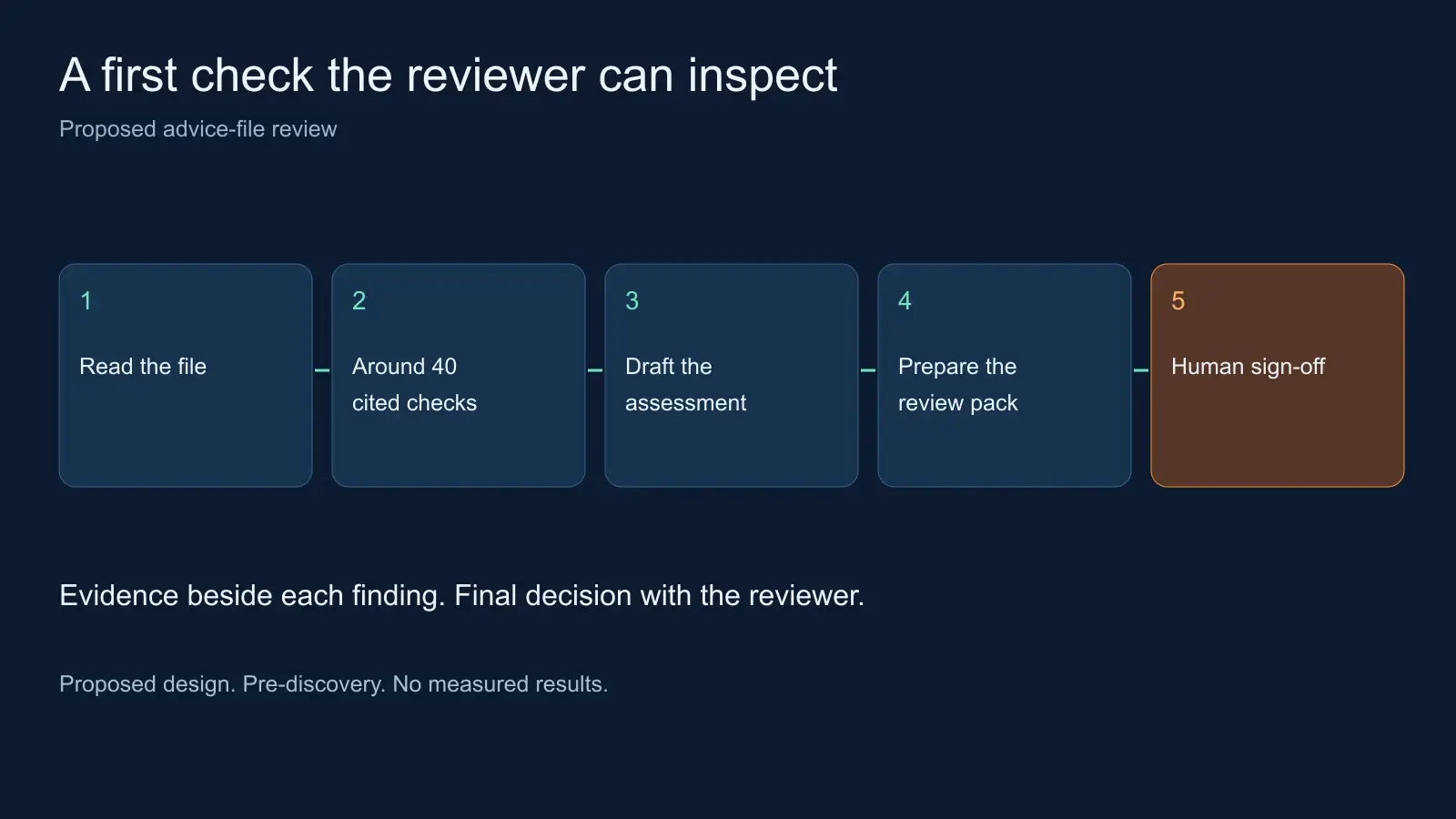
By Ivan Pylypchuk (opens in a new tab), CEO of Softblues. Last checked: 21 October 2026.
AI for wealth managers can prepare a first check of a client advice file, with findings linked to the documents a reviewer needs. The useful boundary is between checking the evidence and deciding whether the advice was suitable. Softblues proposed the approach below for an anonymised financial-advice firm. It remains proposed and pre-discovery, with no implementation results or measured time savings reported.
At Softblues, we help UK and Irish firms choose and implement AI around the work they need to improve. This article explains one proposed workflow, the decisions it leaves with compliance and a practical way to test the idea before commissioning a build.
What does the proposed case actually establish?
These five facts come from the published financial-advice compliance case, checked on 21 October 2026:
- The work is a monthly review of client advice files at an anonymised regulated financial-advice firm.
- The proposed workflow has four preparation stages before human sign-off.
- It includes around 40 mechanical checks per file, with findings cited to source pages.
- It would assemble a one-page review pack in the firm's existing Power BI.
- A compliance reviewer keeps the final decision; the case is at the proposed, pre-discovery stage.
Those are design features. They do not establish accuracy, coverage achieved in production or a financial return. The number of checks belongs to this case, not to a universal regulatory checklist.
Where does the reviewer's work begin?
The case starts with the fact find, statement of suitability and supporting documents. The team has to check the recorded information, consider whether the recommendation fits the client's needs and keep a record of its review.
It helps to separate two questions. Is the relevant information present in the file? Does that information support the recommendation? A system can locate a passage and still draw the wrong conclusion from it. Finding a document is useful preparation, but the reviewer needs to understand what the passage means in this particular file.
For example, imagine a test file containing an old statement of objectives and a later update. A page reference could be accurate while pointing to the superseded statement. This is an illustrative test condition, not an incident reported by the firm. It shows why a useful first check must help the reviewer challenge a finding, including its source and context.
How would the proposed workflow work?
The case describes what Softblues proposed, rather than work delivered by a project team. The responsibilities below are proposed operating roles. The published case does not establish a completed implementation by the firm, its IT provider or Softblues.
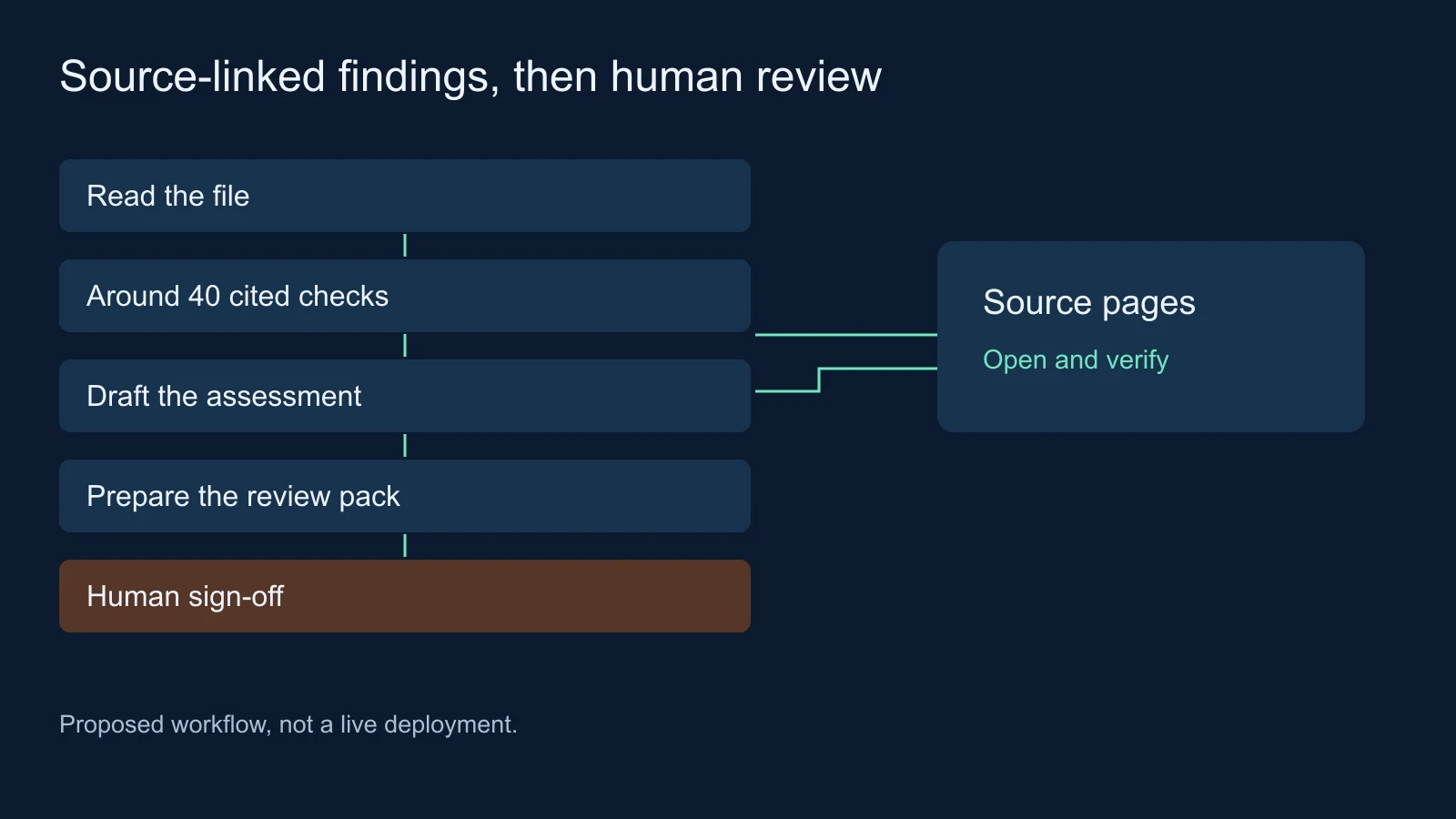
| Proposed step | Who would do it | What it would make available |
|---|---|---|
| Map the documents and sections | Extraction stage in the proposed system | The content needed for each check |
| Apply the mechanical checks | Checks stage, using the agreed requirements | Findings with source-page references |
| Draft the suitability assessment | Suitability stage for a person's review | A comparison of recorded needs and the recommendation |
| Assemble the review pack | Pack-generation stage | A one-page summary in Power BI |
| Check findings and sign off | The firm's compliance reviewer | The human decision on the file |
The case proposes deployment within the firm's Microsoft tenant in an EU region. Treat that as an architecture requirement to validate during discovery. It is not evidence that a deployed environment has passed a data-flow or security review. The exact services, processing locations and access controls still need to be checked for the chosen implementation.
In the core guide, this is Agent 7, Compliance file review at volume, in the P3 engineered-workflow tier. The four stages above are parts of that workflow; they do not change the numbering of the eleven worked-example agents. This case retains a reviewer signing every file, even though other designs may use different review policies.
What should stay with the reviewer?
A useful review pack makes disagreement easy. The reviewer should be able to open the cited evidence, understand the proposed finding and record a different conclusion with a reason. A page reference is a way to inspect the work. It is not a certificate that the assessment is correct.
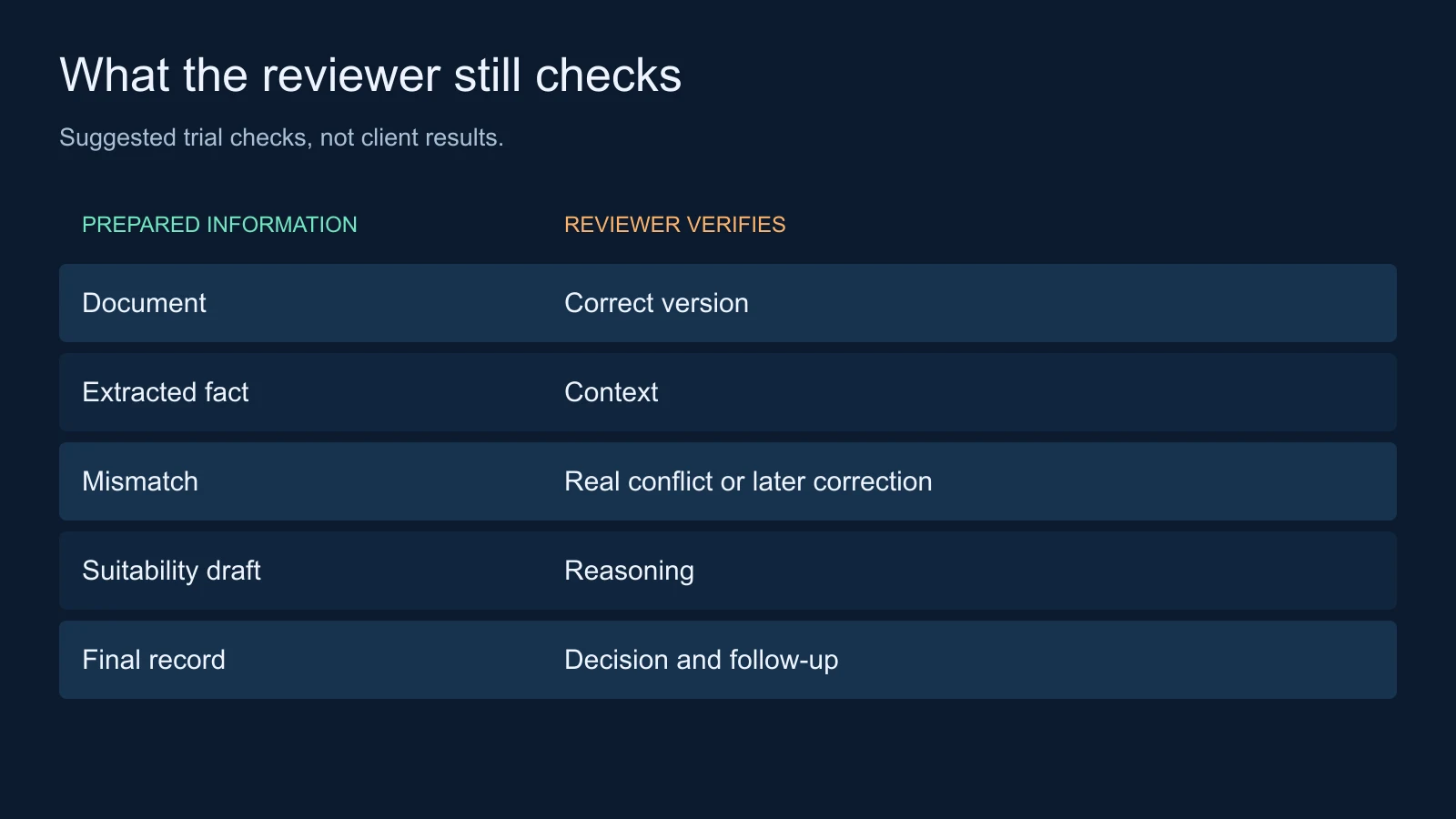
The following table is a suggested acceptance checklist for a reader's own trial. It extends the design into test questions, without claiming those tests have already happened in this case.
| Check type | What the system should prepare | What the reviewer should test |
|---|---|---|
| Document presence | Location of the required document or an explicit missing result | Is it the correct document and version? |
| Recorded fact | The extracted value and its source | Does the source support that value in context? |
| Consistency | The passages behind an apparent mismatch | Is there a genuine conflict or a later correction? |
| Suitability | A draft assessment linked to the file | Does the reasoning support the conclusion for this client? |
| Final outcome | A record ready for review | Is the decision defensible, and is follow-up needed? |
Do not force an uncertain result into a pass or fail simply to complete a dashboard. In a trial, missing evidence and an unreadable document should remain visible. Decide with compliance how each exception is handled before treating the output as work ready for sign-off.
What does the FCA material add?
The FCA's AI good-practice publication, published on 19 October and updated on 20 October 2026, explains how existing frameworks apply to AI. It says its examples do not create new requirements. Firms remain responsible for customer outcomes when using AI-supported tools. This is UK regulatory context, not an approval of this proposed system or a statement of Irish requirements.
The FCA's outcomes-monitoring publication, also checked on 21 October, explains that collecting metrics alone does not demonstrate good outcomes. Firms need to understand the information, act on issues and assess whether the action helped.
For this workflow, our practical interpretation is to keep the review decision and any resulting action connected. A completed pack should not hide an unresolved finding. The firm's compliance lead must decide which requirements apply to its services and how the proposed checks support its existing controls.
What has this design not proved?
There is no measured reduction in review time in the published case. There is no reported comparison against reviewers on a held-out set of files. There is no basis to claim that every important issue would be found, that the model can decide suitability, or that the regulator has endorsed the design.
A proposed pack may reduce searching, yet still create more checking if its findings are weak. That is why the business case should measure the whole review, including corrections and exceptions. The process automation ROI calculator can help explore the economics using your own assumptions. Its output is an estimate, not a result achieved by this firm.
Our broader AI in financial services guide covers the surrounding governance questions. This article stays with one operational decision: whether preparing a cited first check makes a compliance review more useful and efficient while preserving the quality of the final decision.
What can you copy this week?
Start without buying software. Take an existing, authorised historical file and the review checklist your team already uses. Ask the reviewer to mark where each conclusion gets its evidence. This costs staff time but needs no new tool purchase. If the team disagrees about what counts as evidence, resolve that before automating the check.
Next, where your policies and approved tools permit it, trial a narrow set of checks on permitted test material. Keep the existing human review as the reference. Include awkward documents and known issues as well as straightforward files. The purpose is to discover which checks can be made reliable, not to produce an attractive demonstration.
Record the time needed to verify and correct the output. Separate missed issues from unnecessary alerts, because they cause different problems. Agree acceptable results with the compliance owner before seeing the trial output. These are our suggested evaluation steps, not published results from the anonymised firm.
Only then decide whether the volume and integration needs justify an engineered workflow. A useful discovery should establish the review rules, system boundaries, evidence record and acceptance criteria. If a governed assistant and a clearer working practice meet the need, there is no reason to commission a larger system.
How can Softblues help?
Softblues starts with paid discovery to define the process and evidence needed before proposing implementation. Softblues is an OpenAI Select Partner, Certified in the Claude Partner Network, a Google Cloud partner at Services Select tier, and a member of the Microsoft AI Cloud Partner Program.
Book a case walkthrough to discuss how the proposed approach relates to your review process. For platform choice and the eleven worked examples, get the free 21-slide deck, Four ways to make a regulated firm AI-native. Our AI automation overview explains the route from a repetitive process to a scoped implementation.
Frequently asked questions
Can AI decide whether financial advice was suitable?
In this Softblues proposal, AI drafts the assessment for a compliance reviewer. The reviewer checks the evidence and keeps the final decision. The case does not establish autonomous suitability decisions.
Are the 40 checks an FCA checklist?
No. Around 40 is the proposed mechanical-check count in this particular case. A firm's compliance lead must define the requirements relevant to its own services and review process.
Has Softblues measured the time saved?
No measured savings are reported for this case. The published stage is proposed and pre-discovery. Softblues recommends testing the whole review, including verification and corrections, before using savings in an investment decision.
Does an EU Microsoft tenant settle every data question?
No. The proposed location is a requirement to validate, not a completed assurance exercise. Softblues would need to check the chosen services, data flows and access controls during discovery before finalising the implementation scope.
Sources and verification
Case facts: Softblues financial-advice compliance case, read 21 October 2026. No original publication date is displayed on the case page; the date here is the verification date.
Regulatory context: FCA AI good practice, published 19 October 2026 and updated 20 October 2026; FCA outcomes monitoring, both checked 21 October 2026. Links appear in the relevant paragraphs above.
Method and numbering: Softblues core AI adoption guide, Part 7, Agent 7, with the case-specific every-file sign-off taking precedence over generic sampling examples. Suggested test conditions and acceptance checks are editorial recommendations, not client facts.
Work out your numbers
One key process
Process automation ROI calculator
Five questions about one process. See the hours an AI agent frees up, what they are worth and how much becomes profit.
Work out your numbersYour whole firm
AI ROI calculator
Five questions about your firm. See the time AI frees up, what it is worth and when it pays for itself.
Work out your numbers
Free. No sign-up. Your answers stay in your browser.
See it in production
Systems we have built and run for clients, with the numbers that came out of them.
- Secure LogisticsOrder-to-Schedule Automation for a Secure Logistics Operator15–30 hrs/wk scheduling time to reclaim
- Financial ServicesSoftblues' Design for Automating the Monthly Compliance File Review~40 checks per file
- Food ProductionAuditing an AI-Built App and Making It Safe to Scale58K lines audited
Related Articles
Claude for business: training staff on their own work

AI for Logistics and Supply Chain Operations: Where UK Mid-Market Teams Start