Why Your Company Bought AI and Nobody Uses It: An Adoption Playbook for UK Mid-Market Teams
Nearly half of workers never use AI at work, and only 7% of companies have scaled it. The gap is not the model, it is adoption. A practical playbook for UK and Ireland mid-market teams.
By Ivan Pylypchuk (opens in a new tab), CEO of Softblues
Here is the number that should worry any leader who has already paid for AI: nearly half of workers (49%) say they never use AI in their role (Gallup, Q4 2025). The licences are bought. The tools are switched on. Most people still work the way they did last year.
That gap is where the money leaks. McKinsey's State of AI 2025 survey found only 7% of organisations have fully scaled AI, with roughly two-thirds still stuck in experiments and pilots (McKinsey State of AI 2025, via Silicon Canals, Nov 2025). Buying AI is easy. Getting a team to actually run on it is the hard part, and it is the part most companies skip.
Key facts
- 49% of workers say they never use AI at work. The tool exists, the habit does not (Gallup, Q4 2025).
- Only 7% of organisations report AI is fully scaled; about two-thirds are still in pilots (McKinsey State of AI 2025).
- Companies are missing up to 40% of potential AI productivity gains because of gaps in talent and skills strategy, not the technology (EY, Nov 2025).
- The pattern repeats across UK and Ireland mid-market teams: a licence is bought, a demo lands well, and three months later the usage dashboard is flat.
- Adoption is a change problem, not a software problem. The fix is workflow-level, not tool-level.
Why do teams stop using the AI you bought?
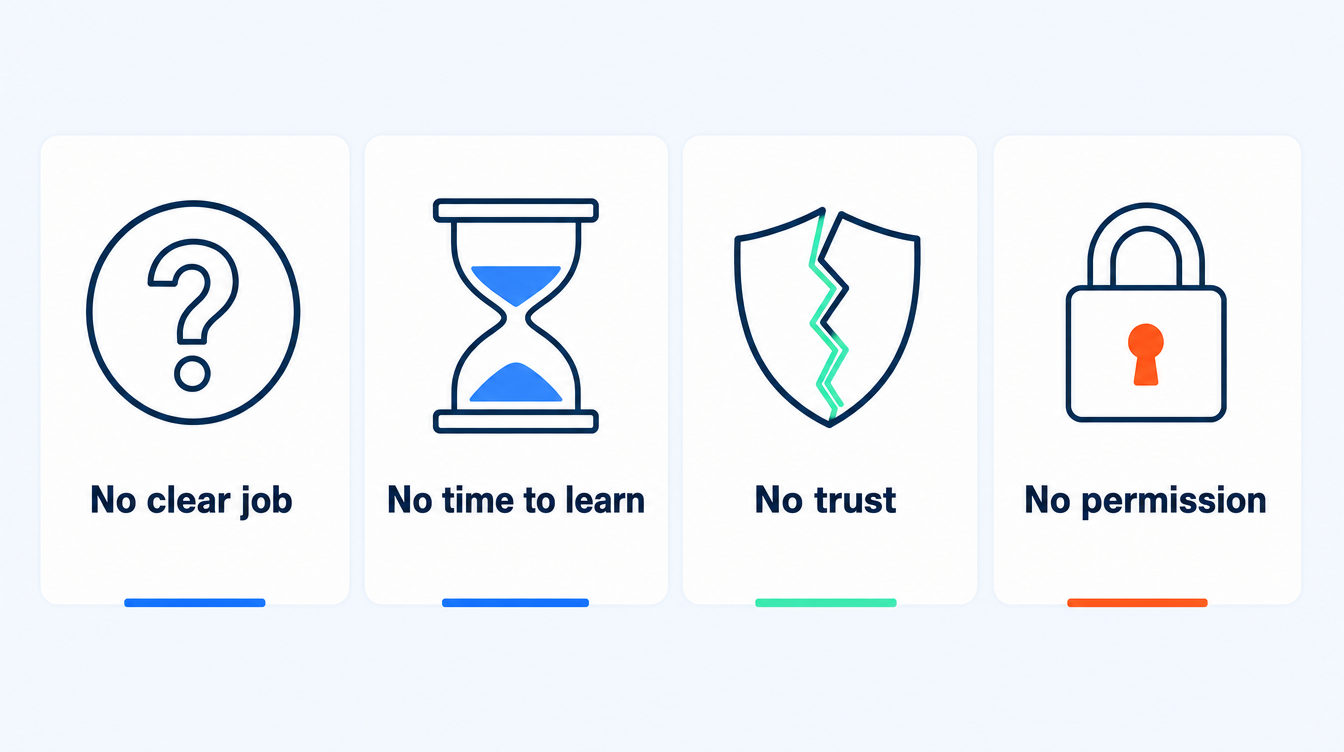
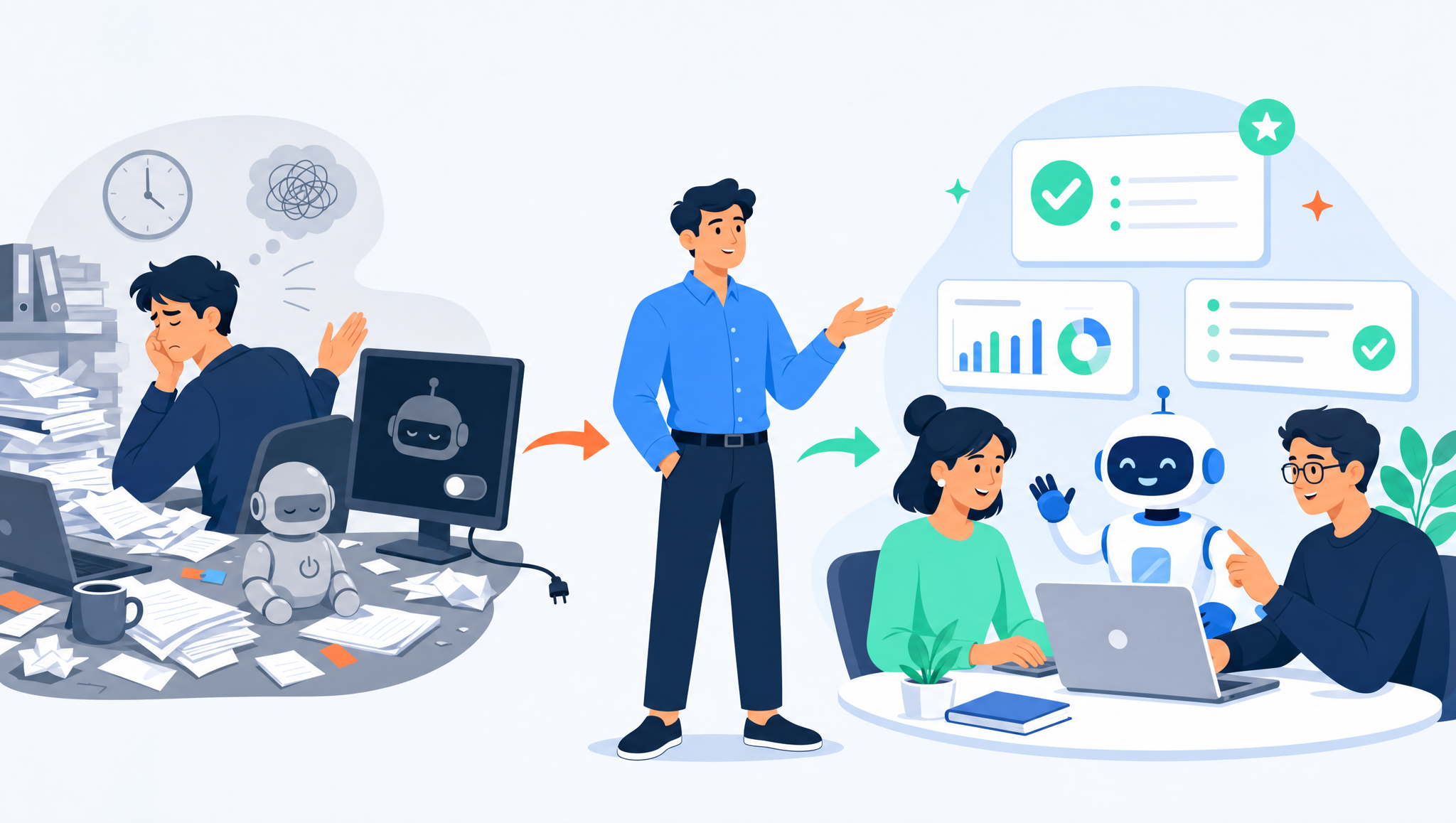
The reasons are boringly consistent, and none of them are about the model being weak.
No clear job. A generic licence with no defined task is a solution looking for a problem. People open the tool, type "summarise this", get a reasonable answer, and close it again. Nothing changed in how the work gets done.
No time to learn. Adoption competes with the day job. If using AI takes longer than the old way for the first two weeks, most people quietly revert. EY's finding that companies lose up to 40% of the productivity upside points straight at this: the capability is there, the investment in helping people reach it is not.
No trust. In regulated and detail-heavy work, one wrong output early on convinces a team the tool "makes things up" and they abandon it. Trust is earned by scoping AI to tasks where its work can be checked, not by asking people to take it on faith.
No permission. People are often unsure whether they are allowed to put a client document into a tool, or whether the output counts as "real" work. Without an explicit policy and a manager who uses it too, most default to caution and shadow tools.
What does an adoption programme actually look like?
The teams that get past the pilot do a few unglamorous things in order. This is the sequence we use with clients, and the one we ran on our own company.
1. Pick one painful, repeated task. Not "use AI more". A named job that happens every week and eats hours: drafting the same report, triaging the same inbox, checking the same documents. One task, one team, one owner.
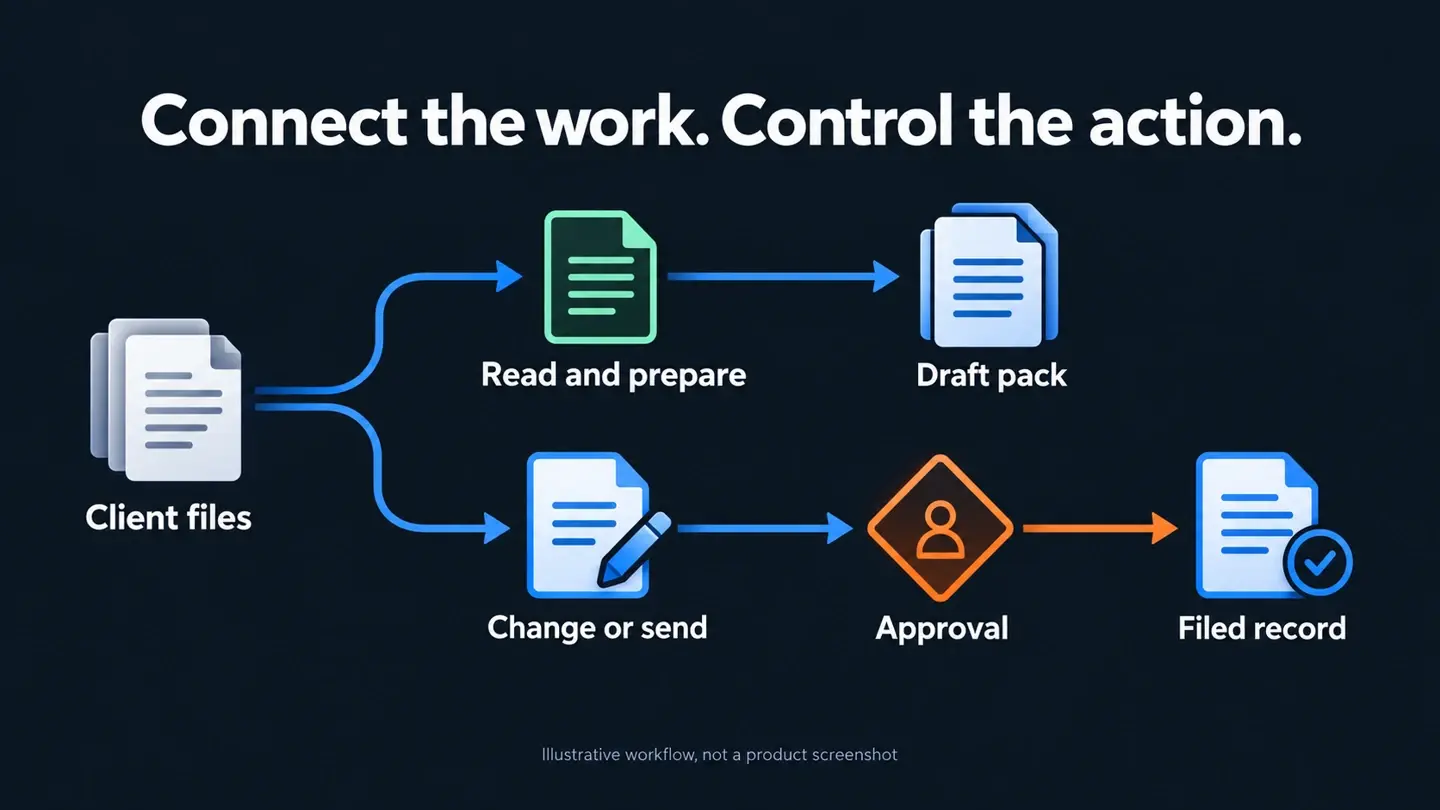
2. Build it into the workflow, not alongside it. The AI step should live where the work already happens, with the right context and access, so using it is the path of least resistance. If people have to leave their normal tools to use AI, they won't.
3. Set a visible success measure before you start. Hours saved, turnaround time, error rate. Measure the old way for two weeks first, or you will never prove the change. Our guide on how to measure the ROI of an AI implementation walks through the framework.
4. Give people time and a person to ask. A named champion on the team, an hour of hands-on time, and a fast answer when someone gets stuck in week one. This is the cheapest intervention with the biggest effect.
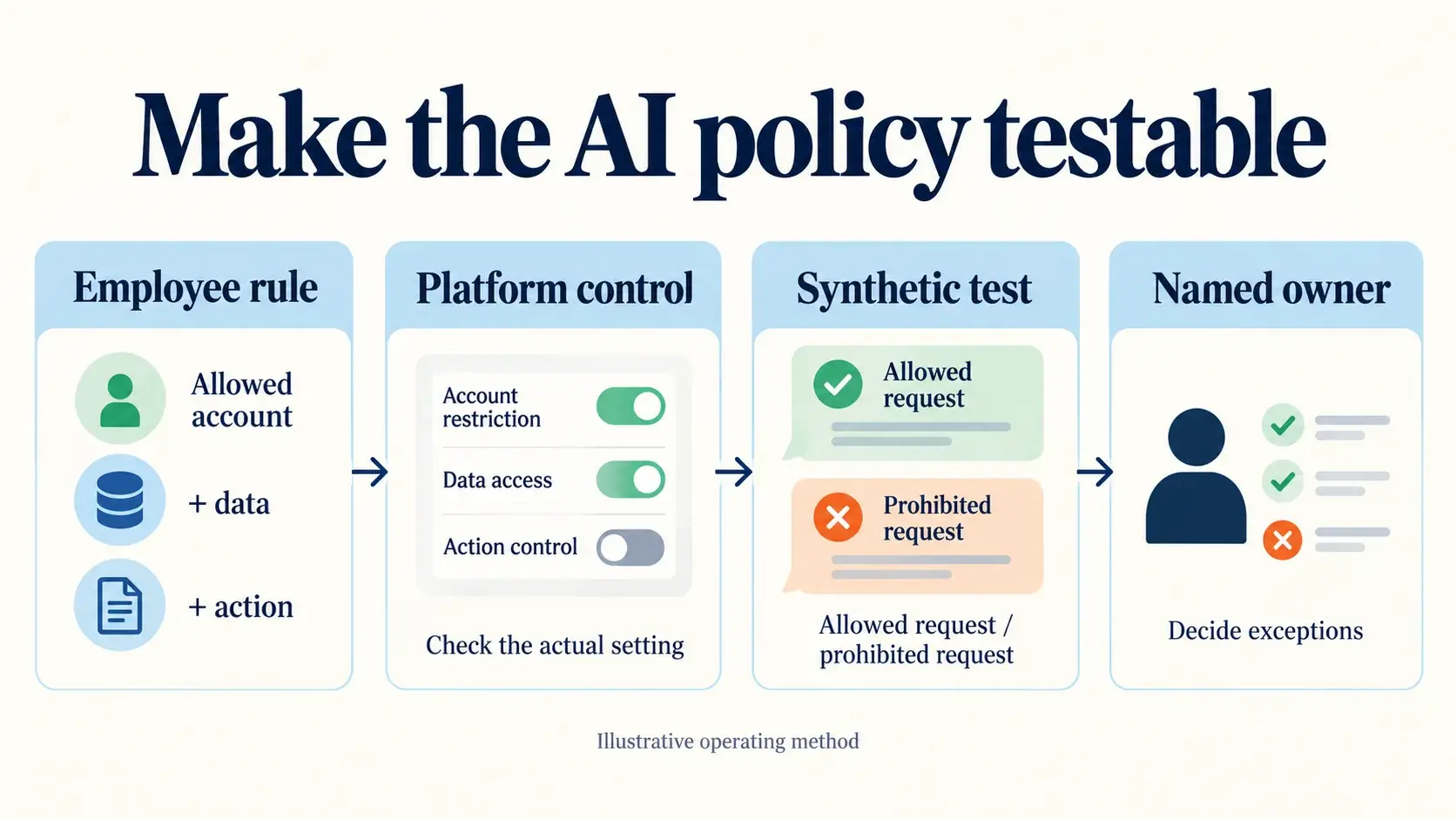
5. Write the permission down. A short, plain policy: what data is fine to use, what needs review, who signs off. Ambiguity kills adoption faster than any rule. See AI governance for UK mid-market companies for a practical version.
6. Expand only after the first task sticks. Prove one workflow, show the team the number, then move to the next. A win people can see beats a rollout plan nobody reads.
To see what real weekly use is worth across your firm, try our AI ROI calculator.
Buy-and-hope vs a structured rollout
The difference between the two approaches is not budget. It is whether anyone owns the change.
| Approach | What it involves | Typical outcome | Best for |
|---|---|---|---|
| Buy licences and hope | Roll out access, run one demo, wait for usage | Flat usage, quiet churn, "AI didn't work for us" | Nobody. This is the default that fails |
| Training add-on | Licences plus a one-off training session | A short spike, then decay back to old habits | Teams with genuinely simple, self-serve tasks |
| Embedded adoption programme | One task wired into the workflow, a success measure, a champion, written permission | Sustained use on a real job, a number you can show, a base to expand from | Regulated and process-heavy mid-market teams |
How we run our own company on Claude
We are not describing this from the outside. Softblues runs its own operations on Claude, from sales and finance to marketing and delivery, and we hit the same adoption walls before we solved them. What moved the needle was exactly the sequence above: naming the task, embedding the step, and measuring the result rather than asking people to "try AI".
You can read the full account in our Claude AI operating system case study: how a company of our size actually put Claude into daily operations, and what we learned about getting people to use it.
That experience is also why we treat adoption as the deliverable, not the software. A tool nobody uses returns nothing, however good the model is.
When should you bring in help?
Not always. If your task is simple and self-serve, a licence and a champion may be enough. Bring in a partner when the work is regulated, when it spans several systems, or when a failed rollout has already made the team sceptical and you need the second attempt to land.
The honest test: if you have bought AI, six months have passed, and you cannot point to one workflow that changed and one number that moved, the rollout has stalled and no amount of extra licences will fix it.
Frequently asked questions
Why do most AI tools go unused after purchase?
Because they are bought as software, not adopted as a change. Without a specific task, time to learn, trust in the output, and explicit permission, people revert to how they worked before. Gallup found 49% of workers never use AI at work despite widespread rollouts.
Is low AI adoption a technology problem or a people problem?
Almost always a people-and-process problem. EY estimates companies lose up to 40% of potential AI productivity gains through gaps in talent and skills strategy, not model quality. The model is rarely the bottleneck.
How long should an AI adoption programme take to show results?
Aim to prove one workflow within four to eight weeks. Measure the old way first, embed the AI step, and track a single success measure. If nothing moves in that window, the task or the workflow design is wrong.
What is the single most effective thing to improve adoption?
Put the AI step inside the tools people already use, on one repeated task. Convenience drives sustained use far more than training sessions or enthusiasm.
Do we need a formal AI policy before rolling out?
Yes, but keep it short. A one-page statement of what data is safe to use, what needs review, and who signs off removes the ambiguity that makes cautious teams avoid the tool entirely.
How do we know if our rollout has stalled?
If six months in you cannot name one workflow that changed and one number that improved, usage has not taken hold. Extra licences won't fix it; a scoped, owned adoption effort will.
Which effort depends on which kind of firm you are. The platform guide splits this as adoption-first or automation-first, and how to tell which you are, with a one-sentence test.
Softblues is an OpenAI Select Partner, Certified in the Claude Partner Network, a Google Cloud partner at Services Select tier, and a member of the Microsoft AI Cloud Partner Program. We are practitioners, not slideware consultants: we run our own company on Claude, and we help UK and Ireland mid-market teams turn bought AI into workflows people actually use. If your usage dashboard is flat, that is a fixable problem.
Work out your numbers
Your whole firm
AI ROI calculator
Five questions about your firm. See the time AI frees up, what it is worth and when it pays for itself.
Work out your numbersOne key process
Process automation ROI calculator
Five questions about one process. See the hours an AI agent frees up, what they are worth and how much becomes profit.
Work out your numbers
Free. No sign-up. Your answers stay in your browser.
See it in production
Systems we have built and run for clients, with the numbers that came out of them.
Related Articles
MCP server access: Claude, ChatGPT and Copilot in Microsoft 365
AI governance framework: a UK employee policy template