Claude vs ChatGPT vs Copilot: what does an AI agent task really cost?
A real research task used 10.14 million tokens. Compare five task budgets, model tariffs, business billing and included usage.

A short research answer can conceal millions of tokens of work.
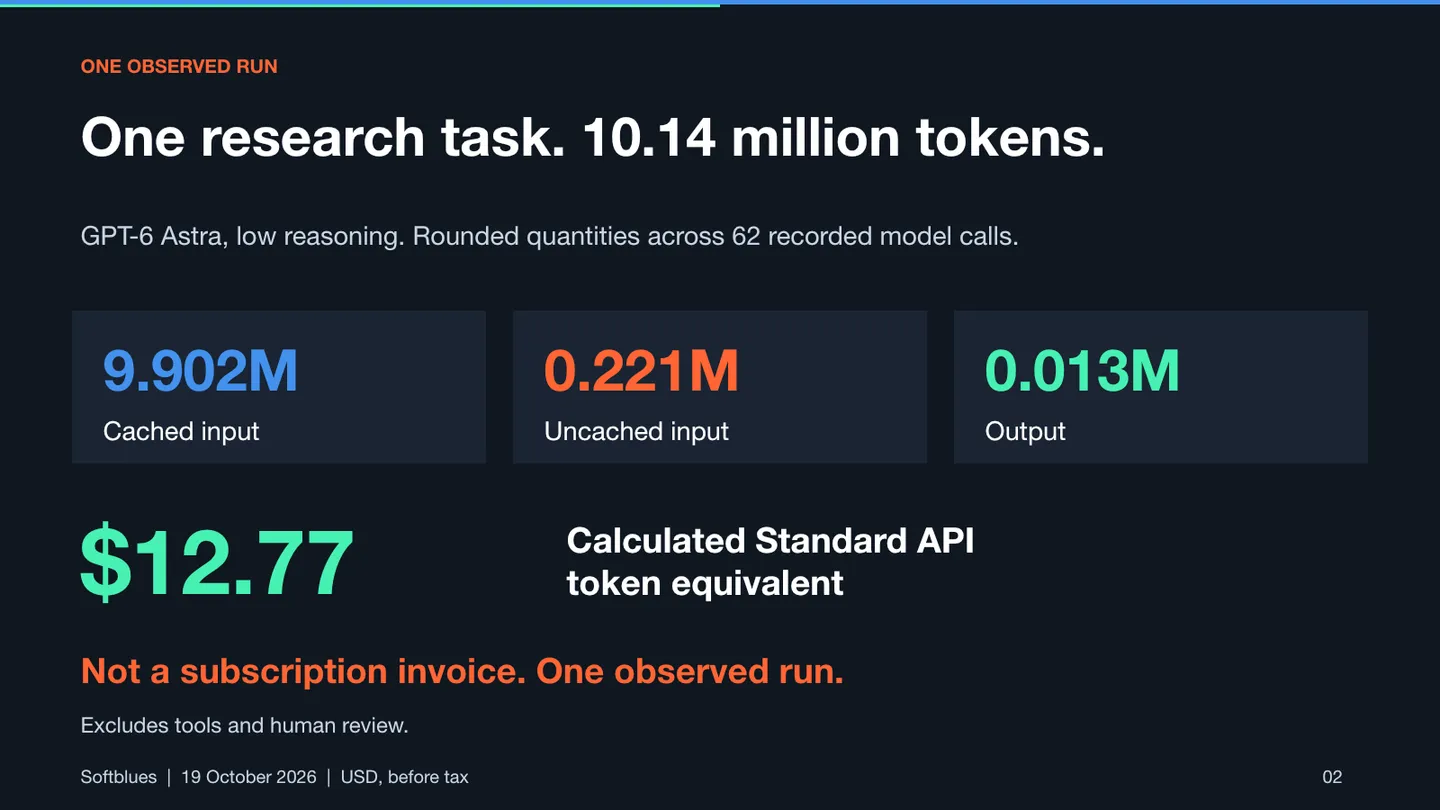
We checked a real browser-based channel research task in Codex. GPT-6 Astra processed 10.14 million tokens across the research and its continuation. At current Standard API rates, the recorded token mix works out at about $12.77. That is a modelled token charge, not a subscription invoice.
The useful question for a business is how that workload changes with the model, caching and purchasing plan. Softblues compared published tariffs with one measured task and four explicitly assumed task budgets. The result is a way to price work before a pilot, then replace assumptions with evidence.
Key facts
- Our observed research used GPT-6 Astra with low reasoning effort: 10,136,087 total tokens across 62 recorded model calls.
- Cached input accounted for 97.81% of input. Charging every input token at the full fresh-input price would materially misstate this run.
- The tables below compare the same token budgets at different tariffs. Only the Astra research quantities were observed; they do not prove other models would use the same tokens.
- Included-usage subscriptions can be cheaper if the required work fits their limits. They do not promise a fixed monthly pot of tokens for these tasks.
- Tools, licences and human review sit outside the model-token tables. A usable result is the unit that matters.
What our research actually used
The task, "Research: new marketing channel", was an initial assessment of a potential acquisition channel. It reviewed a sample of existing opportunities, looked for potentially relevant leads, and examined available historical activity and spending indicators. The output was an initial report on the channel, the opportunities observed and the limits of the evidence.
The measured run includes the initial analysis, an interruption to browser access and the continued research. It excludes later monitoring setup. This was a bounded first review, not an exhaustive market study or outreach campaign.
| Recorded component | Tokens |
|---|---|
| Fresh or otherwise uncached input | 221,343 |
| Cached input | 9,901,696 |
| Output, including reported reasoning | 13,048 |
| Total | 10,136,087 |
The largest single input was 233,556 tokens. The 10.14 million total is the sum across model calls, not a single context window or unique text. Each step can receive instructions, tool descriptions and prior results again. Repeated context is real processing even when it is served from cache.
The selected model in the task log was GPT-6 Astra, reasoning low. The log is not an invoice and does not identify every internal service. Historical speed mode was not established, so our pricing calculation assumes Standard.
Using Astra's published rates, the calculation is 0.221343 million fresh-input tokens at $10, 9.901696 million cached tokens at $1, and 0.013048 million output tokens at $50: $12.77. The trace recorded no separate cache-write quantity. A different API implementation that writes all new input into a five-minute cache would give $13.32 instead. Astra's rate card also distinguishes long-context requests; this trace stayed below its 272,000-input-token threshold.
The deliverable was a preliminary research report, not a validated pipeline of qualified leads. The token count measures the work performed; it does not establish lead quality, client acquisition or commercial return.
Is a million-token task plausible?
Yes, for some agentic work. That does not make it a universal average.
The authors of AgencyBench report demanding scenarios spanning research and other capabilities. Their resource table shows average scenario consumption from 1.2 million to 4.1 million tokens across the listed, older models. Those results are context for scale, not a benchmark of today's Astra or Opus on our office tasks.
OpenRouter's October analysis reports that cached prompt tokens made up just under 90% of agentic tokens in September. It measures API traffic across its network, not subscription allowances. A separate coding-agent study found up to 30-fold variation across runs of the same task. Its domain differs, but the budgeting lesson is relevant: an agent can repeat work, explore unhelpful paths or carry too much context.
These sources support measuring the whole run. They do not establish a fixed token allowance for a finance report.
Start with the model tariff
These are USD prices per million tokens, checked on 19 October 2026, using Standard global API processing. A cache write replaces the fresh-input charge for those tokens; do not add both.
| Model | Fresh input | Cache write, 5 min | Cache read | Output |
|---|---|---|---|---|
| GPT-6 Astra | $10 | $12.5 | $1 | $50 |
| GPT-6.1 Sol | $2 | $2.5 | $0.1 | $10 |
| Claude Opus 5.5 | $4 | $5 | $0.2 | $20 |
| Claude Sonnet 5.5 | $2 | $2.5 | $0.1 | $10 |
Sources: OpenAI API pricing and Claude pricing. Claude's one-hour writes cost more than five-minute writes. Tokenisers also differ, so the same source text need not produce the same counts across vendors.
A platform may expose several models or choose among them. Record the actual selection and settings where available. Do not infer "Astra" merely because a task ran in ChatGPT, or "Opus" merely because it ran in Claude or Copilot.
Five task budgets, with the assumptions visible
One row below is measured. The other four are engineering scenarios for a pilot, not claimed industry averages. Model calls are not the same thing as tool calls.
| Task | Calls | New input | Repeated cached input | Output | Total |
|---|---|---|---|---|---|
| Research: new marketing channel | 62 | 221,343 | 9,901,696 | 13,048 | 10,136,087 |
| Accounting analysis | 20 | 180,000 | 1,020,000 | 12,000 | 1,212,000 |
| 12-slide presentation | 25 | 200,000 | 1,800,000 | 20,000 | 2,020,000 |
| Six-page management report | 25 | 150,000 | 1,350,000 | 15,000 | 1,515,000 |
| Extract and check ten documents | 10 | 60,000 | 240,000 | 6,000 | 306,000 |
The accounting scenario uses a sanitised 10,000-row ledger, reconciliation and an exception list. Its assumed 20 model calls average 60,000 input tokens each, with 85% served from cache. The data itself should be processed with code or spreadsheet formulas rather than repeatedly pasted into the prompt.
The presentation scenario means 12 editable slides from an approved brief, including two native charts. It assumes 25 calls averaging 80,000 input tokens, 90% cached. Generated illustrations are excluded.
The management report is six pages from an approved workbook and four documents: 25 calls averaging 60,000 input tokens, 90% cached. The document-extraction task covers ten text documents, a field table and source checks: ten calls averaging 30,000 input tokens, 80% cached, without difficult OCR.
Output includes intermediate text, code and reported reasoning, not only the final deliverable. Repeated corrections, poor scans or open-ended searching can exceed these budgets. Half-volume and double-volume scenarios are useful stress tests, not confidence intervals or upper limits.
What those budgets cost by model
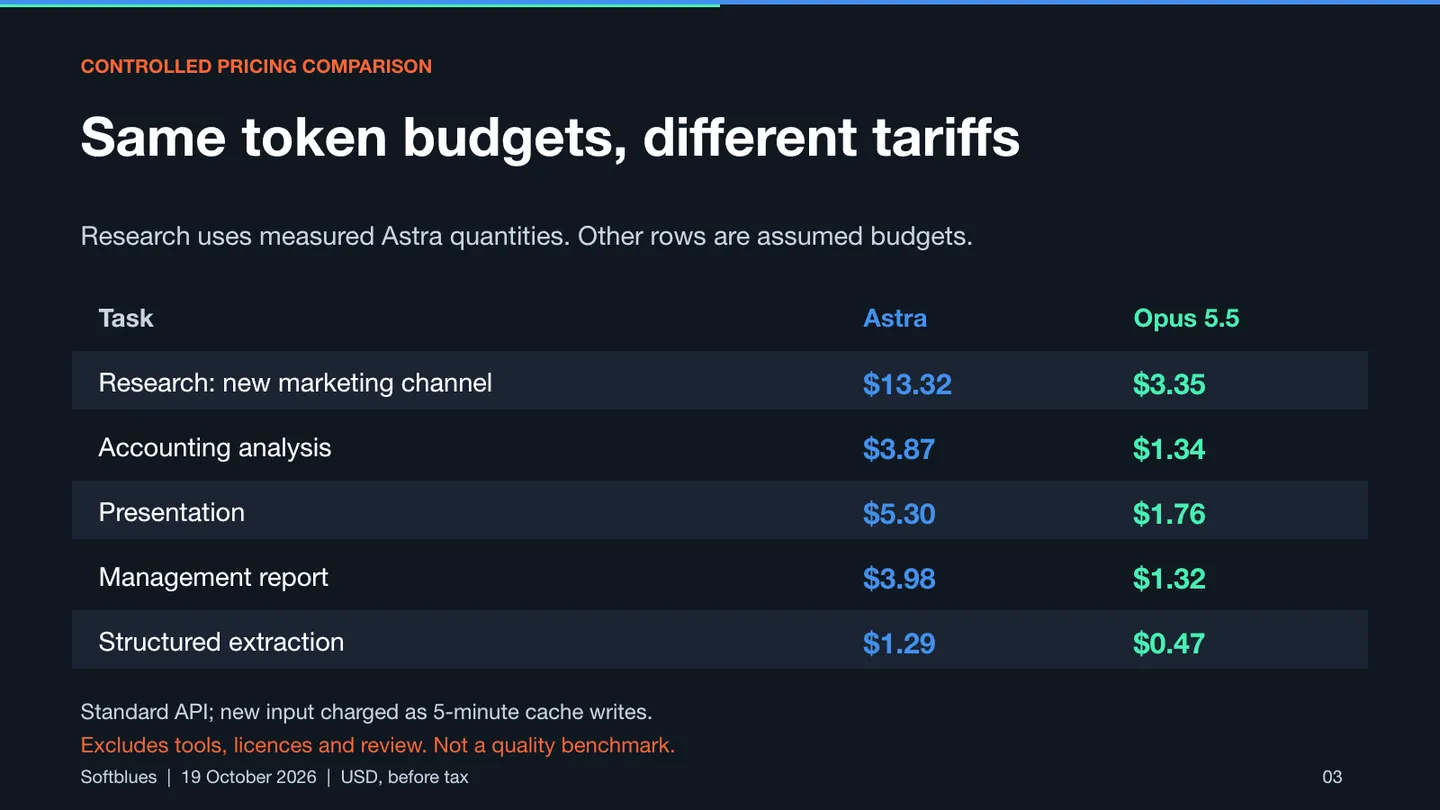
For a consistent comparison, this table assumes all new input is written into a five-minute cache and repeated input is a cache hit. Prices exclude tools, search, image generation, runtime, licences, taxes and human work.
| Task | Astra | Sol | Opus | Sonnet |
|---|---|---|---|---|
| Research: new marketing channel | $13.32 | $1.67 | $3.35 | $1.67 |
| Accounting analysis | $3.87 | $0.67 | $1.34 | $0.67 |
| 12-slide presentation | $5.30 | $0.88 | $1.76 | $0.88 |
| Six-page management report | $3.98 | $0.66 | $1.32 | $0.66 |
| Extract and check ten documents | $1.29 | $0.23 | $0.47 | $0.23 |
The research row is repricing an observed Astra workload, not claiming Opus completed it for $3.35. The other rows price assumed workloads. Actual models may use different counts, take different routes and produce different-quality results. Sol and Sonnet have identical rates in this table; that does not make them interchangeable.
Caching changes the result sharply. The presentation scenario costs $5.30 on Astra or $1.76 on Opus with the stated cache assumptions. With no cache hits and the same input volume, it becomes $21 or $8.40. On Opus, one-hour cache writes instead of five-minute writes make the cached scenario $2.36. These are sensitivity calculations, not measured savings.
Use the price table to choose candidates for testing. Choose the production route only after checking whether the work passes.
Translate model cost into business-platform cost
| Business route | How to calculate | What must be verified |
|---|---|---|
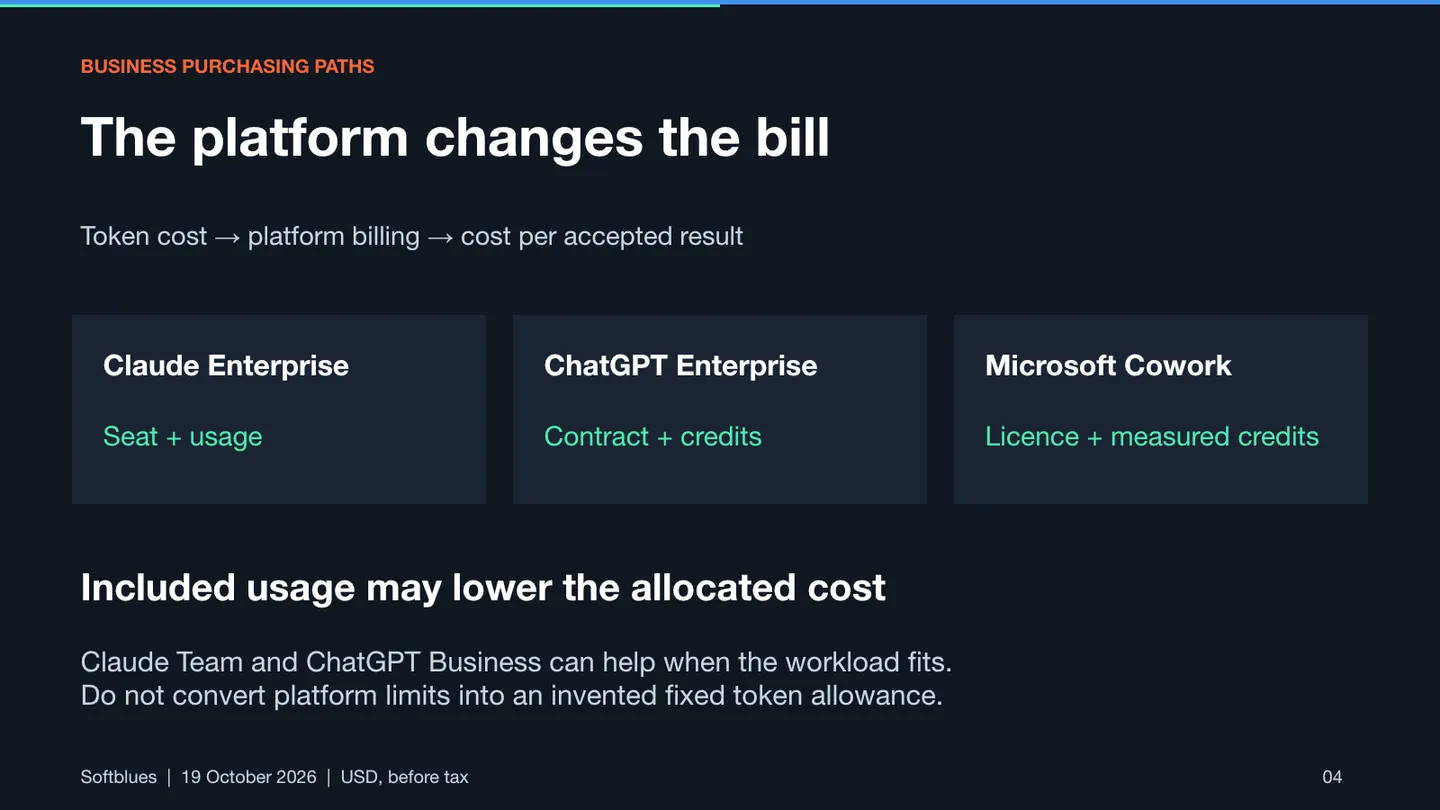
| Claude usage-based Enterprise | Allocated seat fee plus metered usage at applicable API rates | Actual model, cache categories, modifiers, discounts and contract |
| ChatGPT Enterprise / Work credit billing | Applicable token-credit rates multiplied by contracted credit cost, plus allocated seats | Agreement, credit balance, speed and eligible tool charges |
| Microsoft Copilot Cowork | Allocated required licences plus measured Cowork credits at the purchasing rate | Actual session credits, funding source and tenant billing |
Claude's current Enterprise offer lists a $20 monthly-equivalent seat on annual billing, a 20-seat minimum, and usage charged separately. The Opus column can inform its list-rate consumption estimate if the actual token categories and settings match. It is not a quote for a tenant's full bill.
For ChatGPT Work, the published Standard credit rates give the following token-only estimates. There is no separate cache-write charge in Codex credit billing, so these differ from the API table above.
| Task | Astra, OpenAI credits | Sol, OpenAI credits |
|---|---|---|
| Research: new marketing channel | 319.19 | 39.08 |
| Accounting analysis | 85.50 | 14.55 |
| 12-slide presentation | 120.00 | 19.50 |
| Six-page management report | 90.00 | 14.62 |
| Extract and check ten documents | 28.50 | 5.10 |
For example, the research trace corresponds to 319.19 Astra credits. At an assumed $0.04 per credit, that is $12.77; at an assumed $0.03, it is $9.58. Neither rate is asserted to be your contract. Use the current credit documentation and your agreement. A USD-billed Enterprise agreement needs its own rate card. Consuming already-committed credits does not necessarily create a new invoice charge. OpenAI explains the distinction.
Microsoft's commercial reference documents a $0.01 list price per Copilot Credit. That lets you convert 100 measured credits to $1, or 500 to $5. It does not tell us how many credits our five tasks would consume. In Cowork, use /cost, then reconcile with administrator consumption and billing records. Its session figure is approximate.
We have not established a universal token-to-Cowork-credit conversion. Applying an Opus API price, or a Copilot Studio prompt-tool tariff, to Cowork would create a comparison the evidence does not support. A custom agent on Microsoft Foundry is also a different purchasing and implementation route.
Where an included-usage subscription can save money
Claude Team Standard and ChatGPT Business list $20 per user per month on annual billing. Claude Team Premium lists $100. Included usage can make the next task add nothing to the invoice, provided the workload stays within the limits. These are usage allowances, not guaranteed token quantities.
Consider an explicitly hypothetical month: ten of each task in our table, 50 accepted outputs. The API token basket totals about $277.56 on Astra, $82.40 on Opus, or $41.20 on Sol or Sonnet. That holds task counts, token budgets and acceptance constant; none of those conditions has been demonstrated across models.
If the entire workload fitted a $20 seat with no paid overage, its allocated subscription cost would be $0.40 per accepted task. This is the potential saving to test. Do not promise that 50 such tasks fit the plan.
For the same assumed Opus basket, a usage-based Claude Enterprise seat would be roughly $20 plus $82.40, or $102.40 per active user, before other costs and subject to the organisation's minimum-seat commitment. Across 50 accepted outputs that is about $2.05 each.
There is a useful counterexample: a $100 Team Premium seat is not cheaper than $82.40 of API usage by itself. The full product, included tools, controls and actual throughput matter. A lightly used subscription can also cost more per result than consumption billing.
Enterprise may be necessary for audit, access management or retention requirements. Do not remove a required control to save on the token line. Our platform comparison covers the wider deployment decision.
Reduce cost per accepted result
Start with one recurring task on the approved tools you already pay for. Keep the source pack bounded and the acceptance check explicit. Reuse templates and stable instructions; let code perform deterministic calculations. Approve an outline before spending effort rendering a full presentation.
Try a less expensive model or Standard speed, then compare failures and reviewer minutes. The cost of the failed attempts stays in the numerator. At an illustrative $60 an hour, ten minutes of checking adds $10, more than the model charge in several scenarios here.
Measure source accuracy for research, reconciled control totals for accounting, readable charts for presentations, and traceable figures for reports. Record interruptions as well as completed outputs. A cheap task that misses the deadline is not equivalent to a dependable one.
Our financial-advice file-review case shows why evidence and human sign-off belong in the workflow. It is a proposal and discovery case, not measured production savings.
Softblues helps UK and Irish firms choose an appropriate assistant or agent route and test the economics of accepted work. Begin with the AI adoption guides, then use the whole-firm business-case calculator with your own task volumes and review time.
Frequently asked questions
Does a 10-million-token task cost 10 times the headline input rate?
No. Separate fresh input, cache writes, cache reads and output. The mix and per-request modifiers determine the model cost.
Are these measured prices for five tasks on four models?
No. One Astra research trace is measured. Its alternative-model prices and the other four task budgets are clearly specified scenarios to validate in a pilot.
Are included subscriptions always cheaper than Enterprise?
No. They can be cheaper when sufficient useful work fits the allowance and the controls are suitable. Low utilisation, overage and required Enterprise features can change the answer.
Can I use the Opus API price as the Microsoft Cowork price?
No. Cowork's billed consumption includes its own execution and tools. Measure its credits and apply the actual purchasing rate; do not substitute another product's tariff.
By Ivan Pylypchuk. Prices and sources checked 19 October 2026. USD model calculations exclude tax; they are not customer invoices or guaranteed task prices.
Work out your numbers
Your whole firm
AI ROI calculator
Five questions about your firm. See the time AI frees up, what it is worth and when it pays for itself.
Work out your numbersOne key process
Process automation ROI calculator
Five questions about one process. See the hours an AI agent frees up, what they are worth and how much becomes profit.
Work out your numbers
Free. No sign-up. Your answers stay in your browser.
See it in production
Systems we have built and run for clients, with the numbers that came out of them.
Related Articles
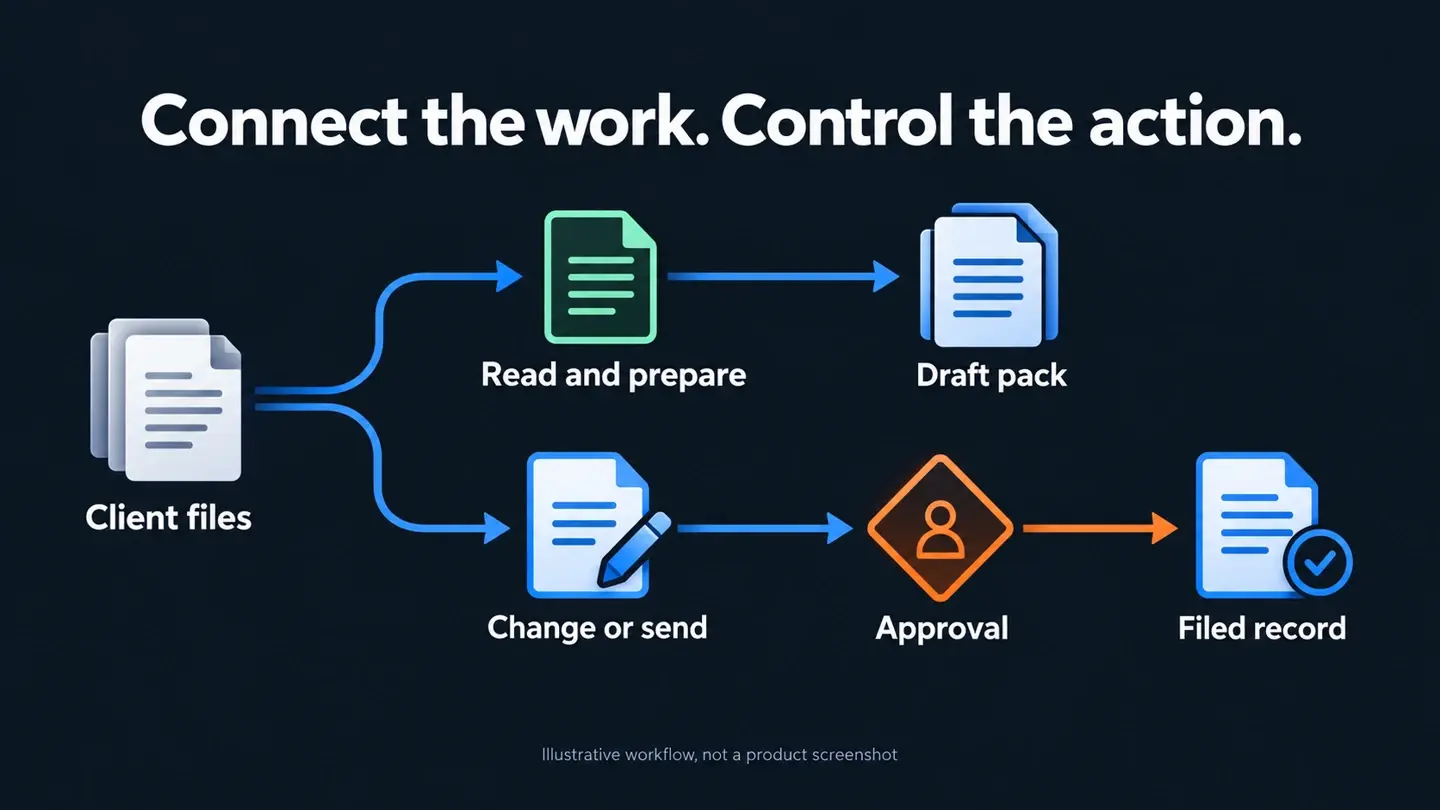
MCP server access: Claude, ChatGPT and Copilot in Microsoft 365
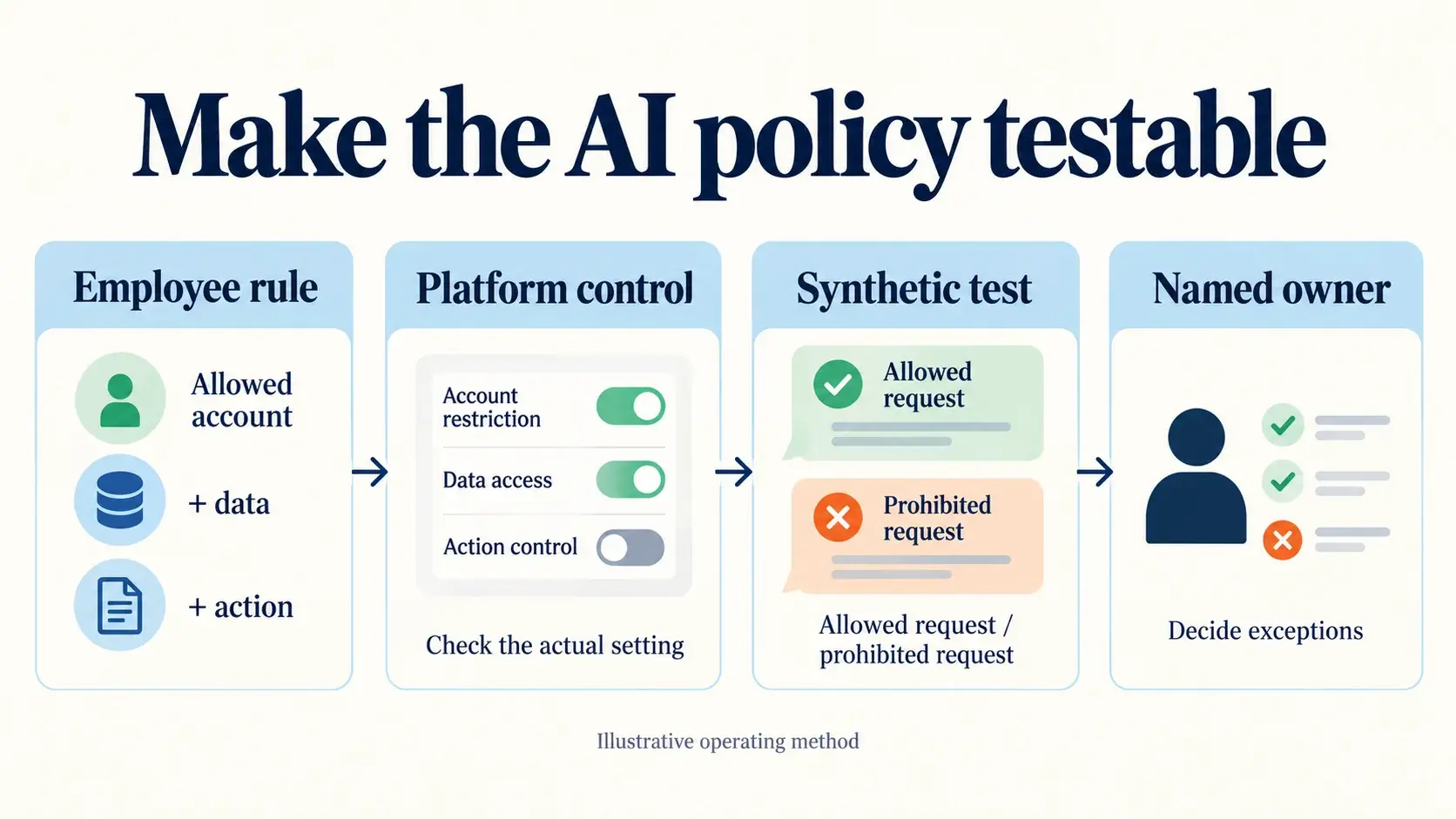
AI governance framework: a UK employee policy template