Claude Enterprise vs Team vs Pro: Which Plan Does Your Business Need?
Claude Enterprise and an annual Claude Team seat both cost $20 per seat per month. They are not the same product: one includes usage, the other bills every token on top. Here is how to pick.

By Ivan Pylypchuk (opens in a new tab), CEO of Softblues. Has led Claude and Gemini implementations for finance, legal and healthcare teams across the UK and Ireland.
Claude Enterprise starts at $20 per seat per month on an annual commitment (Anthropic, August 2026). An annual Claude Team Standard seat also costs $20 per seat per month (Anthropic, August 2026). Same headline number, and that is where most plan comparisons go wrong.
The two seats are not the same product. A Team seat includes usage. An Enterprise seat covers access only. Every token your people spend in chat, Claude Code and Cowork is billed on top at standard API rates, with no included allowance at all. So the plan choice is not really a price comparison. It is a question about how you want to be billed and what your auditors need to see.
This is the plan-picker we use with UK and Ireland mid-market clients before they talk to anyone in sales. For what a full rollout costs once licences, integration and training are added, read our Claude Enterprise pricing and rollout costs guide. This article is about which plan to pick, not what the programme costs.
Jump to: Price table · Seat thresholds · What forces Enterprise · Which one to pick
Key facts
- Pro: $20 per user per month, or $17 a month billed annually ($200 a year), individual plan, no organisation layer at all (Anthropic). Details
- Team: $20 per seat per month billed annually, or $25 billed monthly for a Standard seat. Premium seats are $100 annually, $125 monthly. Minimum 2 members, maximum 150 seats (Anthropic). Details
- Enterprise: from $20 per seat per month, billed annually, plus all usage at API rates. Self-serve minimum 20 seats; sales-assisted minimum 50 seats (Anthropic). Details
- Usage: Team Standard gives 1.25x Pro usage per session, Premium 6.25x, both capped weekly per member. Usage-based Enterprise has no seat-level usage limit at all (Anthropic). Details
- Team already includes SSO, domain capture, just-in-time provisioning and role-based permissions. Enterprise adds audit logs, SCIM, custom data retention, a Compliance API, an Analytics API, customer-managed encryption keys, US-only inference and HIPAA-readiness. Details
- Custom data retention has a 30-day floor and is Enterprise-only; by default data is kept indefinitely until you set a period (Anthropic). Details
- All prices above are US dollars and exclude tax. Currency and tax handling vary by region, so a UK buyer should confirm live pricing before committing. Details
What does each plan cost, side by side?
| Pro | Team | Enterprise | |
|---|---|---|---|
| Price | $20 per user / month, $17 billed annually | $20 per seat / month annually, $25 monthly (Standard); $100 / $125 (Premium) | From $20 per seat / month, billed annually |
| Usage | Included, session and weekly caps | Included: 1.25x Pro (Standard), 6.25x Pro (Premium), weekly cap per member | Not included. Billed at API rates, no seat cap |
| Seat range | 1 | 2 to 150 | 20 minimum self-serve, 50 minimum sales-assisted |
| SSO, domain capture, JIT | No | Yes | Yes |
| Role-based permissions, spend caps | No | Yes | Yes |
| Audit logs, SCIM | No | No | Yes |
| Custom data retention | No | No | Yes, 30-day minimum |
| Compliance API, Analytics API | No | No | Yes |
| Customer-managed keys, US-only inference | No | No | Yes |
| HIPAA-ready with BAA | No | No | Yes |
| Billing terms | Card | Monthly or annual | Annual; multi-currency and invoicing on sales-assisted only |
| Best for | One person testing the ground | 2 to 150 seats, predictable cost, no audit mandate | Audit or retention obligations, or heavy uncapped usage |
| Avoid if | Anyone else needs visibility | You need audit logs, SCIM or retention control | You want a fixed, predictable monthly bill |
Prices are US dollars excluding tax and are subject to change. Confirm the live figure for your region at claude.com/pricing before you sign. Prices checked against claude.com/pricing on 12 October 2026.
What would Claude give a firm your size? Five questions, about a minute. Work out your numbers.
What are the three plans actually for?
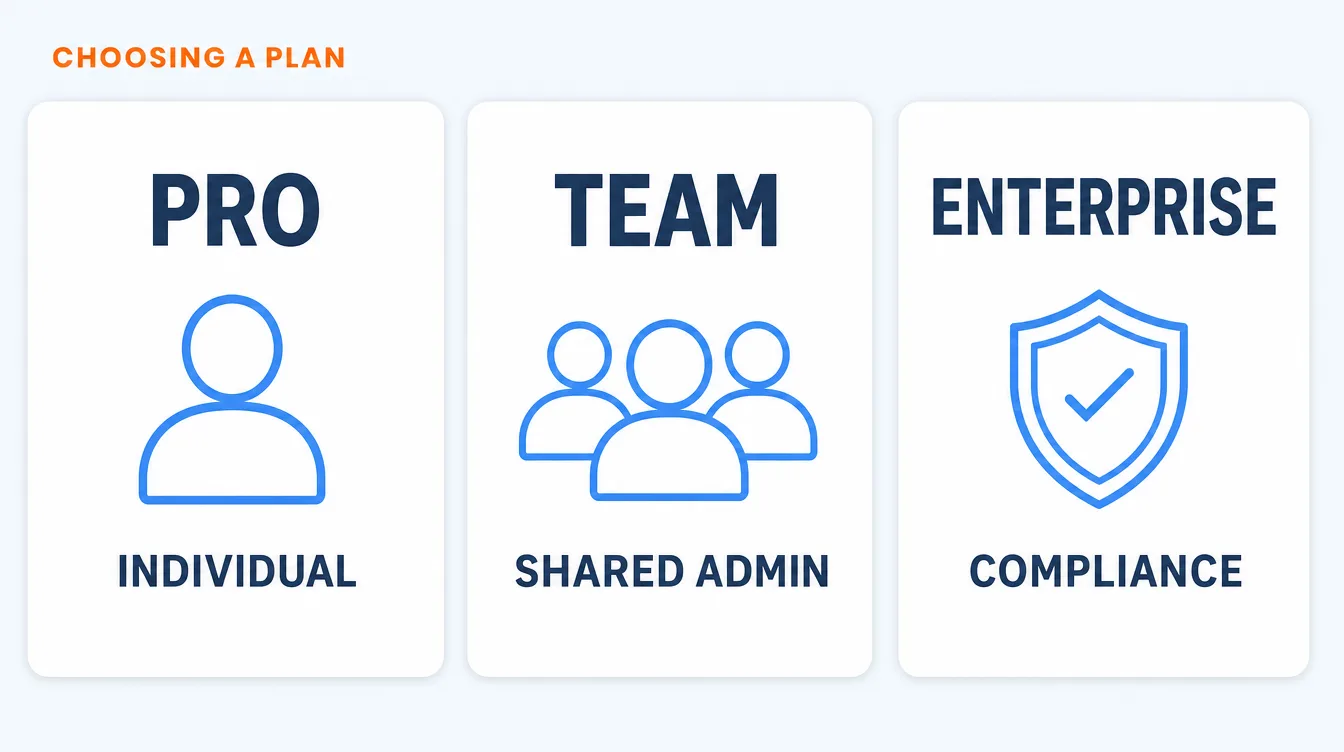
Pro is a personal subscription. One person, one card, no shared anything. There is no admin console, no single sign-on, no central billing and no way for anyone else in your business to see or govern what is happening. It is the right plan for an individual, and it stops being the right plan the moment two people need to work on the same material or anyone needs to answer a question about governance.
Team is the first real business plan. This is the one most people underestimate. Team already carries the identity controls buyers assume are Enterprise-only: single sign-on, domain capture so new starters land in your organisation automatically, just-in-time provisioning, role-based permissions, spend caps at organisation and user level, and connectors into Google Drive, Gmail, Calendar, GitHub, Microsoft 365 and Slack. It needs a minimum of two members and it tops out at 150 seats.
Enterprise is a compliance and billing product. It includes everything in Team, then adds the evidence layer: audit logs, SCIM provisioning from your identity provider, custom data-retention controls, a Compliance API that pulls activity, chats and file content programmatically, an Analytics API, customer-managed encryption keys, the option to keep inference in the United States, and a HIPAA-ready configuration with a BAA. It also changes how you pay, which we come back to below.
How does the billing model differ, and why does it matter more than the seat price?
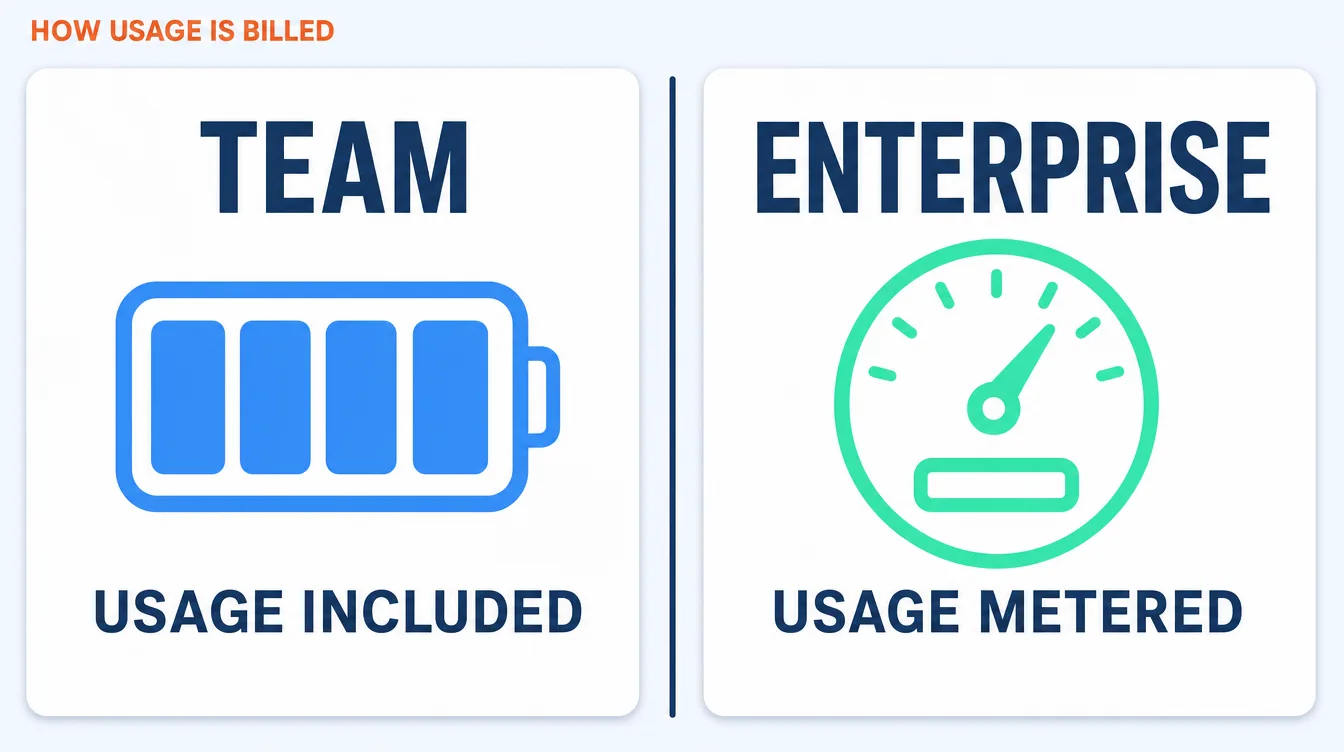
On Team, the seat fee includes usage. Each member gets an allowance (1.25x Pro per session on a Standard seat, 6.25x on a Premium seat) with a weekly cap that applies per member rather than pooled across the team. If one person burns through their allowance, nobody else is affected, and you can top up with prepaid usage credits.
On Enterprise, the seat fee buys access and nothing else. There is no included token allowance and no per-seat cap. Every token consumed in Claude, Claude Code and Cowork is metered and billed to the organisation at standard API rates on top of the seat cost. Admins can set spend limits at organisation and user level, and on self-serve plans you buy usage credits upfront.
That is a real trade, not a technicality. Enterprise removes the ceiling that frustrates heavy users, and in exchange it removes the predictability a finance director likes. If your CFO needs a number they can put in a budget and defend, Team's included usage is the friendlier shape. If your engineers keep hitting weekly limits mid-task, the ceiling is costing you more than the meter would.
Get the plan decision down on paper before you talk to sales. Our Claude Enterprise Buyer's Guide sets out the seat thresholds, the compliance questions to put to Anthropic, and the numbers to have ready so a procurement conversation takes one meeting instead of four. Download the Claude Enterprise Buyer's Guide.
At what seat count does each plan stop making sense?
The seat thresholds create three zones and one genuinely ambiguous band.
Below 20 seats, Team is your only real option. Enterprise self-serve requires a 20-seat minimum, so a 12-person firm cannot buy it without going through sales at a 50-seat floor. This catches people out. If you are a 15-person financial-advice practice that needs audit logs, the honest answer is that you will be buying 20 seats or negotiating.
Between 20 and 150 seats, both plans are available and the decision is not about size. This is the band most UK mid-market companies sit in, and it is where the choice actually has to be made on compliance and billing rather than headcount. Team is cheaper to run and easier to forecast. Enterprise is the answer if you need evidence.
Above 150 seats, Team is not available. The Team plan caps at 150 seats, so growth alone eventually forces the migration regardless of your compliance position.
Which requirements force Enterprise?
Four triggers, in the order they usually appear in a mid-market procurement process.
1. You have to produce audit evidence. If a regulator, an auditor or a client's security questionnaire requires a record of who accessed what and when, you need audit logs, and audit logs are Enterprise. There is no Team workaround.
2. You have to control how long data is kept. Custom data retention is Enterprise-only, with a 30-day minimum, and by default Claude retains data indefinitely until you configure a period. For anyone operating under a documented retention schedule, this is usually the deciding feature.
3. You are provisioning at a scale where manual user management breaks. SCIM syncs users automatically from your identity provider. Team's just-in-time provisioning handles joiners reasonably well; it is leavers and role changes across a few hundred people where SCIM earns its place.
4. You need a BAA, customer-managed keys or US-only inference. These are hard requirements or they are not. If a contract names them, the plan question is already answered.
Everything else you already get on Team: SSO, permissions, spend caps, connectors and shared projects.
How does the upgrade path work?
Pro to Team is straightforward: you can move a personal account into a Team or Enterprise organisation and keep your history. Team to Enterprise is a documented migration, and organisations upgrading from Team pay by card during the upgrade before they can switch to ACH afterwards.
Two details worth knowing before you plan a migration. Self-serve Enterprise is USD only and buys usage credits upfront; if you need invoicing, a currency other than dollars, or dedicated customer success, that is the sales-assisted route with its 50-seat floor. And if you pay by ACH bank transfer, the plan does not activate until the payment lands, which can take up to five business days. Worth building into a go-live date.
There is also a legacy wrinkle. Anthropic is consolidating older Enterprise seat models: organisations still on Chat and Chat + Claude Code seats, or on the older Standard and Premium Enterprise seats with per-seat limits, cannot continue on that billing model past their next contract renewal and will move to the single usage-based Enterprise seat. If you inherited a contract signed in 2025, check which model you are on before you budget for next year.
What we see go wrong
1. Buying Enterprise for features Team already has. The most common and most expensive mistake. Teams pay the usage meter for eighteen months to get single sign-on they could have had on Team.
2. Budgeting the Enterprise seat fee as the total. The seat fee is the access charge. Without a modelled usage estimate on top, the first quarterly invoice is a surprise. Model consumption before you sign, and set organisation-level spend limits on day one.
3. Ignoring the seat floors. A 14-person firm that needs audit logs has a procurement problem, not a plan problem, and it is better to discover that early.
4. Rolling out licences without rolling out the change. This is the failure we are called in to fix most often. Access is not adoption. We run six internal departments on Claude ourselves, and the work that made it stick was permissions design, connector scoping and training, not the licence purchase. At Key Capital, a 45-person corporate finance firm, the same approach got 35 of 45 staff using Claude several times a week. Our Claude Enterprise implementation checklist covers the sequence.
Frequently asked questions
Is Claude Enterprise more expensive than Claude Team?
The seat fee is comparable, with both starting around $20 per seat per month on annual terms, but Enterprise bills all usage separately at API rates on top, while Team includes an allowance. Total cost depends entirely on consumption, so Enterprise can be cheaper for small heavy-usage teams and more expensive for large light-usage populations.
Does Claude Team include single sign-on?
Yes. Team includes SSO, domain capture, just-in-time provisioning and role-based permissions. SCIM provisioning and audit logs are the identity features reserved for Enterprise.
What is the minimum number of seats for Claude Enterprise?
20 seats if you buy self-serve online, and 50 seats if you go through Anthropic's sales team. Sales-assisted plans add invoicing, multi-currency billing and dedicated support.
How many seats can Claude Team support?
Up to 150. Organisations that need more must migrate to Enterprise.
Can we control how long Claude keeps our data?
Only on Enterprise. Custom retention periods have a 30-day minimum, and by default data is retained indefinitely until an owner sets a period in organisation settings. All retention changes are recorded in audit logs.
Can UK companies pay in pounds?
Sales-assisted Enterprise supports multiple currencies; self-serve Enterprise is USD only. Team pricing varies by region, so check the figure shown for your location rather than assuming the US number.
Do we need Claude Code on a separate plan?
No. Claude Code is available on Pro, Team and Enterprise. On Team it draws from the seat's usage allowance; on Enterprise it is metered at API rates like everything else.
Which one should you pick?
If you are one person, Pro. If you are 2 to 150 seats with no audit or retention mandate, Team, and specifically annual Standard seats, moving your heaviest two or three users to Premium rather than upgrading the whole organisation. If you have audit, retention or provisioning obligations, or usage caps are actively costing your team time, Enterprise, with a modelled usage forecast and spend limits configured before anyone logs in. The side-by-side table is near the top of this article. To see what a full rollout looks like in a regulated firm, read how Key Capital moved its whole team onto Claude.
We are Certified in the Claude Partner Network and we run our own business on Claude across six departments. We use it before we sell it, so this advice comes from having made these choices ourselves rather than from a feature matrix. If you want a second opinion on which plan fits your seat count, compliance position and expected usage, book a discovery call and we will work through it with you.
Work out your numbers
Your whole firm
AI ROI calculator
Five questions about your firm. See the time AI frees up, what it is worth and when it pays for itself.
Work out your numbersOne key process
Process automation ROI calculator
Five questions about one process. See the hours an AI agent frees up, what they are worth and how much becomes profit.
Work out your numbers
Free. No sign-up. Your answers stay in your browser.
See it in production
Systems we have built and run for clients, with the numbers that came out of them.
Related Articles

Claude vs ChatGPT vs Copilot: what does an AI agent task really cost?
MCP server access: Claude, ChatGPT and Copilot in Microsoft 365