AI Consultancy Ireland: How to Choose (Dublin and Beyond)
Only 11% of larger Irish organisations report a positive return on the AI they have already bought. How to choose an AI consultancy in Ireland: six shortlist criteria, who actually regulates you, and what state funding really covers.
By Ivan Pylypchuk (opens in a new tab), CEO of Softblues
Most Irish companies shopping for an AI consultancy have already bought AI once. In the 2026 William Fry Technology Report, 69% of larger Irish organisations said they were actively concerned about extracting a measurable return from AI solutions they had already procured, and only 11% reported a positive return to date (William Fry Technology Report 2026, Jul 2026).
That is the real starting position for this decision. You are not choosing your first AI partner. You are choosing the one who has to make the second attempt pay, inside a country that now has its own AI enforcement machinery and its own funding rules.
To choose an AI consultancy in Ireland, screen on four things: proof in a comparable regulated sector, the ability to name which Irish competent authority supervises your use case, engineers you can meet before you sign, and a measured baseline agreed before any build starts. Geography matters less than those four. If you want the map of which kinds of firm exist in the Irish market, that is a separate piece: the types of AI consulting and development companies in Ireland.
Key facts
- 69% of larger Irish organisations are concerned about measuring return on AI they have already bought, and only 11% report a positive return so far (William Fry, Jul 2026).
- 20.2% of Irish enterprises used AI in 2025, split as 57.7% of large, 28.6% of medium and 17.2% of small companies (CSO, Feb 2026).
- Since 2 August 2026 the majority of the EU AI Act applies, Article 50 transparency rules are live, and enforcement has started at national and EU level (European Commission AI Act Service Desk).
- High-risk obligations have not landed yet. Annex III high-risk rules apply from 2 December 2027 and Annex I from 2 August 2028, following the Digital Omnibus amendments (European Commission).
- Ireland designated 15 competent authorities on 16 September 2025, one of the first six member states to do so, and runs a distributed model rather than one AI regulator (Department of Enterprise, Tourism and Employment, Sep 2025).
- An Enterprise Ireland Innovation Voucher is €10,000 as standard, up to €20,000 co-funded, but it can only be spent with a registered publicly funded knowledge provider, not with a consultancy (Enterprise Ireland).
Why is choosing an AI consultancy in Ireland different?
The EU AI Act applies to you directly, as EU law, with no domestic transposition needed to make it bite. UK companies are in a different position, and we covered that separately in what the EU AI Act means for UK companies. If your company is registered in Dublin or Cork, the obligations that started on 2 August 2026 are already yours, and your provider needs to know that.
Supervision here is also fragmented by design. Ireland did not build one AI regulator. It named 15 competent authorities and pushed supervision down to the sectoral bodies that already know your industry. So the first compliance question is not "what does the AI Act say", it is "which of these bodies will be looking at us".
Then there is the labour market, which is unusually tight for the size of the country. Ireland hosts 16 of the world's top 20 tech multinationals (IDA Ireland), which is excellent for the economy and awkward for a mid-market company trying to hire an AI engineer at a sane salary. That is often the honest reason to buy the capability rather than build it.
What should be on an Irish AI consultancy shortlist?
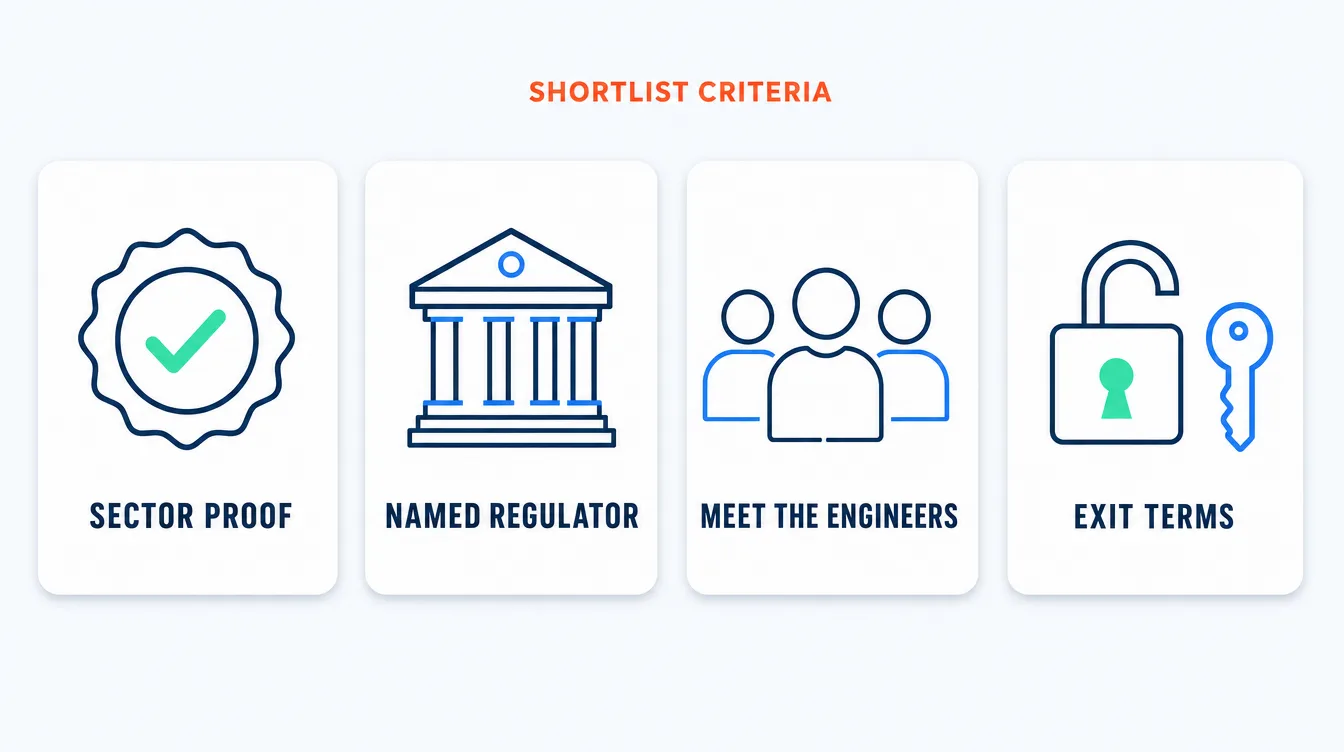
Six criteria, in the order we would apply them. Ask for evidence on each, in writing, before you get to price.
1. Proof in your sector, not proof in general. Ask for a piece of work in a comparable regulatory environment. A retail chatbot tells you nothing about whether a firm can survive Central Bank scrutiny. Our own compliance file review automation for a financial advice firm is a discovery-stage engagement rather than a live deployment, and we say so, because a shortlist built on overstated claims collapses at reference-check stage.
2. A named regulator answer. Ask them which Irish competent authority supervises the use case you are buying, and why. If they cannot name it, they have not done this in Ireland.
3. Engineers you can meet. Ask who writes the code, where they sit, and whether the people in the pitch are the people on the project. This is the single most common failure in Irish AI procurement, and it is easy to test: ask for the delivery team's names before you sign.
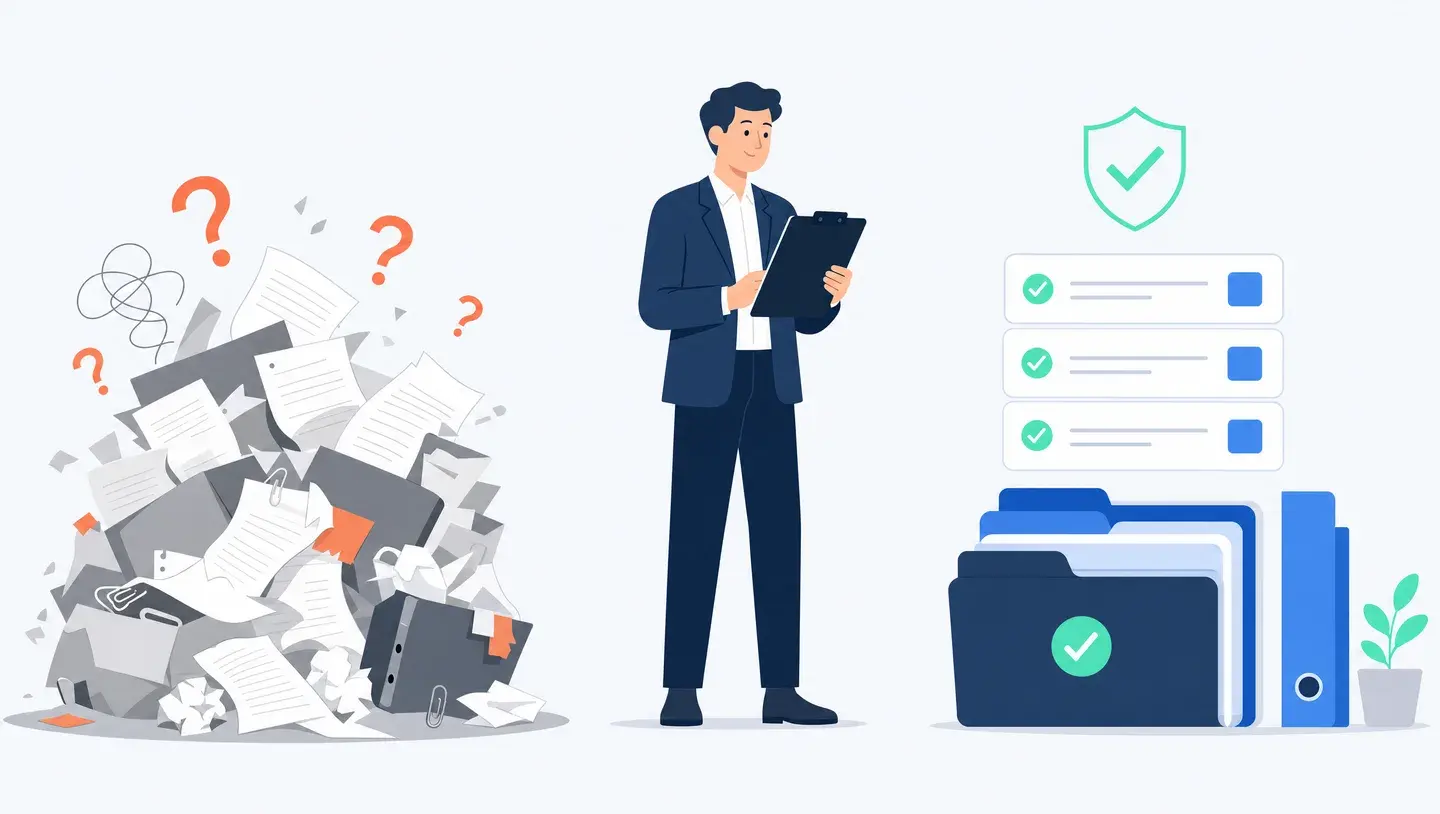
4. A baseline before a build. The 11% positive-return figure is not mainly a technology problem. It is a measurement problem. A serious partner insists on measuring the current process, in hours or error rates or cost per case, before writing anything. If nobody measured the "before", nobody can prove the "after".
5. A defensible classification file. Under the Regulation of Artificial Intelligence Bill 2026, Irish market surveillance authorities can challenge a self-assessment that a system is not high-risk and require a formal evaluation (William Fry, Feb 2026). If a vendor tells you their system is not high-risk, get the reasoning documented. If they are wrong, the obligations land on you as the deployer too.
6. An exit that does not need their permission. Who owns the model configuration, the prompts, the evaluation set and the pipeline code? If the answer is "we host it", you have bought a dependency.
Thinking about your own shortlist? A 30-minute discovery call is a working session, not a pitch. We go through the process you are trying to automate, which Irish authority is likely to supervise it, and whether the return is measurable enough to be worth doing. You leave with a straight answer either way. Book a discovery call.
Who regulates your AI system in Ireland?
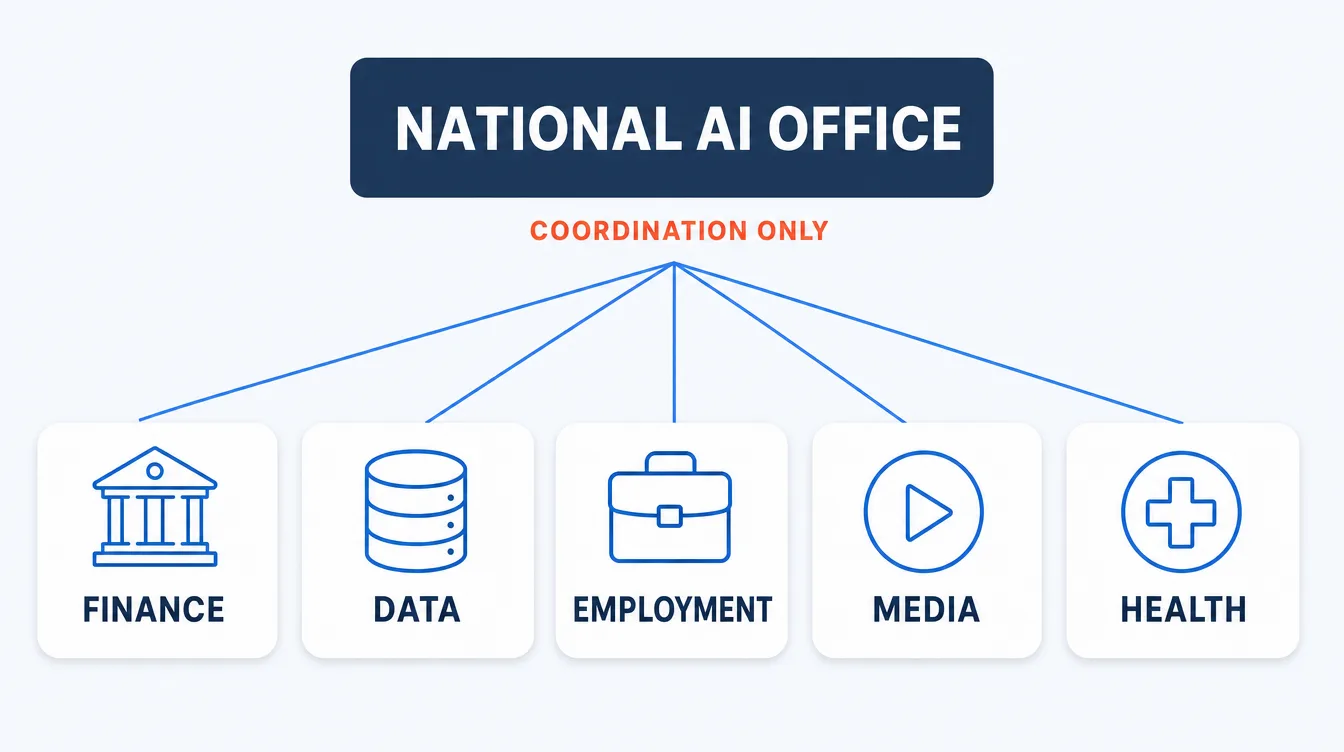
This is the question most buyers skip and most vendors cannot answer. Ireland gave the supervision job to 13 sectoral market surveillance authorities, coordinated by a new central body, the AI Office of Ireland (Oifig Intleachta Shaorga na hÉireann), which acts as the country's single point of contact under Article 70(2) of the AI Act and runs a national regulatory sandbox.
Who you deal with depends on what the system does (William Fry, Feb 2026):
- Central Bank of Ireland : AI in regulated financial services.
- Data Protection Commission : fundamental rights where personal data is involved.
- Workplace Relations Commission : AI used in employment contexts, including hiring and performance.
- Coimisiún na Meán : audiovisual media services.
- Commission for Regulation of Utilities : energy applications.
- HSE : certain high-risk uses in essential public health services and emergency triage.
If you operate across more than one of those, you can be supervised by several at once, each with its own supervisory style. The sanctions ceiling gives the exercise its weight: up to €35 million or 7% of worldwide turnover for prohibited practices, €15 million or 3% for high-risk non-compliance, and €7.5 million or 1% for giving authorities incorrect or misleading information.
Irish provider or UK provider?
Both work. The question is which trade-offs you can absorb. This is what actually differs in practice:
| Ireland-based provider | UK-based provider | |
|---|---|---|
| EU AI Act footing | Operating under it themselves, so the obligations are lived rather than researched | Depends entirely on the firm; some are strong on it, many treat it as a foreign regime |
| Data residency | Easier story for EU-only processing and for a Central Bank conversation | Workable, but you will be asked to evidence the transfer basis |
| Grant eligibility | Straightforward for Enterprise Ireland and Local Enterprise Office supports | Check scheme-by-scheme before you plan around it |
| On-site presence | Same-day for a Dublin or Cork site | A flight, so expect remote-first delivery |
| Talent pool | Competing with the multinationals for the same engineers | Larger pool, particularly for senior platform and Claude specialists |
| Best for | Regulated sectors, grant-funded work, anything needing frequent on-site time | Deeper specialist benches and multi-platform work |
| Avoid if | You need a large team scaled quickly | Your board wants an EU-only supply chain on paper |
The pragmatic answer for most Irish mid-market companies is to judge the engineering and the regulatory literacy, then treat geography as a tie-breaker. A provider two hours away who has shipped your use case beats a local one who has not.
What can Irish state funding actually pay for?
This is where a lot of plans quietly fail, because the best-known scheme cannot be spent on a consultancy at all.
| Support | Value | Can it pay a private AI partner? |
|---|---|---|
| Innovation Voucher (Enterprise Ireland) | €10,000 standard, up to €20,000 co-funded, valid 18 months | No. Only redeemable with registered publicly funded knowledge providers such as universities and technological universities |
| Access Advice: Digital Discovery (Enterprise Ireland) | Up to 80% funding, maximum €5,000 | Yes. It is designed to hire an expert to take a first or next step in AI |
| Local Enterprise Office supports | Varies by office and scheme | Varies. Confirm with your own LEO before you budget |
What the contract needs to say
The William Fry report makes a point worth repeating: the first generation of Irish AI contracts transferred risk to the buyer while leaving the return question undefined, and organisations are now reopening them as the AI Act, DORA, NIS 2 and the Data Act introduce requirements those contracts never addressed.
So put four things in writing.
A measured baseline and a target. The specific metric, how it is measured today, and what "working" means. Without this, the 11% figure is your likely future.
Named people and a real handover. Who delivers, and what your team can operate without them.
IP and portability. Model configuration, prompts, evaluation sets and pipeline code, and the format you get them in.
Regulatory allocation. Who produces the technical documentation, who maintains the classification reasoning, and who carries the cost if a system is reclassified.
Red flags
- A fixed price before anyone has looked at your data. Nobody can scope honestly without seeing it.
- "Everything is high-risk, so you need us now." The high-risk deadlines are December 2027 and August 2028. Urgency built on a wrong date is a sales tactic.
- No named Irish authority. See criterion 2.
- A pilot with no exit criteria. A proof of concept that cannot fail is not a proof of concept.
- Reference clients who cannot be contacted. Anonymised work is fine, and we publish some ourselves, but you should still be offered at least one live reference.
Frequently asked questions
Does the EU AI Act apply to Irish companies now?
Yes, in part. Since 2 August 2026 the majority of the Act applies, including Article 50 transparency obligations, the prohibitions and AI literacy duties, and enforcement has begun. High-risk system obligations come later, on 2 December 2027 for Annex III systems and 2 August 2028 for AI embedded in products already regulated under Annex I.
Who enforces the AI Act in Ireland?
Thirteen existing sectoral market surveillance authorities, coordinated by the AI Office of Ireland. Which one supervises you depends on your sector: financial services sits with the Central Bank of Ireland, employment uses with the Workplace Relations Commission, personal data with the Data Protection Commission.
Can an Enterprise Ireland Innovation Voucher pay for AI consultancy?
No. The voucher is only redeemable with registered publicly funded knowledge providers such as universities, institutes of technology and state research bodies. To fund a private expert, look at Access Advice: Digital Discovery, which funds up to 80% to a maximum of €5,000.
Should I choose a Dublin-based AI consultancy specifically?
Only if you need frequent on-site work or your governance requires a local supplier. Dublin has genuine density of AI talent, but it also has the strongest salary competition, so a Dublin address is not by itself evidence of a stronger delivery team. Judge the engineering first.
How much AI adoption is normal for an Irish company of my size?
In 2025, 20.2% of Irish enterprises used AI in some form. It rises sharply with size: 57.7% of large enterprises, 28.6% of medium and 17.2% of small. If you are a mid-sized company with nothing in production, you are behind your peer group but not unusually so.
How long should a first AI engagement take?
A scoped discovery should take weeks, not months, and should end in a decision rather than a proposal for more discovery. We scope every build in a paid discovery and put the timeline and the price in the proposal before it starts, precisely because open-ended engagements are how the return gets lost.
What if we have already bought AI that is not delivering?
Start with measurement rather than replacement. Establish what the process costs now, what the system was supposed to change, and whether the contract lets you extract your configuration and data. In our experience, most stalled AI projects were scoped without a baseline, not built badly.
Softblues is an OpenAI Select Partner, Certified in the Claude Partner Network, a Google Cloud partner at Services Select tier, and a member of the Microsoft AI Cloud Partner Program. We run six of our own departments on Claude, which is documented in our Claude operating system case study, and we build business process automation for UK and Ireland mid-market companies in regulated sectors. Our security practice is built around ISO 27001 principles.
If you are choosing an AI consultancy in Ireland and want a straight read on whether your use case is worth building, book a discovery call.
Work out your numbers
Your whole firm
AI ROI calculator
Five questions about your firm. See the time AI frees up, what it is worth and when it pays for itself.
Work out your numbersOne key process
Process automation ROI calculator
Five questions about one process. See the hours an AI agent frees up, what they are worth and how much becomes profit.
Work out your numbers
Free. No sign-up. Your answers stay in your browser.
See it in production
Systems we have built and run for clients, with the numbers that came out of them.
Related Articles
MCP server access: Claude, ChatGPT and Copilot in Microsoft 365
AI governance framework: a UK employee policy template