Claude skills vs ChatGPT and Copilot: one procedure, three tools
Compare reusable procedures across Claude, ChatGPT and Copilot, then try a client-letter example with a house template, missing fields and human review.
By Ivan Pylypchuk (opens in a new tab), CEO of Softblues. Last updated 27 October 2026. Product sources rechecked 27 October 2026.
Claude skills, ChatGPT skills and Copilot Cowork skills can carry the same written procedure through a SKILL.md file. For a Microsoft-first UK or Irish firm, start by testing that procedure in the platform already approved for the work. Reusing instructions does not transfer access permissions, administrative controls or proof that the output is correct.
Softblues (softblues.io) is a London AI adoption partner for UK and Irish firms bringing governed AI into everyday work. Softblues is Certified in the Claude Partner Network.
What are the key facts?
- Claude: Team and Enterprise support organisation-wide skill provisioning. Checked 27 October 2026. [1]
- ChatGPT: eligible Business and Enterprise users can use skills, subject to workspace settings and availability. Checked 27 October 2026. [2]
- Copilot Cowork: imports SKILL.md and converts compatible Claude plugin packages. Checked 27 October 2026. [3]
- Copilot Cowork: a standalone skill file can be up to 1 MB. Checked 27 October 2026. [3]
- Microsoft: Business Premium with Copilot costs £24.60 per user per month on annual billing, excluding VAT. Checked 27 October 2026. [4]
- Claude: Team standard seats cost $20 per user per month on annual billing; Enterprise adds usage at API rates to its $20 seat price. Checked 27 October 2026. [5]
Why compare skills rather than another model leaderboard?
The useful purchase decision is whether your firm's method can survive a change of assistant. A finance director does not want to rewrite month-end instructions because one department uses a different tool.
A skill packages instructions for a repeatable job, optionally with reference material or scripts. A project holds the context for ongoing work. Keep that distinction visible: the procedure for drafting commentary should be reusable; this month's figures should remain in the authorised working location. OpenAI's build documentation describes the instruction file and supporting resources explicitly. [6]
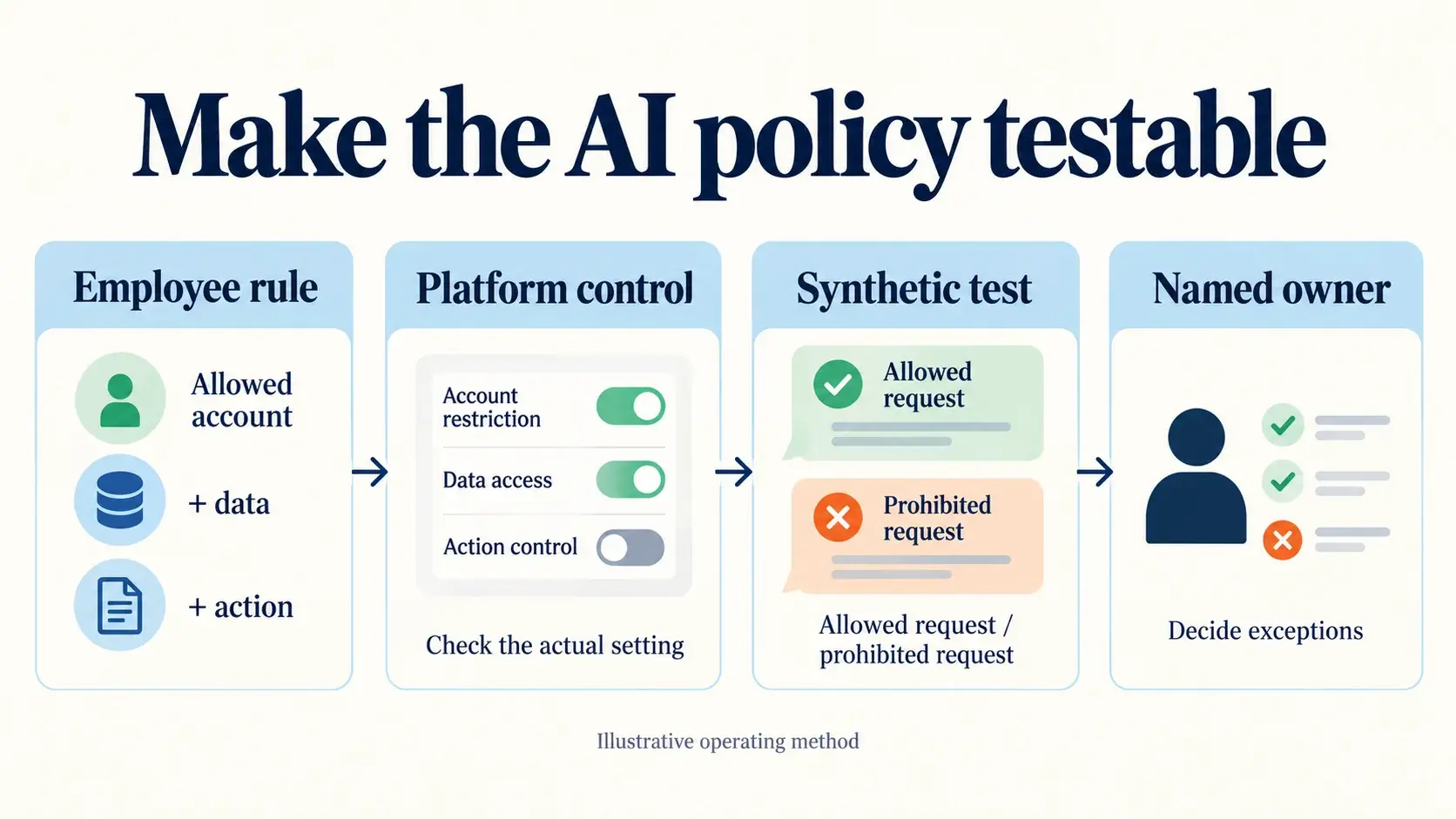
This supports the second test in our AI-native guide: the firm's procedures are encoded in its working practices. Our AI governance policy walkthrough covers the wider rules for staff use.
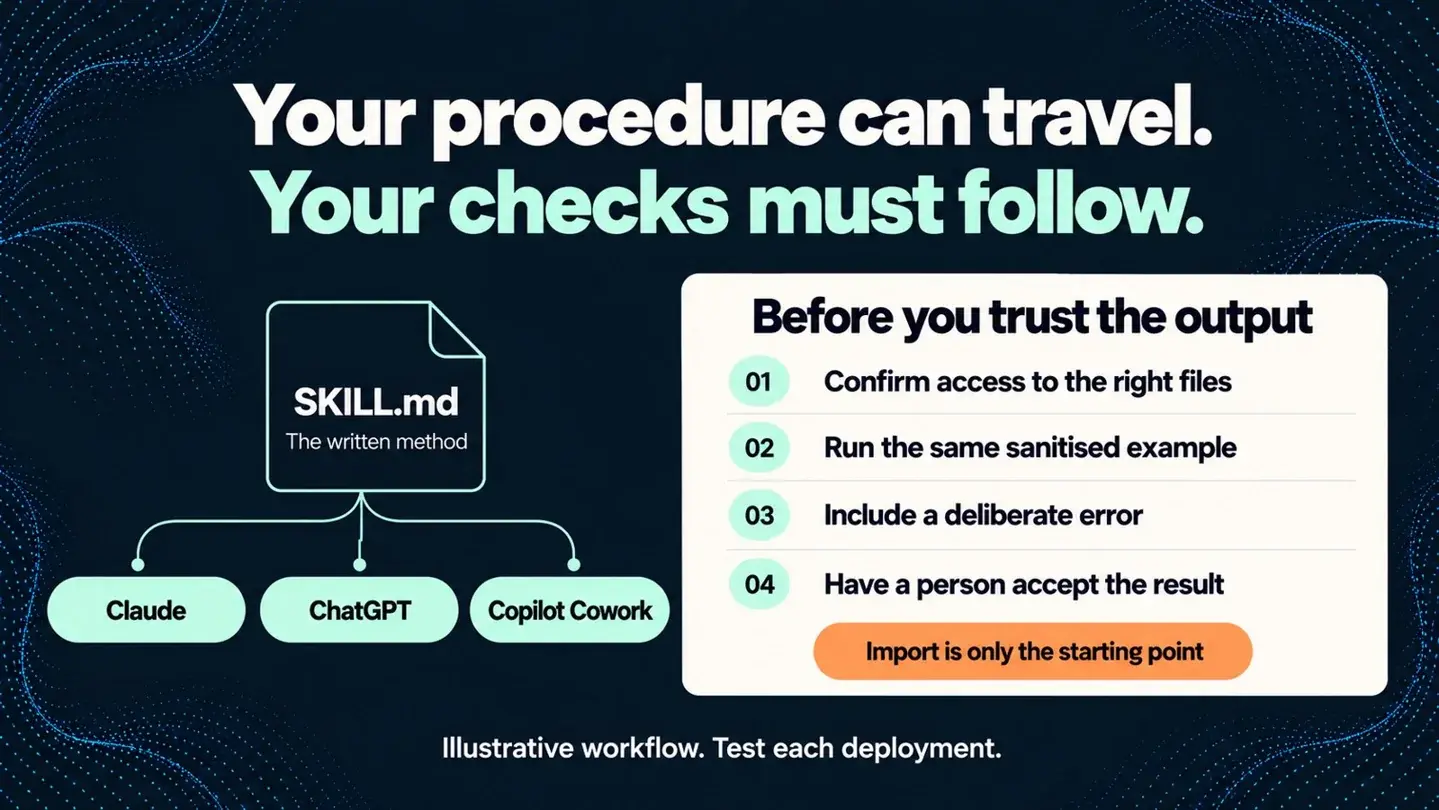
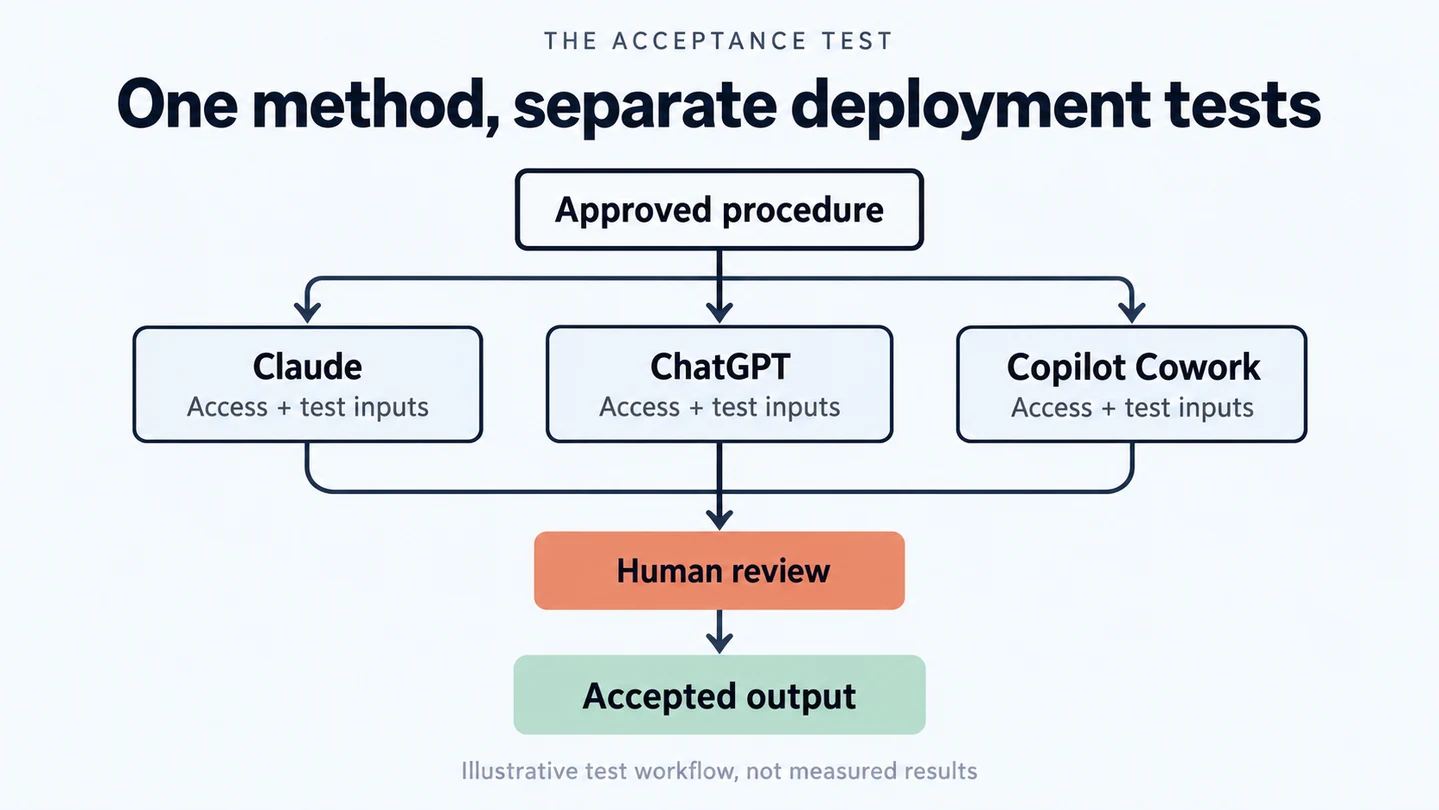
The portability claim is narrower than the headline sounds. Microsoft documents conversion of compatible Claude plugin packages. That is evidence of an import route, not a test showing that every script, connector and approval rule behaves identically after import. [3] Our recommendation is to keep one approved method and test each deployment separately.
How do the three platforms compare?
| Dimension | Claude Team / Enterprise | ChatGPT Business / Enterprise | Microsoft 365 Copilot Cowork |
|---|---|---|---|
| Instruction package | SKILL.md with optional resources [7] | SKILL.md and supporting resources [6] | SKILL.md or supported archive [3] |
| What it can touch | Available files and enabled tools; the skill is guidance [7] | Available resources and apps; dependencies need setup [6] | Connected Microsoft 365 work under user permissions [8] |
| Who enables it | Owners check Skills and code execution policy [1] | Workspace settings control availability [2] | Admin grants access through a spending policy selecting Cowork [9] |
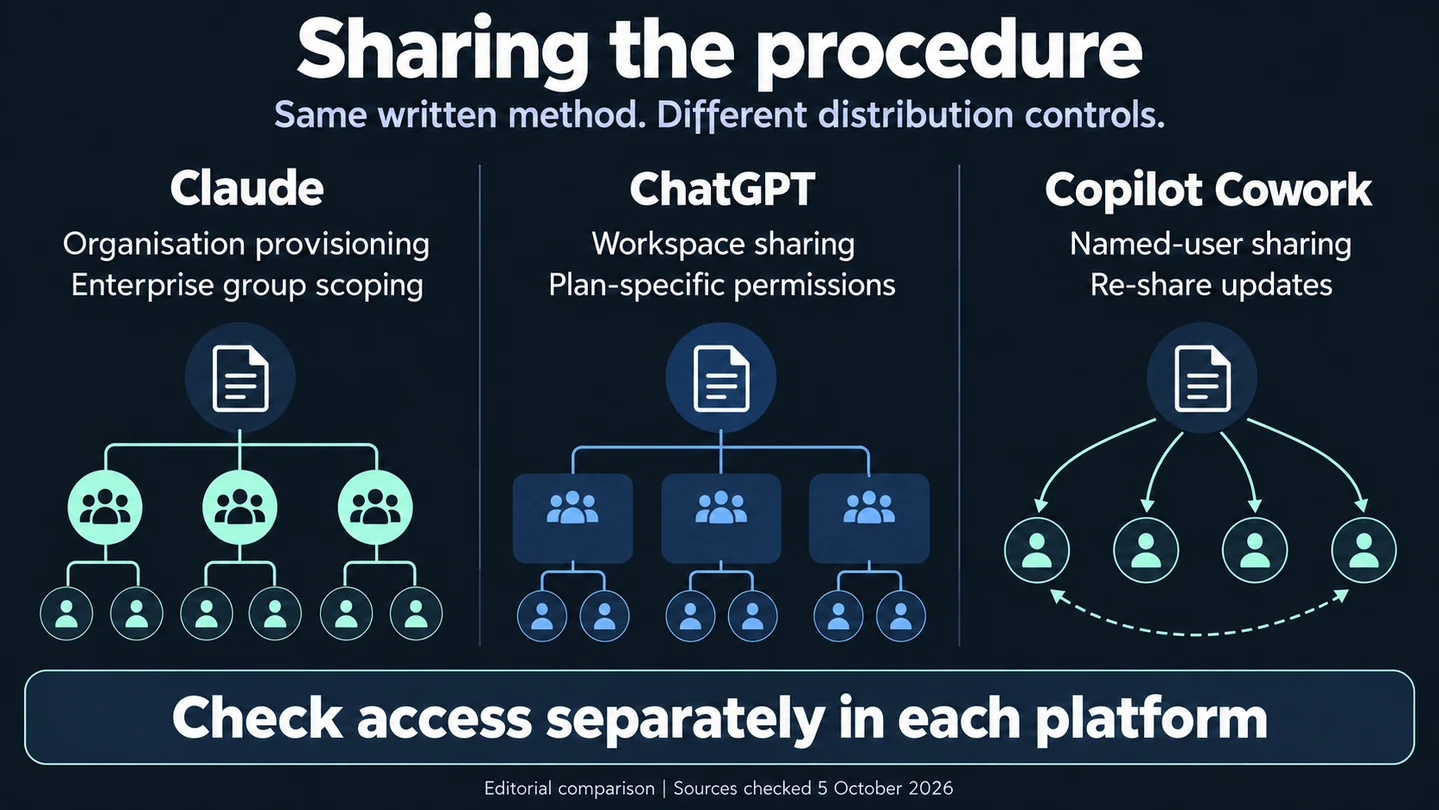
| Sharing and control | Org-wide provisioning; Enterprise group scoping through plugins [1] | Sharing and role controls; detailed administration depends on plan [2] | Named-user sharing; re-share updates [3] |
| Models | Skill is not a model purchase; plan determines access [5,7] | Model access follows the host plan [2,10] | Admin manages model availability [9] |
| Data location | First-party workspace storage currently US [11] | UK storage available for eligible Enterprise workspaces; inference differs [12] | UK is a listed storage geography for covered Copilot content [13] |
| Price basis | Team seats; Enterprise seats plus usage [5] | Business seats and additional usage; Enterprise quote [10] | Qualifying licence plus Cowork consumption [8,9] |
| Availability and limit | Business provisioning documented; confirm tenant policy [1] | Eligible accounts and surfaces vary [2] | Documented Cowork import; do not confuse it with other Copilot skill previews [3] |
Get the Claude deck. Choose the Claude Implementation Guide on the guides and decks page for the eleven worked examples and the wider operating model. It helps distinguish work you can do in an approved seat from work that needs a connected process.
When should a Microsoft-first firm start with Copilot?
Start there when the source material and intended output already live in Microsoft 365 and your approved licence and Cowork access cover the job.
For our illustrative finance job, keep the approved workbook in its working library. Ask the assistant to check the reporting period and draft commentary from the supplied figures. The finance owner approves the explanation before it enters the board pack. This is a suggested pilot, not a measured customer result.
The important limitation is practical: test whether the assistant can read the required source in your actual workspace. A failed source read should stop the draft. It should never be disguised by a confident explanation made from incomplete evidence.
Ask IT to show access and billing together. The licence line alone does not establish the running cost of this workflow; Cowork consumption includes skill and tool calls. [9]
Where do Claude skills fit?
Claude is a sensible candidate when a team already works there and wants a centrally maintained procedure rather than instructions copied between chats. Owners can provision a skill across Team or Enterprise; Enterprise can target groups through plugins. [1]
Keep the procedure small enough for its owner to review. Attach the approved commentary template and explain what counts as acceptable evidence.
Team and Enterprise are separate governance decisions. Compare the retention, identity and audit requirements against the actual plan before putting regulated material into the workflow. Enterprise's seat price also excludes metered usage. [5]
Our existing policy and handbook assistant walkthrough covers the source-grounding side.
Where do ChatGPT skills fit?
ChatGPT is worth testing when the team already uses its workspace and wants to distribute a repeatable method. Business eligibility does not imply every Enterprise administrative control is present on Business. Check the controls you actually need against the current workspace. [2]
The useful separation is between a skill's instructions and the apps that reach other systems. OpenAI's documentation describes dependencies and the resources bundled with a skill. [6] Copying a folder is not evidence that another user's connection has been approved.
For the finance pilot, require the same input files and expected findings used on the other platforms. Have the reviewer mark missing evidence and corrections before considering the writing style. A more fluent draft can still be less useful if it hides a missing reporting period.
How do you draft a client letter from a house template?
Start with the current approved template and a short factual brief. Ask for a draft with visible gaps, then have the document owner check it before sending. This is Agent 3, Standard documents from house templates, P1 in the Softblues Claude playbook: a task within an approved assistant seat, with a person responsible for the finished letter.
The following is a synthetic information-request letter. The names, reference and documents are invented. The output is an editorial example of what a good draft should contain, not a transcript of a tested model run or a client result.
What files should you give the assistant?
Supply a template, a structured brief and a style example. Each has a different job, so label them clearly.
| Input | Synthetic contents | How it may be used |
|---|---|---|
| House template v1 | Dear [recipient]. Please send [documents] by [deadline] to [return address]. Please quote [reference]. | Fill bracketed fields; preserve the surrounding wording |
| Brief | Recipient: Alex Morgan. Documents: signed form. Reference: DEMO-104. Deadline: not supplied. Return address: not supplied. | Sole source of facts for this letter |
| Approved style example | A completed letter using invented details and the same template | Style only; never copy its dates, address or reference |
| Review instruction | Return the draft and a gap list; do not send | Defines the handover to the document owner |
Confirm that the template owner still approves the version before using it. An old letter from the sent folder is a style example only if the owner says its wording remains suitable. It is not a source of facts about the next recipient.
How would you run the first drafting test in Claude?
Use your firm's approved Claude workspace and keep this first exercise synthetic. Attach the input files to a conversation and give the following instruction. If Claude cannot read a file, resolve that first; do not ask it to reconstruct the template from memory.
Fill only the bracketed fields in House template v1 using Brief. Use the approved example for tone only. Preserve all fixed wording. Do not invent dates, fees, commitments, document names or contact details. Write [MISSING: field name] for anything absent. If sources conflict, list the conflict and leave that field unresolved. Return the draft and a separate gap list. Do not send the letter or update another system.
Keep the first test small enough to inspect line by line. A request to produce a downloadable Word file can use Claude's file-creation capability where enabled. For a Word template whose layout must remain exact, ask for variable text only and insert it into the original document. A fluent rewrite is not proof that the original clauses or formatting survived.
What should the draft and gap list look like?
The expected output keeps both missing fields visible. It does not borrow a deadline or address from the example letter.
Dear Alex Morgan,>
Please send the signed form by [MISSING: deadline] to [MISSING: return address]. Please quote DEMO-104.
| Field | Status | Action for the reviewer |
|---|---|---|
| Recipient | Supplied: Alex Morgan | Check against the brief |
| Document | Supplied: signed form | Confirm the requested document is correct |
| Deadline | Missing | Obtain the authorised date |
| Return address | Missing | Confirm the approved destination |
| Reference | Supplied: DEMO-104 | Check character by character |
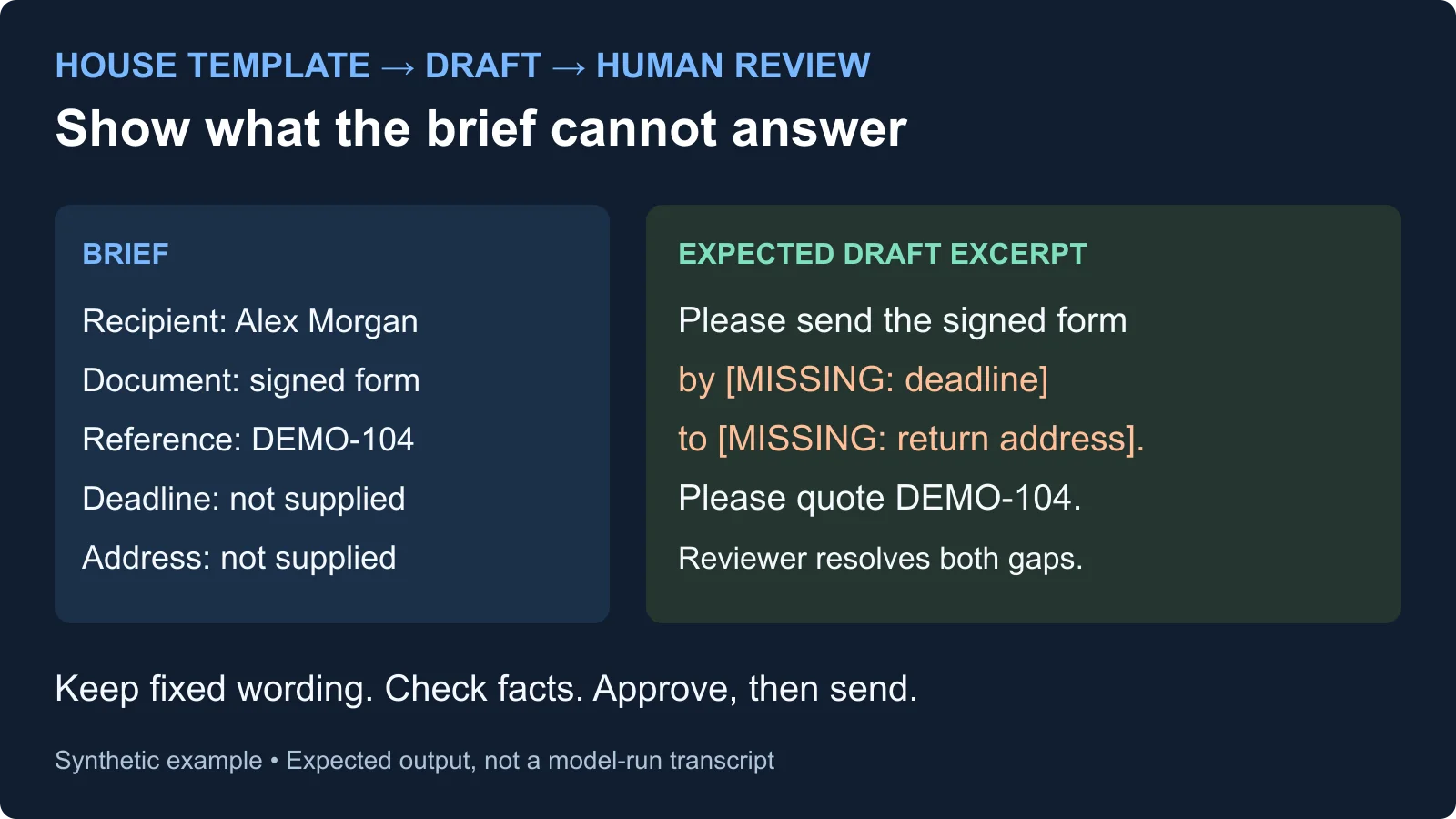
The document owner checks each inserted value against the brief, compares fixed wording with the template, resolves the gaps and approves the final file. The person then sends and files it through the normal process. An instruction saying 'do not send' is a task boundary; technical permissions must also restrict sending if connected tools can take that action.
When should you make the method a reusable Skill?
Save it after the owner accepts the procedure and test outputs. Put stable instructions, the current template and a synthetic example in the skill; supply each new client's facts separately. Include an owner and a version so a template change can be reviewed.
In Claude, the current documented route is Customize > Skills, then '+' > Create skill > Upload a skill for a packaged ZIP. Check the workspace's Skills and code-execution settings with its owner first. Enable the uploaded skill and test it in a fresh conversation. Organisation distribution has separate permissions and review settings. [14]
For a comparison with ChatGPT or Copilot, use the same synthetic brief and acceptance checks. Include a deliberately missing deadline and a conflicting reference in a second test. Check whether the assistant exposes both problems. Import support alone does not prove that a package's dependencies, access controls or results carry across.
Record the time to produce an accepted, filed letter, including review and corrections. Any reduction is freed capacity until the firm decides how to use it; it is not automatically cash saved. This example claims no measured saving.
What would a portable finance procedure actually contain?
Consider a monthly commentary draft. This is a deliberately limited example within Agent 6, Monthly management and board pack, which remains P2 in our core guide. A standalone drafting skill does not by itself deliver that connected agent.
The procedure should tell the assistant to confirm the reporting period, read the approved figures, check differences against the prior period and draft only explanations supported by evidence. If a number is missing or a total fails to reconcile, it should identify the gap and stop that part of the commentary. The finance owner signs off; the assistant does not approve accounts.
For the cross-platform test, give each assistant the same sanitised input. Include a wrong period label and a missing explanation on purpose. Record whether each problem was identified, which source supported each statement, and what the reviewer changed. These are proposed test conditions, not a published benchmark.
Time the complete job, including review and filing, against the existing method. A faster first draft has limited value if the finance director spends longer checking it.
What does this cost for a 100-person UK firm?
Begin with the whole-firm AI ROI calculator to explore your own capacity assumptions. Its outputs are illustrative starting points; this article claims no measured saving or payback. Freed time is capacity until a decision turns it into a financial benefit.
The licence arithmetic below uses public prices checked on 27 October 2026. It excludes VAT or applicable tax, implementation and variable usage. Dollar prices remain in dollars because a made-up exchange rate would make the comparison less reliable.
| Route for 100 people | Published seat basis | Seat arithmetic | Separate budget line |
|---|---|---|---|
| Microsoft Business Premium with Copilot, with Teams | £24.60 per user/month, annual [4] | £2,460 monthly equivalent; £29,520 annually | Cowork consumption; migration or configuration |
| Claude Team standard | $20 per user/month, annual [5] | $2,000 monthly equivalent; $24,000 annually | Extra usage and rollout work as applicable |
| Claude Enterprise | $20 per user/month, annual, plus usage [5] | $24,000 annual seat component | Usage at API rates; implementation |
| ChatGPT Business standard | $20 per user/month, annual [10] | $24,000 annual seat component | Additional usage; implementation |
| ChatGPT Enterprise | Contract quotation [10] | Obtain a quote for the required controls | Confirm usage allowance and overage terms |
Microsoft's row includes a broader productivity and security bundle. The other rows are additional assistant purchases, so these are not like-for-like totals. For an existing Microsoft customer, compare the incremental change from the current contract, not the full bundle price twice.
Implementation needs its own scope: documenting the method, resolving access, testing outputs and training the owner. Obtain a GBP quote for that work.
What should governance and residency cover?
Treat the method as a controlled business document. Name who approves changes and who can distribute them. Keep review outside the assistant where the result commits the firm to an action. A written instruction to ask permission is not a substitute for platform permissions that restrict the action.
Record storage and processing separately. Claude's first-party workspace geography is currently US; OpenAI's eligible UK storage option does not establish UK inference. Microsoft's storage commitments apply to specified content and services. [11,12,13] A skill's external dependencies need their own assessment. Changing the folder format changes none of those terms.
For UK and Irish firms, treat residency as a documentation task, not a legal barrier by assumption. That is a starting point for due diligence, not a conclusion that every transfer is permissible. The firm's responsible advisers must check contractual restrictions and the proposed data flow before approval. Keep the first comparison on sanitised inputs while that assessment is completed.
What should you ask your IT lead this week?
Start at £0 in new software. Ask: "Can we write down one approved procedure and its acceptance criteria using the tools we already have?" A good answer identifies the owner, input location and what a reviewer must accept. Staff time still has a cost.
Use existing approved seats, with usage monitored. Ask: "Can we test that procedure on a sanitised completed job and show the corrections and consumption?" A good answer includes the accepted output and a real usage record. It does not promise that a clean import proves the workflow works.
Buy additional capacity only after the test. Ask: "Which gap requires another licence or an engineered integration?" A good answer names a failed requirement, prices the smallest suitable change and explains how it will be retested. Compare platform routes before commissioning a build.
Softblues uses its own Claude operating system as a practical reference for organising work around maintained procedures. We help firms choose the platform and scope the implementation, including when the right answer is to use a seat they already own.
To discuss your firm's first controlled workflow, book a discovery call.
Frequently asked questions
How do I use Claude skills for business?
Begin with one repeatable job and an approved output example. Package the procedure, test it on sanitised material, and have the owner review results before distribution. Organisation-wide provisioning is available on Team and Enterprise. [1]
What is the difference between a Claude skill and a project?
A skill carries reusable task guidance; a project provides the working context. Keep the stable method separate from changing case material. This makes revisions easier to review and avoids duplicating sensitive inputs. [7]
Can ChatGPT skills use a Claude SKILL.md file?
Both use SKILL.md-based instructions. Check the package structure and any scripts, dependencies or product-specific instructions before use. Shared syntax is a starting point for a test, not evidence of identical behaviour. [6,7]
Are Copilot skills the same as Copilot agents?
No. A skill supplies task instructions within its host; an agent may also need connections, triggers and action controls. This article compares Cowork's skill import path, not every feature called a skill across Microsoft's products. [3,9]
Can AI fill a template without rewriting its clauses?
It can be instructed to fill only named fields, but the document owner must compare the output with the approved original. Softblues recommends producing variable text separately when exact Word layout or fixed wording is essential.
What should AI do when the brief is incomplete?
Leave the field visibly marked as missing and include it in a gap list. Softblues' synthetic example leaves the deadline and return address unresolved. The reviewer supplies authorised values before sending.
Does a faster draft mean the firm has saved money?
No. Measure the whole job, including checking and correction, then decide how any freed time will be used. Softblues treats time as capacity until an operational decision produces a financial benefit.
Sources checked 27 October 2026
[1] Anthropic: provision and manage organisation skills. [2] OpenAI: Skills in ChatGPT. [3] Microsoft: customise Copilot Cowork. [4] Microsoft: Business Premium with Copilot UK pricing. [5] Anthropic: pricing. [6] OpenAI: build skills. [7] Anthropic: what are skills. [8] Microsoft: Cowork common questions. [9] Microsoft: manage Copilot Cowork. [10] OpenAI: ChatGPT Business overview and business plans. [11] Anthropic: commercial data storage and processing. [12] OpenAI: data and inference residency. [13] Microsoft: Copilot data residency.
Work out your numbers
Your whole firm
AI ROI calculator
Five questions about your firm. See the time AI frees up, what it is worth and when it pays for itself.
Work out your numbersOne key process
Process automation ROI calculator
Five questions about one process. See the hours an AI agent frees up, what they are worth and how much becomes profit.
Work out your numbers
Free. No sign-up. Your answers stay in your browser.
See it in production
Systems we have built and run for clients, with the numbers that came out of them.
Related Articles

Claude vs ChatGPT vs Copilot: what does an AI agent task really cost?
MCP server access: Claude, ChatGPT and Copilot in Microsoft 365