Gemini for Business vs Claude Enterprise: Which Fits Your Company in 2026?
Google lists Gemini Enterprise from $21 per seat. What the headline leaves out is that the cheapest tier does not include enterprise-grade security and compliance. An honest head-to-head for UK buyers.

By Ivan Pylypchuk (opens in a new tab), CEO of Softblues. Has led Claude and Gemini deployments for finance, legal and operations teams across the UK and Ireland.
Google publishes a headline price for its business AI: $21 per seat per month for Gemini Enterprise app, Business edition (Google Cloud, 2026). What the headline leaves out is a row missing from Google's own edition table. Business edition does not include enterprise-grade security and compliance. Google says so on the same page, pointing buyers who need "enterprise-grade compliance" at the Standard and Plus editions instead (Google Cloud editions table, updated 11 August 2026).
That gap is why most Gemini-versus-Claude comparisons are useless. They put the cheapest Gemini tier against the only Claude Enterprise tier, and the cheapest Gemini tier is not an enterprise product.
Softblues is an AI implementation firm for the UK and Ireland mid-market. We are Certified in the Claude Partner Network, a Google Cloud partner at Services Select tier and a member of the Microsoft AI Cloud Partner Program, and we run six of our own departments on Claude. We use it before we sell it, so we have a preference, and you should weigh it accordingly. Everything below comes from each vendor's published documentation, with the links, so you can check us.
Key facts
- Gemini Enterprise app, Business edition: from $21 per seat per month, for teams up to 300 users, with a 30-day free trial and no IT setup (Google Cloud, 2026).
- Business edition excludes enterprise-grade security and compliance, the full connector ecosystem, priority access to the newest Gemini models, third-party agents and the Agent Marketplace. Those sit in Standard and Plus, which Google Cloud sales quotes on request (Google Cloud editions table, 11 August 2026).
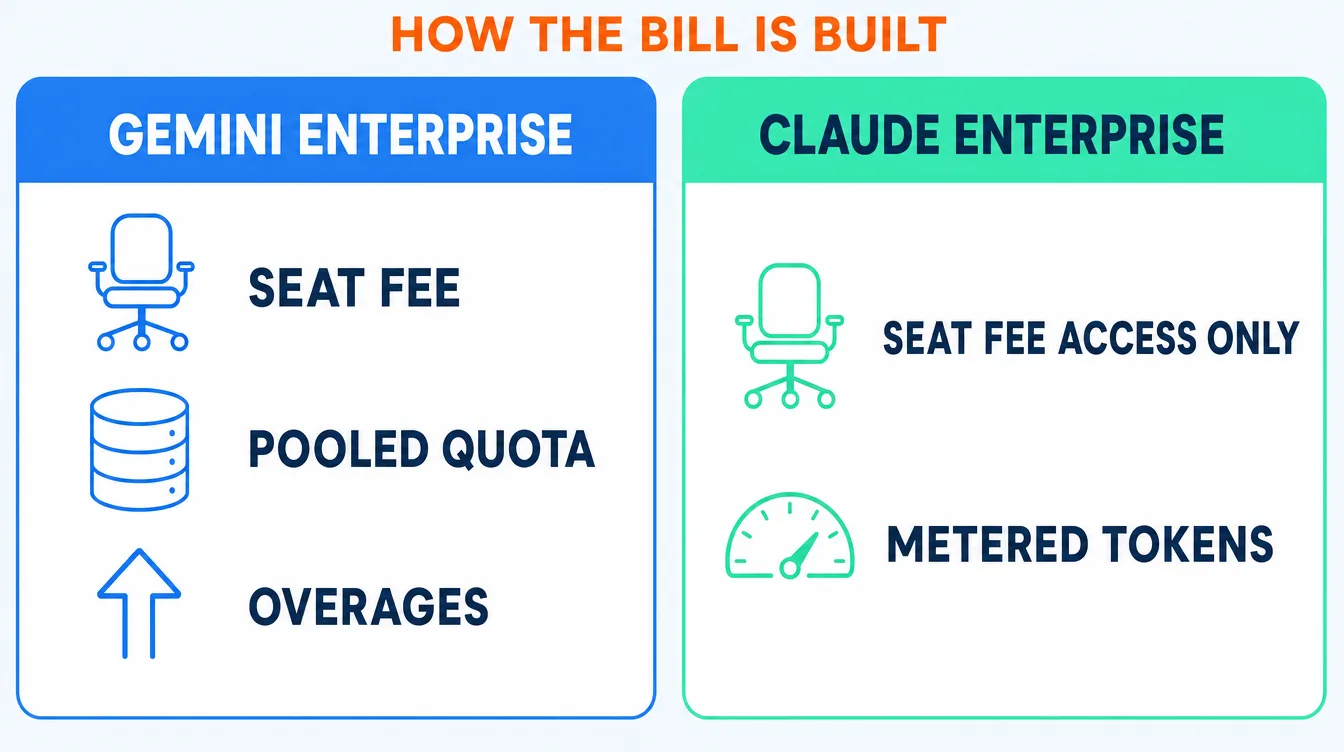
- Claude Enterprise is a single seat type, priced per user per month and billed annually. The seat fee covers access only (Anthropic Help Centre, 2026).
- Claude bills every token separately at standard API rates. No included allowance, no per-seat usage cap. Admins set spend limits instead (Anthropic, 2026).
- Seat minimums differ by route. Claude Enterprise is 20 seats self-serve and 50 seats sales-assisted. Self-serve is USD only, so UK companies wanting sterling invoicing need the sales-assisted route (Anthropic, 2026).
- Both are serious about data. Gemini Standard and Plus offer data residency, customer-managed encryption keys, VPC Service Controls and Cloud audit logging. Claude Enterprise offers audit logs, SCIM, customer-managed encryption keys, a Compliance API and US-only inference.
- Prices are in USD and they move. Treat every figure here as accurate at August 2026 and confirm the live quote before you budget.
Gemini for business or Claude Enterprise: what is the short answer?
Pick Gemini Enterprise if your company already runs on Google Workspace, you want no-code agents that ordinary staff can build, and you need one governed place for Google-made and partner agents. Pick Claude Enterprise if your value sits in long, difficult documents, you want engineers using Claude Code on the same seat, and you would rather extend the assistant through the open MCP ecosystem than a vendor marketplace.
Neither is the better model. They are different shapes of product.
How is each bill actually built?
This is where buyers get caught, because the two vendors meter completely different things.
Gemini Enterprise app is billed per seat, per month, against pooled quotas. Storage and data indexing is pooled across all users in your project: 25 GiB per user on Business, 30 GiB on Standard, 75 GiB on Plus. Go past your subscription quotas and you pay consumption overages on top. One more thing that catches people out: the Gemini Enterprise app and the Gemini Enterprise Agent Platform (the developer platform, and the evolution of Vertex AI) are sold separately. The app is per seat. The Agent Platform is pay-as-you-go on a Google Cloud account.
Claude Enterprise separates the two completely. The seat buys access to Claude on web, desktop and mobile, plus Claude Code and Cowork. Then every token your team consumes is billed at standard API rates, with no allowance bundled in and no seat-level cap. A team of forty where six people are heavy users pays very differently from a team of forty where everyone dabbles.
| Gemini Enterprise app | Claude Enterprise | |
|---|---|---|
| Published seat price | From $21/seat/month (Business edition) | Per user/month, billed annually; published on Anthropic's pricing page |
| What the seat includes | The app, prebuilt Google agents, no-code Agent Designer, pooled storage quota | Claude on web, desktop and mobile, plus Claude Code and Cowork. Access only |
| Usage model | Pooled quotas, then consumption overages | Every token at API rates, no allowance, spend limits available |
| Entry point | 1 seat on Business; Standard and Plus quoted by sales | 20 seats self-serve, 50 sales-assisted |
| Currency | Billed through Google Cloud, multi-currency | Self-serve USD only, multi-currency via sales |
| Best for | Google Workspace shops, broad rollouts, no-code agent building | Document-heavy and engineering-heavy teams, open extensibility |
| Avoid if | You need enterprise compliance on the cheapest tier | You need a predictable flat per-seat bill |
Which one handles your data better?
Both are credible. The difference is what you have to buy to get there.
Gemini Enterprise Standard and Plus give you data residency so your data stays in a chosen region, Google Cloud audit logging, customer-managed encryption keys through Cloud KMS, VPC Service Controls to block access from untrusted networks, and industry compliance including HIPAA and FedRAMP. Every edition, Business included, ships with Model Armor, Google's built-in screening for prompt injection, jailbreaking and sensitive-data detection. Google states that you own your data and that it is not used to train Google models.
Claude Enterprise gives you audit logs, SCIM provisioning, custom data-retention controls, a Compliance API for programmatic access to activity logs and chats, an Analytics API, customer-managed encryption keys held in your own cloud, and the option to keep inference US-only. Eligible organisations can enable a HIPAA-ready configuration and accept a BAA from organisation settings.
The gap that matters for UK and Irish buyers is regional data residency. Google's Standard and Plus editions let you pin a region. Claude Enterprise publishes a US-only inference option, which is close to the opposite requirement. If your board or your regulator has said data must stay in the UK or EU, put that question to Anthropic sales in writing before anything else. Do not assume either way.
How do they connect to the systems you already run?
Gemini Enterprise connects to Google Workspace (Drive, Calendar, Gmail, Groups, with real-time syncing), Microsoft (OneDrive, Outlook, SharePoint, Entra ID), ServiceNow, Jira, Confluence and a long tail beyond that. The full connector ecosystem is a Standard and Plus feature. Business edition gets a curated subset.
Claude Enterprise ships connectors for Google Drive, Gmail, Google Calendar, GitHub, Microsoft 365 and Slack. Beyond that it extends through the Model Context Protocol, which Anthropic created and then donated to the Agentic AI Foundation under the Linux Foundation, co-founded with Block and OpenAI and supported by Google, Microsoft, AWS, Cloudflare and Bloomberg. MCP has become the default way agents talk to tools, and it is not Anthropic-only. Gemini, ChatGPT, Copilot, Cursor and VS Code all speak it.
The practical difference is this. Gemini gives you a governed catalogue of connectors and partner agents, curated by Google. Claude gives you a protocol, so anything with an API can be wired in by your own team in an afternoon. One is a supermarket. The other is a kitchen. Which you want depends on whether you have engineers.
Who should honestly pick Gemini Enterprise?
We will say this plainly, even though we are Anthropic-native.
1. You are a Google Workspace company. If Drive, Gmail and Calendar are where the work lives, Gemini's grounding in that data is native rather than bolted on, and the admin story sits in a console your IT team already knows.
2. You want non-technical staff building agents. The no-code Agent Designer is genuinely aimed at people who cannot code. If your ambition is "let the ops team build their own small helpers", that is a real advantage.
3. You are under 300 people and want to start this week. Business edition needs no IT setup and has a 30-day trial. That is a low-friction way to find out whether AI helps your team at all, as long as you know you are trialling the tier without the compliance controls.
4. You need one governed pane for many agents. If you expect to run Google-made, partner and custom agents side by side, Gemini's marketplace and governance layer was built for exactly that.
5. Frontline staff are a large share of your headcount. Google's Frontline edition is an add-on for Standard and Plus customers with 150 or more users, which covers warehouse or retail staff more cheaply than full seats.
Who should pick Claude Enterprise?
1. Your hard problems are documents. Long contracts, regulatory files, research packs, board papers. This is where we see the widest gap in real client work.
2. You have engineers. Claude Code is included in the Enterprise seat. If your developers already pay for a separate coding assistant, that changes the total cost considerably.
3. You want to build, not shop. MCP means your team can connect Claude to your own internal systems without waiting for a vendor connector. We built our own company's operating system that way, across six departments, and wrote it up in the Softblues Claude Operating System case study.
4. Your usage is uneven and you want to pay for what you use. No allowance to waste, no seat-level cap to hit. With spend limits set per user and per organisation, heavy users do not starve anyone else.
5. You are already multi-model. If Copilot and ChatGPT are also on your shortlist, our three-way comparison of ChatGPT Enterprise, Claude Enterprise and Microsoft Copilot covers that ground, and our honest comparison of Claude and ChatGPT for business goes deeper on the model differences.
What a realistic evaluation looks like
Most companies run this badly. They give both tools to a committee for a fortnight, collect opinions, and pick the one with the nicer interface.
Do this instead.
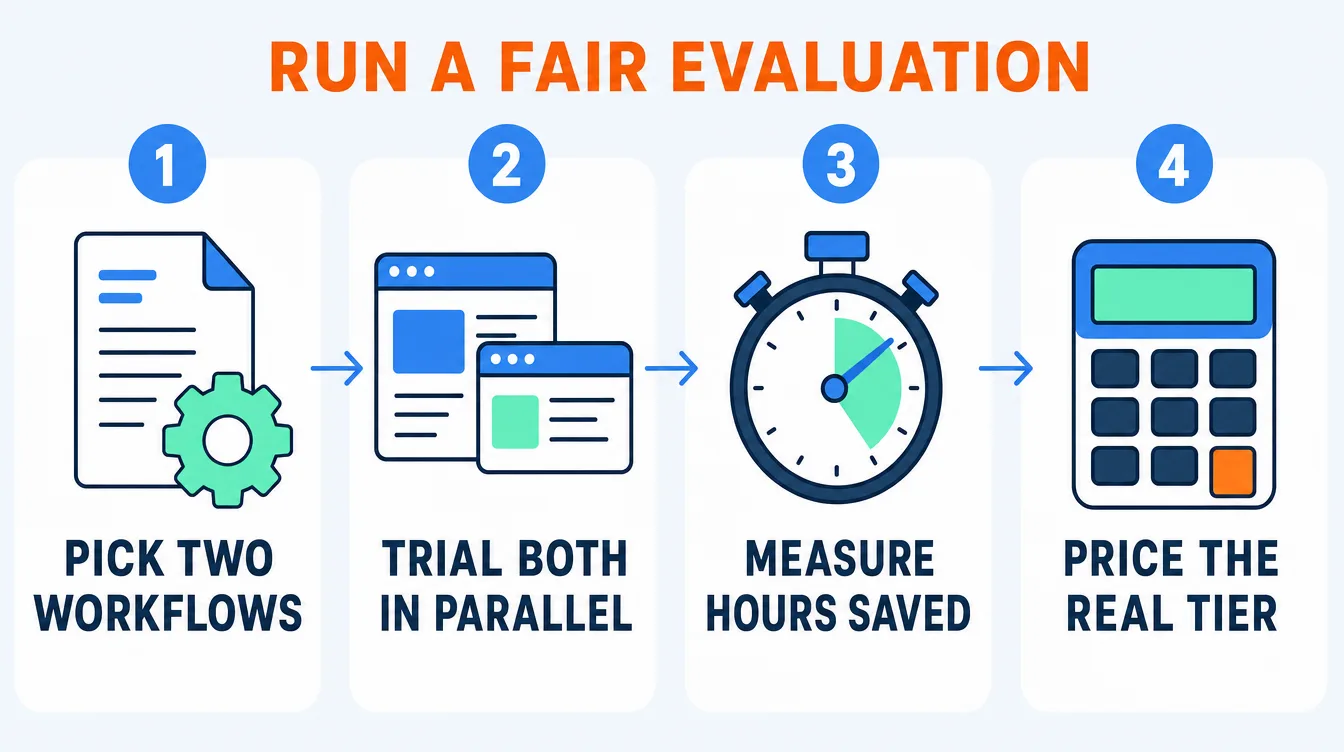
1. Pick two workflows, not twenty. One document-heavy, one routine admin. Real work, with real files, done by the people who normally do it.
2. Run both 30-day trials in parallel. Gemini Business edition and Claude Enterprise both let you start without a long procurement cycle. Same fortnight, same tasks, same people.
3. Measure hours, not enthusiasm. Time the task before and after, per person, per week. Enthusiasm decays. Recovered hours do not.
4. Then price it. Multiply real usage by the tier you would actually need in production, not the trial tier. For Gemini that usually means Standard rather than Business. For Claude it means the seat fee plus a month of observed token spend.
If the two land within twenty percent of each other on cost, pick on where your data lives. That factor outlasts the price difference.
Can you run both?
Yes, and a fair number of mid-market companies end up here. Gemini for the broad Workspace population, Claude for a smaller group doing document and engineering work. It costs more in licences and less in arguments.
The risk is governance sprawl: two admin consoles, two audit trails, two sets of connector permissions. If you go dual-vendor, decide up front who owns each, and how you will answer an auditor asking "where did this answer come from?" in both systems.
Frequently asked questions
Is Gemini Enterprise the same as Gemini in Google Workspace? No. The Gemini app in Workspace is an everyday assistant included with Workspace commercial plans. Gemini Enterprise app is a separate agentic platform that connects across Workspace, Microsoft 365 and other systems, with its own admin console and agent governance.
Does the $21 Gemini price include enterprise compliance? No. Google's own edition comparison leaves enterprise-grade security and compliance out of the Business edition. Those controls start at Standard.
What does a Claude Enterprise seat actually include? Access to Claude on web, desktop and mobile, plus Claude Code and Cowork. Usage is not included. Every token is billed separately at standard API rates.
What is the minimum team size for Claude Enterprise? Twenty seats buying self-serve online, fifty going through Anthropic sales. The sales-assisted route also unlocks invoicing and currencies other than USD.
Can UK companies pay in pounds? For Gemini, yes, through Google Cloud billing. For Claude, self-serve is USD only, so sterling invoicing means the sales-assisted route and its fifty-seat minimum. Worth knowing before you plan a thirty-seat pilot.
Which one is better for regulated industries? It depends on your specific constraint. If regional data residency is mandatory, Gemini Standard or Plus has the clearer published answer today. If your constraint is auditability and retention control, Claude's Compliance API and custom retention controls are strong. Get both answers in writing during procurement.
Do either of them train on our data? Google states that customer data is not used to train its models and is never sold. Anthropic's Enterprise terms likewise exclude customer data from training. Confirm the current terms in your own contract, because both vendors revise them.
How long does a rollout take? Technical setup takes days. Adoption is the real work. Our Claude Enterprise implementation checklist covers SSO, permissions, connectors, training and governance in the order they actually need doing.
We are an OpenAI Select Partner, Certified in the Claude Partner Network, a Google Cloud partner at Services Select tier, and a member of the Microsoft AI Cloud Partner Program. That means we deploy whichever platform fits the client rather than the one we resell. Most UK mid-market companies we work with end up on Claude for depth and keep Google for the Workspace layer, but we have recommended Gemini outright more than once and will again.
For how Gemini sits against the other three paths, including the model limits on its UK region, the platform guide runs the comparison across eighteen concrete tasks.
If you want a second opinion on a shortlist you have already built, or you want someone to run the four-step evaluation above with you, book a discovery call. Thirty minutes, no deck.
Work out your numbers
Your whole firm
AI ROI calculator
Five questions about your firm. See the time AI frees up, what it is worth and when it pays for itself.
Work out your numbersOne key process
Process automation ROI calculator
Five questions about one process. See the hours an AI agent frees up, what they are worth and how much becomes profit.
Work out your numbers
Free. No sign-up. Your answers stay in your browser.
See it in production
Systems we have built and run for clients, with the numbers that came out of them.
Related Articles
MCP server access: Claude, ChatGPT and Copilot in Microsoft 365
AI governance framework: a UK employee policy template