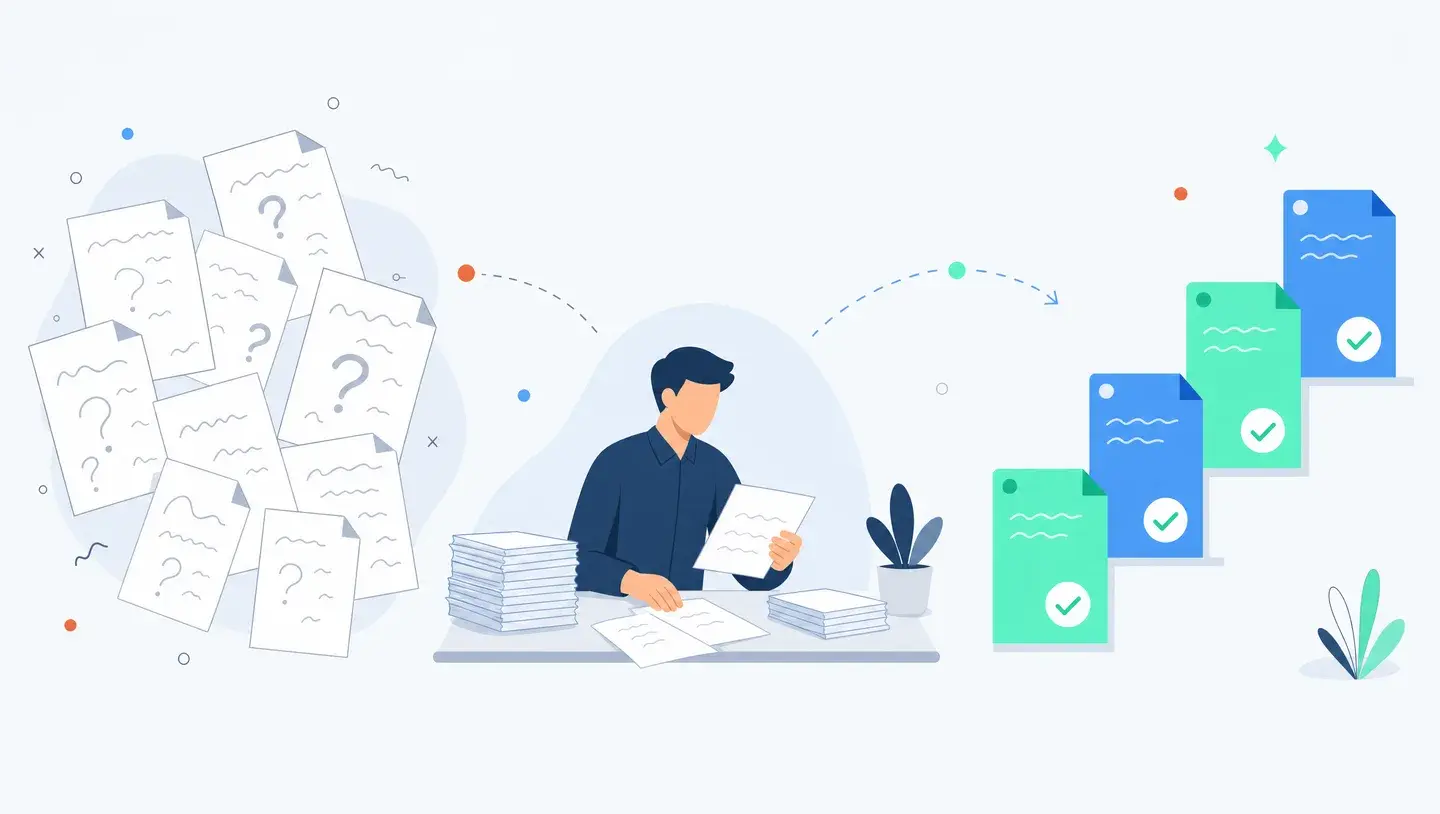
How to Automate Contract Review With AI: A UK Guide
An AI reviewer once matched 94% of NDA issues in 26 seconds, against 92 minutes for lawyers. Here is how UK mid-market firms automate contract review safely, with a person still signing off.
By Ivan Pylypchuk (opens in a new tab), CEO of Softblues. Has led Claude and Gemini implementations for finance, legal and healthcare teams across the UK and Ireland.
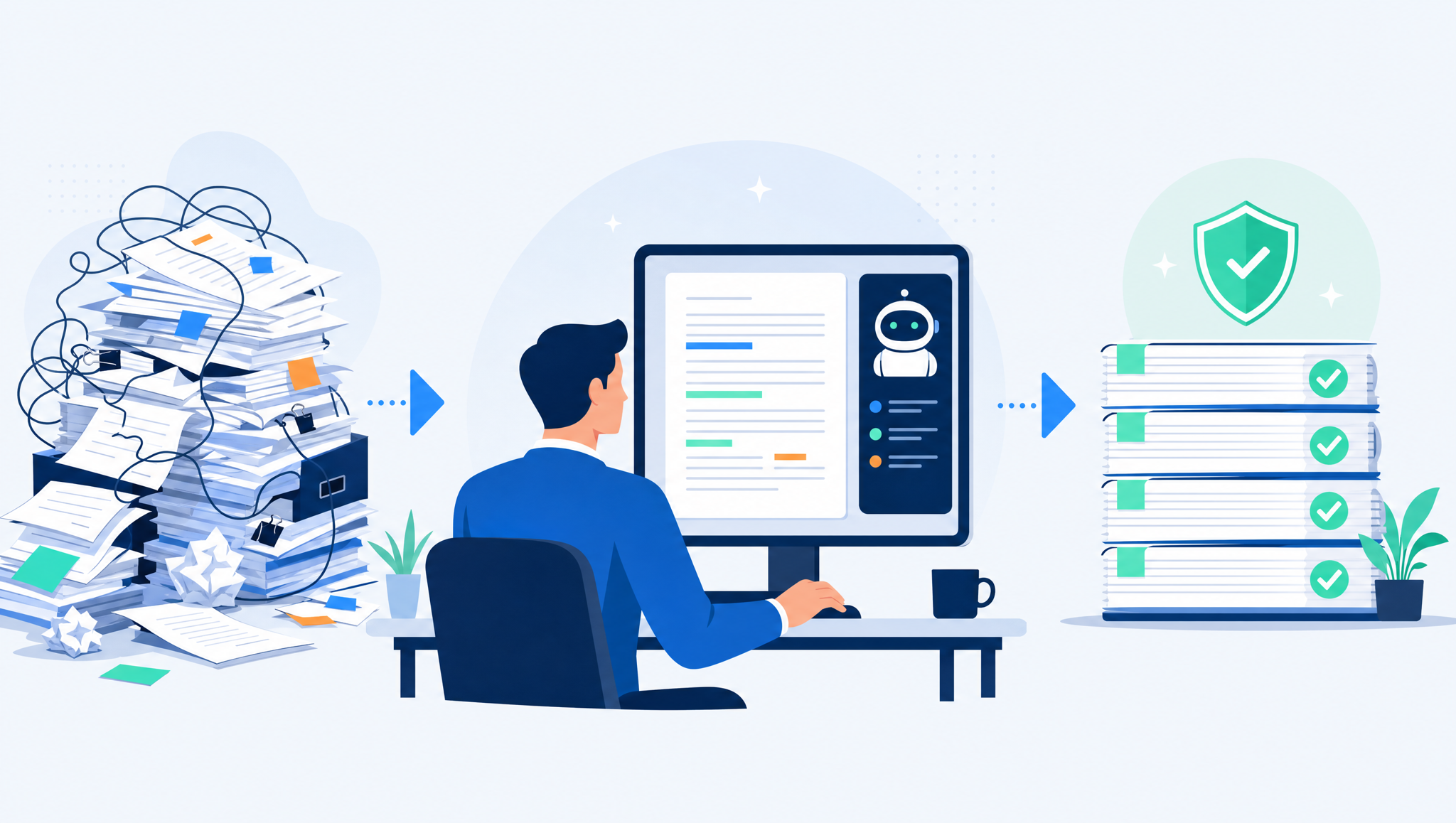
You automate contract review by having an AI model read each contract against your own playbook, flag risky, missing or non-standard clauses, and pass only the exceptions to a person. In UK mid-market firms this works best for NDAs, supplier terms and MSAs. A qualified reviewer still signs off; the AI just clears the routine 80% first.
At Softblues, a firm putting Claude into production for regulated mid-market companies across the UK and Ireland, we build this kind of review workflow as a fixed-price project rather than a tool you are left to configure alone. This guide covers what to automate, what to leave with a human, and how to set it up without creating a compliance problem.
Key facts
- In a controlled 2018 benchmark, an AI reviewer caught 94% of the issues in a set of NDAs against 85% for experienced corporate lawyers, and finished in 26 seconds versus an average of 92 minutes per lawyer (LawGeex, Feb 2018). Treat this as a ceiling for narrow, well-defined tasks, not a promise for every contract.
- Weak contract management costs the average organisation around 9.2% of annual revenue, and more in complex sectors (World Commerce & Contracting).
- Best contracts to start with: high-volume, repetitive, lower-value agreements. NDAs, supplier terms, standard MSAs and DPAs.
- What AI does well: first-pass triage, clause extraction, and spotting deviations from your standard positions. What it must not do: give final legal sign-off or waive a risk.
- UK context to check with your own advisers: the SRA regulates legal practice in England and Wales; UK GDPR and the ICO govern the personal data inside your contracts.
- A realistic first workflow can be live in weeks, not months, because you are automating one contract type, not the whole legal function.
Who this is for, and who it isn't
This is for a 50-to-500-person UK or Ireland firm that signs the same kinds of agreements over and over: an insurance broker, an accountancy or law practice, a procurement-heavy services business, or any company whose legal or commercial team is the bottleneck on deals. If a COO, Head of Legal or CFO is tired of contracts sitting in a queue for a week, this is for you.
It is not for a firm that needs bespoke, high-stakes drafting on every deal, or one expecting AI to replace legal judgement. Contract review automation clears the routine work so your reviewers spend their time on the clauses that actually carry risk. It does not remove the reviewer.
What does "automating contract review" actually mean?
It means turning a manual read-through into a structured, repeatable workflow. A contract arrives, the AI reads it against a written playbook of your standard positions, and it produces three things: an extract of the key terms, a list of clauses that deviate from your playbook, and a recommended action for each. Anything clean and low-risk is fast-tracked. Anything flagged goes to a human with the issues already highlighted.
The important word is playbook. The AI is only as good as the standard you give it: your preferred liability cap, your data-protection wording, your payment terms, the clauses you will never accept. Write that down first. The technology is the easy part; the playbook is the work.
Which contracts should you automate first?
Start where volume is high and each contract is low-value and repetitive. That is where a person's time is worth least and the pattern is clearest, so the AI is both most useful and least risky.
| Contract type | Automate first? | Why |
|---|---|---|
| NDAs | Yes | High volume, narrow issues, well understood. The classic starting point. |
| Standard supplier terms | Yes | Repetitive, playbook-friendly, slows procurement when queued. |
| Data processing agreements | Yes, with care | Structured, but check every flag against UK GDPR before sign-off. |
| Master services agreements | Partially | Automate the first-pass triage; a reviewer owns the negotiated terms. |
| Bespoke, high-value deals | No | Too much judgement and too little repetition to trust to a first pass. |
Prove the workflow on one contract type before you widen it. A pilot that reviews NDAs well and builds trust with the legal team is worth more than an ambitious rollout nobody trusts.
How accurate is AI at reviewing contracts?
Accurate enough to triage, not to sign. The 2018 LawGeex benchmark is the number everyone quotes: 94% issue-spotting accuracy on NDAs against 85% for lawyers, in 26 seconds rather than 92 minutes. It is real and it is genuinely impressive, but read the small print. It was a narrow task, a fixed set of 30 known issues, and one contract type. Your live contracts are messier.
Modern models such as Claude are considerably stronger than the 2018 systems, especially at reading long documents and explaining why a clause is a problem. But accuracy on your contracts depends on your playbook, your contract types and your review workflow, not on a headline figure from someone else's study. The honest framing is: AI will find most of the routine issues most of the time, fast, and a person confirms the rest.
How do you build the workflow without creating a compliance risk?
Keep a human in the loop, log everything, and be deliberate about where your contracts and their data go. A contract review workflow handles commercially sensitive and often personal data, so the same rules apply as to any other system touching that data.
1. Write the playbook. Your standard clauses, red lines and preferred fallbacks, in plain language. This is the single biggest determinant of quality.
2. Choose a first contract type. NDAs or standard supplier terms. One type, clear success criteria.
3. Set the human checkpoint. Decide exactly what the AI may fast-track and what always goes to a person. When in doubt, it escalates.
4. Handle data properly. Know where the contract text is processed and retained, confirm it is not used to train a public model, and check the arrangement against UK GDPR and your own ICO obligations. Anthropic's enterprise terms, for example, do not train on your data by default; verify the specifics for whatever you deploy against the ICO's guidance on AI and data protection.
5. Keep an audit trail. Every review, every flag, every human decision, logged. If a regulator or client asks how a contract was checked, you can show them.
Build, buy, or bring in a partner?
Three routes, and the right one depends on how standard your contracts are and how much control you need over the data.
| Approach | Relative cost | Best for | Avoid if |
|---|---|---|---|
| Buy CLM software with AI review | Ongoing licence, medium | Standard contract types, light configuration needs | Your playbook is unusual or your data cannot leave your control |
| Build a custom workflow on a model like Claude | Higher upfront, lower ongoing | Firms with specific playbooks, data-residency needs, or unusual contract mixes | You have no one to own it and want it fully managed |
| Bring in an implementation partner | Fixed project fee | Regulated firms that want it built right, integrated and handed over | You genuinely have the in-house time and skills to build it yourself |
Costs vary too much by firm to quote a single figure honestly, so treat the above as relative, not absolute. The real question is not price, it is whether the result fits your playbook and keeps your data where it needs to be. We look at that in more detail in our guide to what's safe to automate for legal teams and in AI document processing and workflow automation.
What does this look like in a regulated firm?
Consider a financial-advice firm that reviews supplier and client agreements as part of its compliance obligations. The bottleneck was a monthly backlog of files needing a consistent, documented check. The pattern we proposed put an AI first pass across every file against a fixed checklist, surfaced the exceptions, and left the sign-off with a qualified reviewer, with a full audit trail behind each decision. You can read how we approached it in our compliance file review automation case study. That engagement is a discovery and proposal rather than a live deployment, so we describe the design, not claimed production results.
Frequently asked questions
Can AI replace a contract lawyer?
No. AI replaces the slow first read, not the judgement. It clears routine issues and flags the rest so a qualified person spends their time where it matters. The reviewer still owns the sign-off.
Is it safe to put confidential contracts through an AI model?
It can be, if you control where the data goes. Use an enterprise arrangement that does not train on your content, confirm retention and residency, and check it against UK GDPR. Do not paste sensitive contracts into a consumer chatbot.
How long does it take to set up?
A first workflow for a single contract type such as NDAs can be live in a few weeks. Widening it to more contract types and integrating it with your systems takes longer, and is worth doing only once the first type has earned the team's trust.
What is a contract review playbook?
A written record of your standard positions: the clauses you require, the ones you refuse, your preferred fallbacks, and your red lines. The AI reviews each contract against it. Quality depends on this document more than on the model.
Which contracts should we not automate?
Bespoke, high-value or unusual agreements where every deal needs real negotiation and judgement. There is little repetition for the AI to learn from and too much at stake to trust a first pass.
Does this work with Claude?
Yes. Long-document reading and clause-by-clause explanation are exactly the tasks current models like Claude handle well. The model is one part; the playbook, the human checkpoint and the audit trail are what make it safe.
Automating contract review is one of the clearest early wins in business process automation: high volume, clear rules, and a measurable drop in turnaround time. We build these workflows as fixed-price projects, integrated with your systems and handed to your team, as a firm Certified in the Claude Partner Network and a Google Cloud partner at Services Select tier. If contracts are sitting in a queue at your firm, book a discovery call and we'll map the first workflow with you.
Work out your numbers
One key process
Process automation ROI calculator
Five questions about one process. See the hours an AI agent frees up, what they are worth and how much becomes profit.
Work out your numbersYour whole firm
AI ROI calculator
Five questions about your firm. See the time AI frees up, what it is worth and when it pays for itself.
Work out your numbers
Free. No sign-up. Your answers stay in your browser.
See it in production
Systems we have built and run for clients, with the numbers that came out of them.
Related Articles
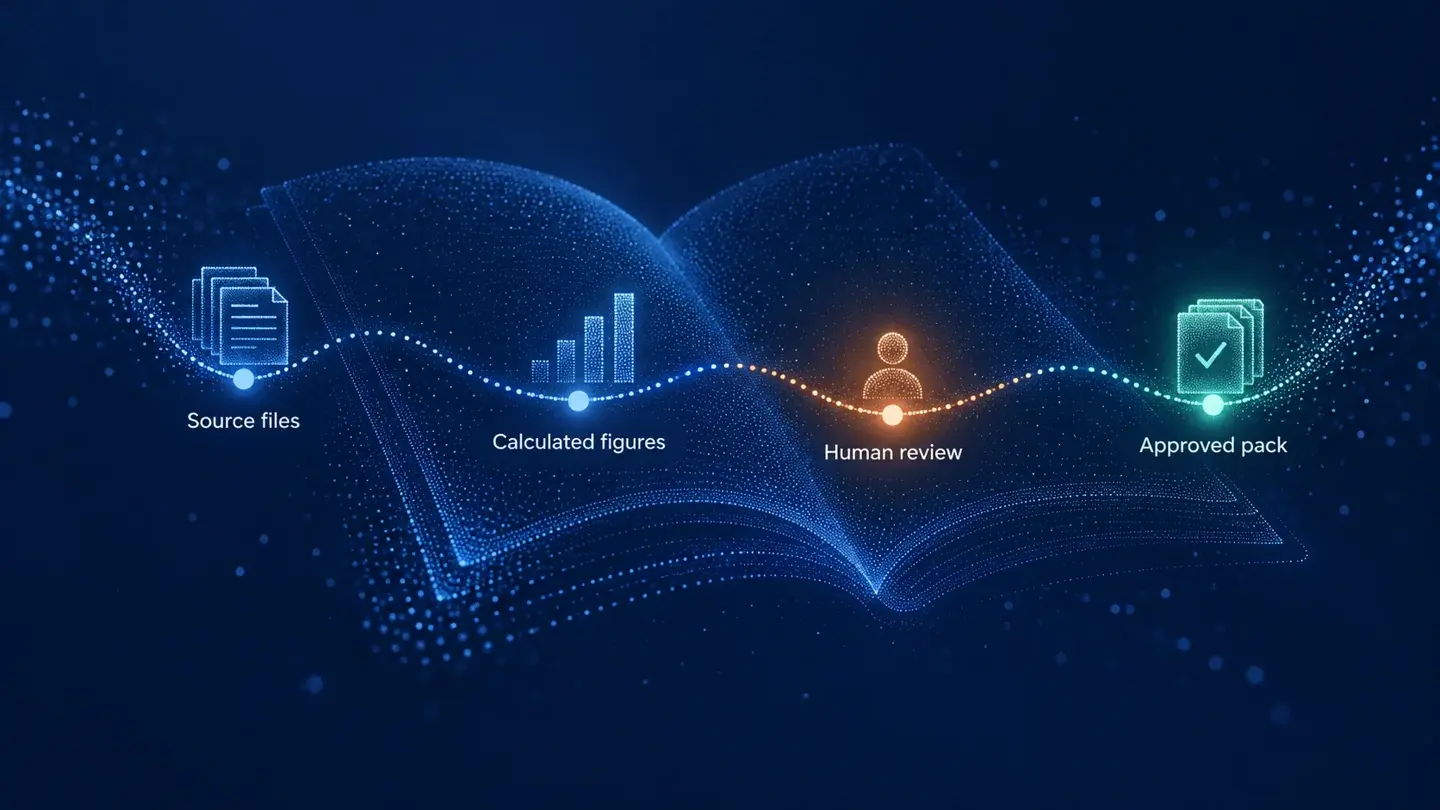
Claude in Excel for the month-end pack: what AI prepares and finance signs

AI meeting notes: the client file workflow for UK firms