AI Consultancy UK: What You Actually Get for Your Money
Gartner predicted at least 30% of generative AI projects would be abandoned after proof of concept by the end of 2025. Here is what a UK AI consultancy should actually hand you, per engagement type, with price bands and the artefacts you keep.
By Ivan Pylypchuk, CEO of Softblues. Has led Claude and Gemini implementations for finance, legal and healthcare teams across the UK and Ireland.
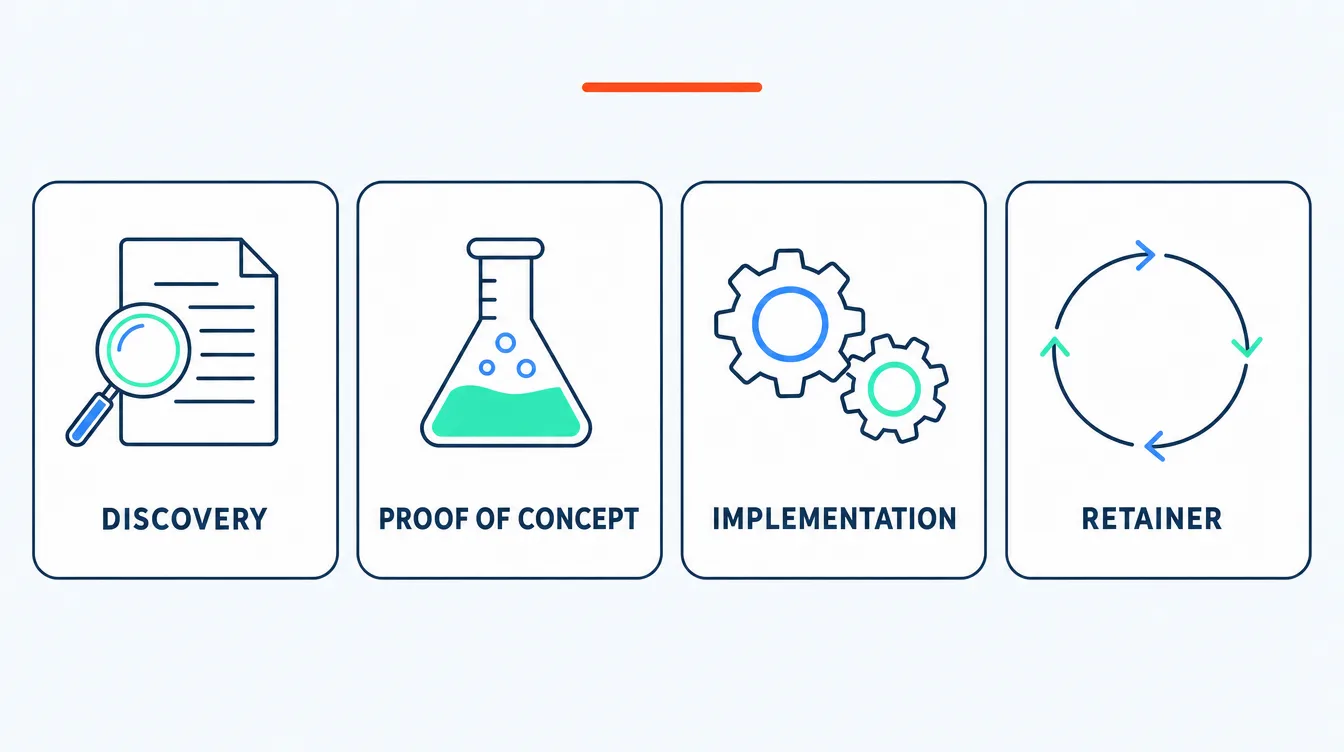
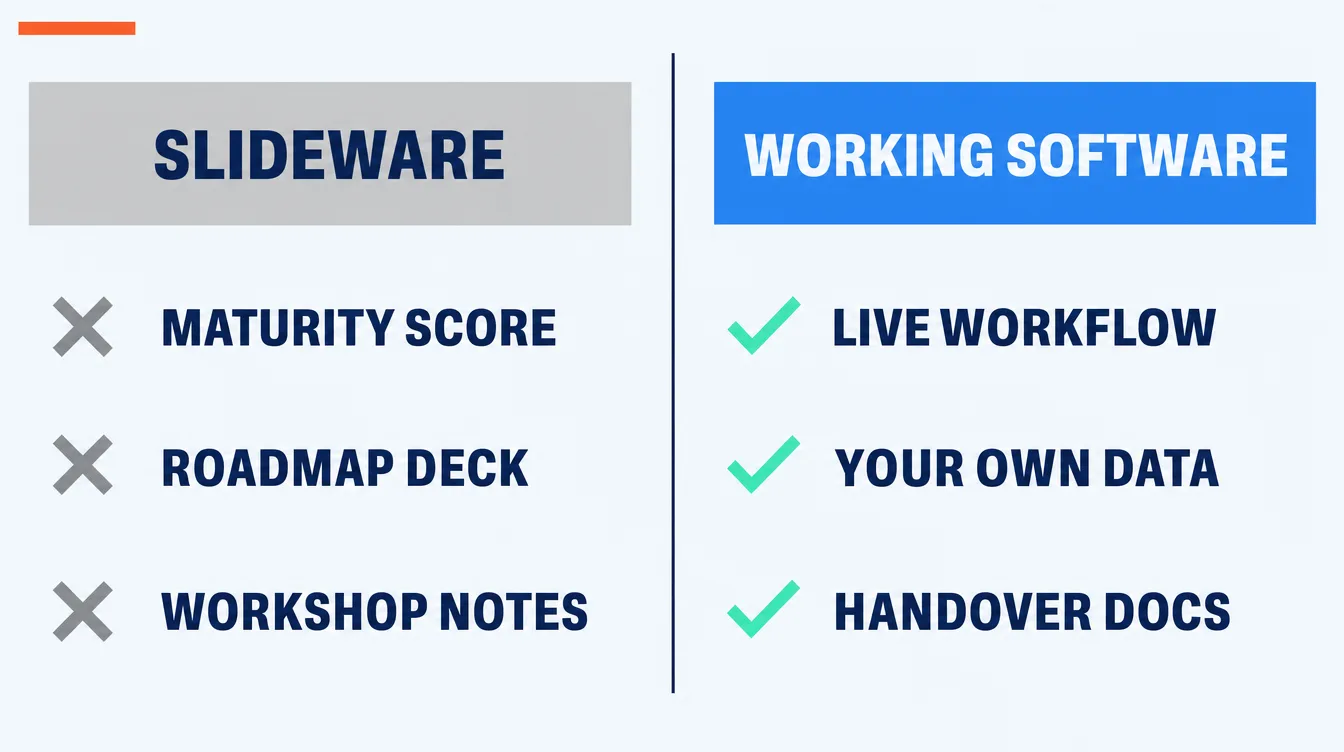
A UK AI consultancy sells one of four things: a fixed-price discovery that ends in a ranked use-case list, a proof of concept that runs one use case on your real data, an implementation that puts a working system into production, or a monthly retainer that keeps it running. What you should get is working software and the documents to own it, not a maturity score.
At Softblues, an AI consultancy working with regulated mid-market companies across the UK and Ireland, we quote most first engagements as a fixed fee against a named deliverable. What buyers get burned on is rarely the rate. It is the vagueness. Gartner predicted that at least 30% of generative AI projects would be abandoned after proof of concept by the end of 2025, citing poor data quality, weak risk controls, escalating costs and unclear business value (Gartner, July 2024). A preliminary study from MIT's Project NANDA put it harder, reporting that around 95% of enterprise generative AI pilots showed no measurable effect on profit and loss. That one is worth treating carefully: it is not peer reviewed and rests on a small interview base (reported August 2025).
Both numbers point at the same thing. A lot of money is being spent on AI work that never becomes something a business can use. So the question worth asking is not what an AI consultancy charges. It is what lands in your hands when the invoice does.
Key facts
Who this is for, and who it isn't
This is for a 50 to 500-person company in the UK or Ireland, often in financial services, legal, healthcare or professional services, that has decided to spend real money on AI and wants to know what a credible engagement actually produces before signing.
It is not for you if you want a weekend prototype, or if you already run an in-house data-science function and need extra hands rather than a partner. In that case you are buying capacity, and a contractor on a day rate is the cheaper route.
What does an AI consultancy in the UK actually deliver?
Four engagement types, four different things in your hands. The table below is the one we work to, with each deliverable stated as an artefact rather than an activity. If a proposal describes activities such as workshops and stakeholder alignment without naming what you keep at the end, that is the gap to close before you sign.
| Engagement | Typical shape | What you keep | Best for | Avoid if |
|---|---|---|---|---|
| Discovery / audit | 2 to 3 weeks, fixed fee | A ranked use-case list, a data-readiness verdict on each candidate, and a fixed-price plan for the first build | Deciding whether and where to start | You already know the use case and have validated the data |
| Proof of concept | About 2 months, fixed fee | One working use case running on your own data, plus technical documentation and a production recommendation | Proving value before a bigger commitment | You need it in production this quarter |
| Implementation | Weeks to months, fixed or capped | A live system, integrated and tested, with handover documentation and a support path | A defined outcome you can sign off | Scope is still exploratory |
| Retainer | Monthly | Ongoing improvement, support, and new use cases on the live system | After the first system is in production | Nothing is live yet |
Two of those four deserve a closer look, because they are where money quietly goes missing.
A discovery should not end in a maturity assessment. A maturity score is a description of your own company, which you already own. A useful discovery ends in a decision: this use case, this data, this build, this price, this payback line. Ours produces the ranked list, a readiness verdict against each candidate, and a fixed-price plan for the one worth building first.
A proof of concept should run on your real data, in your real process, with your real edge cases. A demo on synthetic data proves the model works, which was never in doubt. What is in doubt is whether it works on the invoices your suppliers actually send, and that is the only question a proof of concept is worth paying for.
What should you have in your hands by week 2, and by week 6?
The honest test of an engagement is not the final report. It is what exists early, because the early artefacts tell you whether the team can build.
By the end of week 2 you should have a written scope naming the use case, a data access decision (what you can use, what you cannot, who signed it off), and either a running skeleton of the workflow or a documented reason there is not one yet. You should also know the names of the people doing the work, rather than the names on the pitch team.
By the end of week 6 on a proof of concept you should have the workflow running on your own data, a quality measurement against a sample you agreed in advance, a list of the cases where it fails, and a cost-per-transaction figure. The failure list matters more than the accuracy number. A team that hands you a clean 98% and no failure cases has either not tested hard enough or is not telling you.
If week 6 arrives and the only artefacts are slides, the engagement has drifted into advisory work. That is a fixable conversation, but only if you have it in week 6 rather than week 12.
How much does each engagement type cost?
Price bands with the provenance tagged. Our figures are indicative for August 2026 and quoted as fixed fees rather than open day rates. Market figures are published ranges, and rates move.
| Engagement | Price band | Provenance |
|---|---|---|
| Discovery / audit | £10,000 to £20,000 fixed fee | Our data, indicative August 2026 |
| Proof of concept | From £20,000 fixed fee | Our data, rate card, August 2026 |
| Implementation | Priced per scope. A full twelve-month build scaling to five or six engineers models near £320,000 on our rate card | Our data, August 2026 |
| Implementation, day-rate comparison | 15 to 25 consulting days at mid-tier UK rates of £900 to £1,600 a day is roughly £13,500 to £40,000 | Market calculation, 2026 (source) |
| Retainer, live system | £10,000 to £20,000 a month | Our data, indicative August 2026 |
The spread between a proof of concept and a full implementation is more than an order of magnitude, which is exactly why buying them as one undivided project goes wrong. A fixed fee also moves the overrun risk to the supplier, and that is the most useful commercial term available to a mid-market buyer. We run first engagements as a fixed-price proof of concept with money back if it fails.
For the detail on rates, project totals and what moves a quote, we set the numbers out in AI consulting costs in the UK. If you are further along and comparing suppliers rather than sizing a budget, our honest read on the UK consulting market is the more useful page.
What changes in a regulated sector?
The deliverable list grows, and that is where the extra budget goes. In UK financial services your compliance team will reference the FCA and the Senior Managers and Certification Regime. In legal it is the SRA for England and Wales. In healthcare it is the CQC and the clinical-safety standards DCB0129 and DCB0160, with the MHRA in play if the software might be a medical device. Across all of them sit UK GDPR and the ICO's guidance on AI and data protection. None of this is legal advice, and your compliance team owns the call.
Practically, it means a regulated engagement has to produce evidence as well as output: audit logs, access control, retention design, and a human review step with a record of who approved what. That is engineering, not paperwork, and it is why a finance workflow costs more than an internal marketing helper doing similar work.
A short anonymised example. A food producer had a customer-facing application built quickly with AI coding tools and needed to know whether it was safe to scale. The work that mattered was not new features. It was the audit: finding what was exposed, rebuilding the unsafe parts, and leaving the team with a way of working that would not reintroduce the same problems. You can read how that ran in our audit of an AI-built application. It was an audit and rebuild rather than a long production programme, and we describe it that way.
What are the red flags?
1. No named deliverable. The proposal lists phases and activities but never states the artefact you keep. Ask for the noun.
2. A day rate with no day estimate. A rate without a number of days is not a price. Ask for the blended rate and the estimated days, then multiply.
3. The pitch team is not the delivery team. Ask who writes the code, what else they are on, and whether you can meet them before signing.
4. Synthetic-data demos only. If nobody will touch your data during a proof of concept, the proof of concept is a demo.
5. No failure list. A team that cannot tell you where their system breaks has not looked hard enough.
6. Lock-in framed as architecture. Ask what it would take to change the underlying model in twelve months. A good answer is dull and specific.
7. Change management left out. Getting people to use the system is usually harder than building it. If training and rollout are missing from the plan, the plan is incomplete.
Questions to ask on the call, and what a good answer sounds like
"What exactly will I own at the end?" A good answer lists files and systems: the running workflow, the prompts and configuration, the evaluation results, the handover documentation, and the repository. A weak answer describes a journey.
"Whose data will the proof of concept run on?" A good answer is yours, with a named access process and a data-protection step. A weak answer is a sample dataset.
"What have you put into production, and what broke?" A good answer includes something that went wrong and what changed because of it. Nobody has a clean record. We published our own build of Claude across the company as a worked case study partly for that reason.
"How is this priced, and who carries an overrun?" A good answer is a fixed fee or a cap with a named change-control process.
"What happens if it does not work?" A good answer has a defined exit. Ours is money back if the proof of concept fails.
Frequently asked questions
What is the difference between an AI consultancy and an AI development company?
A consultancy is generally paid to decide what to build and whether it is worth building. A development company is paid to build it. Plenty of firms do both, and we deliberately do, because a recommendation nobody can implement is not worth much. Ask which side of that line a supplier's revenue actually comes from.
Do I need a discovery phase if I already know what I want to build?
Not always. If you have a specific use case, know where the data lives, and have a stakeholder who owns the process, you can usually go straight to a proof of concept. Discovery earns its fee when there are several candidate use cases and no agreement on which one matters.
How long before an AI project pays for itself?
It depends on what the process costs you today, which is why a credible plan states a payback line rather than a percentage improvement. Ask for the calculation: hours saved or errors avoided, multiplied by a rate you recognise, set against the build and running cost.
Is a UK-based consultancy worth paying more for?
For regulated work, often yes, because the value sits in the evidence trail and in someone who already knows which regulator asks what. For a straightforward internal automation with no compliance load, geography matters much less than whether the team has shipped something similar.
What should a monthly retainer include?
A named engineer or a defined share of one, an agreed response time, ongoing evaluation of the live system, and a budget for improvements. If a retainer includes no measurement of whether the system is still performing, it is a support contract rather than an improvement one.
Can we start with automation rather than a full AI build?
Usually the better order, yes. One well-chosen process, automated end to end and measured, teaches you more than a broad programme. That is the shape of most of our business process automation work.
We are registered partners with Anthropic, Google Cloud and Microsoft, and we build with the tools we sell, including running six of our own departments on Claude. We use it before we sell it. Systems go into production at a fixed price, with money back if the proof of concept fails.
If you want a view on which of the four engagement types fits your situation, and an honest answer if the answer is none of them yet, book a discovery call.
Work out your numbers
Your whole firm
AI ROI calculator
Five questions about your firm. See the time AI frees up, what it is worth and when it pays for itself.
Work out your numbersOne key process
Process automation ROI calculator
Five questions about one process. See the hours an AI agent frees up, what they are worth and how much becomes profit.
Work out your numbers
Free. No sign-up. Your answers stay in your browser.
See it in production
Systems we have built and run for clients, with the numbers that came out of them.
Related Articles

OpenAI DevDay 2026: my first impressions for business

Claude Cowork vs Copilot Cowork vs ChatGPT Work: practical tasks, prices and how to choose