AI Consulting Costs in the UK: Day Rates, Project Fees and Realistic Budgets for 2026
UK AI consulting runs from about £500 to £5,000 a day depending on who does the work and how it is priced. An honest 2026 breakdown of day rates, project fees, engagement models and the cost drivers that move the bill.

By Ivan Pylypchuk (opens in a new tab), CEO of Softblues. Has led Claude and Gemini implementations for finance, legal and healthcare teams across the UK and Ireland.
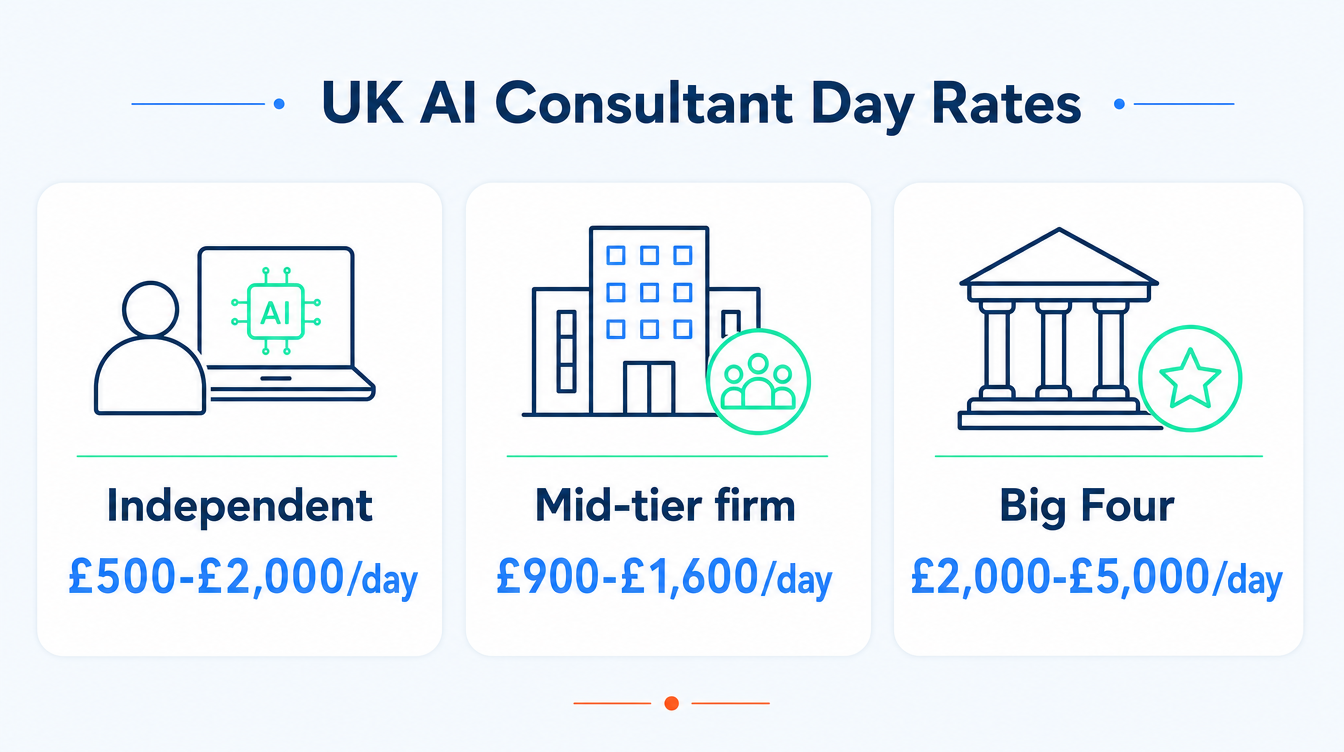
UK AI consulting is priced across a wide band: independent consultants run roughly £500 to £2,000 a day, mid-tier firms £900 to £1,600, and the large management consultancies £2,000 to £5,000 a day with minimum project fees from £100,000 (UK AI consulting pricing guides, 2026). What you actually pay depends on the engagement model, the seniority of the people doing the work, and whether the price is fixed or open-ended.
At Softblues, an AI consulting firm working with regulated mid-market companies across the UK and Ireland, we price most first engagements as a fixed-fee piece of work rather than an open day rate, so the budget is known before anyone starts.
Key facts
- Independent AI consultants: roughly £500–£2,000 per day in the UK (market, 2026); London independents cluster around £700–£1,200.
- Mid-tier consultancies: about £900–£1,600 per day (market, 2026).
- Big Four and large management firms: £2,000–£5,000 per day, with minimum project fees often from £100,000 (market, 2026).
- Engagement models vary the total far more than the day rate: a fixed-price discovery, a proof of concept, a build project, or a monthly retainer all carry different risk for the buyer.
- The cost drivers are predictable: scope, data readiness, integration count, compliance load, and how much change-management the team needs.
- A fixed-price, outcome-linked engagement removes the open-ended-day-rate risk that catches most first-time buyers.
Who this is for, and who it isn't
This is for a 50-to-500-person UK or Ireland company, often in finance, legal, healthcare or professional services, scoping its first or second paid AI engagement and trying to set a realistic budget before talking to vendors. If you are a solo founder wanting a weekend prototype, or you already run an in-house ML team and just need extra hands, the figures below will read high for what you need, and an hourly contractor is probably the better route.
Why is AI consulting priced so differently from other IT work?
Because most of the cost is people, and the people vary enormously. A junior analyst writing prompts and a senior architect designing a compliant, integrated system are both called "AI consultants", and their day rates differ by a factor of five or more. On top of that, the work itself ranges from a two-day audit to a multi-month build, so a single day rate tells you almost nothing about the final bill.
The honest way to read any quote is to separate three things: the day rate (who is doing the work), the number of days (how big the job is), and the commercial model (who carries the risk if it runs over). Most disappointing engagements go wrong on the third point, not the first.
What do UK AI consultants and firms actually charge in 2026?
The table below sets out the published market bands. These are market figures from UK AI-consulting pricing guides, not Softblues prices, and rates move, so treat them as indicative for 2026.
| Provider type | Day rate (market, 2026) | Best for | Avoid if |
|---|---|---|---|
| Independent / freelance consultant | £500–£2,000 | A focused audit, a second opinion, or a single specialist skill | You need a delivery team and ongoing accountability |
| Boutique specialist firm | £1,200–£2,500 | Deep domain or sector expertise on a defined build | Your budget is tight and the scope is exploratory |
| Mid-tier consultancy | £900–£1,600 | A full build with a small team and a named owner | You only need a few days of advice |
| Big Four / large management firm | £2,000–£5,000 (min projects from £100,000) | Board-level change programmes and procurement cover | You are mid-market and want hands-on delivery, not slideware |
Market ranges, 2026 (source).
A worked example makes the totals concrete. A typical mid-market first build, say a document-processing workflow with two integrations, lands around fifteen to twenty-five consulting days. At a mid-tier rate of £900–£1,600 a day that is roughly £13,500 to £40,000 for the delivery work (a calculation from the market day rates above, not a quoted Softblues price). The same scope bought from a large firm at £2,500–£5,000 a day would clear £100,000 quickly, which is why most mid-market teams do not buy AI work from the Big Four.
Which engagement model should you choose, and what does each cost?
The day rate sets the unit price. The engagement model decides who carries the risk and how predictable your budget is.
Most engagements should start with the first row rather than the third. Ours is a generative AI consulting assessment: two to three weeks, fixed price, ending in a ranked use-case list, a data readiness verdict on each candidate, and a fixed-price plan with a payback line for the one worth building first.
| Model | Typical shape | What you pay for | Best for |
|---|---|---|---|
| Discovery / audit | 2–10 days, fixed price | A scoped plan, a risk view, a build/buy recommendation | Deciding whether and how to proceed |
| Proof of concept | A few weeks, fixed price | One working use case on your real data | Proving value before a larger commitment |
| Build / implementation project | Weeks to a few months, fixed or capped | A working system in production, integrated and tested | A defined outcome you can sign off |
| Monthly retainer | Ongoing, monthly fee | Continuous improvement, support, new use cases | After the first system is live |
We start with a paid discovery and put the timeline and the price in the proposal before any build starts, precisely because it removes the open-ended-day-rate risk that worries first-time buyers. You can see how a costed support case stacks up in our piece on what AI strategy consulting should get you for your money, and how integration scope drives cost in AI integration services.
What actually drives the price up or down?
Five things move an AI quote more than anything else:
1. Scope clarity. A tightly defined single use case is cheap to quote and quick to build. "Help us with AI" is neither, and the uncertainty gets priced in.
2. Data readiness. If your data is clean, accessible and in known systems (Xero, Sage, SharePoint, a CRM), build time drops. If it is scattered across inboxes and spreadsheets, the first chunk of the budget goes on getting it usable.
3. Integration count. One integration is a feature. Five integrations is a project. Each connected system adds testing, error handling and security review.
4. Compliance load. A regulated workflow needs evidence, audit trails and human-in-the-loop review, which is real engineering, not paperwork. A finance or healthcare build costs more than an internal marketing helper for this reason.
5. Change management. Getting people to actually use the system is often the hardest part. Training, documentation and a rollout plan are where many cheap projects quietly fail.
How does AI consulting cost differ in regulated sectors?
Regulated work carries an extra layer of cost because the system has to be defensible, not just functional. In UK financial services your compliance team will reference the FCA and the Senior Managers and Certification Regime; in legal, the SRA for England and Wales; in healthcare, the CQC and the clinical-safety standards DCB0129 and DCB0160; and across all of them, UK GDPR and the ICO. None of that is legal advice, but it tells you where the budget goes: audit logging, access control, data-retention design and human review.
A short anonymised example. A financial-advice firm needed a monthly file-review check across hundreds of client files. The expensive part was not the model, it was building the evidence trail a reviewer and the regulator would accept. You can read how we approached that in our financial-advice compliance file-review case study. It was a discovery and proposal engagement, not a live deployment, so treat it as an illustration of the work involved rather than a claimed production result.
What are the red flags in an AI consulting quote?
- A project total with no day rate or day count behind it. You cannot tell if you are buying senior time or a large pile of junior days.
- An open-ended day rate with no cap and no fixed milestones. This is where budgets run away.
- No mention of data, integration or compliance in the scope, on a regulated workflow.
- Outcome language with no definition of done. "We'll transform your operations" is not a deliverable.
- No honest comparison. A partner who says AI is right for every problem is selling, not advising.
What questions should you ask on the call, and what does a good answer sound like?
1. What is your blended day rate and how many days is this? A good answer is two clear numbers and a short explanation of the mix of seniority.
2. Is this fixed price or time-and-materials? A good answer commits to a fixed price or a capped budget with named milestones, not an open meter.
3. What happens if it doesn't work? A good answer describes a guarantee, a staged exit, or at least a clear point where you can stop without paying for the rest.
4. Who actually does the work? A good answer names the people and their seniority, rather than promising a "team" you never meet.
5. Show me a comparable build. A good answer points to a real, relevant case and is honest about what was a proof of concept versus a live system.
Frequently asked questions
How much does AI consulting cost in the UK in 2026?
Day rates run roughly £500–£2,000 for independents, £900–£1,600 for mid-tier firms, and £2,000–£5,000 for large management consultancies, with the latter often setting minimum project fees from £100,000 (market figures, 2026). A defined mid-market build is more often quoted as a fixed price than a pure day rate.
Is a fixed price better than a day rate?
For a first engagement with a defined outcome, usually yes. A fixed price moves the overrun risk to the supplier and makes your budget predictable. A day rate suits open-ended advisory work where the scope genuinely cannot be pinned down yet.
Why are Big Four AI day rates so much higher?
You are paying for scale, brand cover for procurement, and board-level change programmes. For a hands-on mid-market build, that overhead rarely pays for itself, which is why most 50-to-500-person firms use independents, boutiques or mid-tier consultancies.
What is a realistic budget for a first AI project?
A scoped proof of concept on one use case is the lowest-risk way in, and it lets you prove value before committing to a larger build. Using the market day rates above, a focused first build of fifteen to twenty-five days lands roughly in the low tens of thousands of pounds, depending on integration and compliance load.
What makes an AI project cost more than expected?
Unclear scope, messy data, multiple integrations, compliance requirements and weak adoption. The model itself is rarely the expensive part. Pinning the scope and the commercial model before signing is the single best way to control cost.
Do these prices include ongoing support?
Usually not. Build and run are separate. Many firms move to a monthly retainer once the first system is live, covering support, monitoring and new use cases. Ask whether support is in the project price or billed separately.
Softblues is an OpenAI Select Partner, Certified in the Claude Partner Network, a Google Cloud partner at Services Select tier, and a member of the Microsoft AI Cloud Partner Program. We work as practitioners, not slide-writers: every build starts with a paid discovery and a proposal that sets the timeline and the price, so you know the budget and the outcome before we start. If you are setting a budget for an AI project and want an honest scoping conversation, book a discovery call. It also helps to read how to choose an AI consulting firm in the UK before you compare quotes. For the firms themselves, see our comparison of the best AI consulting companies in the UK.
Work out your numbers
Your whole firm
AI ROI calculator
Five questions about your firm. See the time AI frees up, what it is worth and when it pays for itself.
Work out your numbersOne key process
Process automation ROI calculator
Five questions about one process. See the hours an AI agent frees up, what they are worth and how much becomes profit.
Work out your numbers
Free. No sign-up. Your answers stay in your browser.
See it in production
Systems we have built and run for clients, with the numbers that came out of them.
Related Articles

Claude vs ChatGPT vs Copilot: what does an AI agent task really cost?
MCP server access: Claude, ChatGPT and Copilot in Microsoft 365