AI Strategy Consulting: What You Should Get for Your Money
AI strategy consulting should end in decisions you can fund, not a slide deck. Here is exactly what you should get for your money: the artefacts, the week-by-week timeline, and an ROI framework.

By Ivan Pylypchuk (opens in a new tab), CEO of Softblues. Has led Claude and Gemini implementations for finance, legal and healthcare teams across the UK and Ireland.
AI strategy consulting should leave you with decisions you can act on, not a slide deck. For your money you should get a prioritised list of use cases, a build-or-buy call on each, a costed roadmap with named owners, a data and governance plan, and a way to measure return. If a firm cannot hand you those artefacts, you are paying for talk. Here is what our AI strategy consulting produces.
At Softblues, an AI consulting firm working with regulated mid-market companies across the UK and Ireland, we run strategy as the first 2 to 4 weeks of putting Claude into production, not as a standalone report. The test of good AI strategy work is simple: a month later, can your team point to a use case that is live, or scheduled to go live, because of it?
Key facts
- A strategy engagement should produce concrete artefacts: a scored use-case shortlist, a build-vs-buy decision per use case, a costed roadmap, a data and access plan, and an ROI model. Ask to see a sample set before you sign.
- Typical length for a mid-market scoping engagement is 2 to 4 weeks (our data, indicative, June 2026).
- Indicative UK pricing runs from a few thousand pounds for a fixed-scope assessment to mid five figures for a full strategy plus first build (our data, indicative, June 2026).
- Most AI spend fails on execution, not ideas. Strategy work earns its fee by turning a shortlist into a sequenced, owned plan that ships, not a report that sits in a drawer.
- Strategy is worth paying for only if it ends in a decision and an owner. A report with no roadmap is the most common way to waste the budget.
Who this is for, and who it isn't. This is for a 50 to 500-person UK or Ireland firm, often in finance, legal, healthcare or professional services, choosing where to spend its first serious AI budget and wanting proof before it commits. It is not for a solo founder after a weekend prototype, or for a team that has already picked its use case and just needs it built. If you are in the second group, skip the strategy step and go straight to scoping the build.
What AI strategy consulting actually is, and what it should not cost you
AI strategy consulting is the work of deciding where AI earns its place in your business and how you will get it there safely. Done well, it is short, specific and ends in a plan you can fund. Done badly, it is a generic maturity assessment that could have been written about any company in your sector.
The phrase covers a wide range. At one end, a fixed-scope assessment looks at three or four candidate use cases and tells you which to back. At the other, a full programme covers a company-wide AI strategy, a governance framework, and the first build. The price gap between those is large, so the first thing to pin down is which one you are buying.
What you should walk away with: the artefacts
This is the heart of what you are paying for. A strategy engagement should hand you a defined set of artefacts, each of which a member of your team owns afterwards. Ask for these by name.
1. A scored use-case shortlist. Every candidate use case ranked on value, effort, data readiness and risk, with a clear recommendation to do it now, do it later, or drop it. Not a wish list. A ranked list with reasons.
2. A build-or-buy decision for each use case. For every use case you keep, a recommendation on whether to buy an off-the-shelf tool, configure a platform like Claude Enterprise, or build something custom, with the reasoning shown. A good firm will tell you when buying beats building, even though building pays them more.
3. A costed roadmap with owners and sequence. What gets built first, what depends on what, who owns each step, and a realistic cost and time for each. This is the artefact that turns strategy into a budget line.
4. A data and access plan. Where the data lives, what needs cleaning or connecting, who is allowed to see what, and how the AI will reach your systems (Xero, Sage, SharePoint, your CRM) without breaking your access rules.
5. A governance and risk note. How you will keep the work compliant: which regulator applies, what your compliance team needs to sign off, how you will log and review model outputs. For regulated firms this is not optional.
6. An ROI model you can re-run. A spreadsheet, not a paragraph, that shows the assumptions behind the savings or revenue, so your finance team can stress-test it and you can measure against it later.
What a good engagement looks like, week by week
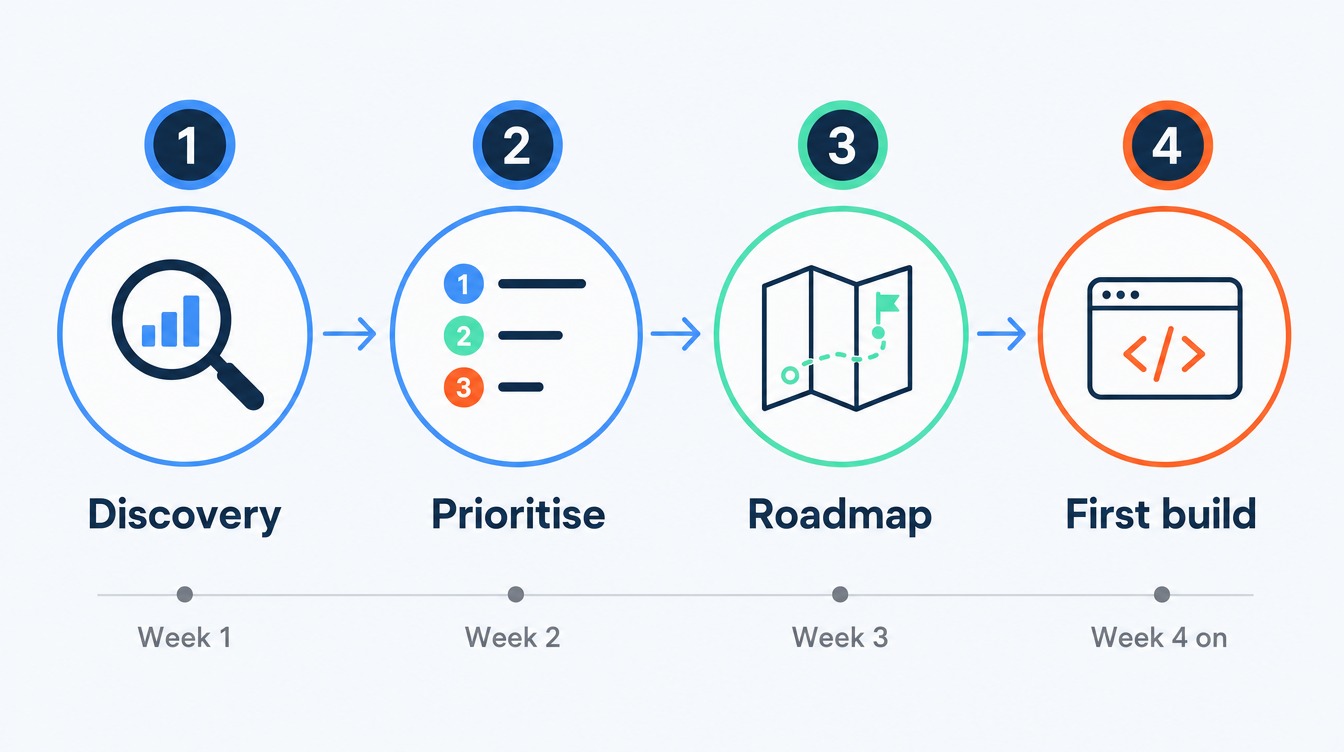
A mid-market strategy engagement should be measured in weeks, not months. Here is the shape we use, which you can hold any firm's proposal against.
| Phase | Timing | What happens | What you get |
|---|---|---|---|
| Discovery | Week 1 | Interviews with the people who do the work; review of systems, data and current tooling | Use-case longlist, data and access map |
| Prioritisation | Week 2 | Score and rank use cases on value, effort, data readiness and risk; build-vs-buy call on each | Scored shortlist, build-or-buy decisions |
| Roadmap | Week 3 | Sequence the work, cost it, name owners, write the governance and ROI model | Costed roadmap, ROI model, governance note |
| First build (optional) | Week 4 onward | Start the highest-value use case under the agreed plan | A working first use case, or a funded build plan |
(Timing is our data, indicative, June 2026.)
If a firm proposes a three-month strategy phase with no build at the end, ask what takes three months. For most mid-market companies, the value is in moving quickly to a small, real build that proves the case.
How AI strategy consulting is priced in the UK
Pricing varies with scope, sector risk and whether a build is included. The bands below are indicative ranges from our own UK engagements, not a published benchmark, so treat them as a guide and ask any firm to map its proposal onto something like this.
| Engagement | Indicative price (our data) | Best for | Avoid if |
|---|---|---|---|
| Fixed-scope AI assessment | Low single-figure thousands | A first look at 3 to 4 use cases before committing budget | You already know your use case and want it built |
| Full strategy and roadmap | Five figures, lower end | A company-wide plan with governance and a costed roadmap | You only need one use case scoped |
| Strategy plus first build | Five figures, higher end | Proving the case with a live use case, on a timeline set in the proposal | You have no internal owner to carry it forward |
| Day-rate advisory | A day rate, retained | Ongoing steer for a team doing the build itself | You need artefacts and accountability, not just advice |
(Indicative GBP ranges from our own UK engagements, June 2026. Ask any firm to show its own bands.)
How to measure the return
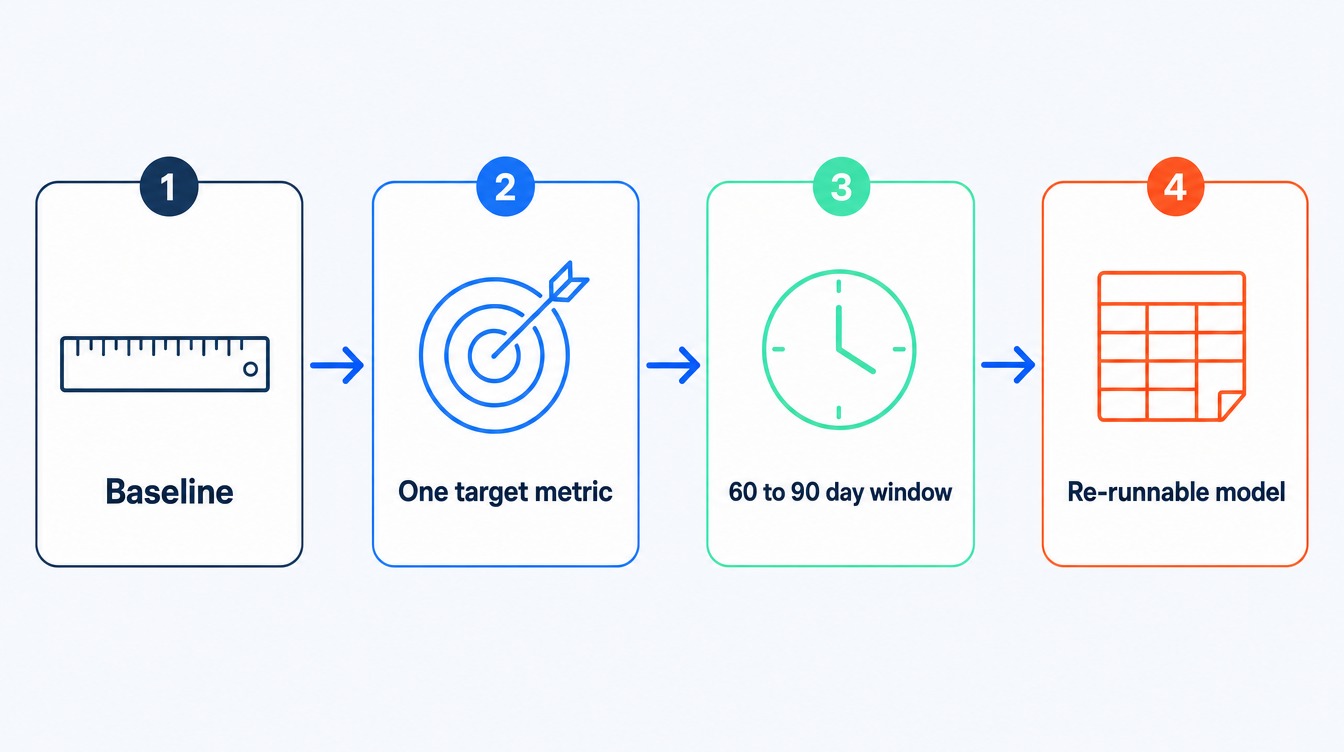
The reason most AI budgets get cut is that nobody agreed up front how they would measure success. Fix that during strategy, not after. A workable ROI framework has four parts.
1. A baseline. Measure the current cost or time of the process before anything changes: hours per month, cost per case, error rate, turnaround time. Without a baseline, any later claim of improvement is a guess.
2. A target tied to one number. Pick the single metric that matters most for each use case, for example hours saved per month in finance, or first-response time in support, and set a target against the baseline.
3. A measurement window. Decide how long you will run before you judge it, usually 60 to 90 days of real use, and who reads the result.
4. A re-runnable model. Keep the ROI model as a live spreadsheet your finance team owns, so the actual numbers replace the assumptions as they come in. This is what turns a hopeful business case into a defensible one.
For a worked view of how use cases reach production once the strategy is set, see our piece on enterprise AI agents that actually ship.
Before a strategy engagement, you can work out what AI gives your whole firm on your own in five questions.
What it looks like in a regulated sector
In regulated firms the strategy step carries more weight, because the governance note is not paperwork, it is the thing that lets the project go ahead at all.
Take a UK accountancy practice scoping AI for client document handling. The strategy work would name the regulator and framework that apply (for financial services that means the FCA and the Senior Managers and Certification Regime), set out how client data is segregated and who can see what, and decide which steps a human must always approve. In a worked example from this kind of engagement, the shortlist cut six candidate ideas to two: automated invoice coding and a first-draft client query assistant, both with a human sign-off step. The roadmap costed the first at a few weeks of build, with a target of cutting coding time by roughly half over a 90-day window (illustrative, our data). The point is not the exact figure, it is that the firm could take the plan to its compliance lead and get a yes.
For legal teams the equivalent regulator is the SRA in England and Wales; for healthcare it is the CQC in England plus the clinical-safety standards DCB0129 and DCB0160. A strategy firm working in your sector should name these without being prompted. If they cannot, they have not worked in it.
Red flags in an AI strategy proposal
- No artefacts named. The proposal promises insight and transformation but never lists what you will physically receive. If you cannot tell what lands on your desk, neither can they.
- No build-vs-buy honesty. Every recommendation happens to be a custom build sold by the same firm. A strategy partner who never says "just buy the tool" is selling, not advising.
- No regulator named for a regulated brief. Generic governance language with no mention of the FCA, SRA, CQC or ICO means they have not done this in your world.
- No baseline, no ROI model. Success is described in adjectives, not numbers. You will never be able to prove the spend worked.
- A long strategy phase with no build. Three months of analysis before anything real ships. The mid-market value is in moving fast to a small, proven use case.
Questions to ask on the call, and what a good answer sounds like
"Can I see a sample of each artefact you'll deliver?" A good answer is yes, with anonymised examples to hand. A weak answer describes the artefacts in the abstract.
"When have you said buy instead of build?" A good answer names a real case where they steered a client away from custom work. A weak answer cannot think of one.
"Who owns each artefact in my team afterwards?" A good answer assigns owners during the engagement so the work does not die when they leave. A weak answer leaves it with them, which means a retainer.
"Which regulator and framework apply to this use case?" A good answer is specific to your sector. A weak answer is "we'll bring in compliance later".
"How will we know in 90 days whether it worked?" A good answer points to the baseline and the single metric. A weak answer talks about momentum and adoption.
For the wider set of checks when comparing firms, see our 12-point buyer's checklist for choosing an AI consulting firm in the UK, and for what happens once the plan is approved, how AI integration connects to the systems you already run.
Frequently asked questions
What is AI strategy consulting?
It is the work of deciding where AI will pay off in your business and how to get it into production safely. A good engagement is short and specific, and it ends with a scored use-case shortlist, a costed roadmap, a data and governance plan, and an ROI model, not just a report.How much does AI strategy consulting cost in the UK?
It depends on scope. A fixed-scope assessment of a few use cases sits in the low thousands, a full strategy and roadmap runs into five figures at the lower end, and strategy plus a first build sits higher (indicative, our data, June 2026). Ask any firm to map its quote onto bands like these.How long should a strategy engagement take?
For a mid-market company, 2 to 4 weeks is usual: roughly a week of discovery, a week to prioritise and decide build-vs-buy, and a week to write the costed roadmap, with the first build starting after. A three-month strategy phase with nothing built at the end is a warning sign.What is the difference between AI strategy and AI implementation?
Strategy decides what to build, in what order, and how to measure it. Implementation is the build itself. The best engagements connect the two, so the strategy ends with the first use case either live or scheduled, rather than handing you a plan and walking away.Should we hire a consultant or build the strategy in-house?
If you have an internal owner who understands both the business and the technology, in-house can work, with day-rate advisory to steer it. If you do not, or you need the work done in weeks rather than quarters, an outside firm that delivers the artefacts and names owners is usually faster and safer.How do we measure the ROI of an AI project?
Set a baseline before anything changes, pick one metric per use case, agree a 60 to 90-day measurement window, and keep the ROI model as a live spreadsheet your finance team owns. Replace the assumptions with real numbers as they arrive.Do you offer AI strategy consulting for regulated firms?
Yes. We work with finance, legal and healthcare teams in the UK and Ireland, and the strategy step names the regulator and framework that apply, sets out data segregation and human sign-off, and produces a governance note your compliance lead can approve.We put Claude into production after a paid discovery, with the timeline and the price in the proposal before any build starts. As a firm Certified in the Claude Partner Network, we run strategy as the first step of that, not as a separate report, so the plan you pay for ends in something working. If you want to see what your first AI use case would be and what it would cost, book a discovery call.
Work out your numbers
Your whole firm
AI ROI calculator
Five questions about your firm. See the time AI frees up, what it is worth and when it pays for itself.
Work out your numbersOne key process
Process automation ROI calculator
Five questions about one process. See the hours an AI agent frees up, what they are worth and how much becomes profit.
Work out your numbers
Free. No sign-up. Your answers stay in your browser.
See it in production
Systems we have built and run for clients, with the numbers that came out of them.
Related Articles
MCP server access: Claude, ChatGPT and Copilot in Microsoft 365
AI governance framework: a UK employee policy template