Boutique AI Consultancy vs Big 4: An Honest Comparison
Small consulting firms took just 3% of the UK's £21.8bn market in 2025. We are one of them. Here is the honest comparison of cost, team, speed and accountability, including the four situations where a Big 4 firm is the better buy.
By Ivan Pylypchuk, CEO of Softblues. Has led Claude and Gemini implementations for finance, legal and healthcare teams across the UK and Ireland.
A boutique AI consultancy suits companies that want a small senior team building a working system in weeks, at a lower cost. A Big 4 firm suits multi-country regulated programmes, board-level assurance and org-wide change, where scale and an independent name matter more than speed. Most UK mid-market firms need the first.
Here is the number that frames the comparison. In 2025, small consulting firms took 3% of the UK's £21.8bn consulting market, while large firms took 77% (MCA Annual Industry Report 2026, via Consultancy.uk, July 2026). So when a boutique argues its own case, it argues from the small end of the market.
At Softblues, an AI consulting firm working with regulated mid-market companies across the UK and Ireland, we sit in that 3%. So read what follows as a boutique AI consultancy vs Big 4 comparison written from the boutique side. Judge it accordingly, and read the section where we say a Big 4 firm is the better buy.
Key facts
Who this is for, and who it isn't
This is for a 50 to 500-person UK or Ireland company, often regulated, choosing its first serious AI partner. You have a budget in the tens of thousands, an executive sponsor, and a real process you want fixed.
Skip it if you are running a multi-country programme with hundreds of internal stakeholders, or if the board has already decided it needs an independent name on the report. In both cases a Big 4 firm is a reasonable answer, and we say why below.
Why is boutique AI consultancy vs Big 4 not a normal procurement decision?
Because you are not comparing two versions of the same thing. With a Big 4 firm you buy an institution: a methodology, a brand the board recognises, a bench deep enough to survive people leaving, and indemnity that means something. With a boutique you buy a specific small group of engineers, and their availability is the product.
The difference shows up in month one. A Big 4 engagement usually starts with an assessment phase that produces a document. A boutique engagement of the same value usually starts with someone reading your actual data and shipping something small that runs. Neither is wrong. They answer different questions, and the mistake is buying an institution when you needed working software.
What does each actually cost, and how big is the gap?
Roughly one order of magnitude for the same scope. A Big 4 assessment of an AI opportunity commonly lands in the low-to-mid six figures. A boutique discovery covering the same ground lands in the tens of thousands. That is not a discount. It is a different cost base: pyramid staffing, global overhead, risk pricing, and a sales cycle someone has to pay for.
| What you are buying | Boutique AI consultancy | Big 4 / global firm |
|---|---|---|
| Discovery or assessment | £10,000 to £20,000 (our data, Aug 2026) | Low to mid six figures (market, indicative) |
| Senior day rate | £700 to £2,500 (market, London specialist) | £3,500 to £6,000 partner (market, indicative) |
| Junior day rate | Rarely billed separately | £800 to £1,500 (market, indicative) |
| Implementation | £10,000 to £20,000 a month (our data) | Fixed-fee programme, often seven figures |
| Commercial model | Fixed price per phase, money back if the PoC fails | Time and materials, or fixed fee with change control |
| Best for | One or two processes, taken to production fast | Multi-country programmes, board assurance, org-wide change |
| Avoid if | You need 200 consultants or a global rollout | Your whole AI budget is under £250,000 |
Two caveats on that table. Our figures are our own published bands and trace to our rate card, not to a market benchmark. The Big 4 figures are third-party published ranges that vary enormously by workstream, so read them as magnitude rather than quotes. The bigger cost driver is neither: data preparation and infrastructure regularly add 40% to 60% on top of any consultant fee, whoever you hire. We broke that down in AI consultant day rates in the UK.
Before you shortlist anyone, get the scope straight. A 30-minute discovery call with us covers which of your processes is worth automating first, what it would cost in our bands, and where we think you should not spend. You leave with a shortlist you can take to any supplier, including a Big 4 firm. Book a discovery call.
Who will actually do the work: the team you meet, or the team you get?
This decides most engagements, and it is rarely asked directly.
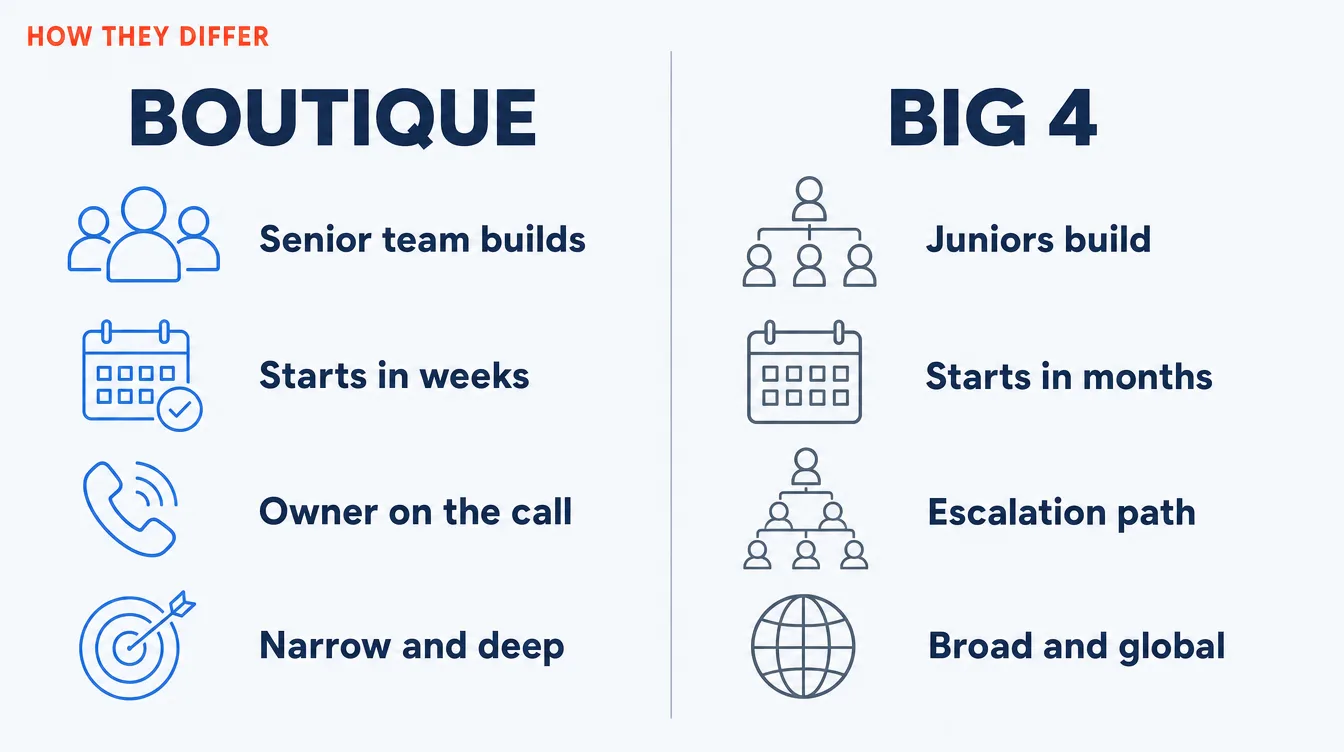
At a Big 4 firm the people in the pitch are usually a partner and a director. The people writing code are usually two to four years into their career, working to a methodology, rotating between accounts. That model exists for a reason: it is how you staff a 200-person programme and keep quality consistent. It also means the expertise you assessed in the room supervises rather than builds.
At a boutique the people in the pitch normally are the delivery team. We have 30-plus AI architects on our bench, and whoever scopes your work is one of the people who builds it. The trade is real: fewer people, so a lower ceiling, and genuine key-person risk if one of them leaves mid-project.
Ask both sides for named CVs of the people who will be on the build, with their last two shipped projects, and put the names in the contract. A firm that will not do that is telling you something.
How fast does each one move?
Weeks against quarters, and mostly because of process weight rather than talent. A boutique can start in one to three weeks because two people make the decision to start. A Big 4 engagement carries procurement, independence checks, resourcing from a shared pool and internal risk review. Those are the same controls that make it safe for a regulated programme.
| Phase | Boutique (our data, Aug 2026) | Big 4 / global firm (market, indicative) |
|---|---|---|
| Contract to kick-off | 1 to 3 weeks | 6 to 12 weeks |
| Discovery | 2 to 4 weeks | 8 to 12 weeks |
| First working system in users' hands | Weeks 4 to 8 | Month 6 onward |
| Production, governed | Within 90 days | Month 9 to 18 |
If your problem is urgent, that timeline gap matters more than the price gap. If your problem is a three-year operating-model change, it does not.
Where does accountability really sit?
Both models have teeth, in different places. A Big 4 firm gives you professional indemnity cover in the tens of millions, a formal escalation path, and a partner whose reputation is exposed. If the programme fails there is an institution to hold to account, and it will still exist in five years.
A boutique gives you a shorter route to the person who can fix it. Our version is commercial: fixed price per phase, money back if the proof of concept fails. That is a real transfer of risk, capped at the size of our business, which is the honest limit of it.
So ask what kind of failure you are insuring against. A large programme going wrong in a way that needs a balance sheet behind it argues for Big 4 cover. Six months spent on a document that never becomes software argues the other way.
When is a Big 4 firm genuinely the right call?
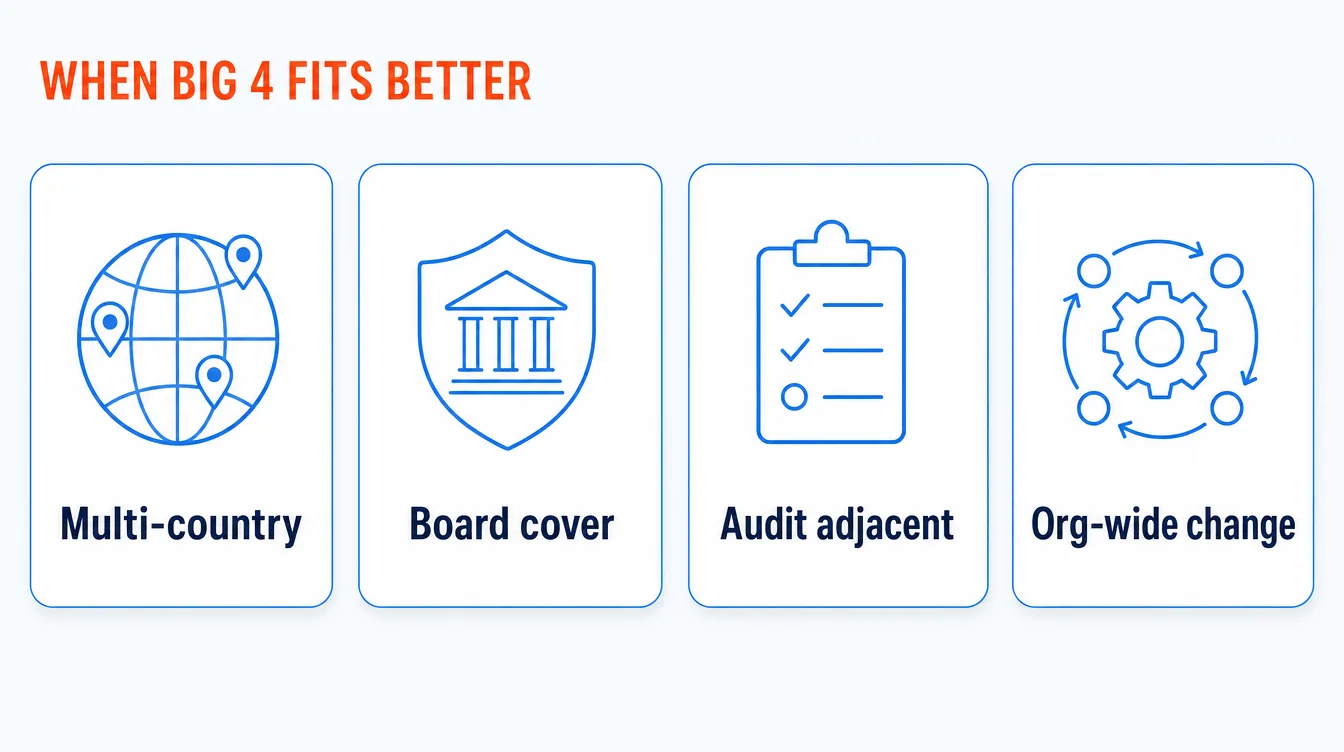
Four situations, and we would say the same on a call.
1. Multi-country regulated programmes. If one AI system has to satisfy the FCA, the Central Bank of Ireland and two more EU regulators, you need people who already hold those relationships and can staff each jurisdiction. That is not a boutique capability.
2. Board or audit-committee cover. Sometimes the deliverable really is an independent assessment a board can rely on, from a name with no stake in the build. If your audit committee has asked for assurance, hiring your implementation partner to provide it is a conflict. Buy the assurance from a Big 4 firm and the build from someone else.
3. Work adjacent to audit, tax or a transaction. AI in financial reporting, model risk, or anything landing in due diligence sits next to work Big 4 firms have done for a century. That context is worth paying for.
4. Org-wide change with hundreds of stakeholders. A 5,000-person operating model change needs project managers, change communications and training at a volume no small firm can supply. A boutique bidding for that is bidding for work it cannot deliver.
There is a quieter fifth reason: supplier risk. A ten-year programme outlives most small firms. If the system has to run past the end of the decade, ask who maintains it, and put source code and runbooks in escrow whoever you pick.
What does this look like in a regulated UK firm?
Take a mid-sized financial advice business, around 120 staff, FCA regulated, with senior managers accountable under SM&CR. A monthly compliance file review eats several days of a small team's time.
The Big 4 shape: a firm-wide AI readiness assessment, a governance framework, and a prioritised roadmap of a dozen use cases, delivered over a quarter for a six-figure fee. Genuinely useful if the board needs a plan for the whole business, and the governance work would stand up to a regulator.
The boutique shape: two weeks reading real files, a working reviewer that samples and flags exceptions, a human sign-off step kept in place because a machine should not be the final word on a regulated file, then a decision at month end about whether to continue. Our own Claude operating system case study is that pattern applied to us: six internal departments running on Claude, built one department at a time rather than as one programme.
Buy the assessment if you want the whole business mapped. Buy the build if you want the file review fixed by Christmas. What you should not do is buy the assessment and assume the build is included.
What are the red flags on each side?
Both types fail in predictable ways.
Boutique red flags: a pitch team that cannot name who will build it, no reference you can actually call, a fixed price with no written scope boundary, a bench of two people behind a website claiming a large team. Most common in AI right now, a firm that has never taken a system past a pilot into production.
Big 4 red flags: a proposal whose first deliverable is a document rather than something running, day rates quoted without naming the seniority mix, an assessment priced with no build option attached. If the answer to "who writes the code" is "our delivery centre", find out where, and ask to meet two of them.
What should you ask on the call, and what does a good answer sound like?
1. Who exactly will build this, and what did they ship last? A good answer is two names, their last two projects, and an offer to put both in the contract. A weak answer describes a team structure.
2. Show me something you took to production, not a pilot. A good answer names the system, the volume it handles, and what broke on the way. Anyone with only pilots to show is learning on your budget.
3. What is the total first-year cost, including our own time and the data work? A good answer adds 40% to 60% for data and infrastructure without being prompted.
4. What will you refuse to do? A good answer names something. We turn down work where the process is not documented well enough to automate, because automating chaos just makes faster chaos.
5. What does my team know how to do when you leave? A good answer is a knowledge transfer plan and a runbook. This is the NAO's own recommendation and the most-skipped clause in AI contracts.
6. If the proof of concept fails, what happens commercially? A good answer is specific. Ours is money back. "We would work with you to find a path forward" is not an answer.
Frequently asked questions
Is a boutique AI consultancy cheaper than a Big 4 firm for the same work?
For comparable scope, usually by around an order of magnitude. Published benchmarks put Big 4 partner rates at £3,500 to £6,000 a day against £700 to £2,500 for London AI specialists (market, indicative, 2026). The saving is real, and it comes with a smaller bench and less institutional cover.
Can a boutique firm work with an FCA-regulated business?
Yes, and many do. What matters is whether the firm can evidence how it handles data, where the model runs, what is logged, and where a human signs off. Ask for that in writing. For a UK-only regulated process a boutique is usually fine. For a four-country programme it usually is not.
Do Big 4 firms actually build AI systems, or only advise?
They do both. All four have substantial technology and engineering arms that deliver production systems. The difference is who does it and at what pace: the build is normally staffed from a delivery pool rather than by the people who scoped it.
What is the biggest risk with a small AI consultancy?
Key-person dependency, and the firm's own longevity. Get named individuals into the contract, insist on a knowledge transfer clause, and put source code and runbooks in escrow. If the system has to run for a decade, plan for the supplier not being there.
Can we use both a Big 4 firm and a boutique?
Often the best answer. Buy independence and firm-wide governance from one, the build from the other. It also removes the conflict where the firm assuring the work is the firm that did it. Say up front who owns which deliverable.
How do we compare proposals that look nothing like each other?
Normalise them on three things: the first date a real user touches something working, the total first-year cost including your own people and the data work, and who is named on the build. Most proposals become comparable once you force those columns. There is a fuller checklist in how UK companies should choose between a consultant, a consultancy and an in-house hire, and our read on the market, including where competitors beat us, is in our honest shortlist of UK AI consulting companies.
We are a boutique, so we will not pretend the Big 4 case is weak. It is strong for multi-country regulated programmes, for board assurance, and for change at a scale we could not staff. What we are better at is getting one important process into production, governed, in 90 days at a fixed price, with the money back if the proof of concept fails. We run six of our own departments on Claude, so we deploy what we sell. Softblues is a registered Anthropic Partner Network member and a registered partner with Google Cloud and Microsoft, so your team gets met on whichever platform it already runs.
If you want a straight answer about which type of firm your problem needs, including when it is not us, book a discovery call. Thirty minutes, no deck.
See it in production
Systems we have built and run for clients, with the numbers that came out of them.
Related Articles
Claude Enterprise vs Team vs Pro: Which Plan Does Your Business Need?
Gemini for Business vs Claude Enterprise: Which Fits Your Company in 2026?