AI Consultant, Consultancy or In-House Hire? How UK Companies Should Decide
An independent AI consultant charges £500 to £1,200 a day; an in-house hire starts near £70,000. Here is how UK firms choose between a consultant, a consultancy and building a team of their own.
By Ivan Pylypchuk (opens in a new tab), CEO of Softblues. We put Claude into production for finance, legal and healthcare teams across the UK and Ireland.
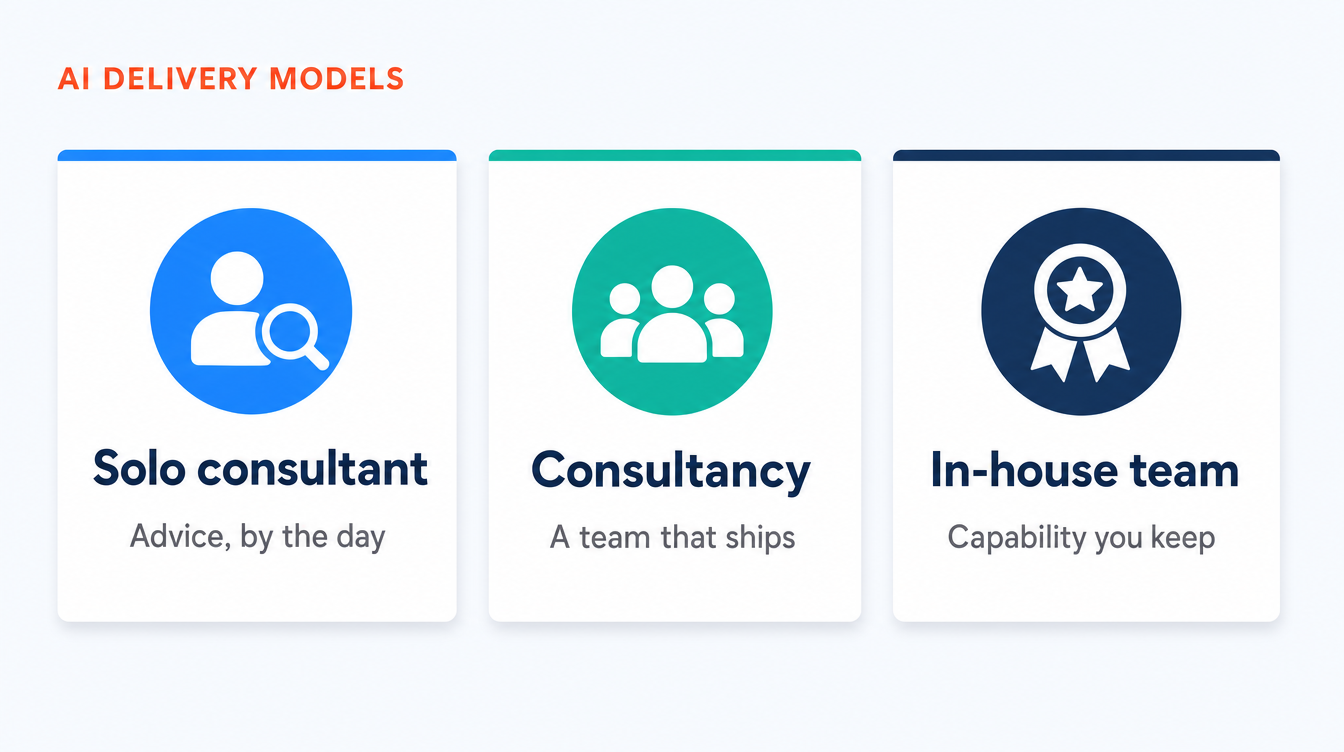
Hire an independent AI consultant for short, specialist advice. Engage a consultancy when you need a team to design, build and support a working system. Build in-house when AI becomes core to your product and you can recruit and keep the talent. Most UK mid-market firms start with a consultancy, then add in-house people once the work is steady.
At Softblues, an AI consulting firm working with regulated mid-market companies across the UK and Ireland, we get this question on most first calls: should we hire an AI consultant, bring in a consultancy, or build a team of our own? The honest answer is that it depends on three things you can measure, not on which option sounds most serious.
Key facts
- Independent AI consultants in the UK charge roughly £500–£1,200 a day in 2026 (market, ITJobsWatch / UK contractor rate data, 2026).
- A permanent mid-to-senior AI engineer costs about £70,000–£95,000 base, before recruitment fees, employer NI, pension and the months of ramp-up (market, Robert Half / Indeed UK, 2026).
- 23% of UK mid-sized businesses now use AI, against 36% of large firms and 14% of micro firms (GOV.UK AI adoption research, 2025).
- Three models, three trade-offs: a consultant is cheapest to start and weakest on knowledge retention; in-house keeps the most knowledge but is slowest to stand up and hardest to staff; a consultancy sits between the two.
- The choice is rarely permanent. The common path is consultancy first to ship the first system, then in-house once the workload is predictable.
Who this is for, and who it isn't
This is for a 50 to 500-person UK firm deciding how to resource its first or second AI project, where the budget is real but the team is not yet built.
It is not for a solo founder who wants a weekend prototype, or for a large enterprise that already runs a mature machine-learning platform with its own staff. If that is you, the decision is already made.
What does an AI consultant actually do, and how is that different from a consultancy?
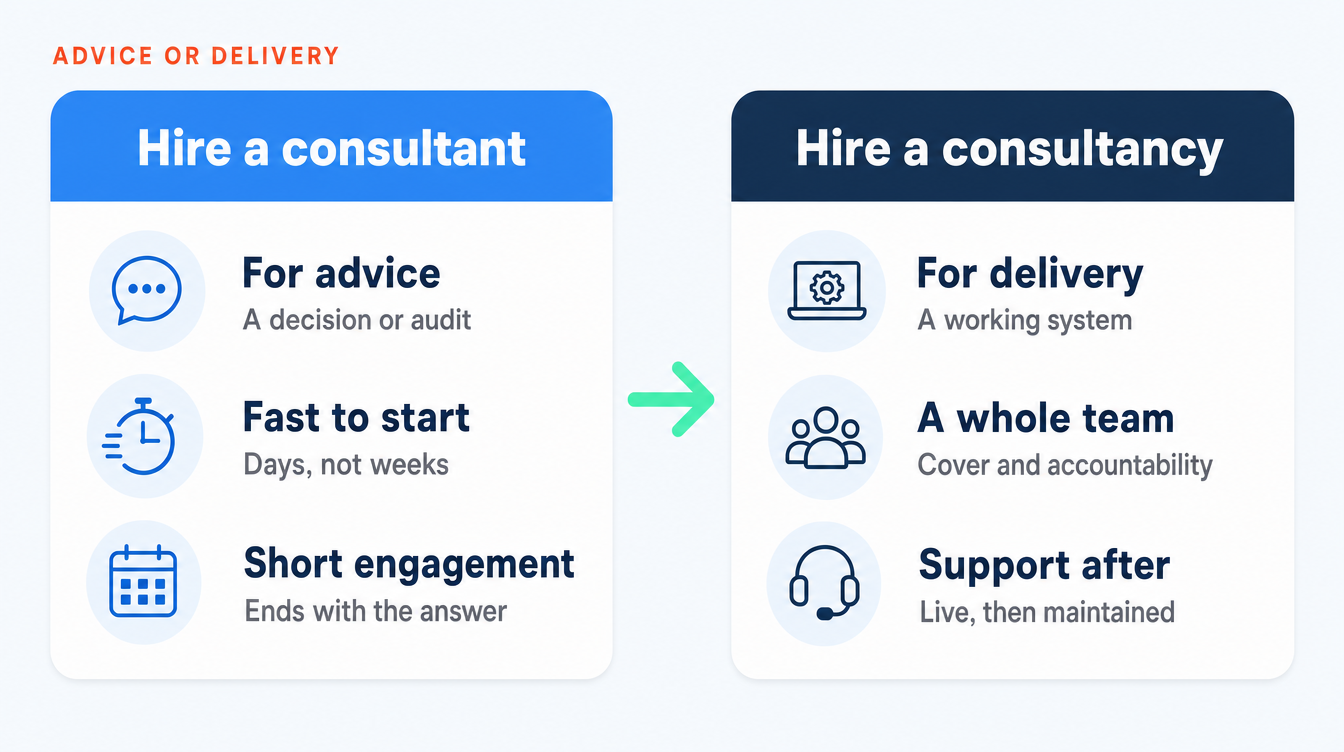
An AI consultant is one person you hire for their expertise, usually by the day or for a fixed scope. They are strong at diagnosis: where AI will pay off, which use case to start with, what could go wrong, and how to brief a build team. Most independents do not ship and support a production system on their own, because that is a team sport.
A consultancy (or agency) is a team you engage to take a problem from idea to working system and then support it. You get a mix of strategy, engineering, security and project management under one contract, with cover when someone is on leave. You pay more per day than for a lone consultant, but you are buying delivery and continuity, not just advice.
In-house means you employ the people. You own the knowledge, the roadmap and the priorities, and there is no day rate. You also own recruitment, retention, management and the risk that your one AI hire leaves six months in.
Why is choosing an AI delivery model different from a normal IT decision?
Two reasons. First, the skills are scarce and expensive, so a wrong hire costs more and takes longer to replace than in most IT roles. The UK AI sector grew to around 5,800 companies and more than 86,000 AI jobs by 2024 (GOV.UK AI sector study 2024, published 2025), and demand still outruns supply, which keeps salaries and day rates high.
Second, an AI project is rarely "done". Models change, prompts drift, data shifts, and a tool that worked in March needs attention by September. That ongoing care is easy to underrate when you are only costing the build. It is also the single biggest argument against the cheapest-looking option.
AI consultant vs consultancy vs in-house: the decision matrix
Score each model against the four things that actually decide it, then weight them for your situation.
| Factor | Independent consultant | Consultancy / agency | In-house hire |
|---|---|---|---|
| Typical cost | £500–£1,200/day, short engagement (market, 2026) | Fixed project fee or retainer; higher per day, lower delivery risk | £70k–£95k+ base per head, plus on-costs (market, 2026) |
| Time to start | Days | One to three weeks | Two to four months to recruit and onboard |
| Delivery risk | Higher: one person, no cover, advice not delivery | Lower: a team, cover, accountable for the outcome | Medium: depends entirely on the hire and your management |
| Knowledge retention | Low: walks out the door at the end | Medium: documented and handed over, but lives with the partner | High: stays in the business if the person stays |
| Best for | A decision, a second opinion, a short audit | Getting a first production system shipped and supported | AI that is core to your product, with steady ongoing work |
| Avoid if | You need something built and run | You want to own deep capability long term | You cannot recruit, manage or keep the person |
Costs are indicative market ranges, June 2026, not a published benchmark. For UK pricing in detail, see our guide to AI consulting costs in the UK.
What each model really costs in the UK in 2026
The day rate or salary is only the visible part.
For an independent consultant, the all-in cost is close to the day rate, which is why they look cheap. The hidden cost is what happens after they leave: if no one in your team can maintain what was specified, you pay again to have it built.
For a consultancy, you usually pay a fixed project fee or a monthly retainer rather than a pure day rate. It is the higher number on the invoice, but it folds in engineering, security review, project management and support, and a credible partner carries the delivery risk. At Softblues we agree a clear scope, timeline and price in the proposal before any build starts, because the delivery risk should sit with the people doing the work, not the client.
For an in-house hire, take the base salary and add recruitment (often 15–25% of salary), employer National Insurance, pension, equipment and two to four months before the person is productive. One senior hire rarely covers strategy, engineering and security on their own, so the real comparison is often a small team, not a single salary.
How long until each model delivers?
| Stage | Consultant | Consultancy | In-house |
|---|---|---|---|
| First useful output | 1–2 weeks (a plan) | 2–6 weeks (a working pilot) | 3–6 months (after hiring) |
| Production system | Not their job | A few months for a scoped build | 6 to 12 months while the team forms |
| Ongoing support | Ends with the engagement | Covered under retainer/SLA | Owned by your team |
Timelines reflect our own UK engagements and typical market patterns (our data and market, indicative, June 2026).
What this looks like in regulated sectors
If you are in a regulated sector, the model you choose has to answer to a regulator, and that usually rules the lone consultant out for delivery.
- Financial services: the FCA and the Senior Managers and Certification Regime expect named accountability for systems that touch advice, suitability or client money. A consultancy can put that governance in writing; a single contractor cannot carry it.
- Legal: the SRA expects supervision and confidentiality controls over any tool that handles client matters.
- Healthcare: the CQC, plus the clinical-safety standards DCB0129 and DCB0160, apply to anything touching patient pathways, with the MHRA in scope if software behaves like a medical device.
- Data: UK GDPR and the ICO apply across all of the above.
A short worked example. A financial-advice firm asked us to scope automating its monthly client-file review. An independent consultant could have advised on the approach in a fortnight. Building it so the checks were auditable and defensible to the FCA was a team job, with a compliance reviewer, an engineer and a clear owner. The lesson was not that consultants are weak; it was that advice and accountable delivery are different purchases. You can see how we approached that kind of work in our compliance file-review case study.
Red flags in each model
With a consultant: they promise to build and run a production system single-handed, quote a day rate with no end date, or cannot point to anything they have shipped.
With a consultancy: no fixed scope or named team, a flat refusal to put numbers in the contract, or case studies with claimed results but no method behind them.
With an in-house plan: budgeting one junior hire to do strategy, engineering and security at once, or no plan for what happens when that person leaves.
Questions to ask, and what a good answer sounds like
1. Who owns the outcome if this fails? A good answer names a person and, from a consultancy, a contractual remedy. A vague "we will work together" is not an answer.
2. What happens after go-live? Good partners describe support, monitoring and a hand-over plan before you ask. AI tools drift, so "we will hand you the code" is not enough.
3. Can you show a comparable build in our sector? You want a method and a named regulator they have worked to, not just a logo wall.
4. What is the total twelve-month cost, all in? A credible answer covers build, support and the cost of change, not the day rate alone.
5. When should we move this in-house? An honest partner will tell you when you no longer need them. That is a sign they are pricing delivery, not dependence.
For a structured way to compare providers once you have shortlisted them, see our 12-point buyer's checklist for choosing an AI consulting firm and our guide to comparing AI consulting proposals and delivery risk.
Softblues is an OpenAI Select Partner, Certified in the Claude Partner Network, a Google Cloud partner at Services Select tier, and a member of the Microsoft AI Cloud Partner Program. We are practitioners, not a pure advisory shop: we scope, build and support AI systems for regulated UK and Ireland firms, and we run our own company on Claude, which you can read about in our Claude operating-system case study. If you are weighing up how to resource your next AI project, book a discovery call and we will give you a straight read on which model fits.
Frequently asked questions
Is it cheaper to hire an AI consultant or a consultancy?
A consultant has the lower day rate, but a consultancy is often cheaper over a full project once you count maintenance, cover and the risk of a build that no one can support afterwards. Compare total cost over twelve months, not the day rate.
What does an AI consultant cost per day in the UK?
Roughly £500–£1,200 a day in 2026, depending on seniority and location, with London at the higher end (market, ITJobsWatch, 2026). Senior architects can sit above that range.
When does it make sense to hire AI in-house?
When AI is becoming part of what you sell, the workload is steady enough to keep a person busy, and you can recruit and retain the talent. Until then, a consultancy usually gives you more capability for less risk.
Can one in-house AI hire replace a consultancy?
Rarely. A single person seldom covers strategy, engineering, security and support at once. The realistic comparison is a small in-house team against a consultancy, which changes the cost picture.
What about IR35 if I use a contractor?
Most mid-market and enterprise contracts are assessed inside IR35, so the contractor is taxed through PAYE and takes home roughly 60–65% of the headline rate. That affects who you can attract at a given rate. Check the status with your accountant before you engage.
How do regulated firms usually resource AI?
They lean towards consultancies or in-house teams rather than lone contractors, because a regulator expects named accountability and documented governance that a single contractor cannot underwrite.
How quickly can a consultancy deliver a working system?
A well-scoped first system commonly takes a few months to reach production, with a usable pilot inside the first few weeks. An in-house route is slower because you have to hire the team first.
If you have settled on a consultancy, the next step is picking one: the best AI consulting companies in the UK, compared.
Work out your numbers
Your whole firm
AI ROI calculator
Five questions about your firm. See the time AI frees up, what it is worth and when it pays for itself.
Work out your numbersOne key process
Process automation ROI calculator
Five questions about one process. See the hours an AI agent frees up, what they are worth and how much becomes profit.
Work out your numbers
Free. No sign-up. Your answers stay in your browser.
See it in production
Systems we have built and run for clients, with the numbers that came out of them.
Related Articles
MCP server access: Claude, ChatGPT and Copilot in Microsoft 365
AI governance framework: a UK employee policy template