AI Consulting Engagement Models: PoC vs Project vs Retainer
UK AI adoption has almost tripled since 2023, but only 10% of adopters use AI extensively. That gap is usually the contract shape, not the technology. How PoC, project and retainer really differ.
By Ivan Pylypchuk (opens in a new tab), CEO of Softblues. Has led Claude implementations from proof of concept to production for finance, legal and healthcare teams across the UK and Ireland.
UK businesses have adopted AI almost three times over in under three years, and barely gone any deeper. The share of firms with 10 or more employees using at least one AI technology rose from around 12% in late 2023 to around 35% in June 2026, yet the average adopting business still runs only 1.6 AI technologies, up from 1.4, and just 10% of adopters say they use AI extensively (ONS, July 2026). Wide, shallow adoption is not really a technology result. It is a contracting result.
AI consulting engagement models are the contract shapes a buyer can choose from: a fixed-price discovery, a proof of concept, a fixed-scope build project, a monthly retainer, or an embedded team. Each carries a different cost profile, a different risk owner and a different exit. Pick the shape that matches how certain you are, not the one the vendor prefers.
At Softblues, an AI consulting firm working with regulated mid-market companies across the UK and Ireland, we quote most first engagements as a fixed-price piece of work that ends in a named decision, because the shape of the contract usually decides whether anything reaches production.
Key facts
Who this is for, and who it isn't
This is for a CEO, COO or CTO at a 50-to-500-person UK or Ireland company, often in finance, legal, healthcare or professional services, who has agreed a budget and now has to choose the shape of the contract.
It is not for a team still deciding whether to use AI at all, and it is not a pricing benchmark. If you are setting a budget rather than picking a contract, read our breakdown of what AI consulting actually costs in the UK first. If you already know your model and need to check the paperwork, go to what belongs in an AI consulting proposal.
Why does the engagement model matter more than the day rate?
Because the day rate tells you what an hour costs, and the engagement model tells you who pays when the work takes longer than anyone thought. On AI work it almost always does. Usually the data is messier than the demo suggested, or the compliance sign-off nobody scheduled takes three weeks.
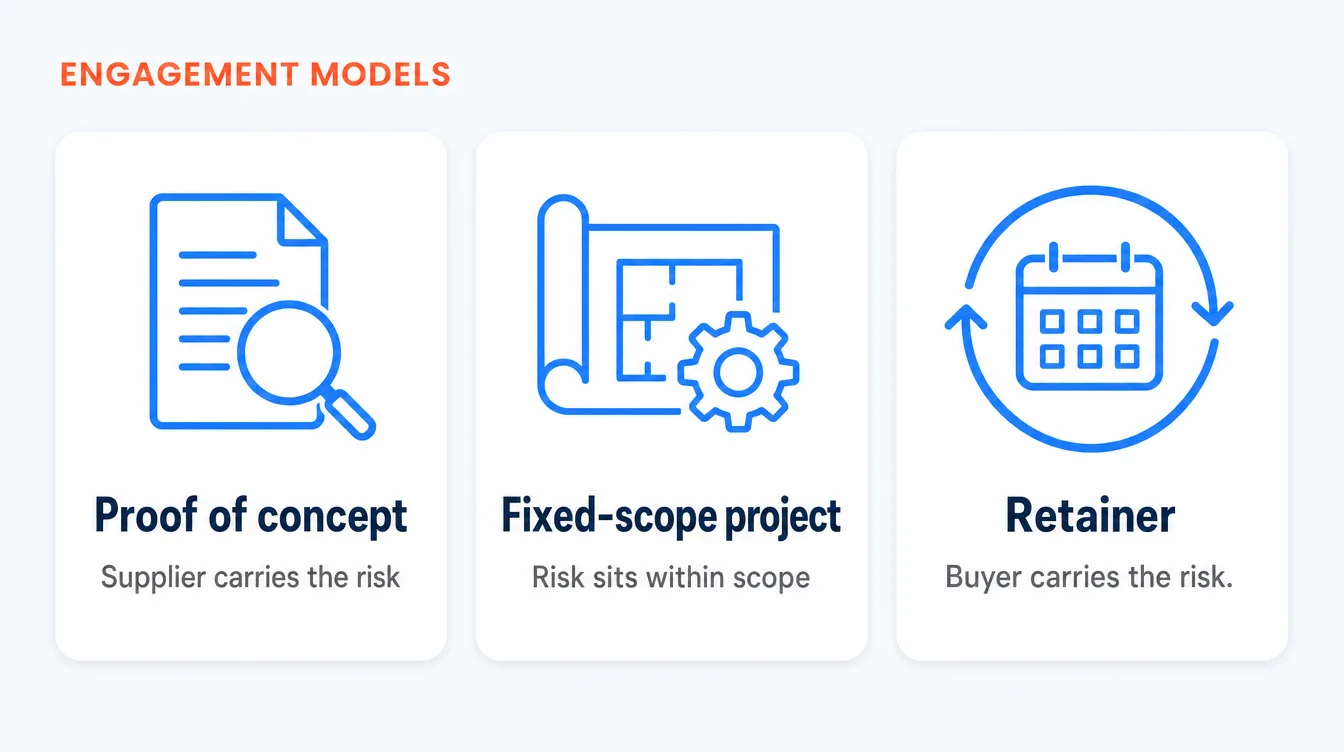
A fixed price puts that overrun on the supplier. Time and materials puts it on you. A retainer puts it on neither, which sounds fair and quietly means it lands on whoever is less organised. None of those is wrong. They are different bets, and you should place the one that matches your uncertainty.
What are the main AI consulting engagement models?
Five shapes cover almost every AI consulting engagement in the UK market. What separates them is the cost profile, who absorbs an overrun, how fast you see something real, and how cleanly you can walk away.
| Model | Cost profile | Who carries the risk | Speed to first real output | How you exit |
|---|---|---|---|---|
| Discovery / audit | Fixed fee, small | Supplier | 2 to 4 weeks | Ends automatically with a document |
| Proof of concept | Fixed fee, capped | Supplier | About 2 months | Ends on a go or no-go decision |
| Fixed-scope project | Fixed fee, large, staged | Supplier, within the agreed scope | 6 to 12 weeks for the first release | Ends at acceptance of the final stage |
| Retainer | Monthly, rolling | Shared, and in practice the buyer | Ongoing from month one | Notice period, usually 30 to 60 days |
| Embedded team | Monthly per person | Buyer | As fast as you can direct them | Notice period per person |
| Model | Best for | Avoid if |
|---|---|---|
| Discovery / audit | You know something is inefficient but cannot yet name the use case, the data owner or the compliance path | You have done this internally and only want it validated. That is a two-day review |
| Proof of concept | One named use case, real data you can share, and a real willingness to stop if the answer is no | The decision to build has already been made politically. Then you are paying for theatre |
| Fixed-scope project | A validated use case with agreed acceptance criteria and a production owner already named | The requirements are still moving. Fixed scope plus moving requirements produces change requests, not software |
| Retainer | Something is already live and needs improving, monitoring and extending as priorities shift | Nothing is live yet. A retainer without a shipped system funds exploration indefinitely |
| Embedded team | You have your own technical leadership and need specific capability at speed | You need someone else to own the outcome. Embedded engineers deliver what you direct |
Not sure which shape fits? A 30-minute discovery call is enough for us to say which of these five we would recommend, and which we would talk you out of. You leave with a shape, an indicative price band and the questions to put to any other supplier you are speaking to. Book a discovery call.
What is the difference between a proof of concept and a pilot?
A proof of concept answers "can this work at all", using real data, on a fixed clock, for a small group who know they are testing something. A pilot answers "does this work in our operation", with real users doing real work, at limited scale, with the support and training a live system needs.
They are different purchases. A PoC that succeeds tells you the technology is viable. It does not tell you your people will use it or that your compliance team will sign the evidence trail. Getting past the pilot is a separate piece of work, and it is the one the ONS depth figures say most firms never bought. Our guide to running a proof of concept that reaches production covers that plan in detail.
Where does each engagement model quietly fail?
Every shape has a characteristic failure, and it is rarely dramatic. It looks like a project that quietly stops mattering.
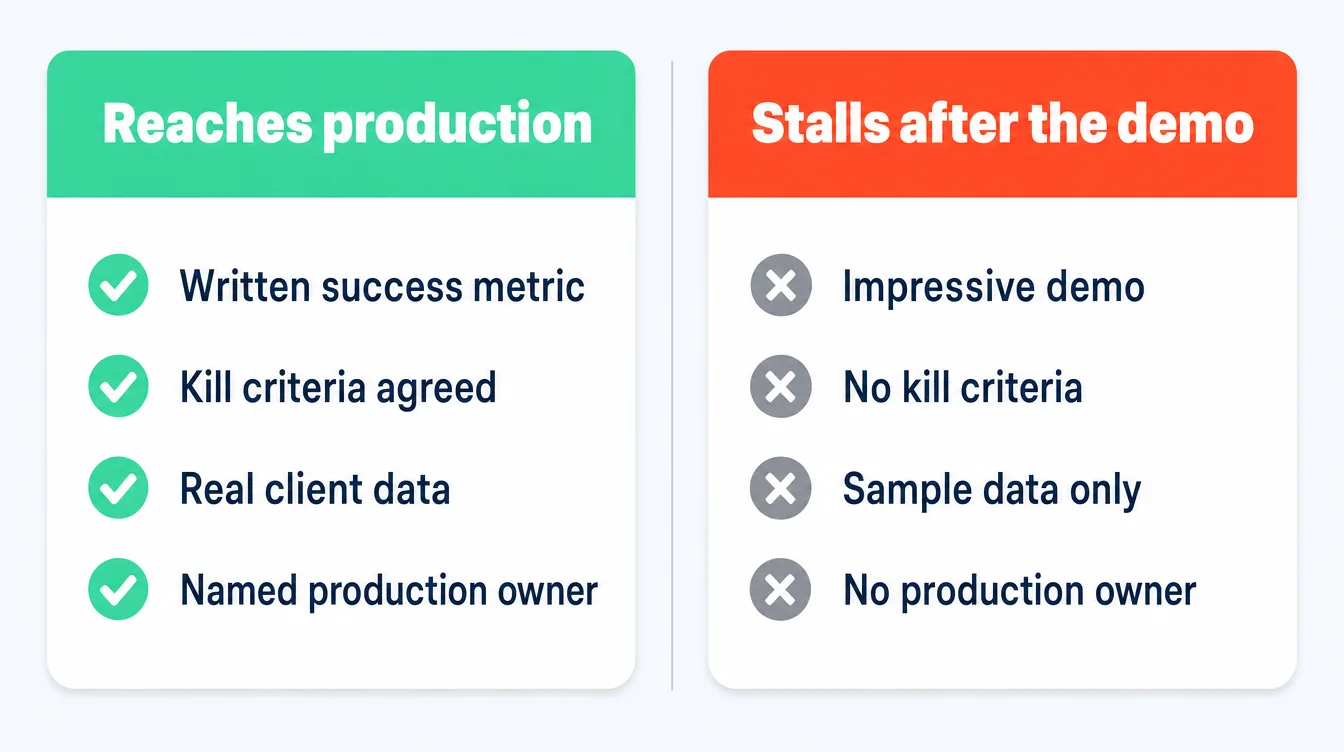
The PoC that never ships. The most common by far. The build works, the demo lands well, and then nobody owns the next step. No production budget was reserved, no internal owner was named, and the kill criteria were never written, so the result cannot even be called a failure. It just sits there. The fix is unglamorous: before the PoC starts, write down the success metric, the kill criteria, and the name of whoever owns production if it passes.
The project that delivers the wrong thing correctly. Fixed scope locks the requirements at the point when you understood the problem least. Six months later you accept a system that meets every criterion and solves a problem that has moved.
The retainer that becomes a subscription. Month one is useful. By month seven nobody can say what the retainer produced last quarter, and it renews because cancelling requires a conversation.
The embedded team with no destination. Capable engineers, well managed day to day, no architecture owner. Eighteen months later you have five working things that do not fit together.
What does each engagement model cost in the UK?
These are our own indicative bands as of August 2026, traced to our rate card rather than to a published market benchmark. Market day rates sit well above them, roughly £900 to £1,600 at mid-tier UK firms and £2,000 to £5,000 at the large management consultancies, which we cover in the AI consulting costs guide.
| Model | Indicative price (our data, Aug 2026) | Typical duration |
|---|---|---|
| Mapping and Strategy, then Full Discovery | £2,000 to £5,000, then £7,000 to £12,000, fixed | 2 to 4 weeks |
| Proof of concept | Set in the proposal after a paid discovery | About 2 months |
| Fixed-scope production programme | Around £320,000 to £355,000 for a full 12-month build, staged | 6 to 12 months |
| Implementation support | Set in the proposal | Rolling |
| Embedded engineer | £4,900 to £8,600 per person per month, by seniority | 12 months or more |
The word staged matters more than the number. A twelve-month programme should be billed against named releases, not evenly across the year, so that stopping after stage two costs you stage two rather than the year.
What does this look like in a regulated firm?
Take a financial planning firm with 40 advisers that wants to automate its monthly client file review. The sequence is the product.
A Full Discovery (£7,000 to £12,000) maps the process, the data sources and the evidence trail a reviewer would need. A proof of concept, priced in the proposal that follows, then runs for about two months against real files and answers one question: does the output survive a compliance reviewer's spot check? If it does, a staged build follows. If it does not, the firm has spent a small fraction of a six-figure programme to avoid committing to something that would not have held up.
The regulatory point is unchanged by any of this. Under the FCA's Senior Managers and Certification Regime, accountability sits with a named individual and does not transfer to a model (FCA). So the system drafts and evidences, and a named human signs off. We use it before we sell it: we run our own company this way across six internal departments, documented in our Claude operating system case study.
What are the red flags in how a proposal is shaped?
A retainer proposed before anything is live. Reasonable for support, a warning sign for a first engagement.
A PoC with no written kill criteria. If nothing would count as failure, you are not buying a test.
Fixed price with an open scope. The change requests are the business model.
No named production owner on your side. A good supplier asks for one before you offer.
A day rate with no estimated day count. A £40,000 engagement is twenty senior days or fifty junior ones. Different purchases, same price.
How should you choose? A four-point checklist
1. Name the decision this engagement has to produce. Not the deliverable, the decision. "Do we build this" is a decision. "A report" is not.
2. Say honestly how certain you are. High uncertainty points to discovery or a PoC. Low uncertainty points to a fixed-scope project. Real ongoing change points to a retainer.
3. Name the production owner before you sign. If you cannot name one, buy discovery, not a build.
4. Confirm who pays for an overrun, in writing. The answer tells you more about a supplier than their case studies do.
We scope Claude deployments in a paid discovery and give you the timeline and the price in the proposal before any build starts, and we would rather sell you a scoped test than a programme you are not ready for. If the use case is an operational one, you can see how we approach business process automation.
For a straight answer on which model fits your situation, book a discovery call. Thirty minutes, no deck.
Frequently asked questions
What are the main AI consulting engagement models?
Five: a fixed-price discovery or audit, a proof of concept, a fixed-scope build project, a monthly retainer, and an embedded team. They differ in cost profile, who absorbs an overrun, how quickly you see real output, and how cleanly you can stop.
Is a proof of concept worth the money if we might not proceed?
That is exactly when it is worth it. A proof of concept that produces a clear no-go has done its job, because the alternative is committing a six-figure build on an assumption. It only wastes money when the decision to proceed was already made before it started.
How long should an AI retainer run before we review it?
Review it quarterly and ask one question: what shipped. If the answer is unclear two quarters in a row, the retainer has become a subscription. We would rather restructure it than renew it quietly.
Can we start with a retainer instead of a project?
You can, and it usually goes badly as a first engagement. A retainer suits improving something that already exists. With nothing live, the monthly fee funds open-ended exploration, and open-ended exploration is what produces the shallow adoption the ONS data shows.
Who owns the code and the models we pay for?
Ask this before you sign, whoever you use, and get the answer into the statement of work rather than the sales call. Some suppliers hand over everything, others retain platform or reusable-component rights. Both are legitimate, but they are different purchases, and the difference rarely shows up in the price.
Does the engagement model change in a regulated sector?
The shape does not, but the discovery gets longer and the evidence requirements get written into the acceptance criteria. In UK financial services, accountability under SM&CR stays with a named person regardless of how the work is contracted, so any model you choose has to keep a human sign-off step in the process.
What if our requirements change mid-project?
Then a fixed-scope project was the wrong shape, and it is worth saying so early. Staged delivery with a decision point between stages handles real change far better than a change-request process bolted onto a fixed contract.
Work out your numbers
Your whole firm
AI ROI calculator
Five questions about your firm. See the time AI frees up, what it is worth and when it pays for itself.
Work out your numbersOne key process
Process automation ROI calculator
Five questions about one process. See the hours an AI agent frees up, what they are worth and how much becomes profit.
Work out your numbers
Free. No sign-up. Your answers stay in your browser.
See it in production
Systems we have built and run for clients, with the numbers that came out of them.
Related Articles
MCP server access: Claude, ChatGPT and Copilot in Microsoft 365
AI governance framework: a UK employee policy template