Employee Onboarding Process Automation: A Step-by-Step Flow for UK Mid-Market Teams
Only 12% of employees say their organisation onboards well (Gallup). A five-stage onboarding process flow for UK teams, and which parts to automate.
By Ivan Pylypchuk (opens in a new tab), CEO of Softblues. Has led Claude and Gemini implementations for finance, legal and professional-services teams across the UK and Ireland.
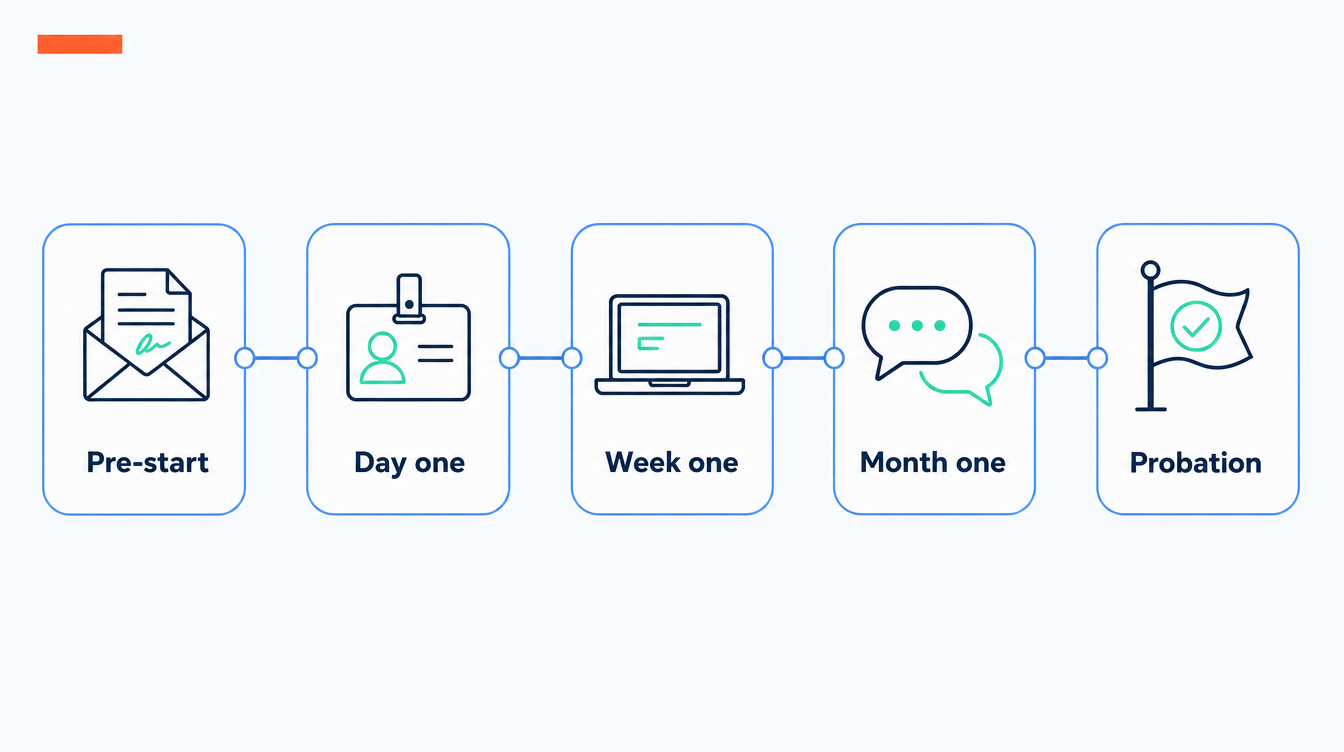
A good employee onboarding process runs in five stages: pre-start, day one, week one, month one and probation. Automation handles the admin in each stage (contracts, right-to-work evidence, IT access, reminders, policy sign-off) so managers and HR spend their time on the human parts: the welcome, the feedback, and the probation conversation.
Gallup found that only 12% of employees strongly agree their organisation does a great job of onboarding (Gallup), and a CIPD survey found over a quarter of UK employers have had a new recruit simply not turn up on day one (CIPD, 2023). At Softblues, an AI consulting firm working with regulated mid-market companies across the UK and Ireland, we treat onboarding as a back-office workflow problem first: most of what goes wrong is dropped admin, not bad intentions.
Key facts
- Only 12% of employees strongly agree their organisation onboards well (Gallup)
- Over a quarter of UK employers have been "ghosted" by a new recruit on day one (CIPD, 2023)
- UK employers must check right to work before employment starts; the process is set out on GOV.UK
- The five stages to build around: pre-start, day one, week one, month one, probation
- Automating the admin layer of onboarding typically takes 3 to 6 weeks for a mid-market team (our data, indicative, July 2026)
Who this is for, and who it isn't. Written for HR leads, ops directors and IT managers at UK firms of roughly 50 to 500 people who onboard a few starters a month and feel every one of them as a week of chasing. If you hire twice a year, a good checklist in a shared doc will serve you fine; come back when the volume hurts.
What does a good employee onboarding process flow look like?
Before automating anything, agree the flow. This is the version we see work for UK mid-market teams, stage by stage.
| Stage | What has to happen | Who owns it |
|---|---|---|
| Pre-start | Contract signed, right-to-work check, payroll and pension details, IT accounts ordered, welcome email, first-week diary | HR + IT |
| Day one | ID and badge, equipment handover, workstation working, team introductions, the welcome conversation | Manager |
| Week one | Role expectations agreed, policy acknowledgements, systems training, first small piece of real work | Manager |
| Month one | Check-in on fit and workload, feedback both ways, early wins reviewed | Manager + HR |
| Probation | Structured review against the expectations set in week one, decision documented | Manager |
Two of these rows carry legal weight in the UK. Right-to-work checks must be completed before the person starts; GOV.UK sets out the accepted routes, including online share codes for most non-UK citizens. And new starters need payroll set up correctly from day one, including a starter declaration where there is no P45 (GOV.UK: telling HMRC about a new employee). Neither is optional, and both are exactly the kind of deadline-driven admin that slips when it lives in someone's inbox.
Which parts of onboarding should you automate?
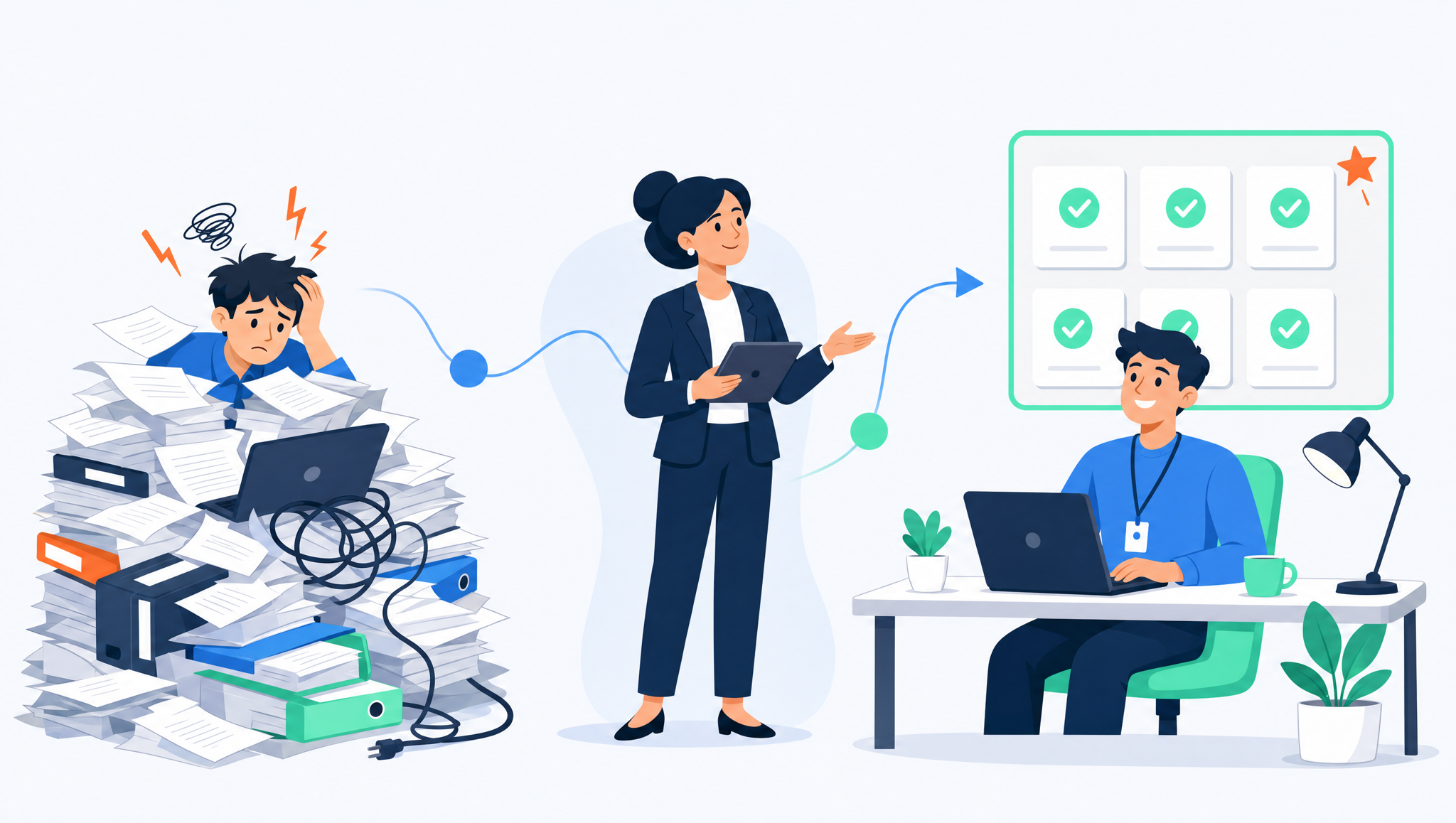
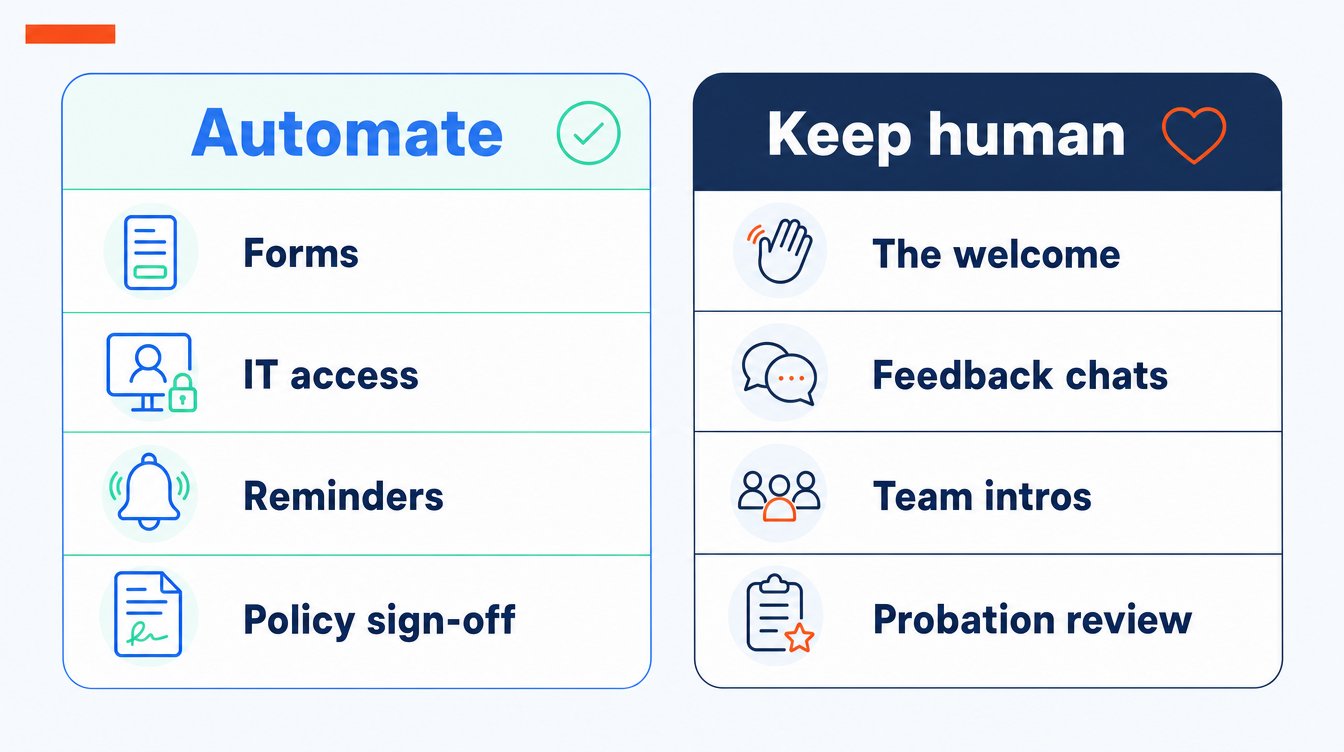
The honest rule: automate the admin, keep the human moments human. A new starter should never notice the automation. They should just notice that everything worked.
The automation targets, in the order they usually pay back:
1. The pre-start pack. One trigger ("offer accepted") kicks off contract generation, the right-to-work request, payroll and pension forms, and the IT access order. The new starter gets one tidy sequence instead of five emails from four people.
2. IT and access provisioning. A structured request to IT with the role's standard kit and system list, raised automatically from the HR record. This is where day-one failures are born; a laptop ordered on day minus-ten beats an apology on day one.
3. Reminders and nudges. The manager gets a nudge before day one ("diary set? first task ready?"), at week one, month one and two weeks before probation ends. Nobody has to remember; the workflow remembers.
4. Policy acknowledgements. Policies issued, read receipts tracked, unanswered ones chased. Dull, necessary, fully automatable.
5. A new-starter Q&A assistant. The highest-value AI piece: an assistant grounded in your own handbook and policies that answers "how do I book leave?" and "what's the expenses limit?" instantly, with citations back to the source document. We wrote a full walkthrough of this pattern in how to build a policy and handbook Q&A assistant with Claude.
What stays human: the welcome itself, introductions, feedback conversations, and the probation review. Automate the scheduling of those conversations if you like, never the conversations themselves.
How do you set it up without buying a whole HR platform?
Mid-market teams usually sit between two bad options: spreadsheets plus goodwill, or a heavyweight HR suite priced for enterprises. The middle path is workflow automation over the tools you already run (your HRIS or even a structured tracker, plus email, calendar, and your IT service desk), with an AI layer for the document-heavy and question-heavy parts. As a rough sequence from our own engagements (indicative, July 2026): week 1 to map the flow and owners, weeks 2 to 3 to build the pre-start pack and provisioning triggers, weeks 3 to 4 for reminders and policy tracking, and weeks 4 to 6 for the handbook Q&A assistant if you want one. Integration effort depends mostly on how clean your HR data is, a topic we cover in AI integration services: connecting AI to the systems you already run.
If you are weighing onboarding against other automation candidates, our guide to what mid-market companies should automate first ranks it alongside invoicing, document handling and support.
Where are the GDPR and fairness boundaries?
Onboarding data is personal data, some of it special category (right-to-work documents, health declarations, bank details). Keep three boundaries firm. First, collect only what each stage needs, and set retention rules; right-to-work evidence has a statutory retention period, most other onboarding artefacts do not need keeping forever. Second, if an AI assistant can see HR documents, scope its access to the current starter's own record and the public handbook, never the whole HR drive. Third, do not automate judgements about people. Screening, probation decisions and anything that affects the person's employment must be made by a human, with automation limited to assembling the evidence. The ICO's employment guidance is the reference point for your data protection lead.
Frequently asked questions
What are the stages of an employee onboarding process?
Five work well: pre-start (contract, right-to-work, payroll, IT), day one (equipment, introductions, welcome), week one (expectations, policies, first real work), month one (check-in and feedback), and probation (structured review). Most onboarding failures are pre-start admin failures.
What onboarding tasks can be automated?
The pre-start document pack, right-to-work request and tracking, IT access provisioning, calendar scheduling, manager and starter reminders, policy acknowledgements, and a handbook Q&A assistant for new-starter questions. Keep welcomes, feedback and probation conversations human.
Do we need new HR software to automate onboarding?
Usually not. Workflow automation over your existing HRIS, email, calendar and service desk covers most of it. A dedicated platform makes sense at high hiring volume; below that, automation over current tools is cheaper and faster to land.
How do right-to-work checks fit into an automated flow?
The workflow can request documents or a share code, track the deadline and store the evidence, but the check itself must follow the GOV.UK process and be completed before the start date. Treat the workflow as the chaser and record-keeper, not the decision-maker.
How long does onboarding automation take to build?
For a 50 to 500-person firm, the admin layer typically lands in 3 to 6 weeks (our data, indicative, July 2026). The handbook Q&A assistant is usually the last piece because it depends on your policies being current.
Is it safe to let AI answer new starters' HR questions?
Yes, with scope limits: ground the assistant in the published handbook and policies, have it cite its source in each answer, and route anything personal (pay, grievances, health) to a named human. Test the refusal behaviour before launch.
Does better onboarding actually affect retention?
The evidence points that way. Gallup links strong onboarding experiences to markedly higher satisfaction and retention, and UK data shows early exits cluster where the first weeks are chaotic. The mechanism is simple: people decide early whether the place is organised and whether anyone noticed they arrived.
Softblues is an OpenAI Select Partner, Certified in the Claude Partner Network, a Google Cloud partner at Services Select tier, and a member of the Microsoft AI Cloud Partner Program. We build this kind of workflow for UK and Ireland mid-market teams, scoped in a paid discovery with the timeline and the price in the proposal before any build starts. We have also built AI for the hiring side, including an AI candidate-assessment platform for an HR technology company. If onboarding admin is eating your HR team's week, book a discovery call or see our approach to business process automation.
Work out your numbers
One key process
Process automation ROI calculator
Five questions about one process. See the hours an AI agent frees up, what they are worth and how much becomes profit.
Work out your numbersYour whole firm
AI ROI calculator
Five questions about your firm. See the time AI frees up, what it is worth and when it pays for itself.
Work out your numbers
Free. No sign-up. Your answers stay in your browser.
See it in production
Systems we have built and run for clients, with the numbers that came out of them.
Related Articles
Claude in Excel for the month-end pack: what AI prepares and finance signs

AI meeting notes: the client file workflow for UK firms