What Is a Claude AI Operating System? How UK Companies Run on Claude
MIT found 95% of enterprise AI pilots produced zero measurable impact. A Claude AI operating system is the layer that moves AI from a stalled pilot into daily operations.
By Ivan Pylypchuk (opens in a new tab), CEO of Softblues. Has led Claude implementations for finance, legal and healthcare teams across the UK and Ireland.
A Claude AI operating system is a set of connected Claude agents and integrations that run recurring business work across the tools a company already uses, with governance built in. It is not a single chatbot. The point is to move AI out of a pilot and into daily operations, where it does real work every day rather than impressing people in a demo.
At Softblues, an AI consulting firm working with regulated mid-market companies across the UK and Ireland, we run our own business this way, on six connected Claude agents, before we recommend the approach to anyone else.
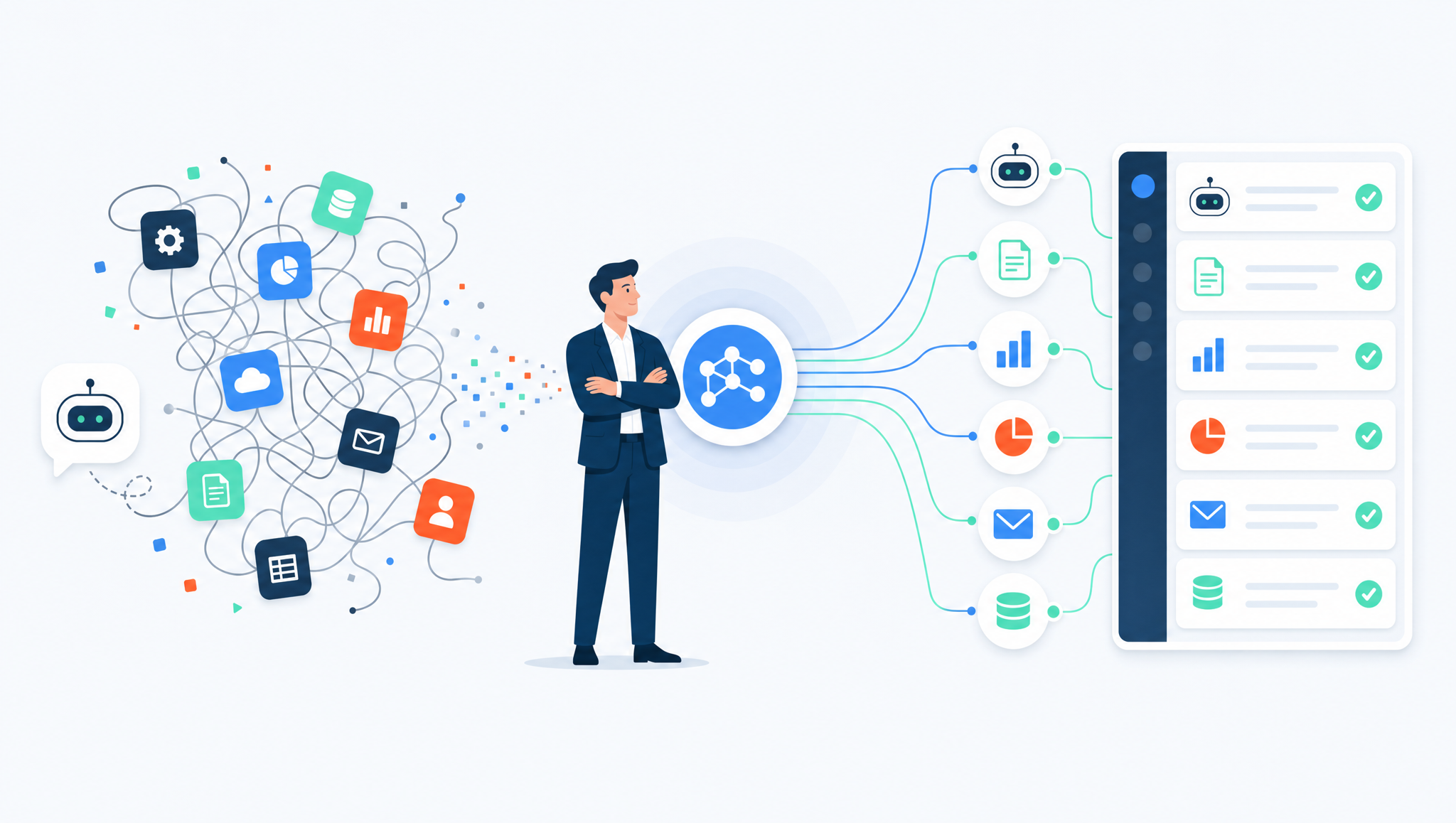
Here is the number that explains why this matters. In MIT's 2025 study, 95% of enterprise generative AI pilots produced zero measurable impact on profit and loss, and only about 5% delivered a rapid gain in revenue (MIT via Fortune, Aug 2025). The models work. What is missing is the operating layer around them: the connectors, the agents, the governance, and the plumbing that turns a clever answer into a job that gets done without a human copying and pasting.
Key facts
- A Claude AI operating system is a network of Claude agents plus integrations that run recurring work across a company's existing tools, not one chatbot answering questions.
- 95% of enterprise generative AI pilots produced zero measurable P&L impact, and only about 5% delivered a rapid revenue gain (MIT via Fortune, Aug 2025).
- MIT found that buying from specialist vendors and building partnerships succeeded about 67% of the time, while internal-only builds succeeded roughly a third as often.
- The failure is rarely the model. It is data readiness, missing success metrics, and no operating layer to run the work in production.
- We run our own company on six connected Claude agents, so we can show the approach working before you buy it.
Who this is for, and who it isn't
This is for an operations, finance, or technology leader at a 50-to-500-person company who has run at least one AI pilot and is frustrated that nothing became a permanent part of how the business runs. It is for people who care about governance and want AI they can put in front of an auditor.
It is not for a team wanting a single answer bot for a website, or a founder after a quick prototype. Both are valid, but neither needs an operating system, and building one for them would be over-engineering.
Why most AI pilots never become operations
A pilot proves a model can do a task once, in a controlled setting. Operations means it does that task every day, connected to real systems, with someone accountable when it goes wrong. That gap is where most projects stop.
The reasons are consistent. There is no clear metric for success, so nobody can say whether the pilot worked. The data the model needs lives in five systems that do not talk to each other. And there is no owner for the ongoing work, so once the excitement fades the tool quietly falls out of use. MIT's finding that only about 5% of pilots deliver a rapid revenue gain is the visible result of this pattern.
What "operating system" actually means here
The phrase is deliberate. An operating system on a computer is the layer that lets applications share resources, follow rules, and run reliably. A Claude AI operating system plays the same role for AI work in a company. It is the layer where agents get access to the right tools, follow governance rules, and run recurring jobs reliably, so that adding a new automated workflow is a normal operation rather than a fresh project each time.
We built this for ourselves first. Our own company runs on six connected Claude agents that handle recurring work across the business, with the controls we would expect any client to want. The full write-up is in our Claude operating system case study. We call it "we use it before we sell it", and it is the reason we can talk about this from experience rather than theory.
What are the building blocks?
Four parts, working together.
1. Connected agents. Purpose-built Claude agents that own a recurring job, such as triaging inbound requests, drafting a document from a template, or reconciling records across systems. Each has a defined scope, not a general licence to act.
2. Tool integrations. The connectors that let agents read from and write to the systems you already run, from your CRM to your finance tools. Without these an agent is a clever assistant with no hands.
3. Governance and controls. Permissions, audit logs, and clear limits on what each agent can do. This is what lets you deploy AI in a regulated setting and answer to a compliance team.
4. Human sign-off. The points where a person still decides. In serious work, the operating system is designed to bring a human in for the calls that carry real risk, not to remove them.
Claude AI operating system, a single chatbot, or point tools?
These are three different things, and buyers often confuse them. The comparison below is the one to keep in mind.
| Single AI chatbot | Buying point tools | Claude AI operating system | |
|---|---|---|---|
| What it does | Answers questions on demand | Automates one narrow task each | Runs recurring work across your tools |
| Integration | Little or none | Per-tool, often siloed | Connected across systems |
| Governance | Minimal | Varies by vendor | Central controls and audit |
| Best for | Quick Q&A, low stakes | A single well-defined job | Running the business, not a task |
| Avoid if | You need work done, not answers | Your work spans several systems | You only need one simple bot |
What does it cost, and how do you buy it?
We build these as a staged, fixed-price engagement rather than an open-ended day-rate project, so the scope and the price are clear before you commit. A typical path is discovery, then a proof of concept on one workflow, then production rollout of that workflow with the operating layer in place, after which adding the next workflow is faster and cheaper. For a fuller picture of how AI engagements are priced across the UK market, see our AI consulting costs guide. MIT's own data supports the staged model: buying from a specialist and partnering succeeded about 67% of the time, while building alone succeeded roughly a third as often.
How long does it take?
Discovery runs over a few weeks. A first workflow can be in production within a small number of weeks after that, depending on how many systems it has to touch and how clean the data is. The operating layer is the investment that pays off later: once it exists, the second and third workflows are much faster, because the connectors and governance are already in place. Our view on moving safely from trial to live is in the AI implementation roadmap.
Red flags
- A vendor sells you a chatbot and calls it an operating system.
- There is no plan for governance, permissions, or audit logs.
- No success metric is agreed before the build starts.
- The agents cannot integrate with the systems you actually run.
- Nobody is named to own the work after go-live.
- The vendor cannot show you AI running in their own business.
What it looks like in practice
Beyond our own company, we recently audited an AI-built application for a food producer, then proposed a secure modular rebuild and set up an AI-assisted development environment for the team. That work is an audit delivered and a rebuild proposed, not a finished production system, and we keep that framing honest. The detail is in our Claude Code audit case study. It shows the same principle: the value is in the operating discipline around the AI, not the model on its own.
Frequently asked questions
What is a Claude AI operating system?
It is a set of connected Claude agents and integrations that run recurring business work across the tools a company already uses, with governance and human sign-off built in. It is designed to move AI from a one-off pilot into daily operations, rather than being a single chatbot.How is it different from just using Claude or ChatGPT?
A chat interface answers questions when you ask. An operating system runs work continuously across your systems, following rules and keeping an audit trail. The difference is the integration and governance layer, which is what most pilots are missing.Why do so many AI pilots fail?
MIT's 2025 research found 95% of enterprise generative AI pilots produced no measurable P&L impact, and only about 5% delivered a rapid revenue gain. The common causes are no agreed success metric, data spread across disconnected systems, and no owner for the work after launch.Do we need to be a technical company to run one?
No. The point of the operating layer is that adding and running workflows becomes a normal operation, not a coding project each time. You need a clear owner and clean access to your data more than you need in-house engineers.Is this only for large enterprises?
No. It fits mid-market companies, roughly 50 to 500 people, particularly regulated ones that need governance. We run our own business of this size on connected Claude agents, which is where the approach was proven.How do we start without a big commitment?
Start with discovery and one workflow. Prove it in production with the operating layer in place, measure it against an agreed metric, then decide whether to add the next. Every stage should earn the next one.Can it meet compliance and audit requirements?
Yes, when it is built for it. Governance, permissions, and audit logs are core building blocks, not extras. For UK and Ireland clients we design for data to stay in a governed environment, which is a large part of the work.Softblues is an OpenAI Select Partner, Certified in the Claude Partner Network, a Google Cloud partner at Services Select tier, and a member of the Microsoft AI Cloud Partner Program. We run our own company on Claude before we recommend it, which is why we talk about the operating layer from experience rather than theory.
The implementation guide shows how the operating layer gets built, tier by tier, from a policy assistant a champion writes in an afternoon to a build running in your own tenant.
If you have run an AI pilot that never became part of how you work, and you want to see what an operating system approach would look like for your business, book a discovery call.
Work out your numbers
Your whole firm
AI ROI calculator
Five questions about your firm. See the time AI frees up, what it is worth and when it pays for itself.
Work out your numbersOne key process
Process automation ROI calculator
Five questions about one process. See the hours an AI agent frees up, what they are worth and how much becomes profit.
Work out your numbers
Free. No sign-up. Your answers stay in your browser.
See it in production
Systems we have built and run for clients, with the numbers that came out of them.
Related Articles
MCP server access: Claude, ChatGPT and Copilot in Microsoft 365
AI governance framework: a UK employee policy template