
How to Automate Management Reporting and Variance Commentary
The median finance team takes 6.4 days to close the books, and the management pack eats days more. A walkthrough of automating the pack, the variances and the first draft of commentary, with controls kept human.

By Ivan Pylypchuk (opens in a new tab), CEO of Softblues. Has led Claude and Gemini implementations for finance, legal and healthcare teams across the UK and Ireland.
AI can automate most of the mechanical work in month-end management reporting: pulling trial balance data, assembling the pack, calculating variances against budget and drafting first-pass commentary. Teams that automate these steps typically cut days from the reporting cycle. Judgement, the final narrative and sign-off stay with a qualified accountant.
The median finance team takes 6.4 calendar days to close its books each month, according to APQC's benchmark of more than 2,300 organisations (market data). And that is only the close. The management pack, the variance analysis and the commentary the board actually reads all come after it. In a 2025 survey reported by CFO.com, half of finance teams said their close takes six or more business days, and teams reported spending 20 to 50 hours a month on reconciliations alone (market data).
At Softblues, an AI consulting firm working with regulated mid-market companies across the UK and Ireland, we automate the reporting layer that sits on top of the close: the pack, the variances and the first draft of the commentary. We also run our own month-end this way, so this walkthrough describes a workflow we use ourselves.
Key facts
- The median month-end close is 6.4 calendar days across 2,300+ organisations; top performers close in 4.8 days or less (market data, APQC).
- Finance teams report 20 to 50 hours a month on reconciliations alone (market data, Ledge 2025 survey via CFO.com).
- AI reliably automates four reporting steps: data pull, pack assembly, variance calculation and first-draft commentary.
- Variance commentary should be drafted against explicit thresholds you set, for example anything beyond ±10% or £10,000 against budget, and always edited by a human.
- Controls, judgement calls and sign-off must stay human. Automating them weakens your control environment rather than your workload.
Who this is for, and who it isn't. This walkthrough is for CFOs, financial controllers and fractional CFO firms producing monthly management packs for UK and Ireland businesses, typically 50 to 500 staff, running on systems like Xero, Sage or NetSuite. It is not for listed-company statutory reporting, which carries audit and disclosure requirements beyond this scope, and not for a five-person startup whose whole pack is one spreadsheet tab.
Why does month-end reporting still take so long?
Because the work is scattered. The numbers live in the ledger, the budget lives in a spreadsheet, last month's commentary lives in a slide deck, and the real explanations live in people's heads. Assembling a management pack means re-keying figures between all of them.
Most finance teams run the same sequence every month: export the trial balance, paste it into the pack template, refresh the charts, calculate variances, chase budget holders for explanations, write the commentary, format, circulate. Very little of that requires an accountant's judgement until the explanation stage. That is exactly why it automates well.
What can AI actually automate in management reporting?
Four steps, in increasing order of value.
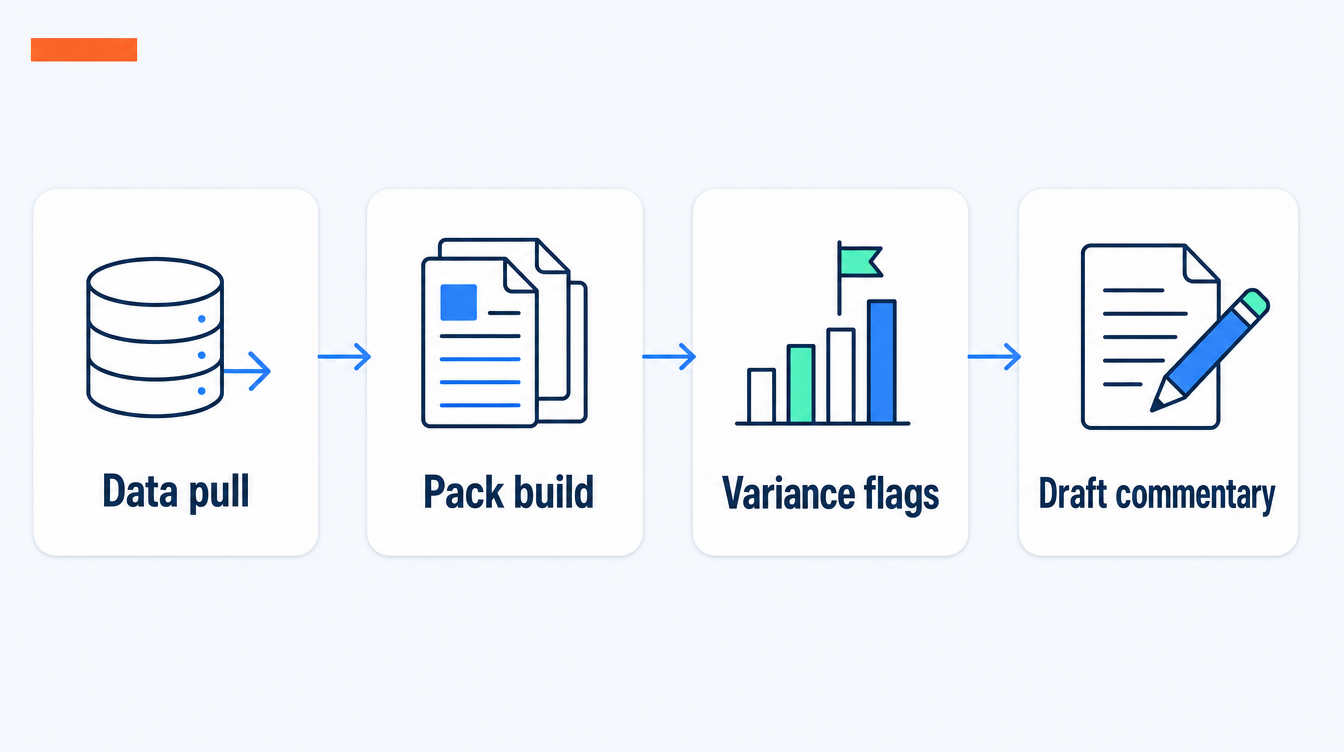
1. Data pull. Claude, or another large language model working through connectors, reads the trial balance and transaction detail directly from Xero, Sage or NetSuite, and the budget file from SharePoint or Google Drive. No re-keying, no stale exports.
2. Pack assembly. Your pack template becomes a set of written instructions: which accounts roll into which lines, which charts refresh from which data, what order the sections run in. The AI rebuilds the pack from live data every month.
3. Variance calculation and flagging. Every line is compared with budget, prior month and prior year. Anything beyond your thresholds is flagged with the underlying transactions attached, so the reviewer starts from evidence rather than a blank cell. The arithmetic is done by code, not by the language model, so it is exact.
4. First-draft commentary. For each flagged variance, the AI drafts a sentence or two: what moved, by how much, and the likely driver visible in the transaction detail, such as a large one-off invoice, a timing difference or a new hire landing in payroll. The accountant edits, corrects and approves.
What does variance commentary automation look like in practice?
Here is the shape of a typical cycle once the workflow is live. The books close on working day five. The agent pulls the final trial balance and the budget, rebuilds the pack and produces a variance report. The financial controller opens a draft in which, say, fourteen lines are flagged, each with commentary and the supporting transactions attached. She rewrites around a third of the drafts, because the model cannot know that the marketing overspend was approved by the board two weeks ago, deletes one flag as noise, and signs off the pack.
In our own monthly reporting at Softblues, that review-and-edit session replaced what used to be days of assembly and writing (our data, indicative, July 2026). The exact saving depends on the size of the pack and the number of entities, which is why we always run the new process in parallel with the old one before switching over.
What must stay human?
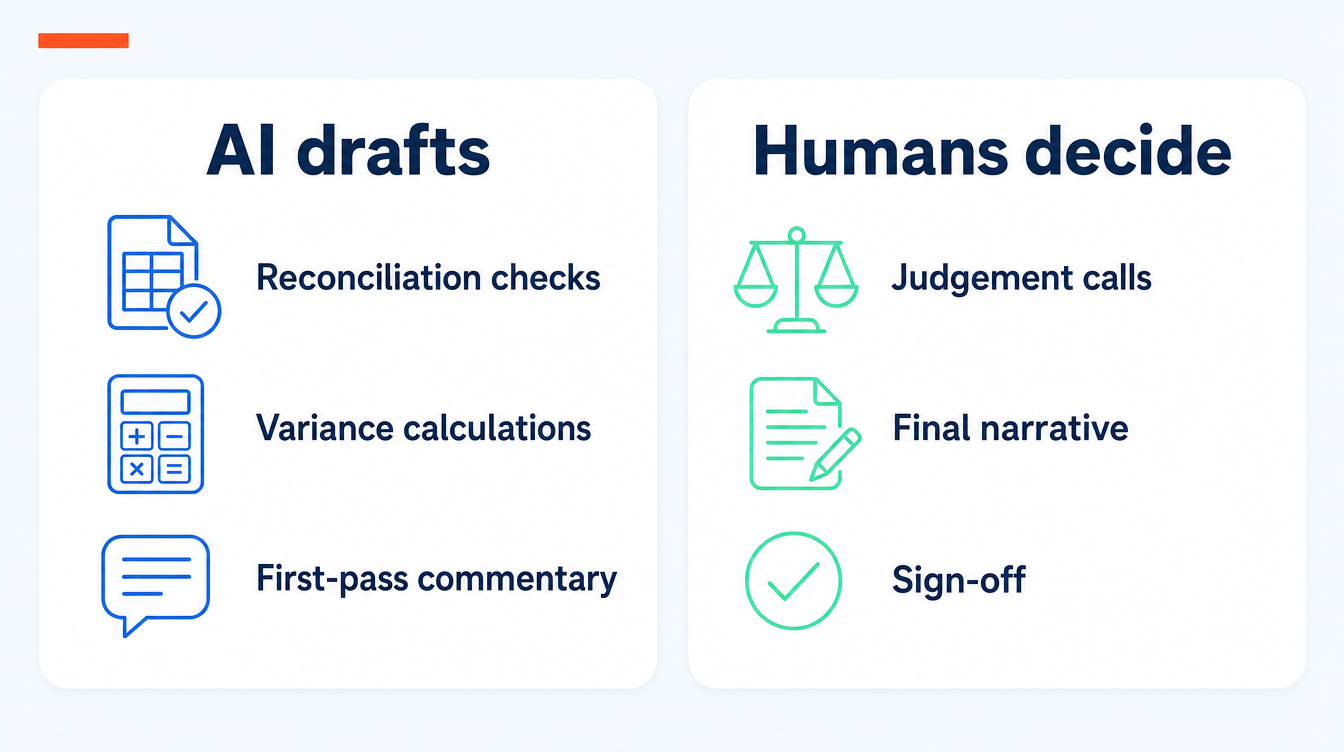
| Stage | The AI does | A human does |
|---|---|---|
| Reconciliations | Matches items, lists exceptions | Approves write-offs |
| Pack assembly | Rebuilds tables and charts from live data | Owns the template and account mappings |
| Variance analysis | Calculates, flags, attaches evidence | Sets thresholds and materiality |
| Commentary | Drafts first-pass explanations | Edits, adds context, owns the narrative |
| Sign-off | Produces an audit trail of changes | Signs off. Always. |
How does this fit a regulated business?
For FCA-regulated firms, management information feeds directly into SM&CR accountability: senior managers remain personally responsible for the numbers they rely on. Automation has to strengthen the evidence trail rather than thin it out, which in practice means source lineage on every figure, drafts clearly separated from approved versions, and a named approver on each pack. Under UK GDPR, keep payroll-level detail aggregated in any commentary that circulates beyond finance.
We applied the same drafting-plus-human-sign-off pattern when we scoped a monthly compliance file review for a financial advice firm: the AI does the reading and the first draft, a qualified person makes every judgement. The full picture of how we run our own company this way, finance included, is in the Softblues Claude Operating System case study.
What does it cost, and how long does it take?
This is a bounded automation project, not an ERP programme. We deliver this kind of workflow within our business process automation practice, scoped in a paid discovery with the timeline and the price in the proposal before any build starts. For realistic UK price bands for this class of work, see our guide to AI consulting costs in the UK.
| Phase | Weeks | What happens |
|---|---|---|
| Map the pack | 1–2 | Document sources, account mappings, thresholds and the review workflow |
| Build and connect | 3–6 | Connect the ledger, budget and document sources; build the agent and templates |
| Parallel run | 7–10 | The AI produces the pack alongside the manual process; compare line by line |
| Go live | 11–12 | Manual assembly stops; human review and sign-off remain |
(our delivery approach; typical elapsed time, indicative)
What are the red flags when buying this?
1. No parallel run. A vendor who wants to switch off your manual process before both have run side by side for at least two cycles is asking you to bet your board pack on a demo.
2. Commentary without evidence. Draft commentary must link to the underlying transactions. Fluent text with no drill-down is fiction with good grammar.
3. Black-box materiality. You set the thresholds. Software that decides for itself what is material has taken over a control, not a chore.
4. No audit trail. Every automated figure needs lineage: source, transformation, reviewer, approver. If the vendor cannot show it, walk away.
Frequently asked questions
Can AI write the whole board commentary?
It can draft all of it, and it should write none of it unsupervised. The model is good at describing what moved and finding the driver in the transaction data. It cannot know strategy, board context or what was agreed in last week's meeting. Draft by machine, narrative by human.
Which accounting systems does this work with?
Anything with an API or a reliable export: Xero, Sage, QuickBooks and NetSuite are the common ones we see in the UK mid-market. Budgets in Excel or Google Sheets are fine, provided the file is versioned and lives in one agreed place.
Is our financial data safe with a large language model?
On an enterprise deployment, yes, subject to the same diligence you would apply to any system. Enterprise Claude plans do not train on your data and offer retention controls; our Claude Enterprise implementation checklist covers the governance settings to get right before finance data goes anywhere near a model.
How accurate is the drafted commentary?
The arithmetic is exact, because calculations are done by code rather than the model. The drafted explanations are right often enough to be a genuine time-saver and wrong often enough to need review, which is why the workflow ends with an accountant, not with the model.
Do we still need our management accountant?
Yes, and they will be doing better work. The role shifts from assembling the pack to interrogating it: chasing the variances that matter, improving the thresholds, and writing narrative the board actually uses.
How long before we see the benefit?
The first parallel-run cycle, usually two to three months in. That first month where the draft pack appears on its own is where the time saving becomes visible and measurable.
Where to start
Start with variance flagging and draft commentary on your existing pack. It is the highest-value step, it changes nothing about your controls, and it produces evidence within one cycle. If you would like a second pair of eyes on your month-end, we run our own on this exact workflow. Book a discovery call and bring last month's pack.
Work out your numbers
One key process
Process automation ROI calculator
Five questions about one process. See the hours an AI agent frees up, what they are worth and how much becomes profit.
Work out your numbersYour whole firm
AI ROI calculator
Five questions about your firm. See the time AI frees up, what it is worth and when it pays for itself.
Work out your numbers
Free. No sign-up. Your answers stay in your browser.
See it in production
Systems we have built and run for clients, with the numbers that came out of them.
Related Articles
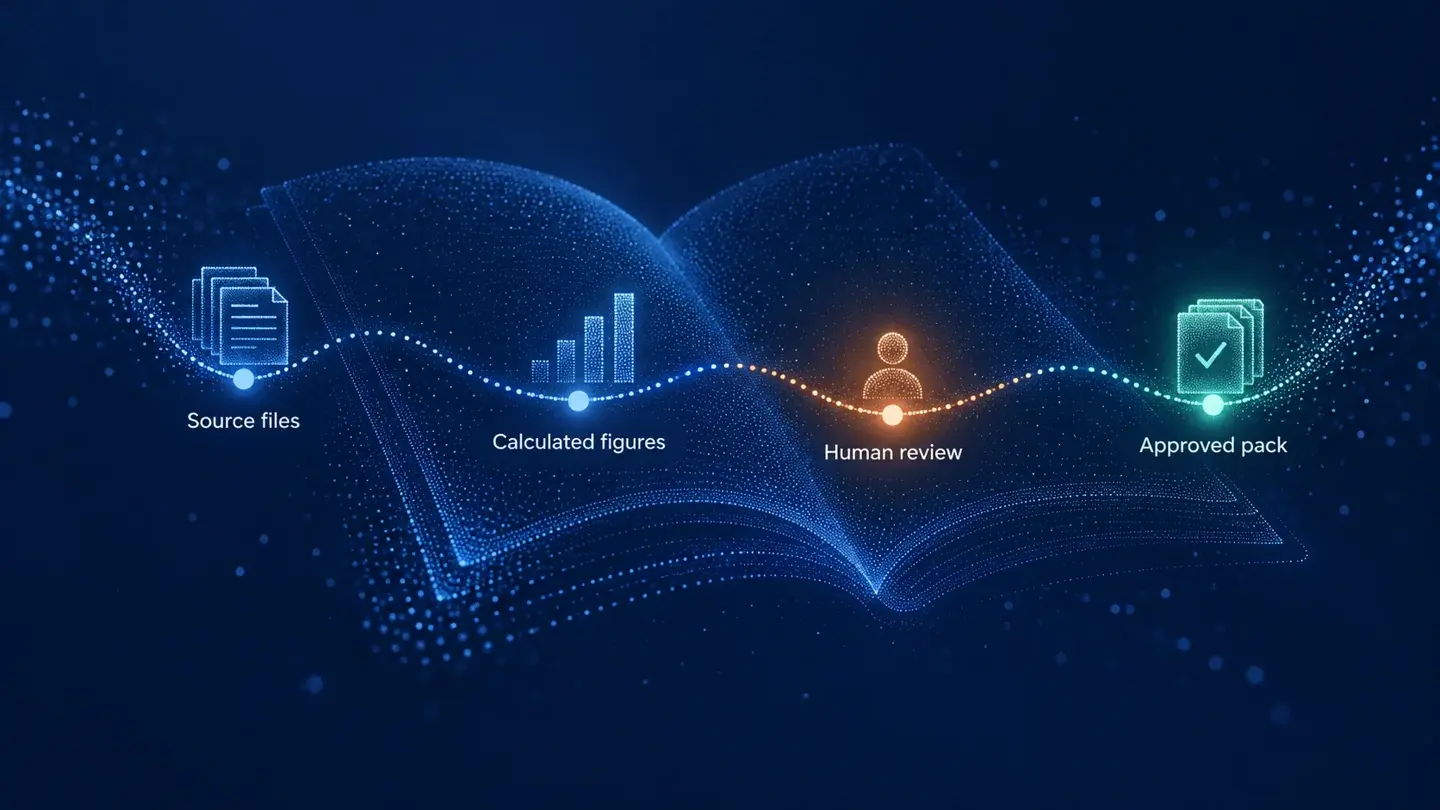
Claude in Excel for the month-end pack: what AI prepares and finance signs

AI meeting notes: the client file workflow for UK firms